




Archive for 2012

An insider’s view of the Bristol mayoral election

26/11/2012, 07:00:31 AM

by Amanda Ramsay

Defeat in the mayoral campaign is hard to take. Labour fought a clean campaign, but lost to a so called “independent” candidate”, George Ferguson, a colourful local business man (famed for wearing red trousers) who stood on a seemingly contrived non-party political platform, despite being a Lib Dem member until August of this year.

We’re all entitled to change our minds in life, of course, but Ferguson made much of rubbishing the Labour party, our manifesto pledges and party politics itself; despite being a former Lib Dem parliamentary candidate and councillor. He ran a distinctly anti-Labour campaign, especially in the final week, presumably because Labour had the momentum and were perceived as the odds on favourite to win.

I’ve covered the mayoral debate all year, initially looking at the ten cities where there were May referenda, in terms of analysing the terrain and outcomes. Back in the spring one Labour MP told me: “Tories recognise that mayoral elections can turn into personality-driven/anti-politics contests, it’s a desperate attempt to undermine Labour in the core cities.”

This has certainly proved the case in Bristol. Ferguson joined the fray with an already established city and media presence, with face and name recognition amongst the chattering classes, city and regional journalists.

The prime minister said he wants a “Boris in every city” – a reference to London mayor Boris Johnson. But other cities fought hard against a Tory-led government, seen as trying to destabilise Labour dominance in metropolitan cities. The likes of Manchester, Sheffield and Nottingham were having nothing to do with it.

Bristol may well have its own Boris now, after all Ferguson literally launched his campaign in a circus, but what next?

(more…)

Facebook Twitter Digg Delicious StumbleUpon

Sunday review: “Populism in Europe and the Americas: threat or corrective for democracy?” by Cas Mudde and Cristobal Rovira Kaltwasser

25/11/2012, 08:00:25 AM

by Anthony Painter

Egyptian president, Mohammed Morsi, has granted himself sweeping new constitutional powers over the constitution, democracy and the legal system. Hugo Chavez did the same in Venezuela and suppressed political opposition and voices of dissent in the media. Viktor Orban, Hungary’s prime minister, has changed voting rules and given himself power over the judiciary and a wide range of protections against legislative change unfavourable to Orban – constitutionally enshrined.

Ideologically, Morsi, Orban, and Chavez could not be more dissimilar: a political Islamist, a socialist, and a radical conservative. Something does link them though: they are all, in different ways, populists. Straight away we enter the realm of confusion. Populism has become a dirty word, synonymous with impulse, emotion, charisma, authoritarianism, fundamental institutional change and destruction of minority rights. From Morsi, Orban and Chavez it can be seen as some if not many of these things but it’s something even deeper than that and where there is democracy then there is populism – yes, even in the case of the UK as we shall see.

Cas Mudde and Cristobal Rovira Kaltwasser take a look at the impact and nature of populism in their important new work, Populism in Europe and the Americas. In this edited volume, experts look at Belgium, Canada, the Czech Republic, Mexico, Austria, Venezuela, Peru, and Slovakia. They might well have added the tea party in the US and euroscepticism in the UK for they define populism as a battle between “the pure people” and “corrupt elites.” In the case of the former, the “corrupt elite” is, of course, Washington and the Wall Street. For eurosceptics they are “eurocrats” or ECHR judges and all who conspire with them.

(more…)

Facebook Twitter Digg Delicious StumbleUpon

The runners and riders for Bristol North West

23/11/2012, 10:20:53 PM

by Amanda Ramsay

The recent controversy over the Rotherham shortlisting shone a very critical spotlight on the candidate selection process within the Labour party, but no such drama is reported from the current contest in Bristol North West, which concludes this weekend. The three hopefuls are Simon Bowkett, Keir Dhillon and Darren Jones.

The search to find Bristol North West’s next prospective parliamentary candidate (PPC) started amidst a long mayoral campaign that gripped Bristol Labour party for five and a half months. Disappointing election results from last week still hang heavy in the air, so lifting members’ morale will be one of the keys to success in 2015, maintaining a match fit team, capable of turning around a 3,274 Tory majority.

Currently represented by Tory MP Charlotte Leslie, one of the beneficiaries of Lord Ashcroft’s millions, back in the pre-2010 general election, Bristol North West saw Labour slip to third place back then.

Former Conservative Party deputy chairman, Ashcroft has recently become the new co-owner of Northcliffe Media, the regional publishing arm of the Daily Mail group, which publishes Bristol’s evening paper, the Post; worrying for local representatives and candidates, keen to have their voices heard through the local press.

On the recent elections Simon Bowkett has this to say: “Last week’s Parliamentary by-election results were very encouraging – a similar swing in 2015 would see Bristol North West return to Labour. Yet the disappointment of the mayoral election shows we can take nothing for granted in Bristol.”

An Exeter Councillor for nine years, Simon works in the voluntary sector. His campaign buzz word has been very much “community”: “Our turnout was very low in core areas and we have much work to do to re-engage with those communities, to build relationships. My background in community development will enable me to lead on this work, to move voters to being supporters, and supporters to being members and activists,” he promises.

(more…)

Facebook Twitter Digg Delicious StumbleUpon

Whisper it quietly, the government maybe about to back Leveson

23/11/2012, 10:32:09 AM

by Atul Hatwal

So now we know, it’s next week. Lord Leveson will finally publish his long delayed report on Thursday 29th November, complete with recommendations on the future of press regulation.

For many months now, the conventional Westminster village wisdom has been clear: Ed Miliband and Nick Clegg will back the report while David Cameron will demur.

The prime minister will kick the report into the long grass and accept the public’s opprobrium because (a) backing the newspapers’ position will guarantee better coverage for his government as the next election approaches; and (b) most people already think the worst of him on this issue with few swing voters likely switch their allegiance on the basis of press regulation.

But, as Lord Leveson’s report goes to the printers, this wisdom is looks increasingly askew. It fundamentally misreads the credibility of the newspaper owners’ blandishments and threats – and the evidence suggests number ten knows this.

The owners might privately brief the government in warm terms about better coverage tomorrow if Leveson is blocked today, but word are cheap; would they really follow through?

There is a deep scepticism within number ten that the attack dogs of the Daily Mail, Telegraph and Sun will meekly roll over and give the government a pass for the next three years.

A story is a story and in the cutthroat competition of the newspaper market, few will refuse the opportunity to hurt the government if it drives sales.  At the margins, perhaps some stories might be soft pedalled, but collectively supressing major news would be commercially counter-productive.

(more…)

Facebook Twitter Digg Delicious StumbleUpon

Labour history uncut: Labour fights its first election

22/11/2012, 03:30:22 PM

by Pete Goddard and Atul Hatwal

The 129 delegates’ votes were counted at the Memorial Hall in Farringdon. Keir Hardie’s motion had been carried and a new movement was born.

The squabbling assortment of socialists and union representatives that had trooped into the hall that fateful morning on the 27th February 1900, had decided to come together to form “a distinct Labour group in parliament”.

There was little time to waste. The working class was in need and now they had a new, thrusting champion, ready to tackle the iniquities of the late Victorian world. It was time for action.

So they formed a committee.

The Labour representation committee (LRC) to be precise, comprising 2 members of the Independent Labour Party, 2 members of the Social Democratic Federation and 7 union members.

Well, you can’t just rush into things can you? A political meeting without a committee – that’s just anarchy.

In the beginning, membership was relatively limited and funds even more so.  Quite how tight the finances were is indicated by the party’s choice of Ramsay MacDonald for their first secretary.

Why did they choose MacDonald? His vision? His passion? His integrity?

No. It was his wealthy wife.

Thanks to the income of Margaret MacDonald, Ramsay was able to work for nothing more than a subsidised sandwich at lunchtime and a stack of Labour representation committee business cards.

Ramsay MacDonald was, in fact, the Labour party’s very first intern.

(more…)

Facebook Twitter Digg Delicious StumbleUpon

Five reasons why the future of the left is local

22/11/2012, 12:57:49 PM

by Graeme Henderson

Localism has emerged as the poster boy of new policy ideas. For instance, the recent Heseltine review, a report on UK competitiveness, could easily be misread as a report on localism. Following similar themes, the publication of IPPR North’s northern economic futures commission final report this coming week will set out how devolving more power to the north of England could help it prosper. All of the main political parties are cautiously warming to localism and its benefits. The caution is understandable as it effectively means national government rendering itself less powerful. However, for those of on the left, the problem is more fundamental: simply put, is localism merely a byword for the dreaded postcode lottery? This is an unfair assessment of localism, yet it is one which is still persuasive on the left.

It is time for us to view the left as the natural home of localism. Localism, after all, means bringing power closer to the people, empowering communities and, when done right, more meaningful democratic accountability. There are several reasons why the left should embrace localism. If you’re still sceptical, keep on reading.

1. We already have a postcode lottery, let’s at least make it accountable

What is important is that local areas receive a fair proportion of public funding, not that funding is delivered (or even raised) centrally. Identifiable public spending per head, excluding social protection, is £6,647 in London, but only £5,385 in the north east. For Yorkshire and the Humber the figure is just £4,841, and yet studies have shown that the higher level of public expenditure received by London does not correspond to objective measures of need.

The regional disparities are even starker for transport infrastructure spending. Failing to adequately invest in vast swathes of the country affects the poor and disadvantaged most. Research shows that the high-skilled labour pool is far more mobile than those with lower skill levels. The most able or those with financial backing can move to wherever the jobs are. If London hoovers up the lion’s share of talent – people educated across the UK – and also public and inward investment, the regions suffer. Such extreme centralisation focused on London and the South East can only result in long-term damage to the national economy. Localism can help give local people a voice when their areas are being overlooked, and by extension, rather than hindering equal opportunities,  it can help to ensure that people get the same chances, wherever they happen to live..

(more…)

Facebook Twitter Digg Delicious StumbleUpon

Uncovered: a secret memo to George Osborne

22/11/2012, 07:00:57 AM

by Peter Watt

I can’t tell you how this came into my possession but the following memo was found on a photocopier in Westminster yesterday.  The send field was hidden.*

MEMO

To: Rt Hon George George Osborne

Date: 20/11/2012

STRICTLY PRIVATE AND CONFIDENTIAL

Turning around our current polling situation

George, as you know the Labour party think that they have the next election in the bag.  They think that the public have pretty much decided that the government is a busted flush.  They think that what has undoubtedly been a pretty appalling year for us has sealed our fate.  Privately they accept that Miliband has a way to go before he’s seen as a prime minister but think that our self-inflicted wounds (if we are honest, our incompetence and successive blunders) will mean that he is given an easy ride through to the election.  And that ultimately our unpopularity will overcome his shortcomings in the minds of voters.  But as I have said to you, I actually think that not only are they wrong, their confidence in the face of their substantial poll leads will prove to be their undoing.

In essence I think that that whilst the Labour party undoubtedly has a lead at this stage, its position is exaggerated by the positions of the Lib Dems and UKIP.  It is virtually certain that the Lib Dems will rise in the polls before the election and in all likelihood will poll in the high teens on election day.  Equally, whilst Farage and co might do well through to the Euros they will fall away as we near the election.  If both of these are correct then the true polling position is considerably closer.  In other words the Labour lead can be overcome.  Of course, that does not mean that we do not need to regroup and fast.

(more…)

Facebook Twitter Digg Delicious StumbleUpon

Garden cities are coming home

21/11/2012, 07:00:18 AM

by Philip Ross

Although most of the big society thinking seems to have been put to the back of the cupboard, one idea seems to have survived -the idea of community ownership of assets. Boris had a section in his manifesto about community land trusts and the first London one was set in Mile End in July. To be fair, he seemed to get it, but elsewhere the Tories have tried to implement a bastardised form of it, basically withdrawing council funding from assets and asking the communities to pay for things themselves. Not quite the same thing.

Community land trusts (CLT), like that setup in Mile End, are a good thing and derive from two great 20th century British land movements which are the co-operative and garden city movements. You may think of garden cities as being very conservative places with high house prices that David Cameron has praised and wants to see more of.

But when the garden city movement was founded it was anything but conservative. For instance Krupskaya reported that while Lenin was in exile in London he attended garden city meetings and even stayed for a while in Letchworth the first garden city.

He said “Ilyich would listen attentively, and afterwards say joyfully: ‘They are just bursting with socialism!”’. This is in part because the first garden city – Letchworth – had as its social foundation stone the concept that the whole town would be community owned e.g. a community land trust.

(more…)

Facebook Twitter Digg Delicious StumbleUpon

New unionism, not at all like New Labour

20/11/2012, 03:30:32 PM

Pete Goddard and Atul Hatwal continue their look at the development of the unions and their role in founding the Labour party

By the mid-1880s, the establishment had got over the initial panic stirred by the emergence of unions. Civilisation had not collapsed and revolution, like coffee in tiny, tiny cups and the ability to pass a football for more than 30 seconds before launching it into orbit, remained strictly a continental phenomenon.

Even the arrival of a couple of actual, real live working class people in Parliament in 1874 hadn’t been too traumatic. From the vantage point of the Tory benches, the Lib-Labbers’, Alexander Macdonald and Thomas Burt, looked respectable enough and it made a nice change to have someone around who could do something about that squeaky door in the lobby.

The calm was not to last.

A new, angry, voice was about to make itself heard on behalf of the unskilled workers. This new unionism was exemplified by three significant groups: the match girls, the gas workers and the dockers

At the Bryant and May factory in Bow, East London, the workers were largely young women who were casual workers. This did not mean that every day was a dress-down Friday. It meant they worked 14 hour days for less than five shillings a week, and had even fewer rights than most other workers.  So less fun even than dress down Friday, then.

On the other hand, they did get to experience one of the period’s most advanced motivational programmes – a range of harsh, arbitrary fines for tiny infractions. For example, turning up late for work meant a fine of a half day’s pay.

On top of all this, the work itself was unusually hazardous. The phosphorous used to make the matches caused yellowing of the skin and hair loss. Worse still was phossy jaw, which may sound like a popular hip hop artist, but is actually a form of bone cancer. The whole side of the face would turn green and then black, discharging foul-smelling pus. And then you died.

Even by Victorian standards, this was a bit much.

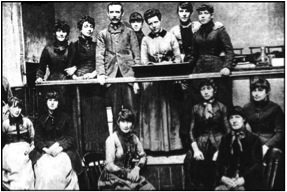
Annie Beasant and the match girls strike committee. Yes, they are judging you

(more…)

Facebook Twitter Digg Delicious StumbleUpon

Can Ed find prime ministerial credibility in selling the case for Europe?

20/11/2012, 12:16:37 PM

by Kevin Meagher

Making a new case for an old ideal. In a nutshell that’s the job of all Labour leaders down the years. But Ed Miliband also thinks it’s the challenge for those who still see Europe as the solution to our national problems rather than the cause of them.

In his speech to the CBI yesterday he warned that fellow EU countries are “deeply concerned” because they sense Britain is “heading to the departure lounge”. A febrile mood on the Tory backbenches reflects the latent hostility among the British public with latest polls showing 56 per cent of Brits would vote to pull out if a referendum is held on the issue.

To his credit Ed stood firm against these siren calls saying he would not let Britain “sleepwalk toward exit from the European Union”. This is as strong an assertion of the importance of the EU as we have heard from any frontline political leader for some time. But even he only managed faint praise.

For he too recognises the EU’s focus is on the past not the future. It is still committed to propping up an insular, agriculturalist ancien regime rather than equipping Europe with the ability to withstand the challenges of the new century.

As he pointed out, farming subsidies still eat up 40 per cent of the EU budget while contributing just 1.5 per cent to economic output.  The focus should instead be on “public goods” for the EU economy like infrastructure, innovation and energy.

In a prescient section of his speech, he conceded that for the post-war generation, including his Jewish parents, “Europe was a murderous continent”. For them European unity was “a noble ideal” with the countries of Europe “seeking to put peace and prosperity in place of war and destruction through economic and political co-operation” (or in former SDLP Leader John Hume’s phrase, the EU is “the longest running peace process in the world”).

(more…)

Facebook Twitter Digg Delicious StumbleUpon