UNCUT: The Uncuts: 2025 awards (pt III)

04/01/2026, 09:58:38 PM

Breakthrough of the year: The Peripheralocracy

Let’s hear it for The Peripherals.

Has our Red/Blue political system ever looked weaker or more irrelevant? A rhetorical question, you understand, with the obvious response being an emphatic ‘No.’

Still, as Chinese Premier Zhou Enlai famously responded when Henry Kissinger asked what he thought about the French Revolution, perhaps it’s too early to tell?

Yet blip or paradigm shift, it’s abundantly clear that all the energy in British politics has drained to the periphery over the past year. A combination of the campaigning brio and easy platitudes of Nigel Farage on the right and Zack Polanski on the left.

Managerial, Red/Blue centrist dad political doesn’t have much appeal when nothing works and everyone’s poor and cheesed off. This was vividly brought home in a YouGov poll the other day looking at where the various parties started 2025 in terms of their polling and where they finished up.

Read the rest of this entry »

Facebook Twitter Digg Delicious StumbleUpon

UNCUT: Sir Patrick Duffy obituary

03/01/2026, 08:28:29 PM

‘The morphine syringe wouldn’t go in his frozen arm, so they had to stab it in’

by Kevin Meagher

Stoicism is often said to be the defining characteristic of the wartime generation. Their lives were enveloped in destruction and uncertainty, with death and privation ever-present. So, they just learned to get on with it.

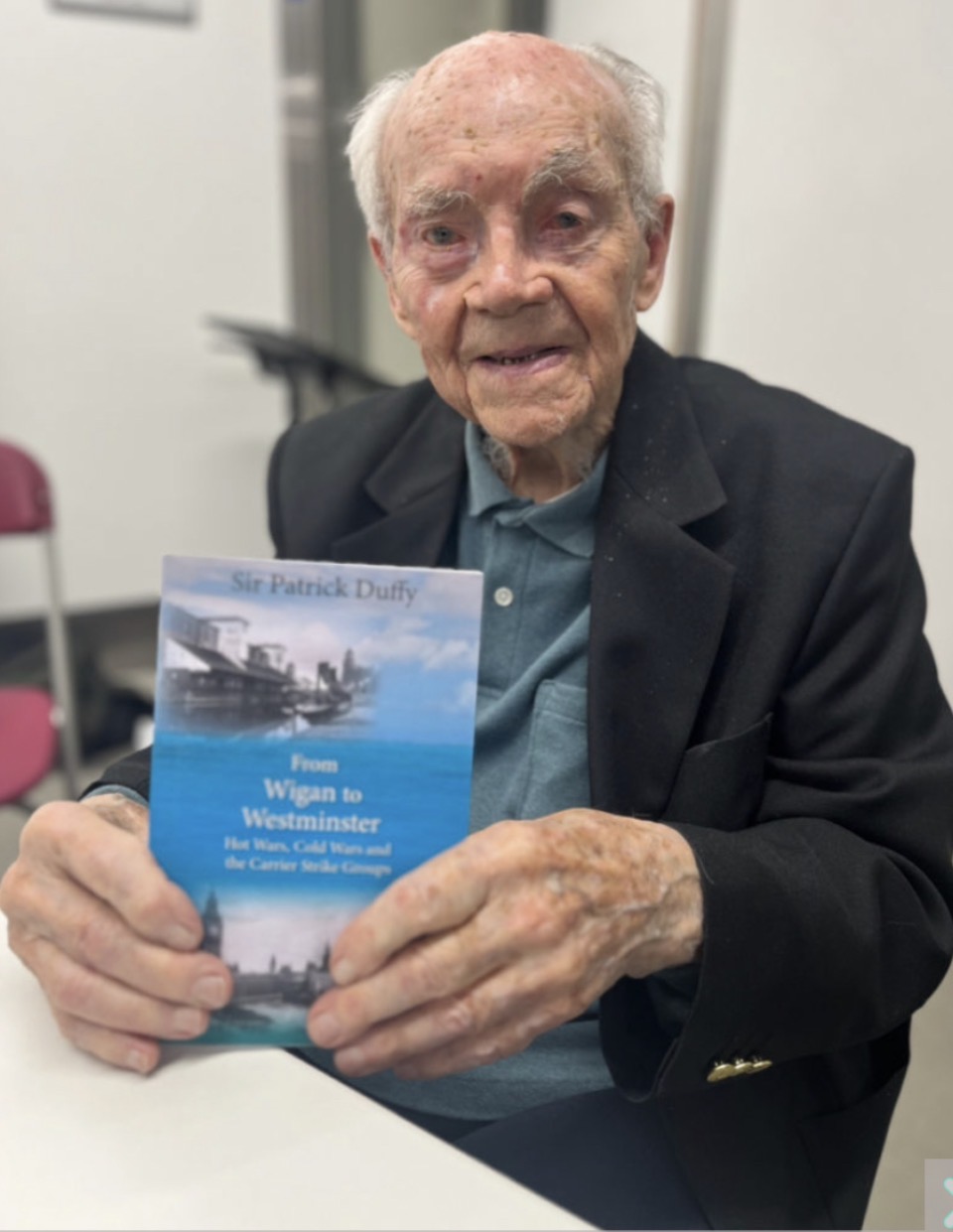
I was reminded of that yesterday, learning of the sad death of my old friend, Sir Patrick Duffy, after a short illness. Amid the towering achievements of his life was his sheer longevity. At 105 years of age, Patrick was hitherto the oldest living former Member of Parliament.

But he was so much more than a footnote, personifying that very stoicism. He served in Fleet Air Arm during the Second World War, surviving a terrible crash at Scapa Flow in the Orkney Islands. His injuries were so severe that he underwent experimental plastic surgery, with regular follow-up treatments even as a centenarian.

Quite matter-of-factly he recalled medics finding him on the mountainside, unconscious in the wreckage of his plane after a day spent freezing to death. The morphine syringe wouldn’t go in his frozen arm, so they had to stab it in.

At just 23, he received the last rites twice from a priest. With the upmost stoicism he flew again and was perilously close to being sent to Singapore in 1945, mercifully accruing a long-overdue piece of good luck as the war ended. The recipient of a military pension since the 1940s, I joked with him that he was personally responsible for the state of the public finances!

Patrick never complained and stayed focused on what Bill Clinton once referred to as the future business. I assisted him with his second book, which was published in 2024 (incidentally making him the second-oldest published author in the world). His acute observations about the post-war world were accompanied with chapters on Brexit and Boris.

Read the rest of this entry »

Facebook Twitter Digg Delicious StumbleUpon

UNCUT: The Uncuts: 2025 political awards (pt II)

02/01/2026, 09:56:27 PM

Defeat From The Jaws Of Victory Award: Jeremy Corbyn and Zarah Sultana

For some light relief in an otherwise challenging political landscape, we now turn to Your Party.

UK fringe parties have generally had a very good year. In addition, during the last six years since the Labour hard left’s loss of the party leadership to Starmer, there has been a steady outward drift of members on the left to other parties. The Green party has been a particularly grateful recipient of Labour’s surplus, and Corbynite vehicles such as Novara Media have increasingly looked towards the Greens as a replacement Labour Party through which to achieve their ends, resulting in an increasingly nutty Green politics, which, let’s face it, was fairly nutty to begin with.

Nevertheless, in light of all this, it should have been a slam-dunk for a hard left group, to capitalise on the disillusion of Labour’s Corbynites on being faced with the unappetising compromises of actual governing; particularly in view of the conscription into the new movement of one former party leader and an MP who was starting to be seen as his anointed successor. Correctly executed, this new party should have been a real threat to Labour.

This, however, was to prove far too simple for the Corbynites: stick them in a room together and there will inevitably be arguments, over what Sigmund Freud referred to as “the narcissism of small differences”.

Having formed in July a new political party with a now-significant membership (estimated at around 50,000), they then proceeded to spend the second half of the year in constant wrangles between the twin factions of Jeremy Corbyn and of Zarah Sultana. It couldn’t decide on its name. It couldn’t decide on who held the purse-strings. And it certainly couldn’t decide on who would lead it. There were expulsions; frenzied briefings and counter-briefings to the press; and Sultana ended up boycotting the first day of her own conference.

Read the rest of this entry »

Facebook Twitter Digg Delicious StumbleUpon

UNCUT: The Uncuts: 2025 political awards (pt I)

31/12/2025, 05:59:24 PM

Most effective Labour frontbencher: Anna Turley MP, Labour Party Chair

This is Anna Turley’s second Uncut award. She was our Labour politician of the year back in 2019, another annus horriblis for Labour. Back then it was for taking on the libellous bullies of Unite and Skwawkbox, this year it is for for leading a step change in effectiveness of Labour’s attack operation. Since taking up the reins as party chair, the party has been quicker and sharper in responding to political developments.

The response to the Farage racism scandal is illustrative of the change she’s brought. The Guardian broke the story at 1500 on the 18th of November. Rather than waiting several days, hemming and hawing about what to say, the party chair was up with a quote 90 minutes later.


It’s clear from her quote that there wasn’t a clear line from Number 10 but Anna Turley understood the importance of ensuring a Labour voice was prominent at the start of a major story cycle. So she leant as far as she could within the parameters of what was possible, to insert Labour into the conversation, without triggering blowback and diverting the course of the story (note no mention of race in the quote). The fact that the party chair had commented meant Labour MPs were empowered to pile into the attack and to be much more explicit about their views on Farage and racism. The momentum of Labour MPs’, activists and councillors commenting boosted the story, pushing it up the broadcast agenda and shifted the dynamic within Labour. By the 21st of November, the Prime Minister was criticising Farage on racism across broadcast media.

Job done. A case study in modern communications and how to manage Number 10 into active decision making. More please in the new year.

Most effective political communicator: Zohran Mamdani

Uncut consulted a reporter who travelled through Pennsylvania during the 2024 US presidential election. All the Trump posters promised Strength to tackle Prices and Borders.

A year on and prices have not fallen. Inflation persists, with wages not growing fast enough to compensate for the dramatic spike in inflation during the pandemic. Trump has also enacted policies that have added to inflation (e.g., tariffs) and acted in ways that communicate different priorities (e.g., the push for a grandiose White House rebuild).

Read the rest of this entry »

Facebook Twitter Digg Delicious StumbleUpon

UNCUT: Labour’s three recent, unforced errors are far more serious than the Budget furore

08/12/2025, 08:46:35 PM

by Rob Marchant

While Westminster has been alight with chatter over whether or not Rachel Reeves misrepresented the facts in the run-up to her Budget, events have been happening in parallel which are likely to have a far longer shadow for Keir Starmer and his crew. Indeed, they are situations which, if left as they are, will continue to have brutal repercussions long after they all leave office.

The first was Wes Streeting’s announcement last month of the puberty blockers trial, due to kick off in the New Year.

When the Cass report landed in April last year, campaigners looking to protect Britain’s children from the harm of untested medicines were surely so overjoyed to see that thousands of lives could be protected from likely sterilisation and severe health problems in later life, that less focus was given to one of the report’s other recommendations, on the smaller number children which it recommended be recruited for a clinical trial, to finally put a stop to any debate on the efficacy of said treatment.

It seemed churlish to complain about this matter of the fine print, when the main battle, over ceasing the general puberty-blocker programme, had already been won. But now the last grain of sand has fallen into the bottom of the egg timer and the trial, which it was easy to blithely assume would never start, is about to begin.

This means that 226 children will be legally taking the same drugs which have been declared illegal for thousands of others diagnosed with gender dysphoria. To recap: these drugs have never been approved for this use; the treatment is experimental, with some horrific side effects; and consent cannot be meaningfully given by minors as young as 10, most of whom are too young to have experienced pubertal changes, let alone sex.

Read the rest of this entry »

Facebook Twitter Digg Delicious StumbleUpon

UNCUT: A boosted Starmer, but he’s still haunted by Burnham and Farage

04/10/2025, 01:26:56 AM

The Labour Party conference fulfilled its time-honoured purpose of providing respite for a beleaguered prime minister, assailed by the vicissitudes of government and the inveterate scheming of colleagues. This is an audience willing its leader on. A useful corrective to the Whitehall slog and the sniping of the Westminster village.

At conference everything is washed clean. At least for a few days. Unity was the vibe, with Keir Starmer greeted by thunderous applause in the hall from delegates as he rattled off a list of the party’s overlooked achievements in government, while he socked it to Nigel Farage. There is no mood in the activist base for a change in leader and the novelty of being in government again after 14 long years in the wilderness has still not worn off.

Not yet.

Will it last, that’s the question. It’s clear that what was true before the conference is still true after it. The country is in turmoil; the product of a general dissatisfaction with Red/Blue politics, but this is overlaid by a stubbornly unresolvable cost-of-living crisis, barely functioning public services, the highest tax-take any of us has known and an all-pervading sense of national decline. Throw in the early manoeuvrings of World War Three and it’s a challenging in-tray for Keir Starmer, to put it mildly.

He might consider the past 12 months have been arduous, but the next year will be worse. A difficult Budget at the end of November and a potentially disastrous set of elections next May could undo this week’s positivity and with it his tenure in Downing Street.

Ministers are plainly rolling the pitch for more tax rises – skating perilously close to their pre-election promises not to raise income tax and VAT – as they seek to plug the hole in the public finances, unable, as they would have preferred, to trim the welfare bill.

And polls point to a devastating set of results in the spring, with Labour in Wales trailing in third place ahead of the all-out assembly elections, while the SNP rides high in Scotland and Reform is set to rampage through Labour’s English local government strongholds.

And then there’s Andy…

Read the rest of this entry »

Facebook Twitter Digg Delicious StumbleUpon

UNCUT: Our paradox PM needs to show us he has the stuff

29/09/2025, 08:50:06 PM

Who is Keir Starmer? I mean, who is he really? A year of more into office, propelled into Downing Street with an enormous 170-seat Commons majority, our chameleon PM remains elusive. Unknowable.

His father was a toolmaker, apparently. But what does he want? Whose side is he on? Are there particular passions that drive him? What is he for?

Our Prime Minister: the walking paradox.

The human rights lawyer who wants to die on a hill over compulsory identity cards. The north London liberal who has gutted the overseas aid budget. The barrister – a King’s Counsel no less – who can only manage faltering performances in the House of Commons.

The man who told us Britian had become a ‘nation of strangers’ because of excessive immigration, only to disown his remarks weeks later. The election winner with personal ratings that are now through the floor (who, in any case, managed to win half a million votes fewer than Jeremy Corbyn did in 2019).

While his army of restless and underworked backbenchers are now plotting against the man responsible for putting them on the green leather benches in the first place.

Governing is hard, it turns out.

Yet Starmer could have made things easier on himself. For a start, the government’s communications have been shambolic – not helped by the general absence of political strategy since entering Downing Street and a revolving door of often sup-par backroom staff.

And who would have thought a PM with a 170-majority would struggle to get tricky proposals through parliament? But he’s managed it with the fiasco over the proposed welfare cuts – which are set to cost more!

Read the rest of this entry »

Facebook Twitter Digg Delicious StumbleUpon

UNCUT: Burnham’s 2015 defeat was Labour’s ‘sliding doors’ moment

12/09/2025, 08:00:35 AM

September 12, 2025.

Prime Minister Andy Burnham is celebrating his tenth anniversary as Labour leader, with speculation growing that he intends to bow out of British politics.

After eight years in Downing Street, he is rumoured to be the favourite to become president of the European Commission, bringing senior-level political clout but a low-key style to the EU’s fractious relationship with the Trump administration.

A committed pro-European, Burnham was widely credited with a successful intervention during the Brexit referendum campaign helping to keep Britain in the European Union.

He subsequently beat Theresa May in the snap general election of 2017, following the Tory party’s implosion over the Brexit result, which forced the resignation of David Cameron as prime minister.

After convincing Germany of the need to tighten borders and limit immigration into Britain with a mixture of charm and quiet tenacity, Burnham won a second term in May 2021.

His widely admired leadership through the Covid pandemic – an empathetic style and consensual approach – were considered to have brought the country together…

Okay, enough hagiography, but the serious point is that Labour politics is full of ‘sliding doors’ moments; counterfactuals and credible what-might-have-beens.

Think how differently our political history might look if Roy Jenkins had won the leadership in 1976, or if Tony Benn had pipped Denis Healey in the 1981 deputy’s race. The 2015 leadership election – ten years ago today – being another case in point.

The race to succeed the defeated Ed Miliband following the 2015 general election seemed to be Burnham’s for the taking: Similar soft-left politics to Miliband but with sharper political skills, he represented a software upgrade but with no danger of downloading Blairite malware.

As we know, ‘twas not to be.

Miliband’s decision to soften party membership rules allowed hundreds of thousands to join the party for £3 – many maliciously – just to vote for Jeremy Corbyn in the leadership contest.

Having started as little more than the left’s dutiful standard-bearer, Corbyn’s new army of supporters propelled him to victory – gobbling-up three-fifths of the vote – with Burnham edging Yvette Cooper for second place (19/17%), while full-fat Blairite, Liz Kendall, was left trailing with just 4% of the vote.

The rest of the tale is familiar enough.

The wild oscillations in Labour’s fortunes over the past decade – swirling from the Corbynite hard left to the Starmerite right – hitting rock bottom in the 2019 election, only to bounce back with the thumping 170-majority just five years later – are head-spinning.

A decidedly less dramatic and certainly less traumatic future was available with a Burnham leadership. The prospect of him synthesising the best of the party’s traditions – a Goldilocks politics of modernity with tradition – could have been a winning formula.

A contrast, certainly, to Blairite permanent revolution and Gordon Brown’s listless tenure in Number 10, while being less geeky and more effective than Miliband.

As a politician, Burnham is more reminiscent of John Smith than anyone else. Overwritten by the scale of Blair’s 1997 victory, Smith led Labour for two successful and collegiate years between Neil Kinnock’s agonizing defeat in April 1992 and his own untimely death in May 1994.

Yes, there was less reforming zeal than Blair eventually brought to proceedings, but there was also a remarkable calm. And that mattered. Ideological battles were avoided with Smith’s successful performances doing much to lift the spirits of a demoralised party and set it up for eventual victory in 1997.

So here we are a decade later; a lost decade at that. Yet rather than bowing out, Burnham remains the prince across the water. Well, across the Manchester Ship Canal at any rate.

The ever-watchful, ever-ready ‘King of the North’ and one of the few Labour politicians of his generation with a record of achievement to point to, transforming the fortunes of the Greater Manchester conurbation he has led since 2017 into the fastest-growing city outside London.

Eight years younger than Keir Starmer, Burnham remains positioned as a future leader, despite his two previous tilts at the top job (he also stood in 2010). As of yet he has no sure-fire way back to Westminster. But staying power is the most important attribute in a political career and Burnham has it in abundance.

The obvious counterpoint to Burnham is that you sometimes need to bounce a political party and its activists out of their comfort zone to connect with the wider electorate and he isn’t willing to do that.

Fair enough, but sometimes bringing calm purpose, respecting the various traditions, having a decent track record and, yes, being a nice bloke is enough.

And all that was available to Labour a decade ago.
Facebook Twitter Digg Delicious StumbleUpon

UNCUT: Pick someone outside the bubble for deputy leader

05/09/2025, 10:21:43 PM

Choosing Labour’s next deputy leader shouldn’t be a cabinet beauty contest, with token representation from the party’s Left. In fact, Labour’s next deputy leader should not be an MP at all.

Its time the rulebook was changed and figures from outside the Parliamentary Labour Party were able to stand for the deputy’s role.

Helpfully the annual conference in Liverpool is three weeks away, providing the perfect opportunity to do just that.

Labour’s General Secretary, Hollie Ridley, has rightly warned about navel-gazing, reminding the party that the contest to find the party’s 19th deputy leader should be conducted ‘in a manner that befits the party of government.’

That’s code for keep it cheap and quick, but it’s also a chance to hold a meaningful election without disrupting ministerial business.

Indeed, the party’s internal workings are not keeping pace with the government’s own agenda.

One of Angela Rayner’s final acts in government was to publish the English Devolution and Community Empowerment Bill, which aims to ‘permanently change the balance of power’ between centre and provinces towards the latter, as she put it in her resignation letter.

Limiting the process to candidates outside the cabinet would amplify Labour as a party for the whole country and show it really is serious about devolution.

And it’s not like there’s a shortage of talented applicants out there.

A poll of party members by Survation/LabourList found that Greater Manchester Mayor, Andy Burnham, was comfortably ahead of any other party figure as a potential successor to Keir Starmer. (Ironically, Angela Rayner was second).

Another recent poll from YouGov saw party veteran David Blunkett come top in the public popularity stakes.

Would either Blunkett or Burnham – or other Labour Mayors like Claire Ward or Tracey Brabin – not be a suitable fit?

Or for that matter Eluned Morgan, the Welsh First Minister? Or Sir Steve Houghton, leader of Barnsley Council and one of the most respected figures in local government?

Rather than a troupe of busy cabinet ministers taking bites at each other, with every utterance translated into an attack on the government, undermining cabinet collective responsibility in the process, would it not be better to leave the stage clear for the party’s stars beyond the Westminster bubble to become deputy leader?

Facebook Twitter Digg Delicious StumbleUpon

UNCUT: Angela Rayner is not too big to fail

03/09/2025, 10:27:36 PM

It always seems trite to focus on ‘the optics’ of a political scandal rather than the substance of one, but the swirling row about Angela Rayner’s complex property affairs looks utterly disastrous, both for her and the government of which she is nominally the second-in-charge.

After a week of headlines about her purchase of an £800,000 flat in fashionable Hove – hundreds of miles from her east Manchester parliamentary seat – the Deputy Prime Minister has been forced to concede she had not paid the full amount of stamp duty owed.

Rayner’s much-publicised living arrangements, dividing her time between her central London grace-and-favour flat, her domestic home in Ashton-under-Lyne and her new flat, is given added complexity as she and her ex-husband share caring arrangements for their children, including a disabled son.

Wise, perhaps, for people without disabled children to withhold judgment about people who have – and it is perfectly feasible that Angela Rayner has followed the expert advice she received, which led her to underpay the correct amount of stamp duty, to the letter.

It seems plausible that the government’s standards adviser, Sir Laurie Magnus, might see it that way. But that must be a hope rather than an expectation. For now, Angela Rayner is in big trouble.

She is not just a mother trying to juggle her domestic responsibilities; she is the deputy prime minister in a Labour government. One that presides over a divided, moribund country having won as little as 34% of the popular vote in last year’s general election.

To state the obvious; two-thirds of voters did not back Labour, with the government bequeathed the worst in-tray since Clement Attlee inherited the smoking ruins of post-war Britain.

Read the rest of this entry »

Facebook Twitter Digg Delicious StumbleUpon