


GRASSROOTS: Labour needs a rural revival to win the seats needed for government

14/06/2017, 10:15:29 PM

by Liam Stokes

The general election has given hope to those of us hoping for a rural Labour revival, but also pause for thought. This is an area in which I have a personal interest. In this year’s Wiltshire Council elections I stood for Labour in the very rural north Wiltshire ward in which Jeremy Corbyn grew up. It was an uplifting experience. People were pleased and surprised to find a candidate roaming the country lanes wearing a red rosette. The most oft-heard quip was “best of luck mate, you’ll need it round here”. Others were more encouraging, which was much appreciated during long and lonely days leafletting. I’ll be eternally grateful to the landscaper who, as my spirits were flagging on a particularly long and rainy walk down an especially remote track, took a break from shovelling gravel to tell me he was glad to see someone “standing for the working man”. But for all that warmth on the doorstep, I got 10% of the vote. Believe it or not even that was 2% better than Labour did last time. The Tory got 69%.

I shouldn’t have been surprised; in the wake of the 2015 election it was painfully clear that Labour had a “rural problem”. Maria Eagle MP wrote a paper with that very title. There are 199 rural constituencies in England and Wales, of which Labour won 30. Earlier this year things got even worse with the loss of Copeland, taking us to 29.

A Fabian Society report produced in the immediate aftermath pointed to 148 constituencies Labour should target in the next general election in order to secure a majority. Maria Eagle’s report highlighted that 28 of these seats were in rural England and Wales, and fretted over the cultural disconnect that might mean we wouldn’t win them. Her report found that rural voters saw Labour as insular and metropolitan, while the party viewed the countryside with “polite indifference”.

Read the rest of this entry »

Facebook Twitter Digg Delicious StumbleUpon

GRASSROOTS: If Labour is to win the next election, we must answer the big questions that Tony Blair posed over a decade ago

14/06/2017, 06:35:27 PM

by Tom Clement

As good as our result was last week, we cannot lose sight of the fact that we did not win. Earning the trust of 41% of the population is a magnificent achievement but it still leaves us sixty seats short of being even the largest party. Our choice now is to either complain about the unfairness of the voting system; or we can equip ourselves to win an election.

And to do this, we must claim the future.

It is the only way we win. In 1945, Atlee realised the need to win the peace following the Second World War and led our most transformative government so far. Wilson won in 1964 after embracing the ‘white heat’ of the technological revolution and liberalise our country as a result. And through facing the Millennium, Blair was able to win in 1997 and deliver the longest period of Labour government to date.

So how do we do it today?

We must face the future and embrace the difficult questions that we have avoided for so long. In fact, if you go back to Tony Blair’s final conference speech as leader, he poses some clear questions that we have still yet to answer.

The question today is … how we reconcile openness to the rich possibilities of globalisation, with security in the face of its threats.”

We live in uncertain times. The recent election result only serves to highlight that. With Brexit, Trump and the chaos in Downing Street, it is impossible to predict what will happen over the next five years.

But that doesn’t mean that we have no control over it. Quite the opposite. The future is very much in our hands but only if we reach out and embrace it.

Our test, put simply, is Brexit. It is no good to just wait for the Tories to make a bad deal and then complain about it afterwards.

We have to lead. We have to be bold about our decisions now and fill the vacuum that Theresa May’s insipid leadership has left.

Corbyn should announce the formation of a cross-Party convention to decide our negotiating strategy for Brexit and invite all parties to it. We should force the debate to be about priorities, not process. We should make clear how a Labour Brexit would be different to a Tory Brexit and we should shame them into sharing their priorities.

Read the rest of this entry »

Facebook Twitter Digg Delicious StumbleUpon

UNCUT: Reality check: a winning party needs to win, you know, seats

14/06/2017, 11:21:42 AM

by Rob Marchant

For some MPs and commentators, suddenly everything has changed about Labour’s situation. But what, exactly? Did we win, as Emily Thornberry thought we did? Has Jeremy Corbyn now become the nation’s best choice for prime minister? Is it just “one more heave”?

Hmm. Not really. In fact, dig a bit deeper and we might observe the opposite: that in fact, very little has changed at all.

Yes, Corbyn confounded expectations of the votes he could poll nationally. As did Theresa May. However, the mere fact that his impressive upswing in vote-share did not actually win him the election should give us pause, for three reasons.

One: an increase in vote-share (in this case, the largest since 1945) is, self-evidently, not just down to the party and its leader in a given moment. Logic dictates that it is down to three other things as well: the opposition, the leader and state of the party last time, and the opposition last time.

In this case we are talking about May, a leader almost universally derided at time of writing, and who may yet turn out to be the shortest-serving prime minister not to resign through ill-health in nearly two centuries; Cameron, who was felt by the public not to be a bad leader (at least at the time of the 2015 election) and increased his vote; and Miliband, who brought Labour’s number of parliamentary seats close to its 1980s post-war nadir.

In this context, Corbyn’s achievement looks somewhat less impressive: he has done better, set against the terrible May, than the terrible Miliband did against the half-decent Cameron. A low bar indeed.

Indeed if, instead of looking at the swing, we look at his vote-share compared with that of other Labour leaders (perhaps a better measure), we can see that he is around the middle of the table. The real news is the confounded expectations, not the absolute result.

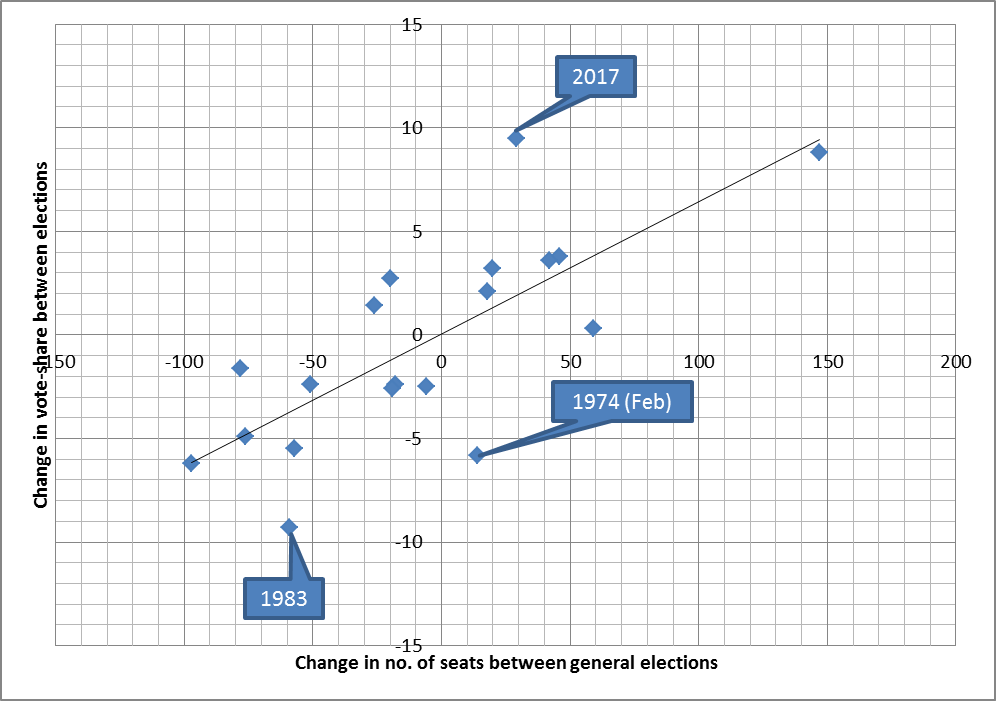
Two: the maths. There is also one thing which really stands out about the big upswing in vote-share compared with other general elections: Labour’s abject failure in translating it into seats. In fact, if we map swings against seats for elections since 1945, we can see that it is a marked outlier.

Fig. 1: Swing vs. seats since 1950. Source data: http://www.ukpolitical.info/ConvLab.htm

Read the rest of this entry »

Facebook Twitter Digg Delicious StumbleUpon

UNCUT: Labour should unite around the possibilities offered by a Corbyn government

11/06/2017, 08:00:30 AM

by Jonathan Todd

Jeremy Corbyn has changed politics. Many – not least at Uncut – doubted whether he could. But he has. And it would be churlish to pretend otherwise.

Corbyn has illuminated a pathway to a transformative Labour government and the salvaging of the UK’s relationship with our European neighbours.

This is a future that everyone in Labour should fight for. Chuka Umunna should be congratulated for making himself available to serve on our frontbench, while the unwillingness of Chris Leslie is disappointing.

Much increased turnout among younger voters has produced a general election result broadly in line with those polls that took people at their word on their intention to vote. The youngsters said they would vote, they did, and Corbyn was key to this. If younger people continue to vote in these numbers, future elections will be different contests from previously.

As encouraging as this change is, the big vote among younger people for Labour was not sufficient to prevent a Tory government. At least for now.

Where coalition with the Liberal Democrats helped modernise the Tory brand, and provided a solid parliamentary majority, working with the DUP – pre-modern in their attitude to women and climate change – deepens the re-toxification of the already UKIP-esque Tories, in exchange for a puny majority.

Read the rest of this entry »

Facebook Twitter Digg Delicious StumbleUpon

GRASSROOTS: Has Corbyn’s elastic stretched as far as it can?

10/06/2017, 04:43:03 PM

by John Wall

Although the dust from the general election is yet to settle and there is much ink still to be spilt it’s clear that, despite the claims of the Corbynistas, Project Corbyn has reached its limit.

Go back a couple of years and Corbyn’s path to Downing Street was essentially predicated on two principles. The first was non-voters, in the hope that they’d support Labour, and the second was attracting fellow travellers on the left, effectively a so-called progressive alliance.

The naysayers countered with analyses contending that these wouldn’t provide sufficient extra support and that a majority could only be secured by attracting Conservative voters.

If we look at the headline figures the two main parties together secured approaching 85% of the vote, a significant increase since the about 67% in 2015 and a massive consequential squeeze on the smaller parties.

Then there was the large increase in turnout by the key, for Corbyn, 18-24 age group.

Notwithstanding the above, and despite a poor campaign, the Conservative vote and percentage share increased, and Labour are still more than sixty seats short of a majority.

It’s clear that, overall, few Conservatives were attracted to Labour and, considering Corbyn’s extremely unsavoury baggage and economic incontinence, this isn’t particularly surprising.

It may, of course, be possible to squeeze the minor parties a little more, but the share of the two main parties is at its highest since about 1970, and perhaps some more 18-24 year olds can be enticed by giveaways, but Lord Ashcroft reckons that two thirds voted for Labour, so these avenues must now be subject to the law of diminishing returns.

Whenever the next election is the Conservatives will have learned the lessons of 2017, simple things like a few devil’s advocates involved in writing the manifesto. There might even be a new leader, it’s a party that is only interested in winning and winners, with no place for sentiment.

Everything went Corbyn’s way but he still fell a long way short. His position is secure, and Labour will now probably be refashioned in his likeness, but that will not attract Conservative voters and will keep them as far from power as ever.

John Wall is a former member of the Conservatives

Facebook Twitter Digg Delicious StumbleUpon

UNCUT: I was wrong about Corbyn. Now, after this result, Labour has the space to make the case for investment

09/06/2017, 10:48:19 PM

by Ian Moss

I was wrong, Corbyn did not drive Labour off a cliff, he won seats and he dramatically increased vote share. He comes out of the election stronger but that is partially because expectations were so low. His leadership was a galvanising force for youth and his language a refreshing change from wooden managerialism; authentic and without the timid terror of trained lines to take.

The challenge is still enormous for Labour. It has lost three elections in a row and is in no better a position, in seats, than it was in 2010 and the Conservatives no worse. Yes vote share has surged, but so too has it for the Conservative party. It’s possible we are back to the two player game for good. However, for the first time in a decade there is an obvious path, one which can galvanise Labour’s coalition of support and put an offer to the country that can bind older voters with the young.

Labour’s moderates can start to be much more confident on the economy and on public spending and move on from the paralysis they have faced since 1992 on it. The Conservatives have absented themselves from the issue of fiscal credibility, as the deficit still looms large, and the public are beginning to see the cracks in their local services. Labour can make the case for investment again, in return for modest increases on the taxes of those that can bear it most and a continuing commitment on efficiency and reform.

Read the rest of this entry »

Facebook Twitter Digg Delicious StumbleUpon

UNCUT: I phone banked for four weeks but picked up no Labour surge. And then, on polling day, there it was

09/06/2017, 06:00:53 PM

by Andy Howell

Early Thursday morning, election day. I made my way into Birmingham Labour’s phone bank with long time, fellow traveller, Bill Lees. As we approached that final push we wondered whether this might be the last time we could run a simple and conventional Get Out The Vote Operation (GOTV). Despite all of the computers and the clever pieces of software GOTV remains based on brute strength. It worked in Stoke on Trent with the backup of hundreds and thousands of volunteers. But could it still work in basic elections?

Bill and I seemed to have been locked in that phone bank for most of the previous four weeks. Bill — who was running the operation — seemed to have moved into the Birmingham office for the duration of the campaign. We survived on a poor diet of caffeine, sandwiches and very bad jokes.

For a month and more a dedicated team spoke to literally thousands of voters, initially to all and then latterly to those who had more closely identified with Labour over the last few years. It was hard going. We experienced little of the Labour ‘surge’. The last few days were positively depressing. In all honesty, we didn’t see Labour’s 40% vote coming, even as we ran wave after wave of phone knock-ups on polling day. Maybe our work did help? Maybe our work had made a difference? Maybe it didn’t? But our input into Labour’s Contact Creator seemingly hadn’t lied. The polls seemed to be right. We missed Labour’s rise completely. So, what were we missing?

Turnout was up significantly in our target seats. In some parts of Jack Dromey’s Erdington seat we were shocked at past voting records. We used Labour’s software to do some fundamental analysis. In one key area — Castle Vale — 42% of voters had not voted once in eight years. Two-thirds of voters had only voted twice across an eight year period and that voting pattern was heavily weighted to the beginning of that eight year period. It seemed these were elder voters simply getting too old to vote.

Voting turnout on ‘The Vale’ is dismally poor and yet residents came out in their droves for the EU referendum, to vote Brexit of course. Anecdotes from Party workers and polling officials suggested that in the referendum many had voted for the first time. These voters had no voting record. Phone numbers and accounts are regularly switched. From our phone banks we had no way of properly engaging with many of these voters; maybe if we had have been we would have not been caught so unaware.

Read the rest of this entry »

Facebook Twitter Digg Delicious StumbleUpon

UNCUT: If Jeremy Corbyn forms a minority government on Friday, he needs to scrap the Fixed Term Parliament Act

07/06/2017, 10:42:33 PM

by Trevor Fisher

With the opinion polls all over the place nothing is clear, but the possibility of a hung parliament has to be considered. One poll with a week to go put the Tories having a 3% lead, another a 12% lead, and the latter is more likely. But the prospect of a hung parliament and Labour having to fess up to challenging May is now worth thinking about. Paul Mason (in the Financial Times of 3rd June) called for Labour to ‘pledge his willingness to govern from the centre… should signal he would form a government with cross party support in parliament, at the very least from the Greens and the progressive nationalist parties’. That raises more questions than answers, but is not what the Front Bench is stating is political stance is going to be anyway.

The Guardian on 1st June reported that Corbyn and Thornberry at a rally in the odd venue of Basildon, considered the options if Labour were the largest party but had no majority. Corbyn echoed Tim Farron in rejecting coalitions, the two leaders clearly aware the coalitions are not popular, stating “We’re not doing deals, we are not doing coalitions, we are not doing any of these things. We are fighting to win this election”. Which is all well and good, but McCluskey of Unite said two weeks earlier that Labour would do well if it did not lose many seats, and to win the election would need Labour holding all its marginals and taking seats off its opponents, especially in Scotland.

However the comment by Emily Thornberry was more important.

She said “We are fighting to win and we are fighting to win a majority. If we end up in a position where we are in a minority, then we will go ahead and put forward a Queen’s speech and a budget, and if people want to vote for it, then good, but if people don’t want to vote for it, then they going to have to go back and speak to their constituents and explain it to them, why we have a Tory government instead. Those are the conversations we have had. No Deals.”

This needs teasing out. If Labour is the largest party, and Corbyn is called to the Palace and becomes PM with no majority, this comment means the front bench are planning to put their plans to the Commons and risking being defeated. If that happened, the Tories would then be the next in line and Corbyn could be the PM with the shortest time in office on record. Blaming the other parties would not be much consolation if the Tories stitched up a deal, as they unlike the Lib Dems and Labour, have said nothing about ruling out coalitions so far.

Read the rest of this entry »

Facebook Twitter Digg Delicious StumbleUpon

UNCUT: Polls: Labour’s surging. Non-London doorstep: It’s a “nuclear winter for Labour.” Party braces for worst

05/06/2017, 10:51:57 PM

by Atul Hatwal

Just over two weeks ago I posted a projection of huge losses for Labour – over 90 seats – based on dozens of conversations with activists, candidates and officials who cumulatively had sight of tens of thousands of canvass returns.

Since then, I’ve continued those conversations as Labour has apparently surged in the polls.

The result is a marked improvement in London but precious little to cheer about outside the capital.

The last few weeks have seen a strong rise in Labour promises in key seats across London, although constituencies such as Dagenham and Eltham remain very difficult.

But in the West Midlands, Yorkshire, North West and the North East, any improvement has been nugatory.

One campaigner from London who spent time in the North East last week described it as a “nuclear winter for Labour.”

The doorstep returns outside of London are saying that Labour is still running substantially below its 2015 vote, that Ukip votes are transferring in huge numbers to the Tories with losses in prospect of the mid-60s to mid-90s and a lingering possibility that the situation could be even worse come Thursday.

What on earth is happening? Are the doorstep results wrong? Or is it the polls?

Read the rest of this entry »

Facebook Twitter Digg Delicious StumbleUpon

UNCUT: Whatever happened to the good old election poster?

03/06/2017, 02:32:56 PM

by Lucy Ashton

Once upon a time our streets would have been ablaze with colourful orange triangles, lurid yellow and red squares and true blue garden stakes. But now, while people are quick to add a twibbon to their twitter profile or a flag to their Facebook picture, the humble election poster has fallen out of fashion.

When I was a kid in the 1980s, I used to help out in election campaigns and we would order posters by the boxful. They were probably one of the biggest election expenses and people very often wanted two or three for their garden, bedroom window and car as they proudly declared their allegiance.

By the 1990s, I was working as a journalist and posters were still popular. I remember writing photo stories where whole streets were decked out in one colour, or married couples had rival stakes in the garden.

Even a few years ago, I could name streets in Sheffield where you could find a swathe of Labour posters in a row or a clutch of Lib Dem triangles.

And then, quite suddenly, election posters seemed to fall out of fashion. It seems normal to lambast friends on Facebook over Brexit and for complete strangers to hurl abuse on Twitter, but admit how you’re voting in an election? That’s a step too far.

People have mixed feelings about them.

Conservative supporter Mike Love stopped putting up posters after a spate of vandalism. “I displayed a Tory poster in my garden in 1987 and someone set fire to it. I’ve tended not to display them since.”

Chris Shaw, a floating voter, says he did once display a Green Party parish council one. But would he display one now? “No way. I’ve traditionally been a shy Tory. I’m considering switching from May but would be embarrassed by a Labour poster.”

For Linda Lefevre, it wouldn’t be a proper election without a few posters. She said: “I display one on our front window as it’s traditional and adds excitement. I hope it will encourage neighbours to get involved and vote.”

Linda does need to impress a certain neighbour though: “We live opposite Ed Miliband, who also has a poster, as do our two next door neighbours.”

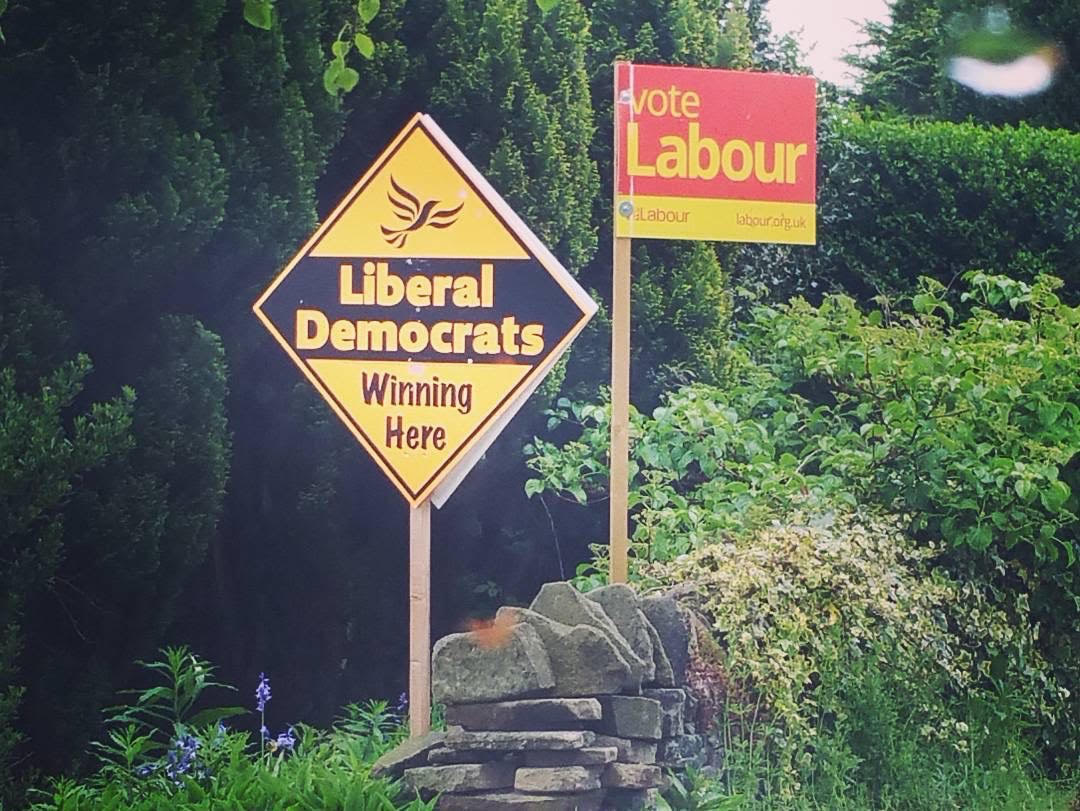
I remember my dad strategically placing one of our election poster by the back wall so it looked as though it was in our neighbour’s garden. Scott Barton – who took the photo with this blog – spotted this house in Sheffield. “This was the same back garden so I guess they’ll have to agree to disagree,” he said.

So if the poster has fallen by the wayside, along with loud hailers on cars and giant rosettes, elections will seem that bit more drab compared to the colourful campaigns of the past.

Lucy Ashton is a journalist and former regional newspaper Political Editor

Facebook Twitter Digg Delicious StumbleUpon