



UNCUT: The real defeat for Corbyn and Farron was when Theresa May suckered them into voting for an early election

08/05/2017, 11:37:41 PM

by Trevor Fisher

The June 8th election will set a new low for political manipulation in British politics. It is run only for the short term advantage of the Conservative party being a classic cut and run while you are ahead move which the Fixed Term Parliament Act was designed to prevent from happening. Historically May scored her biggest victory over the Lib Dems and Labour when they failed to defend the Act. The Tory gamble came off, as neither party had the political courage to call Theresa May’s bluff and vote against the election. The failures of Tim Corbyn and Jeremy Farron will be lasting.

This is the stolen election and a historical turning point. Unless Theresa May had stitched up the vote on the Early Election bill, unlikely as Tim and Jeremy are not going to do a deal openly with the Tories, she was gambling when she called the election, calculating she could get away with it despite the Fixed Term Parliament bill requiring 5 years before a general election – and promising the date would be May 2020.

Theresa May lulled the other parties into planning long term, and they were  caught out by the loophole in the Act which allowed an early election – if two thirds of MPs voted for an early election Bill, which needed 434 M Ps voting for it to pass. As the Tories did not have a two thirds majority only if Labour voted for the bill could this happen. Labour voted for the Bill, thus triggering an election which could only help the Tories. All the problems which were gathering around the Tory party notably election fraud allegations, the economy and major policy areas including prisons, May’s former job as Home Secretary making her responsible, were removed at a stroke.

Read the rest of this entry »

Facebook Twitter Digg Delicious StumbleUpon

UNCUT: The state of Labour: Post-anger, pre-recrimination

08/05/2017, 07:12:10 PM

by Kevin Meagher

Anger towards Jeremy Corbyn – and the blind alley into which he has led Labour – is probably futile at this point. The party was going to lose this general election whenever it was called. It was inevitable the moment Corbyn became leader 20 long months ago. There is a modicum of relief, perhaps, that the process of rebuilding can now begin in 2017 rather than 2020.

After a gruelling week, the scale of the challenge is now agonisingly clear. Glasgow. Tees Valley. Lancashire. The West Midlands. With its heartlands deserting it, there is nowhere in the country where Labour can’t lose at the moment. Much worse is, of course, to come in a few weeks’ time.

Actually, it feels slightly macabre to speculate about Labour’s short term future. So many decent MPs – servants of their community, country and party – are set to have the ground cut from beneath them.

The immediate issue is what do the party’s campaign managers do about Corbyn himself? His penance, such as it is, is to spend the next five weeks campaigning around the country observing the pretence that he is on course to be our next Prime Minister. But where do they take him where he adds any value to Labour’s campaign?

Just wait for the old soldier to accost him on a walkabout. Or the teenager to come up to him and call him a ‘loser’. Or the Jewish granny who gives him a dressing down for soft-pedalling on anti-Semitism.

No party leader who trails amongst every main demographic group is going to win an election. The voters’ basic, crippling assumption that he is not up to the job is not going to change now. In his heart of hearts Jeremy Corbyn doesn’t believe he is winning either. He knows he is squandering the moment.

But here’s the thing. There is little point railing against Corbyn. Better to accept that he is a victim of circumstance. Others created the opening for him and the hard left to make this extraordinary breakthrough. He never wanted this job. It was, infamously, his ‘turn’ to stand for the Labour leadership, as John McDonnell had done before him in 2007 and Diane Abbott did in 2010.

Read the rest of this entry »

Facebook Twitter Digg Delicious StumbleUpon

UNCUT: Theresa May’s dead EU cat shows the fragility of her campaign and paucity of political judgement

03/05/2017, 06:04:40 PM

by Atul Hatwal

The question is why? Why would Theresa May make that speech on the EU in this election? She’s already guaranteed a huge majority. Reports from all parties make it abundantly clear that the number one doorstep issue for switchers is Jeremy Corbyn.

She also knows that this speech will have a long term impact.

In France, Emmanuel Macron, most likely victor in this week’s second round is sure to be asked about it and will harden his line on Brexit. Merkel, approaching her own campaign, will do similar.

The Tory right will use May’s words to  make any backsliding towards the perfidy of compromise for an interim deal that much harder.

The chances of a Brexit disaster on Theresa May’s watch, in the next two years, just leapt exponentially.

So why do it?

A big part of the reason is that her team have been bounced: criticism of the Tories’ lack of policy, her own sheltered campaign which has studiously avoided contact with the public and the robotic repetition of the same lines, has clearly had an impact.

It’s hard to fill an election grid when the only policy commitment is to not make a commitment, journalists are getting restive and bored of anodyne events and the principal lacks the basic retail skill to deliver her core message without sounding like a ZX Spectrum speech program from the 1980s.

This is why Theresa May has thrown a dead EU cat onto the general election table.

Now, the next 48 hours will all be about May versus Brussels.

A great short term media win for the election campaign, disastrous for the premiership that follows.

That Theresa May would sacrifice her own prospects in office for this transitory triumph when facing Jeremy Corbyn says it all about the fragility of her campaign and her underlying lack of political judgement.

Atul Hatwal is editor of Uncut

Facebook Twitter Digg Delicious StumbleUpon

UNCUT: Why Diane’s bungling matters

03/05/2017, 01:37:42 PM

by Kevin Meagher

It’s often said, usually pejoratively, that Tony Blair and New Labour represented the ‘professionalisation’ of Labour politics.

An obsession with presentation. Style over substance. Spin.

What a contrast, then, to today’s unprofessional Labour party.

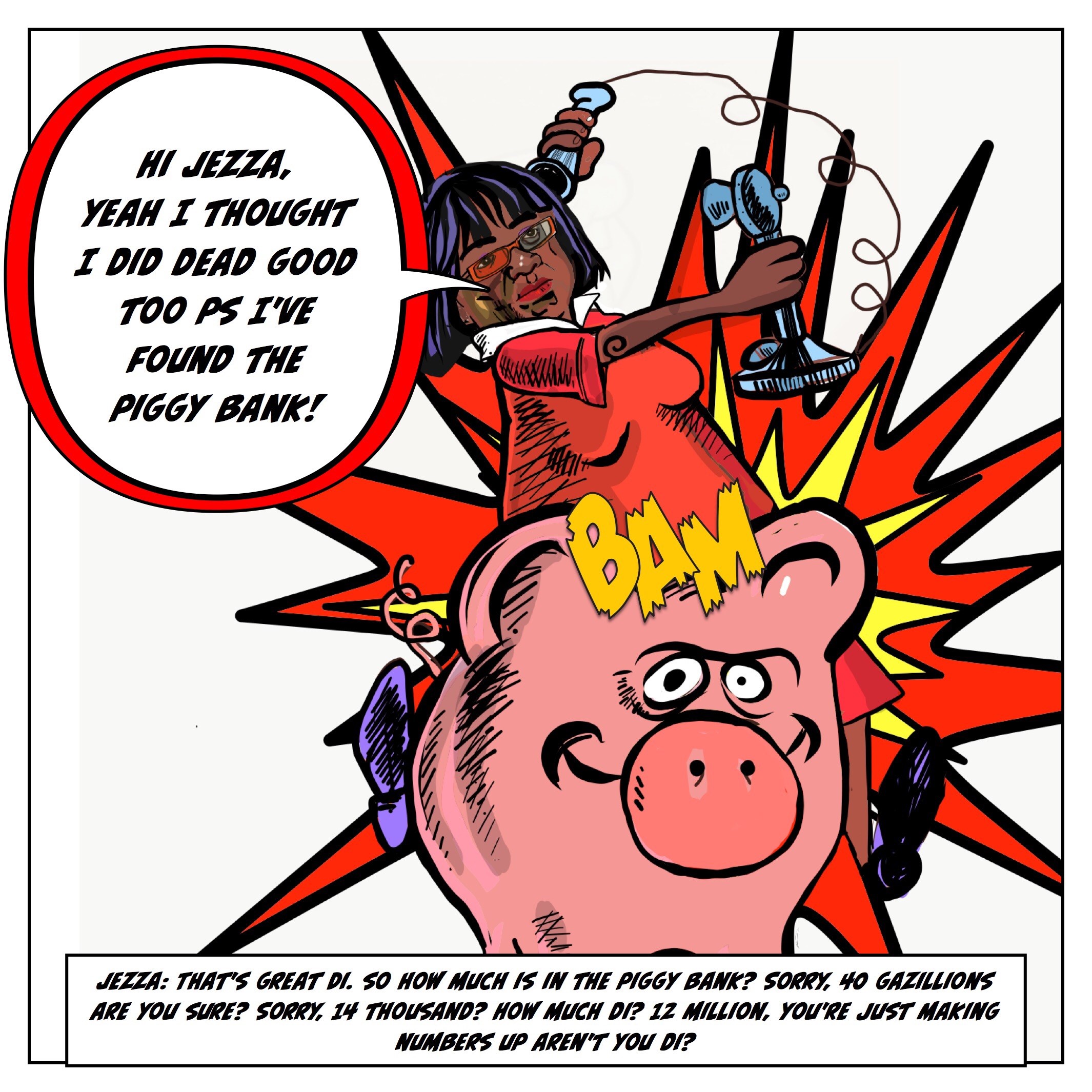
Diane Abbott’s interview yesterday with LBC’s Nick Ferrari, as she announced Labour’s pledge to recruit 10,000 extra police officers, was invariably described as a ‘car crash’.

Actually, it was more like a plane slamming into a mountain. The scale of calamity was of an altogether greater magnitude.

Pieces of smouldering fuselage were scattered across television and radio studios. Diane’s reputation as a ‘serious’ politician was utterly incinerated.

She clearly had no idea how the policing pledge was to be funded, initially suggesting it would cost £300,000. The actual figure is apparently £300 million. 1000 times her original estimate.

Of course, Jeremy Corbyn was ‘not embarrassed in the slightest’ by her blundering.

He should be.

Corbyn can do himself a lot of favours by running a basically competent, functioning election campaign.

I’ve mentioned before that his easy manner contrasts well with the stage-managed hysterics of Theresa May’s campaign.

The obvious caveat is that he is going to lose; but it’s the manner and scale of the defeat that’s in his hands.

Bluntly, he can lose badly or he can lose catastrophically.

The only card he has to play is to confound the low expectations voters, the media and his own colleagues have of him.

That requires using every opportunity, straining every sinew, to at least offer a semblance of coherence.

Alas, that’s too much for Diane.

She is an experienced broadcaster but she is used to spouting her opinion on television and radio.

It requires a higher level of skill and preparation to defend the party line, something she is simply not used to doing.

Did she think she could bluster past the entirely predictable line of questioning about how she was going to pay for 10,000 extra coppers? Is she really that inept?

I guess so.

The upshot is that she has made Jeremy Corbyn’s life a lot harder.

So catastrophic it is then?

Kevin Meagher is associate editor of Uncut

Facebook Twitter Digg Delicious StumbleUpon

UNCUT: Election 1997 20th anniversary: Britpop in London, Coronation Street in Bassetlaw

02/05/2017, 09:05:54 PM

In a series of pieces, Uncut writers look back at election day 1997. Lucy Ashton is the daughter of Joe Ashton, MP for Bassetlaw 1968-2001 and a political journalist.

While the Millbank machine was thundering through key seats in 1997, it was business as usual in Bassetlaw, my father’s constituency in North Nottinghamshire.

My dad had been the Labour MP for 29 years and had lived through the toughest times ever to face both the party and the country, including the devastating Miners’ Strike. He had won successful elections through the bleakest of periods so the media monitoring, battle bus and key message cards somewhat passed us by as we did business as usual.

My dad was a big supporter of Blair and a fan of Alistair Campbell (mainly through their shared love of football) but he knew his constituency better than anyone. Geographically, it’s huge and diverse so he would spend his days hammering posters into farmers’ fields, then door knocking with a loud speaker on disadvantaged council estates. The London Labour party with its Britpop celebrity endorsements seemed a world away.

One of the main towns in Bassetlaw is Worksop which was lucky enough to have a wonderful old building called the Labour Party Headquarters, ideally positioned opposite a pub. It was a great curiously shaped building, full of character and heritage and was used for everything from storing leaflets to holding important ballot meetings.

My dad was in his 60s and I remember him lying down on a 1960s-style orange and brown settee to have a nap mid-afternoon.

But this time my dad knew that finally, he could celebrate a Labour landslide, so while Blair was in his private plane, we were preparing for a street party.

We used chairs to unofficially close the little back street where the HQ building was, effectively shutting off access to the pub but given the landlord was a long-standing party supporter no one seemed to mind.

I wore a bright red polo shirt – nothing fancy to celebrate such a historic occasion – and spent the whole night playing games with the little kids, drinking and laughing.

I remember dancing to ‘Come On Eileen’ with my mum and a group of the Labour party woman, hugging and stamping our feet. This was our time after years of fighting. I still think of that moment when I hear the song.

While Millbank had create a new era of campaigning which would change the way every election was  fought in future, in Bassetlaw it felt like we had returned to the days of Coronation Street in the 1960s, of Harold Wilson, of simple booze-ups and happy times.

Facebook Twitter Digg Delicious StumbleUpon

INSIDE: Danczuk’s treatment makes it open season on Labour candidates’ private lives

02/05/2017, 11:28:37 AM

So Simon Danczuk is to be barred from standing in the general election and deprived of defending his Rochdale seat that he first won form the Lib Dems in 2010.

A high price to pay for being an honest critic of Jeremy Corbyn’s various shortcomings and for his ubiquity in the pages of our tabloid newspapers.

Yesterday, he faced a three-member star chamber of the National Executive Committee to answer allegations that he was involved in sexting a 17 year-old girl back in 2015.

Danczuk made no excuse for his actions. He explained to the NEC that he was going through a hard time in his personal life (for which he subsequently received counselling) and had simply made a foolish mistake.

Without rehashing details, there was no allegation of illegality and most fair-minded observers would regard it as a closed, private matter.

Labour’s NEC operates to higher moral standards, it seems.

They deemed his actions to be so deplorable that he must forfeit his political career.

But in their bid to punish a critic and (they imagine) free up a Labour seat for a Corbyn acolyte, the leadership has just made a catastrophic error.

What will the NEC now do if it is revealed a Labour MP or candidate is, say, having an extra-marital affair? Or has a cocaine habit? Or uses rent boys?

By punishing Danczuk they have just set a precedent that the sexual peccadillos of other candidates are enough to have them dumped, inadvertently announcing open season on Labour MPs’ private lives.

Gleeful researchers in Conservative Central Office will be able to weaponise tittle tattle about Labour MPs to detract attention from the ongoing police investigation into their 2015 election expenses.

Right-wing tabloids, perhaps wary of exposing MPs following the Leveson inquiry, will feel justified in bringing tales of Labour MPs’ human frailties to light.

Corbyn has just done exactly what John Major did during his ill-fated “back to basics” campaign in the early 1990s. He has invited the media to hold other Labour candidates to the same standard as Danczuk.

Many will be found wanting.

Westminster is a gossipy place and there are plenty of Labour MPs who should be panicking right about now.

Facebook Twitter Digg Delicious StumbleUpon

UNCUT: Election 1997 20th anniversary: Fear and loathing in Conservative Central Office

01/05/2017, 10:55:57 PM

In a series of pieces, Uncut writers look back at election day 1997. Mark Stockwell was a staffer at Conservative Central Office.

Twenty-odd points behind in the polls. Divided, discredited, and despised. Doomed to defeat, a whole generation of talent set to be swept aside in an electoral tsunami from the south of England to the highlands of Scotland, and all points between.

That was the situation facing the Conservative Party on 1 May 1997. And although the eventual share of the vote was closer than the polls suggested, the impact in terms of seats won and lost was every bit as devastating.

In the early hours of the morning of 2 May, as the scale of Tony Blair’s victory became clear, a small crowd of ‘well-wishers’ gathered outside the then Tory HQ. Some maintain that they were chanting “You’re out and you know you are” (to the tune of ‘Go West’). From inside the Smith Square bunker, I think it was the more traditional football-terrace lyrics I could hear. And while some were outraged at this impertinence, and still shocked at what had unfolded during the course of the night, a good deal more were inclined to shrug and think to themselves, “fair enough”. Eighteen years of Conservative rule had come to a shattering end and those who had hastened its demise were in no mood for an insincere display of magnanimity.

Earlier, preparing to hunker down for a sleepless night of election coverage and (let’s be honest) steady drinking, a few Central Office staffers in the ‘war room’ had printed off a list of marginal seats and pinned it to the wall in order to keep track of the results as we went along. (Even the memory of this quaint, paper-based approach seems to tinge the whole scene with sepia. I don’t think we even had Excel in those days.)

After a handful of early results had filtered through, the extent of the swing to Labour and the patterns of tactical voting had become obvious. A few of us began to exchange anxious glances. I can’t recall exactly who said it first, or at what stage in proceedings, but pretty soon the conclusion was unavoidable: “We’re going to need to print out another sheet.” And pretty soon, another one. I recalled the words of Pitt the Younger on hearing of Napoleon’s victory at Austerlitz: “Roll up the map; we will not be needing it these ten years.”

Read the rest of this entry »

Facebook Twitter Digg Delicious StumbleUpon

UNCUT: Election 1997 20th anniversary: “Were you up for Portillo? Sort of.”

01/05/2017, 09:51:19 PM

In a series of pieces, Uncut writers look back at election day 1997. Tony Sophoclides was a political adviser to John Prescott and closely involved in the key seats campaign

The morning was knocking up in Enfield Southgate and the afternoon Brentford and Isleworth. For two years I’d been immersed in the key seats campaign and finally polling day was at hand.

Everything about Labour’s campaign in 1997 had been focused on 91 seats to secure a majority of 45. By May 1st our returns pointed to big wins in these seats and a new swathe of seats was targeted in the final week.

Looking back with hindsight, you wonder if we should have expanded the target list much earlier but at the time the fear of failure was stamped on our psyche. To even contemplate a comfortable victory was to tempt disaster.

Canvassing went well but still I was edgy. Some of team Prescott met at a pub in Westminster at about 2030 before heading over to Festival Hall for the party an hour later.

Only then did I relax.

Walking in, you knew it was a party. Word of the swings being reported on the ground had got through and there was a feeling of huge expectation.

Various celebs were dotted around the Festival Hall, including Richard Branson. Labour had tried so hard to get him to back us, only for him to tease but not commit. Yet here he was, at the party.

A group of us ended up chatting to him when he did a very odd thing, which is apparently one of his common tricks.

We all shook hands with him when after a few moments he asked one of our number, Sue Haylock (who worked for JP then and still does), the time. She looked at her wrist but the watch was gone.

Branson opened his hand and there it was. Even with all that was going on that evening, I clearly recall wondering how on earth he had time to learn and perfect that trick when he was meant to be running a mega-million pound set of businesses.

The evening rolled on as did the booze. Maybe a little too much.

Read the rest of this entry »

Facebook Twitter Digg Delicious StumbleUpon

UNCUT: Election 1997 20th anniversary: Then and now

01/05/2017, 07:55:36 PM

In a series of pieces, Uncut writers look back at election day 1997. Jonathan Todd looks at then and now with an eye to the Mayoral votes coming this Thursday

“I don’t know what I was hoping for.”

I don’t know for how many people the words of Nick Cave’s beautiful We Came Along This Road apply to Labour’s 1997 victory.

My family have never been political. I cannot comprehend childhoods snatched under tables in committee rooms. I spent my first 16 years kicking a ball against a wall.

As a sixth-former in Barrow-in-Furness, the hopes that I had for Labour in 1997 did not reside in family inheritance. They did, though, grow out of family circumstance.

While Ken Clarke delivered macroeconomic improvement in advance of May 1997, unemployment was a spectre that ever more encroached on my ball kicking.

In the north of my youth, people were made redundant in middle age and never worked again, youngsters left school to go on the dole. This created a pervasive sense of thwarted hopes.

In the same way that 1945 was about saying “no more” to the economic depravities of the 1930s, my Labour hopes in 1997 grew out of unnecessary economic injustice.

While I was specific about the unemployment that I wanted to leave behind, I was vague about how Labour might fulfil these hopes. I enjoyed A-Level Economics – and was much more Keynes than Friedman – but neo-endogenous growth theory did not much illuminate, at least as I recall my youthful mind, the intensions of Blair and Brown.

1997 is as far removed from today as the second year of Wilson’s premiership was from 1945. By the mid-60s, while Attlee’s achievements, such as the NHS and the welfare state, were immense, they’d long been banked by the public. As much taken for granted as the minimum wage now is.

In 1945, 1964 and 1997, Labour was a breath of fresh air, defined as a vanguard of national renewal, not by what it had done decades previously. Blair will be as irrelevant to the next Labour government as Attlee was to 1964. Or Wilson was to 1997.

Read the rest of this entry »

Facebook Twitter Digg Delicious StumbleUpon

UNCUT: Election 1997: 20th anniversary: “Just let yourselves out quietly when you’re finished”, said Her Majesty’s High Commissioner to South Africa

01/05/2017, 06:48:48 PM

In a series of pieces, Uncut writers look back at election day 1997. Stephen Hardwick had been a shadow cabinet adviser to John Prescott and moved to South Africa to work for the ANC shortly before the election

“Where were you for Portillo?” Drinking white wine and whooping with delirium at the UK High Commissioner’s residence in Bishopscourt, Cape Town, with half of Nelson Mandela’s ANC Cabinet, and my comrade-in-arms, Mike Elrick.

There are worse places to watch the BBC election night coverage than amid the great and the good of South Africa’s first democratic government and as a guest of the fabulous (and late) Maeve Fort – who knew how to throw a party.

But why there?

I’d been working as an adviser to the ANC Chief Whip, Max Sisulu, for a year by then, and Mike, who had been a press officer for John Smith, had joined me six months in. After four years as John Prescott’s speechwriter and policy adviser, I’d quit because I had wanted to ‘do something’ to support the new ANC government in South Africa.

As far as I was concerned, by mid-1996 Labour was nailed-on for a big win, and I felt that I’d done my bit. So while my contemporaries among the Shadow Cabinet advisers – the Milibands, Ed Balls, Yvette Cooper, Pat McFadden and co – would be heading for government or Parliament, I was already there, working ultimately for Mandela.

So on election night, there was a huge projector screen and a BBC satellite feed set up in a grand and spacious dining hall. There was fizz, I recall, to get things started, and waiters circulated topping up bottomless glasses of chilled whites and fruity reds. There was also buffet and the most enormous wheel of cheddar.

It was the scale of the rout that was so shocking, and as seat after seat fell, we Brits kept looking at each other with growing disbelief and, in some cases, unalloyed joy.

Around 2am I called John Prescott to congratulate him. He was on his way from Hull to London and he told me that he’d been up to Sedgefield to see Tony Blair earlier that day and that he was going to be Deputy Prime Minister and Secretary of State for Environment, Transport and the Regions. I’m still proud that I was among the first he told.

Read the rest of this entry »

Facebook Twitter Digg Delicious StumbleUpon