




Posts Tagged ‘economy’

The return of the confidence fairy could spell trouble for Labour

16/01/2013, 10:12:44 AM

by  Dan McCurry

The stock market has historically been a good barometer of future economic activity. It tends to be 6 months ahead of other indicators, representing the daily confidence of company bosses, either in their own investing, or in the conversations they have with institutional investors. However, the stock market has often been a poor tool for the policy maker, since it is so volatile that it is difficult to see the wood for the trees.

The FTSE100 recently broke through the 6,000 barrier. This may be volatility, but a comparison to the bond market may provide clarity.

UK gilts have been unusually expensive in the last few years. So expensive that a 10-year gilt yields less than inflation. This is partly a distortion caused by QE, but it is also indicative of capital preservation. Fear has governed the markets.

However, gilt prices have been falling recently, and the fall appears to correspond with the rise in the stock market. Are investors leaving safe-haven assets and returning to stocks? Are we witnessing the return of the confidence fairy?

(more…)

Facebook Twitter Digg Delicious StumbleUpon

It’s still the economy, stupid, which is why the two Eds should be worried about 2013

31/12/2012, 08:00:15 AM

by Atul Hatwal

The Christmas break will have been a time for some self-congratulation in Labour leadership circles. A solid poll lead, a divided coalition and high hopes for the coming year.

Ed Miliband had a passage in his stump speech on the circuit of pre-Christmas Westminster receptions where he talked about the unprecedented position of strength Labour is in for a new opposition, with such a lead at this stage in the parliament. He is factually right, but then the competition for most effective new opposition is not terrific. In the past 33 years, there’s a choice of two: either William Hague’s Tories or Michael Foot’s Labour party.

And at this point in Mrs.Thatcher’s first term, two and a half years after the election, even Michael Foot managed an average lead over the Tories of 3% (averaging the four polls in November 1981 – h/t Mark Pack and his magnificent polling spreadsheet).

When considering unprecedented political phenomena, Ed Miliband, and indeed Ed Balls, might want think more carefully about where the party stands with voters on economic competence.

Decades of polling gives a very clear message: no opposition has won an election without a commanding lead on the economy.

In 1979, voters preferred Jim Callaghan to Margaret Thatcher as PM by 50% to 31%, but still elected the Tories who led on economic issues by an average margin of 10%. In 1997, Labour led by 10% on the economy at the election, while in 2010 the Tories led by 8%.

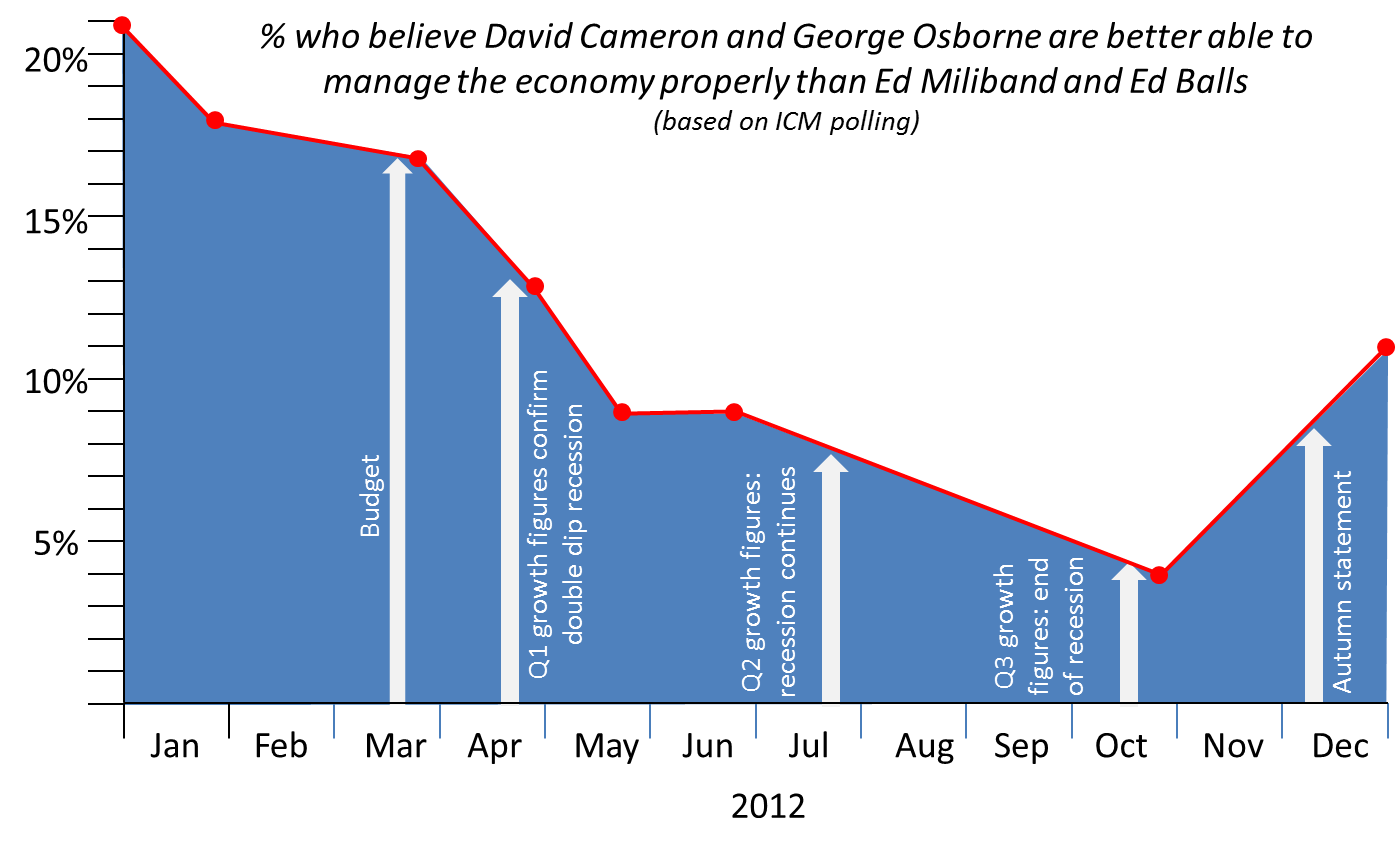
Currently. Labour is 11% behind on economic competence and no opposition has gone on to win the next election when trailing the government on the economy, after two and half years.

Typically, there just isn’t the time left in the parliament to overhaul the government lead and build a sufficient cushion prior to the inevitable narrowing of the polls as election day draws near. Based on the polling facts, a Labour victory in 2015, from this position, would truly be unprecedented.

(more…)

Facebook Twitter Digg Delicious StumbleUpon

The root causes of today’s problems go back further than the crash and require structural economic change

29/09/2012, 06:22:58 PM

by Jonathan Todd

We continue to live through the hangover from what Mervyn King called the NICE decade – non-inflationary continuous expansion. Just like all hangovers what we are living through is consequence of what came before. The supposed NICE decade was always pregnant with the nastiness of now.

This nastiness includes growth that is so feeble that GDP remains 4 per cent below its 2008 peak; a longer contradiction in growth than the notoriously grim 1930s; youth unemployment worse than in the 1980s; and an unprecedented incomes squeeze. It’s hurting but it’s not working: we’re told this is all the price for reducing the deficit but government borrowing is on the rise.

In what senses was the NICE decade pregnant with this nastiness?

Outside of London real median wages began to stagnate in 2003. The level of investment in the real economy was also weak over this period. Public finances became increasingly dependent on one sector of the economy (finance, obviously). The problem of youth unemployment, as David Miliband says, didn’t originate with this government but they made it worse. That can be said for other kinds of nastiness as well.

What was happening in the financial sector – the credit that it extended to households allowing them to live lives their incomes could no longer sustain; the taxes and bond purchases that it provided to government enabling them to spend more than otherwise – disguised the scale and extent of the structural problems with median wages, investment in the real economy, public finances, and youth unemployment.

We’ve transitioned from a “let them eat debt” era into a protracted period of public and private deleveraging and as we’ve done so, the structural problems have become more apparent and more pronounced – but they haven’t been created; they were always there.

(more…)

Facebook Twitter Digg Delicious StumbleUpon

Budget preview: Osborne plays politics with Britain’s economy

20/03/2012, 07:00:25 AM

by Jonathan Todd

Literally no one alive today has experienced a period as economically bleak as we face today.

There could be hope. The chancellor retains a capacity to improve our situation through bold policy and a display of leadership. Instead we can expect a Budget of ruses, a rearranging of the pieces on the political chessboard with little or no thought for the wider reality in which the rest of us reside.

Osborne’s capacity to frame political debate should not be underestimated. He has the bully pulpit of office, a sympathetic media, and the public have bought into his central narrative: there is no alternative to his tough deficit-reduction medicine and anyone who suggests otherwise, particularly on behalf of Labour, who he paints as wholly culpable for our economic predicament, represents an unaffordable risk.

It is a powerful argument, a train rumbling down the track straight for Labour, threatening to smash us into another parliament in opposition. Some think the train will change direction, almost irrespective of what Labour does. They hope and believe that exasperation with Osborne will build such that his prescription is rejected.

Some contend that the train is immutable and that Labour had better adjust – deficit reduction will remain the key issue and Labour must do more to demonstrate how we would deliver this.

(more…)

Facebook Twitter Digg Delicious StumbleUpon

How Labour has misread voters on the deficit

09/03/2012, 08:30:21 AM

by Atul Hatwal

On Tuesday, Ed Miliband did what should have been a good thing.

His speech on the need for a more active industrial policy was rooted in common sense. Ideas like a British bank tasked with expanding business lending are widely supported. And it was a neat idea to back an existing campaign by British manufacturers for a “made in Britain” label.

Although sceptics will always roll their eyes at a buy British campaign, the politics were right. Identifying the party with a business led initiative that had lots of businesses ready to talk positively about the proposal is a world away from “predators and producers”.

The government did their bit too, issuing a rebuttal comment that talked about the need for global trade and international business. The dividing line could not have been clearer – Labour backing British business while the government opened the next round of GATT negotiations with the public.

But despite receiving as warm a reception as he has enjoyed for an economic policy speech, what thanks did Ed Miliband get? Minutes after the applause he was fighting off a baying mob on Radio 5 live.

It was impossible not to feel sorry for him. The leader offered the usual platitudes about the scale of the task facing Labour, building up support slowly and getting a warm reception up and down the country. But it was just chaff.

What Ed Miliband reaped was in part the inevitable result of Labour’s economic strategy.

The last election was lost on the deficit. The electoral challenge for this parliament: which party is most trusted to reduce it.

In a way, Labour has understood this and developed a strategy that does indeed address the deficit.

Every press release issued by the economic team is rigorously consistent. The headline is almost always about poor growth with a clear causal link made in the story between growth, unemployment, reduced tax revenues and a worsening deficit.

Great. Job done, right?

(more…)

Facebook Twitter Digg Delicious StumbleUpon

Revealed: foreign investment in the UK collapses by 33% in a year with £16.2bn less invested

17/02/2012, 07:00:02 AM

by Atul Hatwal

New figures uncovered by Labour Uncut reveal that investment in the UK by foreign companies has plummeted by a third. The latest results, released at the start of February, are for 2010 and show a massive fall of £16.2bn from the £49bn invested in 2009 to £32.8bn in 2010.

In an ominous sign for David Cameron’s isolationist European policy, the biggest fall over the year was in investment from Europe which fell by 94% from £32.1bn in 2009 to £1.8bn in 2010 – the lowest level since records began in 1988.

Despite the British prime minister’s initial close relationship with French president Nicolas Sarkozy, France led the way in withdrawing funds from the UK. They cut their investment in Britain by a net £23.7bn in 2010, a record for a European country.

(more…)

Facebook Twitter Digg Delicious StumbleUpon

Smart people learn from their enemies

23/01/2012, 02:00:55 PM

by Rob Marchant

The furore over last week’s defection of former Labour staffer, Luke Bozier, to the Tories provides a convenient excuse for a closer look at the party that he has just joined. Not with a view to doing the same, you understand – it’d be a cold day in hell for most of us – but with a view to a bit of hard-nosed, non-partisan analysis.

Leafing through Alan Clark’s idiosyncratic history of his party, The Tories, there are some interesting lessons for Labour. Not ideologically, of course: but about the nature of politics, and the nature of power. And power is something which the Tories were uncommonly good at securing and retaining during the period of the book, from their successful defenestration of Lloyd George in 1922 through to their rout in 1997. Indeed, during this period, as Clark points out:

“…the Conservative Party was the dominant political force in Britain – even when, for short periods, it was in Opposition”.

(more…)

Facebook Twitter Digg Delicious StumbleUpon

The twelve rules of opposition: day two

26/12/2011, 12:01:56 PM

by Atul Hatwal

Rule 2: Use the government’s tax and spending plans as a bridge back into the argument

All oppositions start their lives with a trust deficit on the economy.

Defeat at a general election is the most stark demonstration of voters’ lack of faith. It is the public sending a clear message that they do not believe that the party has either the policies or the capability to deliver on their promises of a brighter tomorrow.

The pre-eminent requirement for an opposition is to bridge this trust gap, as quickly as possible.

But deprived of power, and the ability to demonstrate how alternative policies would have been more effective than the government’s, the options are limited.

(more…)

Facebook Twitter Digg Delicious StumbleUpon

A three point plan for opposition

10/11/2011, 02:35:08 PM

by Peter Watt

Being in opposition can be thankless and getting the tone right can be tricky. Right about now it is doubly so. Which is why I was taken by an interesting article over at Labour List penned by Mark Ferguson. In “Labour can’t afford to look smug“, Mark argues that Labour risks looking smug in the face of the current dire economic situation if they appear to take every bad headline or statistic as vindication for their proposed approach. As he says, if we look smug:

“…then all we do is ensure that at best the public think ‘a plague on all your houses’ and at worst, we end up looking smug about a crisis that many people think we caused”.

Now I didn’t agree with some of the underlying assumptions in the post, but on this central tenet he was spot on. We do sometimes and inadvertently sound quite pleased at the poor economic outlook and the public hate it. And so I started thinking about what exactly the strategy for opposition should be for Labour right now. And I have come up with a cunning three point plan. (more…)

Facebook Twitter Digg Delicious StumbleUpon

60 more seconds: 60 more votes

26/10/2011, 06:00:01 AM

by Adam Richards

A former colleague, now a journalist, took to tweeting an exasperated message because his newsroom hadn’t picked up on the political [in]significance of the EU debate that took place last night. Nor did the BBC it seems, who took nearly an hour to feature the story on their site, at the bottom of the newsfeed.

With the government moving the debate forward so that David Cameron and William Hague could [not] attend it seemed to appear out of nowhere. The newspapers covered the story over the weekend and the majority of pundits, from the left and right, focussed their ire towards the Conservatives, with only a couple foolishly believing Cameron would come out of it strengthened. Today’s media coverage seems to confirm this. In a flash, Cameron has suffered an embarrassing erosion of his leadership.

When Tories debate Europe time goes backward. It is a common mistake to believe the digital clock in the chamber represents time; it is the number of Conservative voters jumping ship. As sure as tick follows tock, Tory followed Tory and story followed story. There aren’t many more satisfying things than watching Jacob Rees-Mogg on telly – he is after all a walking talking party political broadcast for Labour. There were wry smiles allround when his honourable colleague intervened and he was granted a further 60 seconds on the floor. 60 seconds, 60 votes, thank you very much, sir. (more…)

Facebook Twitter Digg Delicious StumbleUpon