




Posts Tagged ‘Jeremy Corbyn’

I phone banked for four weeks but picked up no Labour surge. And then, on polling day, there it was

09/06/2017, 06:00:53 PM

by Andy Howell

Early Thursday morning, election day. I made my way into Birmingham Labour’s phone bank with long time, fellow traveller, Bill Lees. As we approached that final push we wondered whether this might be the last time we could run a simple and conventional Get Out The Vote Operation (GOTV). Despite all of the computers and the clever pieces of software GOTV remains based on brute strength. It worked in Stoke on Trent with the backup of hundreds and thousands of volunteers. But could it still work in basic elections?

Bill and I seemed to have been locked in that phone bank for most of the previous four weeks. Bill — who was running the operation — seemed to have moved into the Birmingham office for the duration of the campaign. We survived on a poor diet of caffeine, sandwiches and very bad jokes.

For a month and more a dedicated team spoke to literally thousands of voters, initially to all and then latterly to those who had more closely identified with Labour over the last few years. It was hard going. We experienced little of the Labour ‘surge’. The last few days were positively depressing. In all honesty, we didn’t see Labour’s 40% vote coming, even as we ran wave after wave of phone knock-ups on polling day. Maybe our work did help? Maybe our work had made a difference? Maybe it didn’t? But our input into Labour’s Contact Creator seemingly hadn’t lied. The polls seemed to be right. We missed Labour’s rise completely. So, what were we missing?

Turnout was up significantly in our target seats. In some parts of Jack Dromey’s Erdington seat we were shocked at past voting records. We used Labour’s software to do some fundamental analysis. In one key area — Castle Vale — 42% of voters had not voted once in eight years. Two-thirds of voters had only voted twice across an eight year period and that voting pattern was heavily weighted to the beginning of that eight year period. It seemed these were elder voters simply getting too old to vote.

Voting turnout on ‘The Vale’ is dismally poor and yet residents came out in their droves for the EU referendum, to vote Brexit of course. Anecdotes from Party workers and polling officials suggested that in the referendum many had voted for the first time. These voters had no voting record. Phone numbers and accounts are regularly switched. From our phone banks we had no way of properly engaging with many of these voters; maybe if we had have been we would have not been caught so unaware.

(more…)

Facebook Twitter Digg Delicious StumbleUpon

If Jeremy Corbyn forms a minority government on Friday, he needs to scrap the Fixed Term Parliament Act

07/06/2017, 10:42:33 PM

by Trevor Fisher

With the opinion polls all over the place nothing is clear, but the possibility of a hung parliament has to be considered. One poll with a week to go put the Tories having a 3% lead, another a 12% lead, and the latter is more likely. But the prospect of a hung parliament and Labour having to fess up to challenging May is now worth thinking about. Paul Mason (in the Financial Times of 3rd June) called for Labour to ‘pledge his willingness to govern from the centre… should signal he would form a government with cross party support in parliament, at the very least from the Greens and the progressive nationalist parties’. That raises more questions than answers, but is not what the Front Bench is stating is political stance is going to be anyway.

The Guardian on 1st June reported that Corbyn and Thornberry at a rally in the odd venue of Basildon, considered the options if Labour were the largest party but had no majority. Corbyn echoed Tim Farron in rejecting coalitions, the two leaders clearly aware the coalitions are not popular, stating “We’re not doing deals, we are not doing coalitions, we are not doing any of these things. We are fighting to win this election”. Which is all well and good, but McCluskey of Unite said two weeks earlier that Labour would do well if it did not lose many seats, and to win the election would need Labour holding all its marginals and taking seats off its opponents, especially in Scotland.

However the comment by Emily Thornberry was more important.

She said “We are fighting to win and we are fighting to win a majority. If we end up in a position where we are in a minority, then we will go ahead and put forward a Queen’s speech and a budget, and if people want to vote for it, then good, but if people don’t want to vote for it, then they going to have to go back and speak to their constituents and explain it to them, why we have a Tory government instead. Those are the conversations we have had. No Deals.”

This needs teasing out. If Labour is the largest party, and Corbyn is called to the Palace and becomes PM with no majority, this comment means the front bench are planning to put their plans to the Commons and risking being defeated. If that happened, the Tories would then be the next in line and Corbyn could be the PM with the shortest time in office on record. Blaming the other parties would not be much consolation if the Tories stitched up a deal, as they unlike the Lib Dems and Labour, have said nothing about ruling out coalitions so far.

(more…)

Facebook Twitter Digg Delicious StumbleUpon

Polls: Labour’s surging. Non-London doorstep: It’s a “nuclear winter for Labour.” Party braces for worst

05/06/2017, 10:51:57 PM

by Atul Hatwal

Just over two weeks ago I posted a projection of huge losses for Labour – over 90 seats – based on dozens of conversations with activists, candidates and officials who cumulatively had sight of tens of thousands of canvass returns.

Since then, I’ve continued those conversations as Labour has apparently surged in the polls.

The result is a marked improvement in London but precious little to cheer about outside the capital.

The last few weeks have seen a strong rise in Labour promises in key seats across London, although constituencies such as Dagenham and Eltham remain very difficult.

But in the West Midlands, Yorkshire, North West and the North East, any improvement has been nugatory.

One campaigner from London who spent time in the North East last week described it as a “nuclear winter for Labour.”

The doorstep returns outside of London are saying that Labour is still running substantially below its 2015 vote, that Ukip votes are transferring in huge numbers to the Tories with losses in prospect of the mid-60s to mid-90s and a lingering possibility that the situation could be even worse come Thursday.

What on earth is happening? Are the doorstep results wrong? Or is it the polls?

(more…)

Facebook Twitter Digg Delicious StumbleUpon

Why Catholics like Corbyn

01/06/2017, 11:41:25 PM

by Kevin Meagher

Support among Britain’s Jews for Jeremy Corbyn may be flat-lining – with just 13 per cent planning to vote Labour according to a poll in the Jewish Chronicle – but Britain’s Catholics are set to ride to Labour’s rescue.

In all probability, Labour’s most important demographic, many of Britain’s five million Catholics are habitually loyal to the party, supporting it through thick in thin for generations. This peaked with a 60-19 per cent gap over the Conservatives back in 2001.

Even in 2015, 41 per cent of Catholics voted Labour – 11 per cent higher than the population at large, according to figures from the British Religion in Numbers project at Manchester University. While Muslims also vote Labour is very large numbers, I suspect the wider distribution of Catholic voters across the country has more strategic impact on Labour’s fortunes.

Indeed, much of the party’s meltdown in Scotland at the last general election (where it lost forty seats) was down to Catholics abandoning Labour in droves. Between 2010 and 2015, Labour’s share of the Catholic vote fell from 63 per cent to just 36 per cent. Any way back for Labour in Scotland means retrieving Catholic support that went to the SNP.

Catholic support for Labour is perhaps most pronounced in general political attitudes. After the 2005 election, IpsosMori found that while fewer than a quarter (22 per cent) of the public generally described themselves as ‘Old Labour’, over a third (34 per cent) of Catholics said that description best suited their political outlook.

On questions of distributional justice, many Catholics are reliably left-wing. Perhaps Corbyn’s genuine moral outrage about poverty connects deeply with the Faithful? As does his commitment to peace and dialogue. Even his embroilment in Northern Ireland is potentially a positive here.

Quite apart from his support for Irish republicanism, Corbyn was also involved in campaigns to overturn the miscarriages of justice concerning the Birmingham Six and Guildford Four and has been active on Irish community concerns, from fighting racism to supporting Travellers’ rights throughout his career.

(more…)

Facebook Twitter Digg Delicious StumbleUpon

The final straight of two terrible campaigns

01/06/2017, 05:21:00 PM

by Rob Marchant

A week left of campaigning, and Britain’s political race to the bottom is in full flight. Polls all over the shop; but narrowing at the end, as they invariably do.

In different ways, the Tory and Labour campaigns are spectacularly failing to enthuse the electorate.

The Tories, for whom the election has always been theirs to lose, seem intent on torpedoing their own campaign. Uncosted pledges – almost unheard of for usually-meticulous Tories – and their fiasco on the “dementia tax”, resulting in a mid-campaign U-turn by May.

Then there is the air campaign. First she is front and centre: then the party panics and sees her wooden, unengaging and largely absent. John Prescott reports a senior Tory viewing the campaign as “a disaster”, and that opinion is surely not a one-off among the grandees, let alone the commentariat.

To round off her dismal campaign, she has made an awful blunder, not so much in boycotting the televised debates, but worse: sending a substitute and saying she is too busy “thinking about Brexit negotiations”. The optics, as they say, of such a high-handed approach are awful, and the natural response uncomplicated. “I’m sorry? Who was it actually called the election?”

The one ray of light on the horizon for the self-sabotaging May must surely be that the poll-narrowing currently taking place will probably be enough to animate her base to come to the polling station, rather than stay at home. Meaning she will win comfortably where she does not deserve to. But, then again, neither does her opposite number.

Ah yes, Labour. Where to start?

(more…)

Facebook Twitter Digg Delicious StumbleUpon

Why doesn’t Corbyn just go and join the Tories?

31/05/2017, 02:26:04 PM

by George Kendall

Jeremy Corbyn’s astonishing victory in the Labour leadership contest of 2015 was in reaction to the then Labour leadership’s decision to abstain on some parts of the Tory welfare bill. At the time, Corbyn said: “Families are suffering enough. We shouldn’t play the government’s political games when the welfare of children is at stake”.

On being elected leader, Corbyn was remorseless in continuing his attacks on welfare cuts.

In autumn 2015, Corbyn’s ally, the Shadow Chancellor, committed to reversing the tax credit cuts in full. He tweeted: “We are calling on Osborne to reverse his decision to cut tax credits. If he doesn’t reverse these cuts, we’re making it clear that we will”.

Even as recently as Monday of this week, in his interview with Jeremy Paxman, Corbyn said: “I am fighting this election on something very important, that is the levels of poverty in our society, the levels of children that are not supported properly in our society. I’m fighting this election on social justice”. (7.15 mins in)

These are stirring words. But are they actually true?

Earlier in the interview, after considerable pressure from Paxman, he said that benefits wouldn’t be frozen for three years (3.33 mins in here). According to the respected independent think-tank, the IFS, this would require an additional £3.3bn per year, yet any funding to pay for this is missing from his costed manifesto.

Even more striking is that his explicit commitment in the Paxman interview, to ensure that “children are properly supported in our society” isn’t matched by his manifesto, which fails to reverse child tax credit cuts, a change that would have required £4.8bn per year. In addition, his manifesto only allocates £2 billion of the £3 billion per year that would be needed to reverse cuts to universal credit.

In combination, these cuts will take £9.1 billion per year from the lowest paid in our society.

Instead, he and his team have chosen to allocate most funds to initiatives which will be particularly attractive to middle-class voters.

(more…)

Facebook Twitter Digg Delicious StumbleUpon

Whatever the result in this election, voter registration must be a big part of Labour’s future

28/05/2017, 10:39:31 PM

by Trevor Fisher

Last Monday, 22nd May, my inbox was full of messages about the election – the big news being the Tory manifesto or rather the May manifesto, building on the lead May has in the opinion polls with her running ahead of her party – while Corbyn runs behind his. The latest polling before the manifesto row the previous week showed Tories 47%, Labour 32%, LD 8% and UKIP 5%, but on the leaders May was 24 points ahead, with just 23% believing Corbyn would make a good Prime Minister.

However the 22nd was an inbox of reminders that the deadline for registration, with some 7m people not registered. On the day in fact some 2m registered, leaving 5 million out of the system. This is bad news for Labur as 30% of under 24s and 28% of people who moved in the last year were unregistered. The old, pensioners without jobs but with no plans for moving are the stable basis of the Tory vote, with much more likelihood to cast a ballot. Indeed, the news prompted a brief flurry in the Independent which deserves to be more than an eve of deadline chatter fest. Corbyn will go at some point. But the problems of a Tory bias in voting will remain. And the individual voter registration system may be the most serious of all New Labour mistakes, and another you can’t blame Corbyn for. Not that he understands the problem.

(more…)

Facebook Twitter Digg Delicious StumbleUpon

Campaign frontline: ‘Gentlemen versus players’ on the election campaign’s fiercest frontline

27/05/2017, 07:29:50 PM

In a series of reports from the frontline, Uncut looks at what’s happening on the ground. Kevin Meagher visited City of Chester, to see the campaign in Britain’s most marginal constituency

As you drive in on the A56, the scale of Labour’s task becomes clear. ‘Welcome to Chester – International Heritage City’. This is a seat, it is fair to say, where many of the residents are not short of a bob or two.

Indeed, this is the most marginal constituency in the country, with Labour’s Chris Matheson, a former senior Unite official, holding the seat against Tory expectations in 2015 with a majority of just 93. It requires a swing of just 0.1% to fall to the Tories.

Labour’s Christine Russell first took City of Chester in the 1997 landslide, ousting the colourful Gyles Brandreth in the process. It remains a classic Labour/Tory marginal but has stayed red for two decades.

Synonymous with tourism, high-end retail and Hollyoaks, Chester may be outwardly prosperous it also has its fair share of struggling families too. 

Last year, the West Cheshire Poverty Truth Commission found some parts of the borough had a life expectancy gap of a decade and in-work poverty has grown by 40 per cent since 2004.

As I drive down into the city centre there are few election posters to be seen. A sign of the times, perhaps, with online campaigning increasingly coming to dominate elections. Still, all the posters I can see are for Matheson. 

(more…)

Facebook Twitter Digg Delicious StumbleUpon

Corbyn’s comments on the IRA are being scandalously overplayed – but he needs to get this behind him

22/05/2017, 10:19:40 PM

by Kevin Meagher

What on earth does Jeremy Corbyn think he’s doing? Claiming Sinn Fein showed ‘courage in abundance’ and that Martin McGuinness made an ‘essential and historic contribution’ to peace in Northern Ireland? Does he not understand how that goes down with voters?

Of course Corbyn paid neither compliment. Tony Blair made the first remark and Theresa May the second. The very same people Corbyn is vilified for speaking to when it was unfashionable to do so are exactly the same people lauded by statesman today. C’est la vie.

Corbyn’s interview with Sophy Ridge on Sky News on Sunday, in which she repeatedly asked him to condemn the IRA’s bombing campaign, was glib and tried to create a hierarchy of victims. Were those killed by loyalists less important? Or those killed by British Forces? By singling out the IRA’s killings,Sky News appears to think so.

As the New Statesman’s Jonn Elledge has already pointed out, Corbyn did answered Ridge’s question perfectly reasonably (‘I condemn all the bombing by both the loyalists and the IRA’).

Indeed, it was all the more remiss to raise it as last week saw the 43rd anniversary of bombings inDublin and Monaghan which killed 33 people in the Irish Republic – the troubles’ single biggest loss of life. Loyalists admitted the attacks, but the suspicion remains that British state assets colluded with them.

All of which is to say this is complex stuff. Yet given Ridge has just a quarter of the audience of ITV’sPeston on Sunday show, a degree of media hyperbole on these issues is probably inevitable. (Especially when ‘event moments’ from an otherwise run-of-the-mill interview play well on catch-up media).

Of course, it’s fairly disastrous retail politics for the Labour leader to become embroiled in semantic rows about whether his disavowal of the IRA was fulsome enough midway through a general election campaign.

Yet it’s clear this attack line was always coming. The busy bees in the Conservative Research Department and their friends in the right-wing media were always going to see to that.

However, there’s a sense that the public has already priced-in what it thinks of Corbyn and his associations with radical politics and I’d be surprised if this latest hullabaloo has a significant effect on the polls.

With their big personality attack on Corbyn launched we await to see if it has the desired effect. If not, what else have the Tories got left to throw at Jezza?

Kevin Meagher is associate editor of Uncut

Facebook Twitter Digg Delicious StumbleUpon

New poll analysis: Watson, Skinner and Flint facing defeat. Cooper, Miliband, Reeves and Rayner on the edge

20/05/2017, 11:11:11 PM

by Atul Hatwal

Labour is facing a parliamentary wipeout on June 8th. The defeat will be greater than 1983 with the leading figures such as Tom Watson, Dennis Skinner and Caroline Flint facing defeat while many others, including Yvette Cooper, Ed Miliband and Angela Rayner, are teetering on the brink.

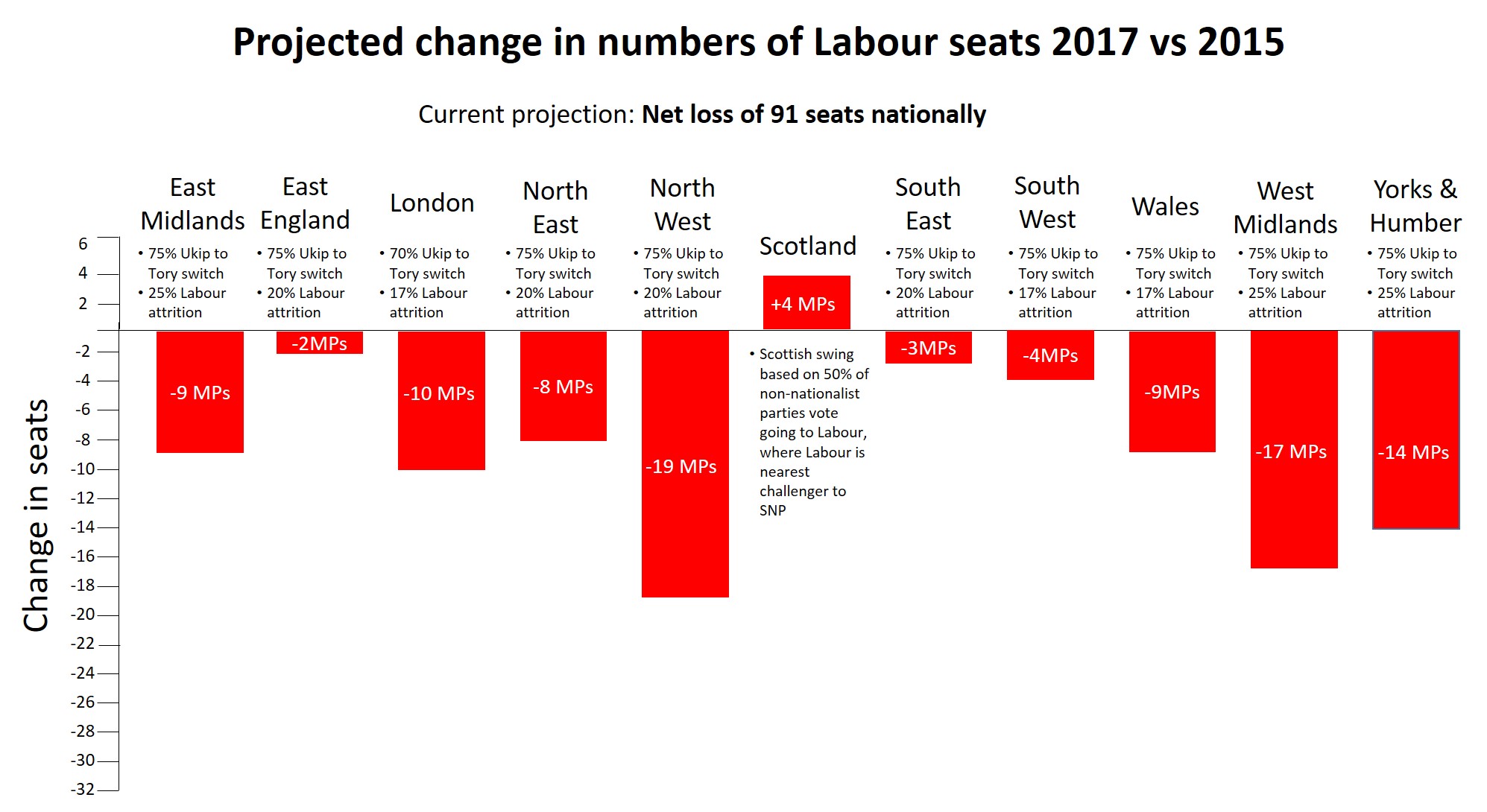
Currently Labour is set to lose just over 90 seats but a relatively small deterioration of the party’s position on the ground could see dozens more fall.

These are the findings of new analysis by Uncut based on the views of dozens of Labour candidates, party officials and activists following the past three weeks of intensive canvassing.

In this time, thousands of Labour members and supporters have knocked on tens of thousands of doors in constituencies across the country. While social media is a place where hackneyed tropes about a “great reception on the #Labourdoorstep,” are trotted out, in reality Labour’s army of canvassers has been gathering huge amounts of intelligence and feeding it back through the party’s operation.

Uncut has focused on two questions in conversations with Labour campaigners to understand the situation on the ground:

  1. What is the scale of switching from Ukip to the Tories? This issue has been highlighted widely in the media and is evident in the Tories rising poll rating and Ukip’s symmetrical slump.
  2. What is the drop-off in 2015 Labour vote? Every area is reporting the Corbyn effect on the door with Labour voters refusing to back the party, but this hasn’t been clearly captured in the public polling.

For both questions, the estimated shift has been quantified at a regional level based on feedback from campaigners and applied to the 2015 vote share for each constituency in that region. In line with feedback from across the country, the Lib Dems and Greens are assumed to be on track to repeat their 2015 performance.

The results are not pretty.

While the national polls suggest Labour’s vote is holding up, potentially even advancing on 2015, in the constituencies that matter, something very different seems to be happening.

A net loss of 91 seats would be devastating.

The two factor model on which these findings are based for England and Wales is rudimentary and mechanical (agricultural even). But then, so is what is happening to the Labour party.

The combination of Ukip voters turning to the Tories with Jeremy Corbyn’s impact on 2015 Labour voters has created a perfect storm.

Scotland is an anomaly. North of the border an entirely different election is being conducted. One where the defining issue is the union and if Labour can position itself as a vehicle for unionists, there are grounds for optimism that some small but significant gains can be achieved.

The situation is very bleak (the detailed seat by seat breakdown is below) but there is still action that Labour can take to limit the damage.

One of the salutary lessons of the 2015 election was the futile manner in which Labour diverted significant resources to seats where there was barely a glimmer of hope of victory. If the effort and organisation that went into the quixotic hope of defeating Nick Clegg in Sheffield Hallam had been directed a few miles away towards protecting Ed Balls in Morley and Outwood, he might still be an MP.

(more…)

Facebook Twitter Digg Delicious StumbleUpon