




Posts Tagged ‘Jonathan Todd’

Clegg’s pitch for the centre falling flat as exclusive Uncut poll reveals 60% of voters think Lib Dem’s headed in wrong direction

15/09/2013, 10:06:57 PM

by Jonathan Todd

There are two core dimensions to the Nick Clegg project. To make the Liberal Democrats both a party of government and of the centre. His external critics probably struggle most with the latter, seeing him as a Conservative in all but name, and his internal ones the former, uncomfortable with the compromises of power.

These loud complaints shouldn’t distract from how close he is to completing his project. The chances of another hung parliament are non-trivial. In anticipation of this, Conservatives and Labourites are keen to be on good terms with him.

How would we regard Clegg if he were to serve in government until 2020? And with which party would he prefer the second half of this period to be served?

After a decade in government, there would be voters who wouldn’t be able to remember the Liberal Democrats in opposition. To serve half of this time with the Conservatives and half with Labour would reinforce their centrist claims. Which is why, if we take these claims seriously, Clegg may favour changing governing partners in two years.

One Liberal Democrat minister has, though, recently claimed: “A Miliband government would be catastrophic.” But his party’s president, Tim Farron, is clearly keener. The ambitious Farron might feel that his own leadership ambitions are assisted by a change in coalition partner.

Labour have synchronised policies with Clegg’s party on a mansion tax, votes at 16 and a 2030 decarbonisation target for electricity, which makes it easier than otherwise for him to make this transition. But Labour should reflect on the polling that YouGov have done for Labour Uncut.

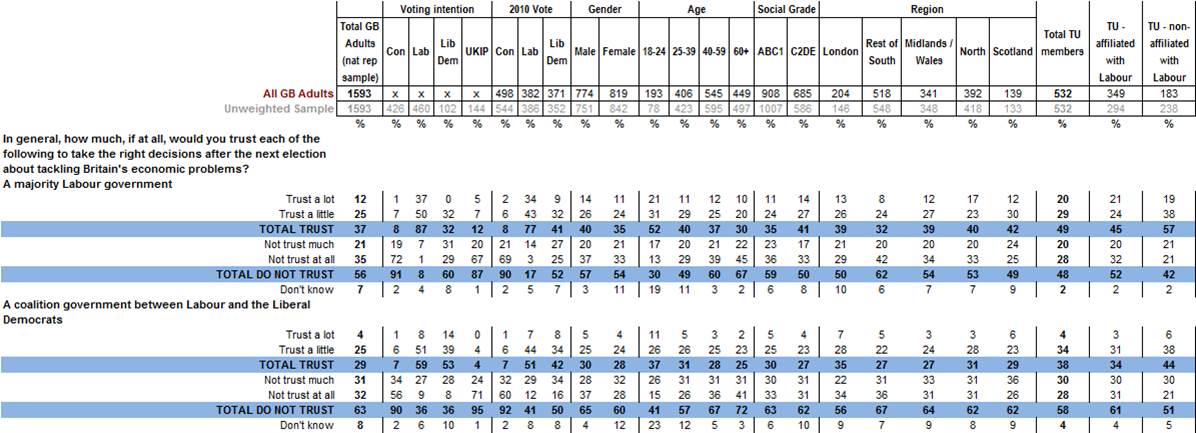
While government with the Liberal Democrats was thought to help detoxify the Tory brand, we find no evidence that government with the Liberal Democrats would strengthen the Labour brand. 37 per cent of voters would trust a majority Labour government to take the right decisions on the economy – 8 per cent more than would trust a Labour-Lib Dem one, as the polls below show.
(more…)

Facebook Twitter Digg Delicious StumbleUpon

Only Miliband can now lead Britain on Syria

30/08/2013, 12:00:35 PM

by Jonathan Todd

All changed, changed utterly. If politics is trench warfare, advancement by inch, especially now with our major parties seemingly so entrenched in their political and socio-economic citadels, with their safe seats and ideological comfort zones, then last night was a moment when the terrain dramatically shifted.

Ed Miliband led the Labour party out from behind the ghosts of Iraq. What emerges, however, is not a pacifist party. At the same time, the prime minister lost control of his most fundamental responsibility. “The people have spoken, the bastards,” he might lament.

The awful truth is that UKIP remain the party with a position closest to most of these people. Which is that we should stay completely out of a quarrel in a far-away country between people of whom we know nothing. There may be some who mistakenly think that this is Labour’s position.

The party’s position was, however, clearly set out in the 5 points that Miliband emailed to party members last night:

1.) We must let the UN weapons inspectors do their work and report to the UN Secretary Council;

2.) There must be compelling and internationally-recognised evidence that the Syrian regime was responsible for the chemical weapons attacks;

3.) The UN Security Council should debate and vote on the weapons inspectors’ findings and other evidence. This is the highest forum of the world’s most important multilateral body and we must take it seriously;

4.) There must be a clear legal basis in international law for taking military action to protect the Syrian people;

5.) Any military action must be time limited, it must have precise and achievable objectives and it must have regard for the consequences of the future impact on the region.

(more…)

Facebook Twitter Digg Delicious StumbleUpon

Ed gets it: the red line matters – but so does international legitimacy

29/08/2013, 08:34:51 AM

by Jonathan Todd

Daniel Finkelstein in the Times yesterday quoted Andrew Tabler, a Syrian expert, as saying: “What happens (in Syria) will not stay there.” Which makes it imperative that as large an international coalition as possible is built behind the evidence that the Assad regime used chemical weapons against its own people, constituting a violation of international law that must be punished.

This must not be Barack Obama “shooting an elephant” – the George Orwell analogy employed by Stephen Walt: the strong doing something only because it is expected. It must be the world coming together to protect the weak: those that have been gassed by Assad and those who may have WMD used against them by tyrants in future.

It is incontrovertible that an attack has occurred. It also seems highly likely that the Assad regime carried out this attack. Finkelstein is right that if this breach of the established red line passes without consequence, a green light is given to other evils. Iran and all world-be oppressors would note.

Enforcing that red line is vital. But so is enforcing it in the right way. Transparently drawing upon robust evidence, UN process and established precedent, to build both a watertight legal case against Assad and one that motivates wide support for the actions that follow. Failing to do this would degrade international law and weaken the capacity of the UK and our allies to positively influence the future of Syria and the wider region.

Under a scenario where the US and her supporters retaliate against Assad before UN processes have run their course, they would do so without the support of Russia, China and Middle Eastern states that might otherwise be brought on side. Whatever strikes are executed would be unlikely to remove Assad from power – and may do relatively little to undermine his capacities, while fortifying the resolve of his supporters and backers to resist The Great Satan. Hezbollah may well attack Israel. Western interests would crash under the force of the Electronic Syrian Army. Assad would launch further attacks against his own people – whether using WMD or not.

What would the US then do?

(more…)

Facebook Twitter Digg Delicious StumbleUpon

A tale of two very different Guardian interviews: Darling and Burnham

13/08/2013, 10:54:24 AM

by Jonathan Todd

Decca Aitkenhead reported this weekend on Andy Burnham telling her that Labour must shout louder or risk election defeat. Some twitter reaction suggests that this would help Labour on the doorstep. As with Chris Bryant’s Monday morning Today appearance, we might wonder, however, whether it is content more than volume that is causing Labour to fail the Daz doorstep challenge.

Almost exactly five years ago, Aitkenhead interviewed Alistair Darling. Maybe there is something about the summer heat that causes Labour politicians to unbutton themselves around her. “Now Alistair,” Aitkenhead records his political advisor imploring when they sat down for the interview, “tell her everything. Make sure you tell her everything.”

This instruction implies, unsurprisingly, prior calculation. And for all the conviction that Burnham was eager to display to Aitkenhead – for the NHS and for comprehensive schools, in particular – we should probably also assume, as is the way of serious politics, calculation on the part of Burnham. We might, therefore, wonder what the calculations of Burnham and Darling were intended to accomplish.

“No one had any idea,” Darling replied when asked whether anyone had anticipated the scale of the financial crisis that was still unfolding at the time of his interview. He warned that the economic climate of 2008 was “arguably the worst … in 60 years. And I think it’s going to be more profound and long-lasting than people thought.”

This remains the weakest economy on record and, as Mark Carney noted last week in his first press conference in charge of the Bank of England, those records go back more than one hundred years.

This speaks amply of Darling’s prescience. We might wonder whether so many would now blame Labour for the state of the economy if we’d done a better job in 2008 of getting across what Darling’s interview sought to communicate: we’re being hit by a unprecedented, global shock, which we must travel a long, hard road to recover from.

Darling was doing what Labour does at our best: being honest with the country about the scale of the challenges that confront us and providing leadership to meet them. He was, however, rewarded with “the forces of hell” from Gordon Brown’s operation next door. Presumably, they either didn’t accept that things were as bleak as Darling contended (but Carney’s assessment bears out Darling’s judgment) or reasoned that to acknowledge as much would reflect badly on Labour (but while reality can’t be denied, as Bryant discovered, it can be explained, and better in terms of the inefficiencies of global capitalism than the Labour government).

(more…)

Facebook Twitter Digg Delicious StumbleUpon

Does Labour even have an opinion on monetary policy?

08/08/2013, 09:22:41 AM

by Jonathan Todd

This is a rare thing: some thoughts from a Labour perspective on the politics of monetary policy. Maybe it derives from reverence for the last government’s decision to make the Bank of England independent. Perhaps it comes from a slowness to appreciate how the George and Mervyn show has so smoothly transitioned to the George and Mark show. In any case, we do not hear enough from Labour on monetary policy.

Ed Miliband followed Stella Creasy is stressing the importance of having females on banknotes. While the symbolism of this is significant, it is only symbolism. As Carney was being pictured with Creasy and other campaigners, in the manner, according to Dan Hodges, of “three schoolgirls who have just won a Blue Peter competition to design a new bank note”, he was putting the finishing touches to an intervention of more than symbolic consequence.

That this heralded the age of the perpetual never-never – otherwise known as forward guidance or cheap money till the other side of the election – is also predictable. It has not come from the ether. It is what Carney did in Canada. Like all the most profitable, international consultants, he’s selling the same recommendations to a new client. As a variation on the framework adopted by the Federal Reserve at the end of last year, it is also of a piece with an emerging monetary consensus.

All of which sounds very elite and removed from the shop floor. Yet what could be more shop floor than worrying about how many people are on it? The rate of employment, in other words. By targeting the unemployment rate, Carney has created something akin to “the bank for the workers”, which I argued for at a Pragmatic Radicalism event at the start of this year.

All I was really doing at this event was cribbing the Fed’s idea. But, for some reason, there was something about targeting the unemployment rate that seemed apt for our party. The clue is in the name, as someone once said.

If the Fed is targeting the unemployment rate, wouldn’t you think both that this might be something the Labour party can call for and an idea whose time has come?

(more…)

Facebook Twitter Digg Delicious StumbleUpon

Unite’s confused kulturkampf

08/07/2013, 07:53:52 PM

by Jonathan Todd

Len McCluskey began his article in the Mirror over the weekend by stating:

“If your son or daughter fancies becoming a Labour MP, forget it. They have more chance of cleaning in the Commons than being elected to it.”

Who is he addressing?

The mother who has worked in the NHS all her life and the father who served his time as an electrician? They’ve never been active in politics or known any university besides the Open University. They have no friends in high places, whether in the “posh part of Stockport” or elsewhere.

Or is McCluskey warning off Oxbridge educated, ex-ministerial advisors and Demos associates? The thing is: Those are my parents and this is my life.

Perhaps my background is working class enough to get over the Unite acceptability threshold. But having checked my privilege, I’ve damned myself by having the temerity to get as good an education as I could and make the most of the opportunities this created.

It seems to me ever harder to be sure what class you are. By most measures, I’m probably becoming more middle class as I get older. But life isn’t a bowl of strawberries. Property prices, childcare costs, pension saving. They worry me as much as the next dad to a young family. I believe there is a term for this: the squeezed middle.

I don’t feel that any superior virtue or wisdom attaches to me through membership of the squeezed middle. We all have our strengths and weaknesses, whatever our class. While class membership seems to me more perplexing than ever, all Labour members can agree with the famous Neil Kinnock line: “The real privilege of being strong is to help people who are not strong.” And caring enough about other people to want to help them is a matter of empathy, not class allegiance.

(more…)

Facebook Twitter Digg Delicious StumbleUpon

Balls is no Churchill

03/06/2013, 05:40:13 PM

by Jonathan Todd

Politics, as Churchill said, is the ability to foretell what is going to happen tomorrow, next week, next month and next year. Much of the theatre of politics exists, however, in the unanticipated events to which Macmillan attributed the failure of political plans. While, to paraphrase Lennon, politics is what happens when you are making other plans, plans are politically necessary and should be attuned to the likely and inevitable.

Political tacticians specialise in events. Political strategists identify trends and plan accordingly. The character of politicians is revealed in their handling of events but they are exposed without convincing strategy. And the strategic context that was obvious from the outset of this parliament was the politics of the deficit.

We might have thought in May 2010 that the government’s economic strategy of tough deficit reduction would fail and the public would then turn to Labour. Perhaps we thought that this strategy would fail, causing the government to adopt the Plan B that Labour called for and the public to conclude that Labour was right all along.

Few seriously thought that things would work out precisely as George Osborne forecast in his hopelessly optimistic 2010 budget. The real debate was always about whether this failure in itself would be enough to return support to Labour.

Unsurprisingly, Osborne has not said: “Ed Balls was always right”. We don’t need the spending review to know, however, that the government is failing. But polling published by Labour List contains scant evidence that this failure builds support for Labour on the economy.

As Osborne scraps around to increase the capital budget and Vince Cable cobbles together the kind of active industrial strategy that he previously denounced, agreement with Balls is implicit in their actions. Government policy inches towards Plan B but recognition that this constitutes a Plan B is politically impossible.

(more…)

Facebook Twitter Digg Delicious StumbleUpon

3 years on: We’re still at square one on the economy

30/05/2013, 12:23:58 PM

It’s 3 years since Uncut started so, in a series of pieces, we’re taking stock of  what has changed for Labour since 2010. Jonathan Todd looks at Labour’s progress, or lack thereof, on the economy.

As anticipated in my first Uncut piece, the deficit has defined the politics of this parliament. The political premium on being able to say where the money will come from has remained high, while the interest on government debt has stayed low.

George Osborne claims these low interest rates as City endorsement for his policies when really they implore him to borrow to invest. The market, it seems, is always right but only when it’s politically convenient.

While ministers struggle to offer the Treasury the cuts that the spending review demands, the political potency of the cuts narrative hardly seems diminished. This is in spite of the government failing to meet their stated objective: deficit reduction. As they reap a whirlwind of youth unemployment and stagnant growth.

Yet the economic debate stubbornly refuses to turn to Labour. The public seem trapped in a doom loop that is economically self-fulfilling and debilitates Labour, which must convince that a better economy could be achieved under prime minister Miliband.

As well as winning on bread-and-butter issues, Miliband has to address the deep structural problems that the nasty hangover from the NICE – non-inflationary continuous expansion – decade has revealed. Economic rebalancing requires rebalancing our top heavy state. The best chance for this in this parliament came and largely went with the mayoral referendums.

Having worked on Siôn Simon’s campaign, it was a big disappointment that Birmingham rejected this way forward. I’m working with Demos to try to think through new ways ahead for our cities.

These are times laden with immense challenges and without the resources that the delusions of the NICE decade conjured. Solutions urgently demand bold imagination. “One more heave” isn’t enough, as my first Uncut piece concluded.

Jonathan Todd is Labour Uncut’s economic columnist

Facebook Twitter Digg Delicious StumbleUpon

Labour must look forward, not back, to win in 2015

28/05/2013, 09:51:49 AM

by Jonathan Todd

Peter Kellner reminded us in his recent hard hitting analysis for Progress that the Tories’ central message in 1992 was that Neil Kinnock was a dangerous man who would lead Britain down the road to ruin. He also recalled that the same trick completely failed in 1997. This was because, he argued, Tony Blair had reassured voters that their jobs, homes, pay and savings would be safe with him.

The “Demon Eyes” poster just seemed daft next to the reassurance that Blair had provided. Labour’s “Demon Eyes” football team, founded in 1997, plays on, but the need for reassurance from Labour has returned. Ed Miliband is, according to the Tories, the menace that Kinnock once posed. He must convince that his sums add up on the big challenges facing the country: the economy, welfare, immigration, public services and the cost of living.

While Miliband must seek to reassure, his capacity to do so is not entirely in his control. It can be argued that the tentative economic recovery of 1992 was a harder context in which for Kinnock to provide reassurance than the more upbeat economy in which Blair campaigned in 1997.

Taking a chance on an opposition party seems less of a risk in a stronger economy. Which is why a tepid recovery by 2015 may be the best backdrop to David Cameron’s “don’t let Labour ruin it” message.

Labour’s opposing message, of course, will be “it’s time for a change”. But why? We might say that it’s time for a change because if too far, too fast cuts had not been implemented then we’d now be better off. Unfortunately, this invites the Tories to remind the country why they deemed the cuts necessary: Labour’s profligacy. And there is evidence that this argument increasingly convinces the public.

As the opposition party, Labour has to argue for change in 2015 but this should be an argument about the change that could be achieved from 2015 under Labour, not the change that might have been achieved had Labour been in office from 2010. This might seem obvious but placing an attack on the depth and speed of the government’s cuts at the centre of our economic argument has us looking back to 2010.

Labour can only win with a positive argument for how things will be better from 2015. Yet not only is our main economic argument backward looking but it is backward looking in a tonally negative way. The implicit message of much of our rhetoric is fearful: the government shrinks and the economy collapses; the immigrants arrive and society implodes.

(more…)

Facebook Twitter Digg Delicious StumbleUpon

David Cameron and Ed Miliband are both sons of Gordon Brown

06/05/2013, 09:58:01 AM

by Jonathan Todd

There is probably a significant degree of cross-party agreement that Douglas Carswell is wrong to argue that the present government is a continuation of the last. Even David Cameron’s critics in the Conservative party would claim that he is an improvement on Gordon Brown, while many Labour party members see Cameron as the worst prime minister since Margaret Thatcher or perhaps even worse.

Yet the evidence that Carswell is not entirely wrong was clearly on display during the last PMQs. Cameron and Ed Miliband, in one sense at least, jostled for the crown of heir to Brown. They did so by benchmarking their success against how much they are spending or propose to spend on particular public services.

Given the unpopularity of Brown, this is curious politics. To make a virility symbol of state spending is even worse policy. To assume that more government is necessarily moving us closer to solutions ignores even in the best of times the reality of government failure.

These are far from the best of times. There is immense pressure on public resources. And this will continue, as Patrick Diamond notes: “Actuarial estimates suggest that an ageing population will have a bigger impact on public finances than the catastrophic effects of the financial crisis.”

This context demands a politics capable of deliberating seriously about the effectiveness and efficiency of public spending and which doesn’t simply seek to win arguments with reference to how much money is being spent in certain areas. Yet the very first thing that Cameron said in response to Miliband’s questioning was: “This Government believes in our NHS and are expanding funding in our NHS.”

Ring-fencing the NHS budget is supposed to be a signal that the service is safe in Conservative hands. One consequence of these politics is that average GP salaries are preserved at £110,000, while the welfare payments of the very poorest are cut, as the DWP does not benefit from the same ring-fence as the NHS.

(more…)

Facebook Twitter Digg Delicious StumbleUpon