




Posts Tagged ‘Nick Clegg’

Why on earth are we even talking about Lords reform?

26/04/2012, 07:45:35 AM

by Peter Watt

I have been building up to write this for days now.  Because I have been getting angrier and angrier the more I thought about it – House of Lords reform.

What is it that politicians don’t understand here?  Voters hardly hold their political masters in the highest regard.  Not to put too fine a point on it, they don’t like politicians and certainly do not value them.  It may or may not be unfair but they think that politicians are self-serving and live in their own rarefied world.

What voters certainly do not see is a political system that provides a solution to the problems that they experience in their day-to-day lives.  In fact many voters are angry and probably blame politicians for many of the world’s ills.  To be fair, from the voters point of view there is much to feel angry about.  The expenses scandal; an economic crisis that the political class seems immune from; tax cuts for their mates, tax rises for everyone else and ever increasing prices.

And the response of our politicians?  That we need even more politicians!

Apparently we need to expend huge amounts of political energy and effort passing legislation that will create 450 new professional politicians.  Presumably all of whom will need paying, will need staff, offices and expenses.  Who will need to be elected and who will all need to spend their time justifying their existence.

(more…)

Facebook Twitter Digg Delicious StumbleUpon

Let knowledge, not politics, rule the Lords

25/04/2012, 01:30:53 PM

by Jonathan Roberts

For a hundred years discussion of the reform of the House of Lords has provided intrigue, gossip and occasional melodrama.  The outrage at new proposals coming from the government backbenches rightly highlights how ‘out of touch’ this diversion from more pressing matters is (like, you know, the economy), but the depth of feeling some Parliamentarians have gives an indication as to why meaningful reform has never happened.

The most significant improvement in modern times came early in the Labour Government with the removal of the vast majority of hereditary peers.  Even this change, which was so obviously appropriate, caused Tony Blair a huge headache.  To impose genuinely radical reform will result in something closer to a debilitating migraine.

It is easy to forget that the current make up of the House of Lords was specifically argued against in the Parliament Act itself – where it is described that the current regime should be only a temporary measure until peer elections were fought.  Bearing in mind that income tax, introduced by William Pitt the Younger, was supposed to be a temporary measure, one could be left with the impression that there is nothing more permanent in government than a system originally labelled as ‘temporary’.

But the parties should not race towards House of Lords elections.  The UK is not suffering from an absence of democracy – quite the opposite, with parish, district and county elections every four years, European and parliamentary every five.  Soon we will be adding mayoral and police elections to the mix and I have a sneaking suspicion American-style school boards won’t be far behind.  This voting business is really rather regular – and with turnouts being as dire as they are, one has to question whether the public really is crying out for yet another dreary Thursday morning trip to the village hall.

(more…)

Facebook Twitter Digg Delicious StumbleUpon

What on earth is going on with politics at the moment?

19/04/2012, 07:00:53 AM

by Peter Watt

Does anyone know what is going on out there?  Really?  Until a month ago it was all so much simpler.

The Tories didn’t really have a coherent tale to tell but then nor did anyone else so it didn’t really matter all that much.  They bumbled along making mistakes and generally looking incompetent.  But crucially voters had been persuaded that they were dealing with an out of control deficit that Labour had caused.

And that was the end of the discussion.

Anyway, they had David Cameron and he looked and sounded prime ministerial, made tough decisions and even diplomatically bashed the Germans and French.  No matter how bad it got, he was their trump card.  And Labour, not to put too fine a point on it, had its own problems:  perceptions of economic incompetence and a leader who was still finding his feet as far as voters were concerned.

But then came the budget and suddenly the Tories and David Cameron are wobbling.

All that bravado and self-confidence appear shaken to its core.  Instead of charting a route to sunnier times the budget looked elitist, favouring the rich.  And worse it looked muddled as its measures unravelled and established more and more losers.

Ed Miliband gave one of his finest performances in the Commons after Osborne’s budget speech.  The discomfort on the faces of David and George was there for all to see, and on the benches behind them you could see doubt.

Over 4 weeks later the budget is still the issue of the moment, and at issue is the Government’s credibility.  George Osborne appears to have disappeared and no one on the Government side seems overly keen to defend the finance bill.  Certainly not David Cameron; he seems intent on avoiding answering any of Ed Miliband’s questions at successive PMQ’s.

Ed’s victories at the despatch box have rattled Cameron.  And the more rattled David Cameron gets the less prime ministerial he looks and sounds.  His attacks become more and more sneering, dismissive and personal and his lack of attention to detail becomes ever more obvious.  It’s not attractive.

(more…)

Facebook Twitter Digg Delicious StumbleUpon

The Lib Dems’ amazing adventure

09/04/2012, 07:00:05 AM

by Ben Mitchell

Once upon a time there was a political party who believed in something. Who stood for something. Who held views other parties rejected. Who campaigned on issues that weren’t always universally popular.

They then had a leader who grew and grew in stature. Who charmed and won over the electorate in a series of pre-general election televised debates.

But, unfortunately, for said party, this never translated into votes on polling day. Blame our antiquated voting system they raged. We sympathised.

But then, when all seemed lost, along came a smart and convincing salesman offering them the chance of a lifetime. This jolly, chirpy, chappy, waved the prospect of power-sharing under their disillusioned noses.

What’s more, this guy looked and sounded very much like our guy, thought the party faithful.

They hit it off instantly. The public were taken aback: two sworn enemies jumping into bed with each other; governing together? But, their politics are so different. How will they ever get anything done, asked a sceptical media?

Won’t they bicker and argue constantly?

But, they didn’t. In fact, they seemed to quite like each other. A lot. That other bunch aren’t so bad after all, they thought to themselves. We’ve been unfair to them all these years.

Anyway, the party thought, we’ve still got our beliefs and our principles. We’ll never sacrifice them.

(more…)

Facebook Twitter Digg Delicious StumbleUpon

Two years, two David Camerons

04/04/2012, 03:22:51 PM

by David Talbot

Another day, another big society re-launch. The surest sign that this government is in trouble is when they wheel out the big society for another spin round the news cycle.

It was all so different just three weeks ago. Then, a confident Cameron stood next to President Obama in the rose garden at the White House. Under the Washington sun the two leaders peppered each other with lavish praise. It harked back to the mood and setting of where this government began.

Almost two years before, Cameron strode out with the Liberal Democrat leader Nick Clegg, basking in the warmth of the Downing Street rose garden. The easy rapport between the two men was as self-evident as it was the government’ initial strength.

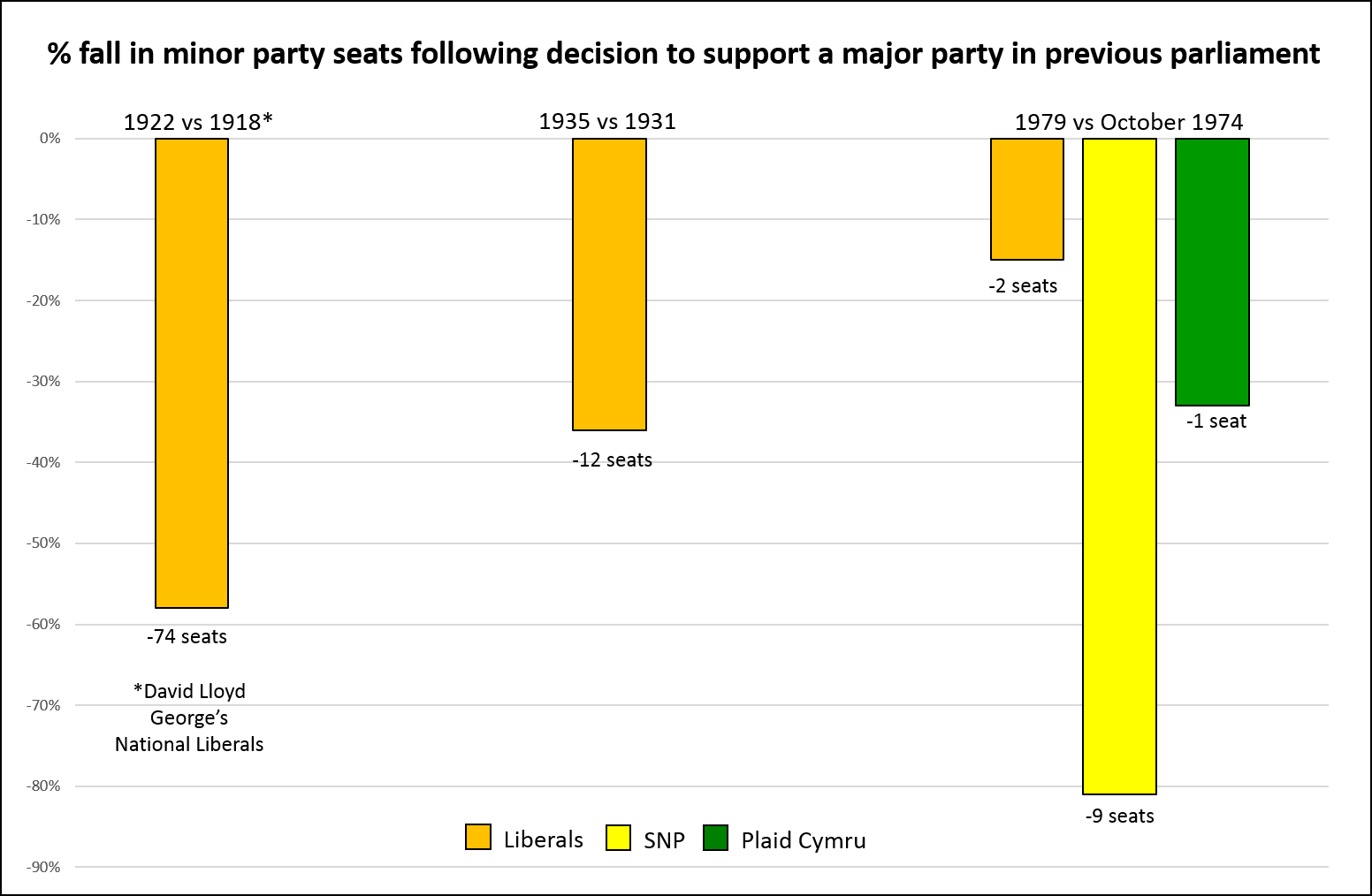
Though their first press conference has long-since passed into Westminster legend, the political significance is not to be underestimated; Cameron had risked his career – Clegg his party.

The 12th of May will see that modest milestone pass, two years to the day that Clegg and Cameron announced the creation of Britain’s first peacetime coalition since the 1930s. Cameron, against a visibly decaying Labour party, had failed to deliver an outright Conservative majority. At his weakest he had made a “big, open and comprehensive offer” to secure a parliamentary majority, and his position as Conservative leader.

He produced a masterful political coup, not so much a coalition as a political chokehold on the Liberal Democrats. He needed them badly, but never showed it. Without them he might have stumbled on for a few months, and then risked the uncertainty of another election.

Those few days must seem like a life time ago given the past two weeks. The Budget, the funding scandal and the manufactured fuel crisis have risked destroying years of work under project Cameron.

(more…)

Facebook Twitter Digg Delicious StumbleUpon

Labour needs to wake up to the threat of Nick and Dave’s very civil partnership

14/03/2012, 12:00:50 PM

by Kevin Meagher

“If it ain’t broke, don’t fix it” remarked Bert Lance, the former Carter-era official. His homespun phrase, much emulated since he coined it in 1977, is intended to ward off the siren demand for change for change’s sake.

That very same advice now rings in the ears of Liberal Democrat ministers as they ponder what state their party will be in at the next general election. Don’t change what doesn’t need to be changed.

Frankly, as most Lib Dems must realise, it would be easier to sell the Sun in Liverpool than hold many of their marginal seats. How can their ministers hope to stay in the style to which they are undoubtedly now accustomed riding a dying horse into the 2015 election?

Let’s fast forward three years. David Cameron will surely – and reasonably – hope to win a big working majority at the next election; this is his obvious Plan A. But continuing with the coalition will be his close-run Plan B. His worst of all worlds would be to win with a small Tory majority. The last thing he wants is to be reliant on his party’s backbenches or, even worse, his rank and file, as John Major was following his general election victory twenty years ago.

For the Lib Dems – trailing in single digits in most polls – their very salvation lies in preserving the status quo. Their worst of all worlds is to see a return to binary politics with Labour and the Tories carving up British politics once again. That appears a distinct possibility with the Lib Dems now seriously looking over their shoulder as UKIP threatens to usurp them for the third party slot.

They should seek payback for holding their collective noses and backing Cameron over issues like tuition fees, austerity and NHS reform in the shape of a semi-formal electoral pact. Their candidates go into the next election with their nominal Tory opponents defending a joint record, so why not a joint ticket as well?

(more…)

Facebook Twitter Digg Delicious StumbleUpon

Welcome to the 2010s: the era of reactive, populist, say-anything politics

22/02/2012, 12:00:59 PM

by Rob Marchant

What has David Cameron done so far, which has marked him out as a prime minister? The answer is, surprisingly little, as John Rentoul observes in the Independent on Sunday: “…the Prime Minister seems unformed. He is adroit at reacting to events, but not so good at making them happen.”

But that does not mean he is unpopular (despite lots of potential reasons for this to be so), or that he will lose the next general election. It is just an example of an era, post-2010, which has seemingly been defined by a lack of seriousness of purpose on the part of the major parties.

Cameron has scored a few political successes. He has done what few would have predicted: he has put together, and held together, a coalition that has lasted nearly two years and will quite likely last five.

He has been successful, thus far, in winning public support for his eminently populist handbagging of his EU partners, although only time will tell whether he was wise to do so. He is generally felt to have had a “good war” in Libya.

But as regards defining a domestic policy direction for his government, he has relatively little to show: an austerity program, showing strength but courting unpopularity; and education reforms which are competent and probably modestly positive with the public, although mostly despised by Labour. The rest is largely either a blur, with no significant impact made, or a mess.

Now compare and contrast with his coalition partner. Clegg made a textbook populist pitch before the election, “an end to politics as usual”, before demonstrating eighteen days later, via the person of David Laws, that he represented just the opposite.

Being a junior coalition partner encourages populism, because of one’s limited impact on events and the inevitable going along with large numbers of things which you do not like. There’s not much else you can do: hence the rubbish about “alarm clock Britain”, Clegg’s desperate and probably doomed scrabbling around for a distinct identity for his party.

And lastly ­- in the order in which the media currently treat the three parties – we come to Labour. Miliband at times seems populist, but it is not in the sense that most people would recognise. And this is because his populism is mostly directed inwards, at his own party, and what they want to hear.

(more…)

Facebook Twitter Digg Delicious StumbleUpon

The polling that explains why Andrew Lansley is safe

13/02/2012, 07:00:36 AM

by Atul Hatwal

Dead man walking. That is one of the more polite descriptions of Andrew Lansley’s current state of political health.

His bill is an unmitigated disaster. This mish mash of compromises and quangos is trapped in the quicksand of parliamentary process, generating ever worse headlines for Lansley and the government.

Yesterday he suffered perhaps the greatest indignity to date: Simon Hughes ventilating on the right time to shift the health secretary.

Setting aside the nonsense at the heart of what the Liberal Democrat party president was saying – that Lansley should be moved only after the damage has been done when a bill that Hughes himself describes as not the one “we wanted”, has been passed – even hard Labour hearts will have felt a little sympathy for Andrew Lansley having his career dissected by Hughes at his most sanctimonious.

So the conventional wisdom is clear. Lansley is finished.

In one sense, this is right. The secretary of state for health will be moved, but then in the long run so will most of the cabinet. Where many commentators will be wrong is on timing.

For all the pressure, Andrew Lansley is still safe in his job. Yesterday’s Sunday Times YouGov poll held the key to why.

(more…)

Facebook Twitter Digg Delicious StumbleUpon

This Fox has been ripped to pieces, but his colleagues elude the hounds

21/10/2011, 02:47:55 PM

by Kevin Meagher

The blood lust of our “feral” media, combined with the unmistakeable whiff of a politician in distress, always ends the same way. But despite Liam Fox’s exit this remains quite simply, the luckiest government in living memory.

There have been no shortage of political scandals and pratfalls over the past 17 months that could have seen any number of Dr. Fox’s colleagues beat him to the ignominious honour of being the first cabinet minister kicked to Whitehall’s curb.

But Tory and Lib Dem ministers seem to be blessed with nine lives. Perhaps rabbits’ feet are handed out to ministers with their red boxes?

Take Andrew Lansley. Surely it is only a matter of time before a piano drops on his head? He has made a complete hash of the health bill, finding himself in the curious position of pleasing absolutely no-one with his proposals, yet he remains in situ.

And then there’s Michael Gove. Although he is a true Cameroon, of which great things were not unreasonably expected, his career has never quite been the same since he was pranged early on by Ed Balls, colliding into him over the scrapping of the building schools for the future programme. He wobbled, but has recovered, of sorts, only to now find himself caught up in revelations that he and his advisers operated a secretive email network, by-passing his department’s official channels. If compelled to publish the messages under freedom of information obligations, he may find he has strayed down a Fox-hole in terms of ministerial propriety.

Before Liam Fox, the previous holder of the dubious title “cabinet-minister-most-likely–to-resign” had long been held by energy secretary Chris Huhne. He has spent the past few months on the precipice of a resignation, as the excruciating half-life of his messy divorce sees both him and his ex-wife embroiled in an unseemly “he said, she said” squabble over one or the other’s penalty points for speeding. Although a fairly mediocre crime, in the grand scheme of things, it has acquired epic proportions given the energy secretary’s career is essentially being strafed by friendly fire.

Yet he clings on. Your average rhino resembles an Oil of Olay model in the skin suppleness stakes when measured alongside Huhne. His leader, however, is forced to develop a thick hide on the job. Nick Clegg has spent most of his 17 month tenure as deputy prime minister as a pariah. He is the unhappiest looking bloke in British politics, and with good reason; he is the most hated. He has scuppered the very essence of the Lib Dems’ brand by doing the coalition’s dirty work, and now his own constituency is set to be eviscerated in a pointless parliamentary boundary review he only signed up to in order the secure the doomed referendum on AV; yet he hangs on too.

But these are just the top-drawer near-death experiences of the coalition. There are another set of ministers who have had a close shave through good old-fashioned political bumbling. Take Ken Clarke’s howler of a radio interview about rape sentencing, coming on top of his faltering handling of his brief, which has seen Tory backbenchers turn puce at what they see is the forfeiting of their credibility on law and order due to Clarke’s leniency on sending criminals to jail.

Or Vince Cable’s silly self-aggrandising, bragging that he could bring down the government if he chose to by deploying his “nuclear option“ as he sought to impress a couple of fetching young female undercover reporters from the Daily Telegraph. Dufferish, old bloke failings, but indicative of senior politicians who have difficulty keeping their political antennae erect.

The last category is the weird and wonderful. Think of William Hague’s hotel arrangements. Or Oliver Letwin’s curious al fresco filing system. Or Caroline Spelman not being able to see the wood for the trees in relation to the flogging-off of national forestry management.

Any one or all of these ministers could have plausibly walked the plank during the course of the last year for either political or personal difficulties. Paradoxically, Liam Fox looked likely to become a cabinet mainstay. Meanwhile, the scalp to end all scalps, remains tantalisingly out of reach. For now.

The jet-black pelt of the chancellor is worth a dozen Fox skins. Osborne’s eventual embrace of a plan B for the economy warrants his resignation. The change of direction that will eventually come – and which Osborne puts off for the narrowest political considerations – should make his position utterly untenable.

Liam Fox will doubtless feel rather lonely as the first occupier of the cabinet’s sin bin. But he should content himself. He won’t be the last.

Kevin Meagher is associate editor of Labour Uncut.

Facebook Twitter Digg Delicious StumbleUpon

The undead Nick Clegg starts to stir…

23/09/2011, 12:00:41 PM

by Dan Hodges

Ed Miliband has a nightmare. Forget the sleep apnoea;  this is what really keeps him awake at night.

He is walking along the corridor of a dark, abandoned castle. He turns a corner into an imposing room. Like the rest of the castle, the room has been ransacked by  angry villagers determined to wreak revenge for the evil that once dwelt amongst them. All that is left is a large black table. Upon the table sits a coffin, lid open.

Ed inches closer, torch flickering. He peers in. Inside there is a pale figure, eyes closed, dressed in a dark morning suit. It wears a gold tie.

Ed is initially gripped by fear. But as the moments pass the fear recedes; replaced by a strange feeling of empathy. Then sympathy.

Poor Nick Clegg. What he did was wrong. So very, very wrong. But he has paid the price. The price exacted from all politicians when their public turns upon them. Now, at last, he has found peace…

“Hello, Ed. I’ve been waiting for you”.

Dear God, he’s alive! He’s sitting up! He’s…

“You’ll find it’s not so bad in there. You have time to stop and think. To come to understand where it all went wrong”.

Ed turns, tries to run. But his feet are like clay. Clegg is out of the coffin now advancing towards him, cape spread wide. He can see razor-sharp teeth glinting in the moonlight; a cold, piercing stare reaching out from dark, empty eyes.

And somewhere in the distance he hears a laugh. A cruel laugh. He knows that laugh. It is David Cameron’s. Then there is silence.

(more…)

Facebook Twitter Digg Delicious StumbleUpon