




Archive for 2012

Sunday review on Tuesday: Pragmatic Radicalism’s defence “top of the policies”

27/03/2012, 05:48:12 PM

by Amanda Ramsay

Affecting party policy should be more about ideas and innovation than shabby promises to open-up the Downing street policy unit for £250,000. This is what Pragmatic Radicalism offers Labour members and last night it hosted the first event of Labour’s defence policy review with Labour Friends of the Forces.

Chairing was shadow secretary of state for defence, Jim Murphy MP, with speakers having just two minutes to present ideas as complex as the reform of NATO and UN Security Council to the complete overhaul of the territorial army. Two minutes of questions from the floor for each person was then followed by a vote at the end.

Security and resilience issues in a globalised and highly networked world were tackled by the winner, Dan Fox, UCL honorary research associate at the Institute for Security & Resilience Studies, with “cyber reserves: strength through expertise.”

Fox, a serving JNCO in the Territorial Army, outlined the need to have a dedicated cyber Reserve supported by cyber apprenticeships, co-ordinated by the ministry of defence and with greater collaboration between FE colleges and ICT practitioners. Fox presented the common sense but intriguing notion of “white hatting” hackers, to turn their expertise and skills to do good.

Speaking to Labour Uncut last night, Fox said: “No party has a monopoly on caring about and promoting the best policies for our armed forces. Pragmatic Radicalism’s defence ‘top of the policies’ evening showed that we in Labour have the ideas, experience and commitment to ensure our national security, and support our servicemen and women.”

(more…)

Facebook Twitter Digg Delicious StumbleUpon

The false debate over the public funding of politics

27/03/2012, 09:00:15 AM

by Atul Hatwal

Here’s a question: who is Labour’s biggest donor under Ed Miliband?

Is it Unite? Unison? Maybe the GMB?

Answer: none of the above.

An Uncut analysis of donations to the Labour party since Ed Miliband became leader reveals that the biggest single donor is the House of Commons, giving £9.6m. This so called “short money” is a stipend paid to the opposition to balance the advantage a government gains from the enormous resources of the civil service.

Roll in the funding the opposition receives from the House of Lords, the Scottish Parliament and grants from the Electoral Commission for policy development and Labour has banked almost £11.3m from public funding sources since October 2010. That’s more than the combined donations to the central party (as opposed to individual constituency parties) from the all of the unions.

This isn’t a recent a development either. A decade ago, when the Tories were at their nadir, what was their biggest source of funding? Was it Lord Ashcroft? Or a.n.other city gent, eager to run down his bank balance?

Of course not. In 2002 the total donations from individuals to the Tories came to £2.3m. In comparison the amount the Tories drew from public funds was nearly double at £4m.

These figures expose one of the myths in the political debate on funding – that the public will not accept state funding of politics.

Newsflash: they already have.

(more…)

Facebook Twitter Digg Delicious StumbleUpon

Where have the working class MPs gone?

26/03/2012, 02:26:11 PM

by Hazel Blears

The 2010 General Election was notable for ending – at least temporarily – the era of one-party dominant governments in the UK, and ushering in a coalition. Less notable, but much more worrying, was the continued demise of that all too rare representative: the working class MP.

In 1983, a staggering 51% of MPs had been educated at private school. This began to gradually fall, dropping to a low of 30% in 1997. However since then the figure has begun to rise again, and the 2010 election saw constituencies return an intake of MPs of which 35% have been privately educated. By comparison, only 7% of the school age population are in private schools; politicians are drawn from a narrow social class.

Of the 2010 intake 91% of MPs have attended university. So cliquey is politics that just under 30% of our MPs come from two universities, Oxford and Cambridge. Just 13 schools produce a tenth of MPs. Politics is clearly becoming a graduate profession.

Whilst some MPs from working class backgrounds have made it to the top of politics – the likes of Alan Johnson and David Davis – the reality is that the social composition of our representatives is not representative of our country.

Good governance requires a range of views for effective policy making. If politicians are approaching issues from the same point of view and life experiences, they are likely to create group-think, and their narrow social experiences will be reflected in policy making. A case in point – would the current cabinet have been so quick to withdraw tax credits for working families if any of them had ever had to rely on them? Even the Labour party – the most diverse of all three main political parties – is hardly in a position to lecture about diversity.

(more…)

Facebook Twitter Digg Delicious StumbleUpon

The Kelly proposals: eminently sensible and workable

26/03/2012, 02:08:13 PM

This post by Peter Watt was originally published on 24th November 2011. David Cameron could have done with reading it back then, might have saved himself a spot of bother. But at Uncut we believe in giving people second chances, so here it is again.

The reaction to the report “political party funding – ending the big donor culture“, by the committee on standards in public life, chaired by Sir Christopher Kelly, has been depressing if not surprising.

I feel strongly about this issue. I was caught up in “cash for honours”. I had to instigate swingeing budget cuts and redundancies to avoid bankruptcy at the Labour party. I was part of Labour’s negotiating team in the failed Haydn Philips inter-party talks on party funding in 2006 and I was embroiled in a pretty major funding scandal that lead to my resignation as general secretary and another police investigation. I also gave evidence to the Kelly enquiry.

So let’s start with some cold hard facts.

  1. Politics is expensive. Staff that run campaigns, develop policy and arrange conferences, plan strategy, engage the public and design materials, websites and videos cost money. And there’s everything a reasonable sized organisations needs:  advertising, membership systems, property, cars, travel, hotels, publications, professional services like accountants and lawyers, furniture, computers, software licenses, insurance and stationery. This does not come cheap and it all needs to be paid for.
  2. Politicians are generally shallow and fear failure. This means that they don’t care all that much about where the money comes from to pay for those things that they think that they need to maximise their chances of winning. They will dress it up as wanting to win to do good things, and there is obviously some truth in that. But fundamentally they want the glory; and they need funds to achieve it.
  3. Politicians do not get involved in fundraising. They, rightly, fear being tainted by the “dirty” business of fundraising. So while they demand that the funds are there when they need them, they generally don’t lift a finger to raise it unless absolutely forced. The result is that those charged with raising funds are put under enormous pressure and are given very little support to raise the necessary cash.
    (more…)
Facebook Twitter Digg Delicious StumbleUpon

The Lib Dems and their dissociative disorder

26/03/2012, 07:30:10 AM

by Kevin Meagher

Making a diagnosis for multiple personality disorder (MPD) requires the presence of two or more distinct identities which recurrently take control of a person’s behaviour.

Two competing, contradictory personalities vying for supremacy? Now I am no psychiatrist, but if organisations could develop the condition, then the Liberal Democrats are surely a classic case?

Take Simon Hughes. He is the personality who dominates the airwaves when the Lib Dems have done something bad. Every time they sell their soul to the Conservatives up pops Simon, combining earnestness and convoluted circumlocutions to explain away why they have not done what the dogs in the street can see they have done.

He is like a bank robber pleading in mitigation that the gang were only interested in notes and at least had the decency to leave the loose change alone. They may have waved the sawn-off shotgun in the bank teller’s face, but they didn’t actually pull the trigger. He is a splitter of hairs so fine that it would require the Hubble telescope to be trained on his logic in order to make out the nuances.

He was out there on Wednesday and Thursday, distancing himself from the decision to scrap the 50p top tax rate – the signature proposal in the budget – and one to which the entire cabinet is actively signed-up. “The chancellor took a view that he wanted to do things that mattered a lot to Conservatives” the deputy leader of the Lib Dems told Radio Five Live. “What mattered to us [the Lib Dems] was not that at all.”

(more…)

Facebook Twitter Digg Delicious StumbleUpon

George Osborne’s ugly society

25/03/2012, 08:30:04 AM

by Helen Godwin Tiege

The news is full of the budget, and it seems George Osborne is getting himself into a pickle after breaking the “don’t mess the with pensioners” rule. Even the Daily Mail has turned on the Tories, along with almost every other newspaper.

We have also heard how great this budget is for business, with the scrapping of the 50p tax rate and further reduction in corporation tax. The CEO of Glaxo, Sir Andrew Whitty, was quite happy for the chancellor to claim their announcement today, that they will create over 1000 new roles, was a result of new measures announced in the budget, as well as the Labour-led changes to patenting laws.

We heard from several “business-leaders” who felt that the scrapping of the 50p rate would mean that Britain was once again “open for business”. And this is all great news, only a twisted cynic would want to see the economy fail or go into stagnation after what has been a troubling and difficult 4 years. If these measure really will bring investment and job creation to Britain then I would not want to oppose them.

However, I cannot see how such changes which ultimately benefit individuals can be introduced at a time when there is still rising unemployment, a very real threat of a “lost generation” and millions of people around the country about to face their darkest times as a result of local authority cuts that come into effect from April.

(more…)

Facebook Twitter Digg Delicious StumbleUpon

Whips Notebook: Postcard from Bradford West

23/03/2012, 03:15:10 PM

by Jon Ashworth

I love by elections and always have done so since I first campaigned as a scruffy teenager with a hair-do like Noel Gallagher in Littleborough and Saddleworth.

Those were heady summer days indeed as us young insurgents fought like tigers for every Labour vote. The drill was soon to become familiar in by election after by election. We slept on floors at night and knocked on doors all day. A merry band of brothers and sisters from which enduring friendships formed and last to this day – Tom Watson, Michael Dugher, Gloria De Piero to name just a few of the future stars I would first meet on the by election campaign trail in towns like Littleborough.

Sadly in Littleborough and Saddleworth it wasn’t enough with the Lib Dems managing to just nick it. But the Tories were obliterated and we knew that our unsuccessful candidate Phil Woolas would easily take the redrawn seat whenever the general election came. 15 years later I would be trudging through many of the same streets in thick snow to help Debbie Abrahams secure victory in the successor Oldham East and Saddleworth seat.

Not downhearted with defeat, in fact the very opposite, we moved on to Wirral South. A ‘safe’ Tory seat that easily tumbled to us with local businessman Ben Chapman, whose election posters proudly boasted “Ben Chapman means business”, becoming Wirral South’s first Labour MP. Ben retired at the 2010 election but Wirral South is still held by us today by the ever impressive Alison McGovern.

Looking back it feels like all I did was work on by elections in those early years of the Labour government.

(more…)

Facebook Twitter Digg Delicious StumbleUpon

Ken Livingstone’s crumbling Labour flank

23/03/2012, 08:52:50 AM

by Atul Hatwal

Earlier this week YouGov released their latest London mayoral poll. While Boris Johnson’s 49%-41% lead on first preferences was widely reported, some of the most striking results were lost in the news vortex of the budget.

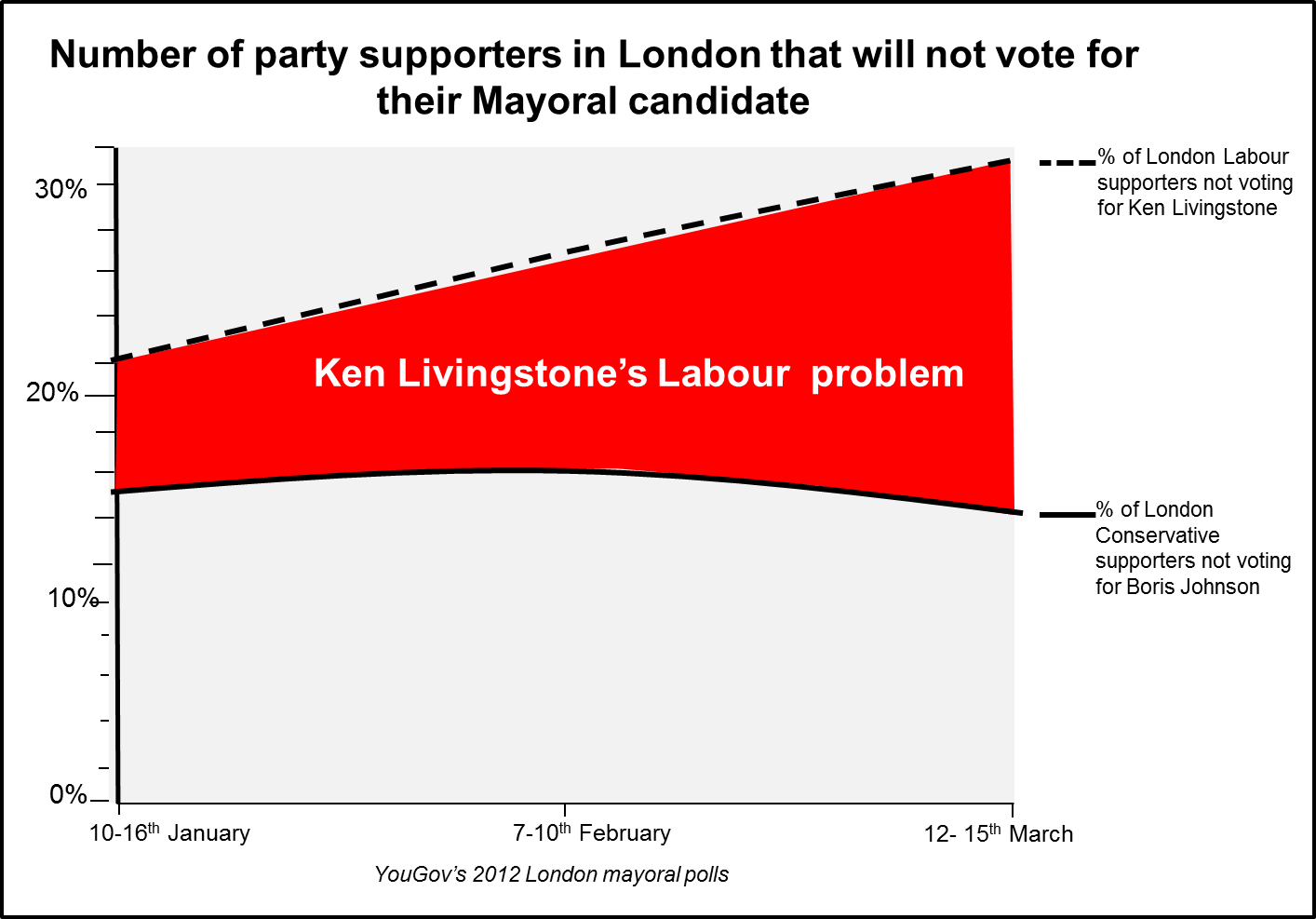
Chief among these is the scale of Ken Livingstone’s problem with Labour supporters: 31% say they will not vote for him in the mayoral election.

Just weeks before the election, almost 1 in 3 Labour supporters are refusing to back the party’s candidate for mayor.

In comparison, Boris Johnson’s core support is firmer. 86% of Conservative backers say they will vote for him with 14% either supporting other candidates or undecided.

The impact of this differential in party supporters’ commitment to their candidate is critical for the mayoral race: it translates into an 8% boost in Boris Johnson’s overall total.

And 8% is, coincidentally, the size of Johnson’s latest lead over Livingstone.

The bad news for Labour is that this problem has been building all year. The graph below shows how Ken Livingstone has progressively bled support from Labour backers while Johnson has consolidated his vote amongst Conservatives.

(more…)

Facebook Twitter Digg Delicious StumbleUpon

Sunday Review on Thursday: Progress Political Weekend 2012

22/03/2012, 01:22:41 PM

by Jonathan Todd

Peter Mandelson was there but, pace Michael Meacher, the Progress Political Weekend 2012 was not a meeting of the Bilderberg group. For one thing, I imagine, the Bilderberg Group comes to conclusions.

This was not the only difference. There was no secret agenda. It was advertised online. This was less an elite stitch-up and more the imbibing, both of learning and alcohol, by bright young things.

The discussion was perceptive, but the themes covered were not unexpected: fiscal credibility, public service reform, southern discomfort. So much was everyone on pretty much the same page that Douglas Alexander arrived, having followed earlier proceedings on twitter, worried that Liam Byrne had already delivered his speech.

I’m not sure what Meacher would expect but I got what I anticipated, which was some education (Phil Collins’ session on speech writing was particularly illuminating) and some reflection on the hard questions that face Labour.

But I’m not sure how far we got with answers.

At the same conference a year ago Douglas Alexander and Jim Murphy in separate sessions said that Labour needs “a draw on the deficit, a win on growth”. How is that working out?

This year Patrick Diamond warned against Labour being hawkish in principle and dovish in practice on the deficit. Talking tough on the deficit but not providing support for cuts to match this tough talk.

But Meacher can be assured that no plans were hatched to carve up the state in the country house, now owned by the NUT, just a taxi ride away from the grocers in which Margaret Thatcher grew up.

Not one suggestion for a cut was proffered, as far as I recall, though, sadly, I needed to be in London on Sunday, so missed the second day of the conference and perhaps some proposals for cuts.

(more…)

Facebook Twitter Digg Delicious StumbleUpon

The real impact of the budget on the public

22/03/2012, 07:00:14 AM

by Peter Watt

The thing about big political events is that they generally aren’t big events in the same way that, say big sporting events or a royal wedding are.  The latter are things that most people are aware of and that get people talking.  Big political events generally do neither.  But they certainly feel like really big events if you are a political junkie or you are working inside the political world.

I can remember when Labour Party HQ used to buy all of the staff ice-creams on budget day; it was a bit of a tradition.  In the weeks building up to the day itself there would be mounting excitement.  Briefings were prepared and printers were primed to start printing materials within minutes of the end of the budget so that local campaigners were ready for their weekends work. Because the point was that budgets were big, game-changing, or game re-enforcing events.

Except looking back, they generally weren’t, and very little actually changed.  The polls might blip but they soon blipped back to where they were before.

And I was reminded of this yesterday; because I, along with every other political obsessive, had enjoyed this last week.  The NHS Bill skirmishes and the budget briefing.  Both had left us all with plenty to read, discuss and tweet about.

(more…)

Facebook Twitter Digg Delicious StumbleUpon