




The Euros are the elections that don’t matter. Except they do.

14/05/2014, 08:50:50 AM

by Rob Marchant

It’s complicated. Next week’s election will not change very much in itself. We will send members of our favourite parties off to Brussels again in greater or lesser numbers to vote on things that, we tell pollsters on a regular basis, we care little about. Everyone’s eyes will be on the greater prize of a general election, less than twelve months away.

And you can forget the polling around this election; it means very little. Rarely has there been an election with so much of the electorate avowedly committed to protest voting, often for parties they don’t even really like.

A friend of mine, traditionally to the left of me, is voting UKIP. Why? Not because he likes them. Because he’s fed up with both right and left. “Because there’s a chance, just a chance”, he says, “that something might change”.

Now, I believe him to be wrong. But his vote forms part of an anti-establishment effect, which transcends right and left and which has blossomed in recent troubled times right across the developed world. It is not just UKIP, but Respect. It is the People’s Assembly, UK Uncut and other anti-austerity groups. The Occupy crowd. The other nationalists and secessionists. The Spanish “Indignados”. The Tea Party. The list is long.

The principal common trait of all these groups is being against the political establishment and, with the possible exception of the nationalists, if ever confronted with the tedious demands of actually having to do something in office, most would surely run in horror in the opposite direction.

So, forget the Euro-election polling and results. They tell us nothing. Things will blip up for UKIP and punish the main parties, and then in all probability blip back down by the end of the year, well in time for a distinctly lukewarm performance at the general election.

(more…)

Facebook Twitter Digg Delicious StumbleUpon

As Labour’s poll ratings dive, finally, the scales begin to fall from the Milibelievers’ eyes

13/05/2014, 07:00:30 AM

by Atul Hatwal

The biggest surprise is the surprise. Shock and consternation were in plentiful evidence across Labour’s twitter base yesterday at the news that the party was lagging the Tories in two polls.

But this was not some bolt from the blue.

Over the past months Labour’s lead has been slipping steadily. Yesterday was the first polling evidence of the logical denouement of a long established trend. Labour will almost certainly bob back into the lead in future polls, but with every passing month, the party’s electoral waterline will dip ever lower.

Some will point to the shambolic European election campaign as a cause of the drop in ratings. But, poor as the campaign has been, its impact has surely just been to accelerate the inevitable.

The problems underlying Labour’s predicament remain the same as they were this time last year, and the year before that, and the year before that.

Labour has still not satisfactorily answered the two questions asked by the electorate at the 2010 election: Can we trust you with the economy? And is your leader a prime minister?

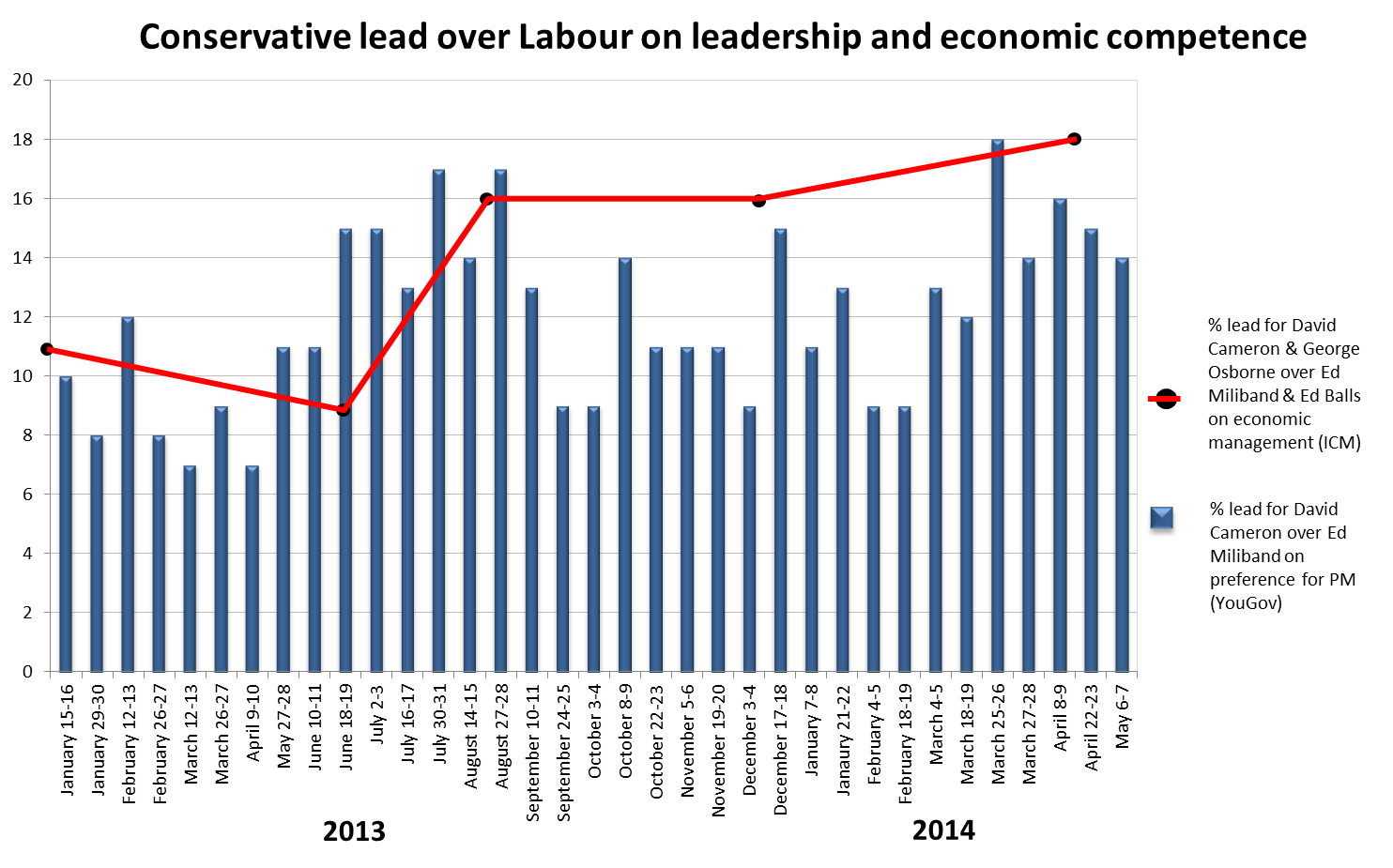
At the last election, in both cases, the answer was a narrow but clear no. According to ICM’s polling just before election day, David Cameron and George Osborne held a 1% lead on the economy over Gordon Brown and Alistair Darling. And on preference for prime minister, YouGov registered a 6% lead for David Cameron over Gordon Brown.

The chart below shows Labour’s performance on these two indicators since the start of 2013.

David Cameron and George Osborne now lead Ed Miliband and Ed Balls by 18% on the economy while David Cameron bests Ed Miliband on preference for PM by 14%.

At no point in the past four years has Labour narrowed the gap on either the economy or leadership to the level it achieved on the eve of the election in May 2010. An election where Labour polled a miserable 29%.

(more…)

Facebook Twitter Digg Delicious StumbleUpon

Labour’s populism is all about redistributing wealth. Creating it matters too

09/05/2014, 10:47:18 AM

by Jonathan Todd

Labour forms a majority government, Alan Milburn wrote in the FT on 13 April, when focused as much on creating wealth as distributing it. Pat McFadden used a very similar line when speaking to Newsnight the same week. McFadden used to work with Peter Mandelson as a minister at BIS. Now Chuka Umunna is shadow secretary of state to this department and consciously echoed Mandelson when he recently said: “I don’t have a problem with people making a lot of money, so long as they pay their taxes.”

Similarly, I’ve argued that Labour should focus on growth as well as the cost of living; in other words, making the economic pie bigger, in addition to sharing it more equitably; being a party of increased production, not simply fairer distribution. Whether when Harold Wilson proclaimed ‘the white heat of technology’ or when Tony Blair unrelentingly championed aspiration, Labour has advanced as a party of growth and production. This is not to downplay the redistributive gains that Labour made during these periods. We had our first statutory minimum wage under Blair and got rid of the eleven-plus under Wilson.

These redistributive gains were facilitated by Labour’s strength on production. In crude policy terms, when economic growth is robust, it’s easier to find resources to redistribute to the less well-off. The politics are simpler too. Voters are less likely to withdraw their support from a redistributive party for self-interested reasons if they are reassured that this party is also capable of delivering the growth that will help their back pockets.

(more…)

Facebook Twitter Digg Delicious StumbleUpon

Enough is enough. Labour should kick out Ken Livingstone

08/05/2014, 03:44:44 PM

by David Talbot

In January 2004 a controversial member of the Labour family was readmitted to the fold. Ken Livingstone, the hitherto independent Mayor of London, had submitted his application before Labour’s NEC in order to run as the official Labour candidate in the forthcoming second London-wide ballot.

Livingstone had been expelled from party membership for five years in 2000 when, having been blocked by the party’s hierarchy from running as its official candidate for Mayor, he stood as an independent. Labour’s gerrymandering of the selection procedure, coupled with its heavy-handedness in throwing out the longstanding MP, merely resulted in Livingstone beating Labour’s official candidate into a humiliating fourth place.

Upon his return to the Labour column a jubilant Livingstone described it all as an unfortunate misunderstanding and of a marriage that had temporarily broken down. It is near long-forgotten that this fiercely independent firebrand lobbied extensively for his readmission to the party. But since then Livingstone has abused this “marriage of convenience” with the Labour party to the point where many right-minded Labourites can no longer willingly tolerant his membership of their party.

He has taken all he could from the relationship, and given scant in return. The charge sheet of abuse, varying in seriousness, is so extensive and so oft-repeated it is barely worth the bandwidth to detail further; campaigning against an official Labour candidate in 2010, admitting that he never voted Labour under Tony Blair’s leadership, whilst throwing in the customary charge that he should be tried for war crimes; his tax avoidance, his penchant for the mullahs of Tehran, telling the Reuben brothers to go “back where they came from”, likening a journalist to a concentration camp guard – even after he knew he was Jewish, his distaste for the Jewish community in general, and his patronage of Shaykh Yusuf Al Qaradaw, who denies the Holocaust, promotes female genital mutilation, and urges the throwing of homosexuals from rooftops as a punishment for their sin.

(more…)

Facebook Twitter Digg Delicious StumbleUpon

Left-wing populism is not the answer for Labour

07/05/2014, 10:51:28 AM

by Renie Anjeh

Energy price freeze, scrapping the bedroom tax, rent controls, 50p tax rate – all part of Labour’s offer to the British people next year.  No more Old Labour, definitely no more New Labour – it’s all about Radical Labour.

The party is beginning to set out its popular, and increasingly populist, stall for the British electorate in the run up to the election next year.  Those who are arguing for Labour to ‘shrink the offer’, are losing the internal debate in the party – the radicals have come out on top.  It’s unsurprising that there are those who want the party to go even further by promising to renationalise the railways, introduce a graduate tax, abolish zero-hour contracts and borrow more to pay for spending commitments.  However, this strategy could hinder, rather than help, the Labour party.

Look at the Tories in Opposition. In 2001 and 2005, both William Hague and Michael Howard championed rightwing populism.  Hague – a fervent Eurosceptic – campaigned against the prospect of Britain joining the euro, saying that there were ‘twelve days to keep the pound’.  Although his policy on the euro was undoubtedly very popular, Hague lost the election and became the first Tory leader not to become Prime Minister.

Howard, having given up on his early attempts to modernise the Conservative party, campaigned on tougher controls on immigration, a tough stance on crime, more stringent discipline in schools and lower taxes.  These policies were also very popular with the public but he lost the 2005 election.

This was partly because the Tories were simply not trusted with public services, they looked uncomfortable with modern Britain and people felt that some of its policies reinforced the ‘nasty party’ label.

Labour’s critical weaknesses are on the economy, welfare and leadership and if the party fails to address these issues then, like the Tories in 2001 and 2005, it could end up in opposition for another five years.

(more…)

Facebook Twitter Digg Delicious StumbleUpon

When did the Labour party give up on fighting racism?

06/05/2014, 09:03:14 AM

by Atul Hatwal

There was a time when Labour was the party that stood for equality. For people in a minority community, those of a different colour or heritage, Labour was the party that would fight for them.

No more.

The basic principle of confronting racism, once an irreducible element of Labour’s core, has been greyed into a guideline.

During the past few weeks Labour politicians have been complicit in allowing Ukip to redefine what is acceptable in our national debate.

When Nigel Farage used an interview in the Guardian to brand Romanians as having a “culture of criminality,” and said that British people were right to be worried if Romanian families moved in on their street, there was barely a murmur from Labour.

The party’s silence has helped validate an extraordinary shift: it’s now politically legitimate to say Britons should be scared of foreigners moving in next door.

Politics has just regressed 40 years.

Back then, as now, fear of the foreigner was a defining aspect of political debate. Rather than eastern Europeans, the targets in the 1970s were Asian and Afro-Caribbean immigrants, but the sentiment was exactly the same.

(more…)

Facebook Twitter Digg Delicious StumbleUpon

Northern Ireland can’t afford another week like that

05/05/2014, 02:00:55 PM

by Kevin Meagher

By now, you’ve probably heard of Jean McConville, the Belfast mother of ten who was brutally murdered and “disappeared” by the IRA in 1972. You’ve probably not, however, heard of Joan Connelly.

She was another Belfast woman, a mother of eight, who was also brutally killed back in the early 1970s. She went to aid a young man who had just been shot in the street before the same British soldiers turned their rifles on her, shooting her in the head and body.

Her injuries were so serious that half her face was blown off. Joan’s husband could only identify her, on the third attempt, as he recognised her red hair.

This was in August 1971 during Operation Demetrius when internment without trial was brought in to target “IRA ringleaders”. Weak intelligence and the sectarianism of the Stormont government instead saw hundreds of ordinary Catholics arrested and jailed, (but not a single loyalist).

Northern Ireland erupted and in the ensuing tumult, eleven people were killed by the British army over a two-day period in the Ballymurphy area of Belfast. As well as Connelly, soldiers also shot dead a Catholic priest.

Although the Police Service of Northern Ireland has just spent 96 hours grilling Sinn Fein President Gerry Adams about Jean McConville’s heinous murder, there will be no similar effort expended investigating Joan Connelly’s.

We know this because Northern Ireland Secretary Theresa Villiers last week ruled out setting up an inquiry into the Ballymurphy killings.

(more…)

Facebook Twitter Digg Delicious StumbleUpon

Farage fears UKIP can’t win a ground war

30/04/2014, 03:23:09 PM

by Kevin Meagher

So Nigel Farage has decided to act strategically rather than tactically by not putting himself forward for the Newark by-election.

He knows two things only too well. The first and most obvious is that because he’s so publicly the face of UKIP, he cannot damage his own brand – and by extension the party’s – by standing and losing.

Second, he knows his party’s organisation isn’t yet strong enough to take on the other parties polished by-election operations in a tough fight.

Announcing his decision on Radio Four’s Today programme this morning to accusations he was “frit”, Farage described himself as “a fighter and a warrior but I am determined to pick my battles”.

To continue the military analogies, Farage knows that he’s successful at hit-and-run tactical opportunism and runs a good air war, using his media profile to good effect to rain down rhetorical bombs on the Tories’ crumbling fortifications.

But when it comes to the ground war – where elections are won and lost – Farage’s troops are still raw recruits, while his boots are more used to treading the manicured lawn of College Green than Newark High Street.

UKIP seemed genuinely put out at Labour’s postal vote operation in the Wythenshawe by-election in February, with Farage claiming: “I have been on benders for longer than the opening of the nominations and the start of the postal ballots. This has been a farce.”

If he doesn’t understand how the postal vote system works in elections, then he really isn’t ready for close electoral combat.

But UKIP is learning.  Building membership and organisation, getting tough with errant candidates, learning political tradecraft and raising enough cash to keep the show on the road is the boring bit of politics. But without it, UKIP has no chance of making a breakthrough.

Farage knows this. He is biding his time, hoping that he turns his barmy army into crack shots in time for next year’s general election.

Kevin Meagher is associate editor of Labour Uncut

Facebook Twitter Digg Delicious StumbleUpon

Unite’s takeover of PCS will have big implications for Labour if Ed doesn’t make it into Number 10

30/04/2014, 07:00:32 AM

by Rob Marchant

While we all want the morning of 8 May, 2015 to be defined by a triumphant Miliband glad-handing a crowd of jubilant supporters in Downing Street, it is worth taking a moment for a cold, hard look at the opposite: the Armageddon scenario of Labour returning to opposition.

Although this may be seen as a distasteful or even a disloyal task, neither is it, if the direction of travel of poll lead continues, one that is unthinkable in an election still far too close to call. Forewarned, as they say, is forearmed.

What will surely weigh heavily in the minds of all the major players at that point are the desires of one man, who over the last couple of years has shown himself to be the party’s trickiest stakeholder. That man is Len McCluskey.

While the furore of the Falkirk selection disaster has died down and the party reform agenda has largely gone through for the long term, Unite has been quietly preparing itself for a post-election world. It seems fairly obvious that, should Labour win, the chances of a split with Unite look remote; it would be a short route to instant marginalisation. As Prime Minister, Miliband could afford to face down a little union cage-rattling, and potentially even expand his party reform agenda.

But were Labour to lose – and presuming losing were deemed a “hanging offence” for the current leader, though we should not rule out, by the way, that Miliband might not look to hang on as a unity candidate –there would be a leadership election in which, as Uncut has observed before, it would be politically impractical to preclude unions from taking part “in the old way”. That is, such that candidates would need to court them just as they did before the Collins reforms. McCluskey would, at this point, have three important levers at his disposal.

(more…)

Facebook Twitter Digg Delicious StumbleUpon

From Margate to Montrose, it’s time for Labour to raise our game

29/04/2014, 08:00:52 AM

by Jonathan Todd

Tony Stockwell, the psychic medium, performs at Margate Winter Gardens on 11 September. Perhaps he’ll reveal whether Nigel Farage, rumoured to be considering standing for parliament locally, will become South Thanet’s MP. Tracey Emin, a renowned daughter of Planet Thanet, “won’t let that happen,” retorted my wife.

Emin, like Johnny Depp, is older than Farage. She is, though, a hipper figure. This didn’t stop her, like South Thanet, voting Tory in 2010. But she thinks Margaret Thatcher “should be tried for crimes against humanity”.

The north of England and Scotland might agree with her about this. This continues to frustrate Tory recovery in the north, where more people agree with the Tories than vote for them. Due to the negative perceptions that Thatcher created and which persist.

As they do in Scotland, where swathes of the population have convinced themselves that UK government can offer only Thatcherism or Thatcherism lite. Labour for Independence “consists of members, voters, supporters, former voters who felt the party left them not the other way around”. Only in an independent Scotland, they contend, can they recover their party.

The voters of South Thanet also feel they’ve lost something. “They may not be able to pinpoint what it is,” Laura Sandys, the incumbent MP, recently told The New Statesman. “But they don’t think they’re getting it back.”

Whatever Farage may promise to recover for these people, he’ll do so on the basis of an affinity with Thatcher. Jonathan Aitken, her unofficial biographer, “cannot believe that a young Margaret Thatcher leaving Oxford today would join the Conservative Party led by David Cameron. I think she’d come and get involved in UKIP.”

While, to many Scots, Cameron personifies what they see as the perpetual Thatcherism of the UK, he’s a pale shadow of the 1980s prime minister, according to her greatest admirers. Another paradox is that Farage is supposedly the keeper of Thatcher’s flame and a challenger to Labour in the north, where she remains a drag on Tory support.

(more…)

Facebook Twitter Digg Delicious StumbleUpon