




When it comes to Britain’s EU membership, it really is the economy, stupid

04/04/2014, 08:50:40 AM

by Callum Anderson

In less than a couple of months, UK voters will go to the polls to elect their representatives in Brussels. In the event of a strong UKIP performance, it is likely to put yet more emphasis on the potential referendum on Britain’s EU membership.

And that’s in addition to the exposure the issue has received as a result of the debates between Nick Clegg and Nigel Farage.

As I have already argued, it is my strong belief that the UK needs to play at the heart of a reformed EU and resist the temptation to ‘pull up the draw bridge’.  As was teed up by the Budget a couple of weeks ago, the economy is the issue that concerns the vast majority of voters: jobs, real terms wages and taxes will be the particular battlegrounds. Like it or not, Britain’s ability to build a strong and resilient economy lies in its ability to form and maintain relationships with other nations. None of this is more evident than the relationship with the EU.

Now, I know Nigel Farage and his fellow Eurosceptics can sometimes be a little short on facts, but let me shed some light.

Let me start off with trade.

Business for New Europe recently found that the growth in free trade within the EU has generated as much as 6 per cent for every British household, equivalent to £3,500 every year. A not too insignificant figure. This is clearly because UK businesses have access to the richest and biggest single market in the world. And it’s not just that. The UK benefits from the EU conducting free trade deals on its behalf, and undoubtedly obtaining deals on better terms than if it negotiated alone.

For instance, the EU-South Korea Free Trade Agreement has benefitted UK businesses to the tune of £500 million a year. The Centre for Economic Policy Research (CEPR) has also found that a EU-US Transatlantic Trade and Investment Partnership (TTIP) could boost UK national income by up to £10 billion a year, with our automotive industry benefiting most, thus creating the manufacturing jobs that Britain has needed for a generation.

So, what effect does this have on jobs?

(more…)

Facebook Twitter Digg Delicious StumbleUpon

Farage might have won the live debate but Clegg triumphed in the news packages. And more people watch the news

03/04/2014, 10:08:03 AM

by Atul Hatwal

A thumping victory for Farage. That was the consensus following last night’s big debate. The pundits said it, the polls said it; there was little doubt.

But for people like me, who didn’t see the debate, and whose only sight of the combatants was on the evening news, the result was very different.

In the contest of the clips, Clegg was the winner.

This doesn’t mean that the verdict of those who saw the live debate was wrong. Just that, as so often is the case, the highlights reel told a different story.

The BBC News at Ten package, which would have had the most viewers, focused on four passages in the debate: the clash over Putin, immigration, past Lib Dem promises of a referendum and the closing statements.

Nick Robinson’s report can be seen here.

While Farage had the upper hand in the latter two exchanges, the first two were the most resonant.

On Putin, the key moment was when David Dimbleby intervened to contradict Nigel Farage’s assertion that he had never said he “admired Putin.”

Although most viewers are likely to have minimal interest in Nigel Farage’s position on Vladimir Putin, it’s always extremely powerful when the neutral debate moderator intervenes against one of the participants.

Quite apart from the topic under discussion, it sends a clear message to the viewing public that this politician isn’t being straight with the audience.

(more…)

Facebook Twitter Digg Delicious StumbleUpon

Why the surprise? Labour’s poll slippage was predicted and is on trend

02/04/2014, 07:00:18 AM

by Rob Marchant 

Ah, the panic. You can see it setting in as there is a blip downwards in the polls. Two consecutive polls show Labour and the Tories neck and neck, and we have a letter to the Guardian. As Uncut’s Atul Hatwal noted last week, there are now rumblings on the Labour right.

But while it is a perfectly respectable aim to ask Miliband to change course on a raft of policy areas, one cannot help but think it is a conversation we should have been having two or three years ago.

The good news is that this jitteriness is based on very little change in the actual prognosis.

To explain: political journalists are not, in the main, statisticians. Neither are politicians. And so both groups often subscribe to a mathematical fallacy, and it’s this: the polling of today is our best indicator of a general election result in X years time. It’s not. It’s a very rough guide which fails to account for the cycle of the parliamentary term, and in particular an opposition’s mid-term bounce. For the hard of maths, you can skip the next nerdy paragraph and trust us on this.

Our best guess – the expected value – of a general election vote-share lead is not equal to the value of our polling lead now. It’s equal to the value of our polling lead plus our expectation of how much that lead is going to change in between now and then. Trouble is, that second bit is crucial and historically, it’s not zero. In short, it is reasonable to argue that we shouldn’t just extrapolate today’s poll out to 2015 in a straight horizontal line. For an opposition party, it should be a line that inclines downwards.

(more…)

Facebook Twitter Digg Delicious StumbleUpon

Len McCluskey signals potential Unite exit from Labour

01/04/2014, 04:39:01 PM

by Atul Hatwal

Big news from Len McCluskey’s turn before the press gallery this afternoon. Speaking to journalists, he said that he could envisage Unite changing its rules on funding to support other parties and leaving Labour, if the Labour was to lose the next election.

“Only if we change our rules, within Unite’s rules, we are affiliated to the Labour party. We cannot give any financial support to any other political party. So the rules within Unite would need to be changed, not by Len McCluskey – I know some of your papers think I have this huge power to flick switches on and off – but by our rules conference. Can I ever envisage a rules conference voting to disaffiliate from Labour? I can, I can, and that’s a challenge to Ed Miliband because I believe the Labour party is at a crossroads, this is a watershed…if Labour lost the election next May I fear for the future of the Labour party and so these are serious debates at this point in time in our history we have to kind of consider all of those issues, at the moment, though that’s not on our agenda.” (h/t Isabel Hardman)

This is potentially an enormous shift in Labour politics. If Unite were to disaffiliate, three points are relevant.

First, the balance of the party would shift towards the right. Unite are the most vocal and powerful of the unions on the left and without their seats on the NEC, votes at conference, financial leverage and members’ role in any future Labour leadership election, the party would likely move more to the centre.

Second, it suggests the Collins union reform proposals, passed with much fanfare in February, were only a stop-gap for Unite, pending the result of the next election. If Labour loses, then all bets are off.

Third, it would mean that the total number of trade unionists affiliated to the Labour party would drop below half the total number of trade unionists in the country for the first time.

At the moment there are 6.5m trade unionists in Britain and according to the latest figures on the TUC website, the 15 trade unions affiliated to the Labour party represent 4.2m of them. If Unite disaffiliated, with a membership of 1.4m, the number of trade unionists affiliated to Labour would drop to 2.8m or 43% of all trade union members.

(more…)

Facebook Twitter Digg Delicious StumbleUpon

With Douglas Alexander in the firing line, cui bono?

01/04/2014, 12:37:22 PM

by Atul Hatwal

As Labour’s internal wrangles have spilled into the papers over the past week, there has been a single thread running through each story. Sam Coates at the Times summarised it well on Sunday when he tweeted,

One common theme in all Labour row stories this weekend (and my piece last week): all involve people having problem with Douglas Alexander

— Sam Coates Times (@SamCoatesTimes) March 30, 2014


Last week Douglas Alexander was vetoing John Cruddas’ expansive policy review proposals. Then on Saturday he was firing Arnie Graf, swiftly followed on Sunday with Alexander falling out with almost everyone involved in Labour’s campaign.

This last story in the Mail on Sunday was particularly jaw-dropping, even by Labour’s standards of red on red briefing. The incredible level of detail, the direct quotes and conspicuous subsequent silence from the principals on several of its specifics, speaks volumes about the splits at the top of the party.

The narrative seems set: Douglas Alexander is the problem.

But is this all rather too easy? Allies of Douglas Alexander and even neutrals are suggesting a rather different view of what is happening within Labour.

The missing element in all of these stories is some important context about the battles behind the scenes as Labour attempts to define its policy platform.

(more…)

Facebook Twitter Digg Delicious StumbleUpon

Labour’s real divisions are between “Would-ers” and “Could-ers”

31/03/2014, 03:22:53 PM

by Kevin Meagher

Andrew Rawnsley’s guide to modern divisions in the Labour party in yesterday’s Observer makes a great political parlour game, identifying, as he does, five new fissures in the party in how it approaches strategy, policy and winning next year’s election.

Yet, it’s much simpler than that: Labour’s sedimentary rock cracks neatly into two main groups.

The first, is the ‘Would If We Could’ camp. They want to make as much difference as possible while never losing sight of the fact that the British people are instinctively cautious and even suspicious of political grandiosity. “We would back X policy if we could get it past the public, but we don’t think we can” goes the theory.

For the Would-ers, winning power is their main preoccupation. There are no silver medals in politics and no point remaining ideologically chaste but losing in the process. So splitting the difference becomes second nature, or “shrinking the offer” in current parlance.

Then there’s the ‘Could If We Would’ group. They argue that Ed Miliband needs to be bold and present a big offer to voters. If he does, Labour will swing millions of people who are disenfranchised with politics and want something to believe in behind the party. “We could win, if only we would back X policy.” This isn’t a view confined to the old Left; it strikes a chord with many people on the party’s centre-left too who yearn to have their idealism validated.

(more…)

Facebook Twitter Digg Delicious StumbleUpon

Helen Hayes: A star is born in Dulwich and West Norwood

31/03/2014, 09:48:14 AM

by Jonathan Todd

It wasn’t quite a warm summer day spent indoors writing frightening verse, as the Smiths song goes but it was a warm day, spent indoors, in a school hall with large windows. We could see the sunshine but we weren’t in it. We were inside, stewing.

When we re-emerged, Helen Hayes had been selected to fight Dulwich and West Norwood (DaWN) for Labour at the general election. Tessa Jowell has represented the seat since its creation in 1997, having won the previous Dulwich seat from the Conservatives with a slender majority 5 years earlier. Favourable boundary changes and Jowell’s assiduous cultivation of support across a constituency with pockets of affluence and poverty mean that she bequeaths a much more substantial majority of over 9000 to Hayes.

The seat may have transitioned from being perceived as marginal to safe under Jowell but some parts of it conform to the characteristics of seats that Lewis Baston deems ‘gentrifying inner London’. He sees changes in them that may benefit the Conservatives – “old working class traditional Labour households in terraced areas have been replaced by upwardly mobile and high paid couples and families”. The East Dulwich ward in DaWN, for example, is much less blue-collar than when Jowell worked in it as a social worker in the 1970s. Foxtons, Caffè Nero and various gastro pubs have arrived in the 8 years that I’ve lived in the ward.

Hayes will need Jowell’s capacity to build a big tent of support across different groups to keep the seat as safe as it has become. Douglas Alexander, Rachel Reeves and Chuka Umunna saw sufficient evidence of Hayes’ talent to endorse her candidacy. In addition, Frank Dobson, Patrick Diamond and – declaring an interest – myself did so. While it’s unusual for someone seeking to become a Labour PPC to secure the support of three members of the shadow cabinet, Hayes was not alone among the candidates in getting top level backing.

(more…)

Facebook Twitter Digg Delicious StumbleUpon

Letter from Wales: Labour’s record in Wales is harming the party’s national prospects

29/03/2014, 11:06:50 PM

by Julian Ruck

At long last national media appears to be waking up to the situation in Wales. Newspaper reports of Ed’s address to the Welsh Labour conference are peppered with serious questions about what is going on over here. It is a great pity that most Welsh Labour MP’s are not following the same path.

Indifference and Welsh political secession are the orders of the day where Westminster is concerned. Welsh MP’s represent their constituents and yet feel obliged to wail the same insipid refrains of “That’s a devolved matter and nothing to do with me!,” every time they are confronted with pointed questions about the Welsh administration and its more than obvious failure to bring Wales out of the dark ages.

Welsh schoolchildren enduring schools not fit for purpose, a Welsh NHS where waiting times for hip replacements are months longer than England and an economy that national growth is leaving behind, are matters beyond their remit and whatever you do don’t be seen to exercise the democratic prerogative of outspoken criticism.

Cowering resistance to accusations of “traitor!” and “quisling!” by the Crachach aristocracy must be avoided at all costs.

Hywel Francis MP, Geraint Davies MP and former secretary of state for Wales no less, Paul Murphy, have all been contacted for a comment on the devastation that is the Welsh education comic opera.

Responses?

None.

(more…)

Facebook Twitter Digg Delicious StumbleUpon

Shadow cabinet league: Khan remains the boss

28/03/2014, 05:15:01 PM

by Alan Smithee

This column returns, bronzed with liver aching, from a brief absence. Thankfully, the shadow cabinet has not taken a similar sojourn. As we enter the New Politics™ era, the shadow cabinet remains important to delivering a Labour victory in 2015 and harrying the coalition in the meantime.

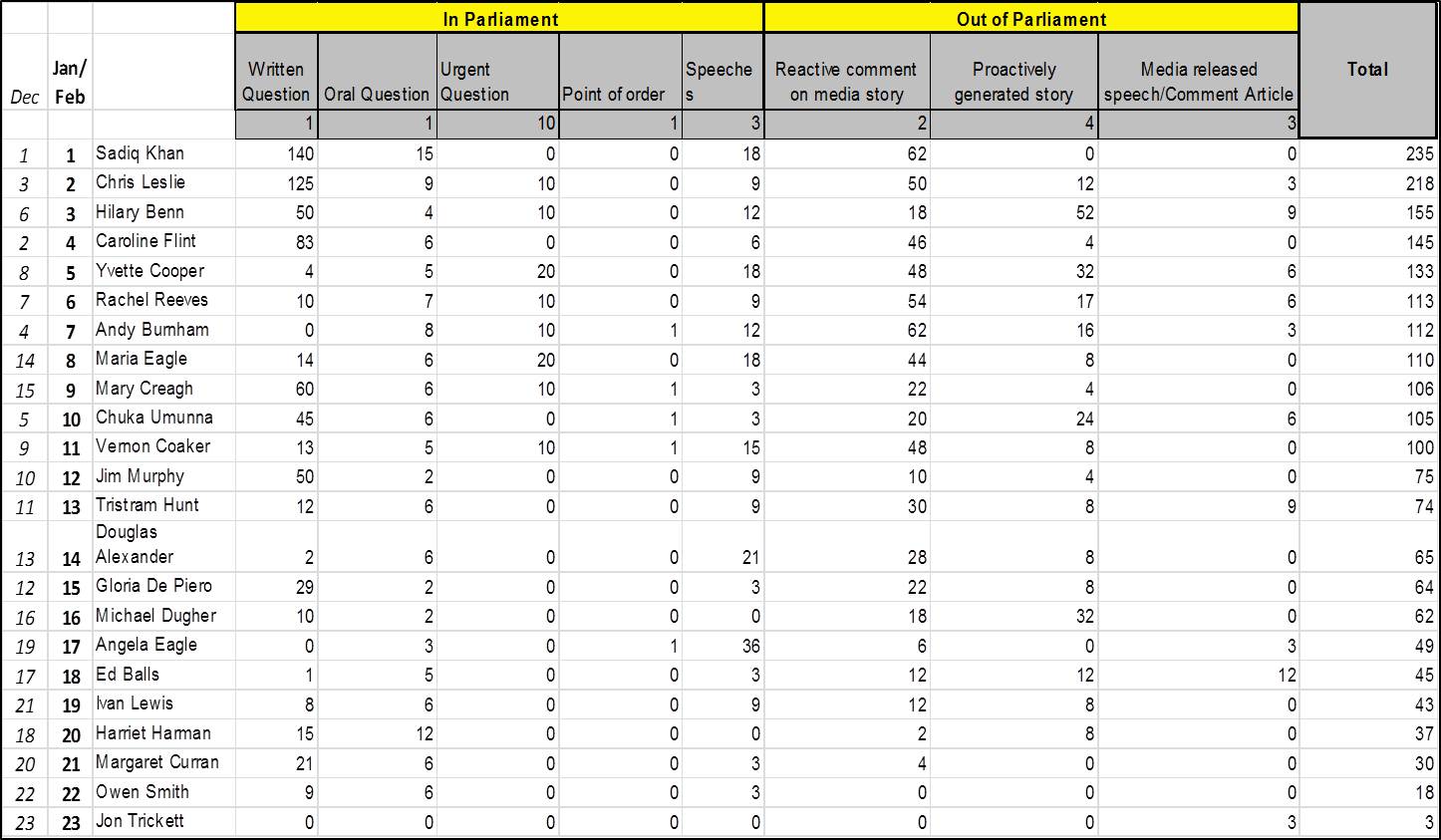
Two MPs have established a commanding lead at the top of the table. Sadiq Khan and Chris Leslie have consistently performed well. Khan has excellent in consistent reactive media work and producing a gargantuan amount of written question. His continued focus on Oakwood Prison and the disturbance in January shows a commitment to scrutiny rather than questions based on cynical opportunism.

Leslie, who does the donkey work in the Treasury team, has produced similar levels of questions and has been able to generate a number of attacks on the Government.  His speech on the zero-base review helped flesh out Labour’s pledge, key for offering fiscal credibility.

Shad Cab table 2013-02-28

(more…)

Facebook Twitter Digg Delicious StumbleUpon

Labour’s right is rumbling. Not before time.

27/03/2014, 10:23:02 PM

by Atul Hatwal

Since 2010, one of the most successful operations mounted by Ed Miliband’s team has been to convince journalists that the party is at peace. That Labour has avoided the type of bitter in-fighting that characterised past ejections from government and is united around the leader.

This point is so core to the Miliband narrative that he repeats it in his stump speech to Labour audiences.

However, while it is true the 1980s haven’t been re-run, the absence of conflict is not the same as the presence of unity.

The reason Labour’s divisions have not been visible has been  a temporarily effective but ultimately unsustainable party management strategy; one that has combined Ed Miliband avoiding taking definite positions on the most contentious political questions with a concerted marginalisation of Labour’s right-wing.

When Gordon Brown was defeated in 2010, his electoral demise bequeathed two questions to Labour.

In a world of limited spending, what would Labour prioritise and what would it cut?

And how could more, be achieved from less, in the areas where money was to be spent?

From day one, Ed Miliband has run from these questions, in part for good reason.

Hamstrung by a lack of support in the parliamentary party and reliant on the unions’ succour to bolster his position, he has had to tack left to retain his union support while not straying so far from the more centrist concerns of the electorate that Labour’s poll rating collapses.

For Ed Miliband, to answer has been to lose – either the electorate or his political life support system on the left.

(more…)

Facebook Twitter Digg Delicious StumbleUpon