




Does Labour even have an opinion on monetary policy?

08/08/2013, 09:22:41 AM

by Jonathan Todd

This is a rare thing: some thoughts from a Labour perspective on the politics of monetary policy. Maybe it derives from reverence for the last government’s decision to make the Bank of England independent. Perhaps it comes from a slowness to appreciate how the George and Mervyn show has so smoothly transitioned to the George and Mark show. In any case, we do not hear enough from Labour on monetary policy.

Ed Miliband followed Stella Creasy is stressing the importance of having females on banknotes. While the symbolism of this is significant, it is only symbolism. As Carney was being pictured with Creasy and other campaigners, in the manner, according to Dan Hodges, of “three schoolgirls who have just won a Blue Peter competition to design a new bank note”, he was putting the finishing touches to an intervention of more than symbolic consequence.

That this heralded the age of the perpetual never-never – otherwise known as forward guidance or cheap money till the other side of the election – is also predictable. It has not come from the ether. It is what Carney did in Canada. Like all the most profitable, international consultants, he’s selling the same recommendations to a new client. As a variation on the framework adopted by the Federal Reserve at the end of last year, it is also of a piece with an emerging monetary consensus.

All of which sounds very elite and removed from the shop floor. Yet what could be more shop floor than worrying about how many people are on it? The rate of employment, in other words. By targeting the unemployment rate, Carney has created something akin to “the bank for the workers”, which I argued for at a Pragmatic Radicalism event at the start of this year.

All I was really doing at this event was cribbing the Fed’s idea. But, for some reason, there was something about targeting the unemployment rate that seemed apt for our party. The clue is in the name, as someone once said.

If the Fed is targeting the unemployment rate, wouldn’t you think both that this might be something the Labour party can call for and an idea whose time has come?

(more…)

Facebook Twitter Digg Delicious StumbleUpon

As the party looks forward to conference season, there’s unfinished business over Falkirk

07/08/2013, 08:20:23 PM

by Rob Marchant

There is a distant rumbling going on within the labour movement, with parliament in recess and the media in silly season, which will surely last until conference. It may, in fact, last until next Spring’s special conference. Or it may even last until the next general election.

Perhaps thanks to the timely intervention of the summer holidays, the media circus seems to have moved on from the Falkirk selection debacle.

But not so fast. This one will continue to rumble, and the reason is simple: we have ended the current chapter with two poles of the Labour party power structure effectively giving diametrically opposing versions of events, and both cannot be right.

This uneasy truce is neither sustainable in the long-term – truth will invariably out – nor making for anything like a trusting relationship in the near future.

To recap: Miliband has supported his party organisation, who seem to be telling him that Unite made moves to fix the selection. Len McCluskey, on the other hand, denies any wrongdoing whatsoever on the part of his union. He, along with various other party figures, is asking for the report of the party’s internal investigation to be published.

This is in spite of the fact that some clear facts are known: that people were signed up as party members without their knowledge and that the clear beneficiary was Karie Murphy, described by Channel 4 as a “close friend” of McCluskey and office manager to Tom Watson MP, his friend and former flatmate. The chair of Unite in Scotland, Stephen Deans, also happened to be, very handily, the chair of Falkirk West constituency Labour party.

We may never know the full contents of that report; if it has not been published or leaked by now, it seems pretty likely that it never will be. It is also completely understandable why: it would very likely cause a massive and unwanted row between the two sides.

Miliband is stuck. One cannot help speculating that McCluskey is perhaps only calling for it to be published out of pure brinkmanship, because he knows that Miliband will not do it. But whatever the answer, the report itself is now key.

In the midst of all of this, BBC Radio 4 made a rather intriguing recent programme called “Fight over Falkirk”. Intriguing because its “storm in a teacup” conclusion seemed to go directly against what insiders have been saying for weeks.

The three key BBC claims were: one, that at least some of irregularities were not down to recruitment through Unite’s Union Join scheme anyway; two, that the NEC didn’t see the full report, only a damning executive summary; and three, that the body of the report didn’t seem to support that summary.

(more…)

Facebook Twitter Digg Delicious StumbleUpon

C’mon Ed, fight

05/08/2013, 08:43:06 AM

by Dan McCurry

In case the reader needs reassurance that Osborne is a failed chancellor, you only have to look at what the financial services people are saying. A couple of weeks ago, Citywire ran with this headline, “Hooray for the (debt-fuelled) UK recovery!”

How about this funny analysis from the stockbroker Hargreaves Lansdowne:

“Former US president Abraham Lincoln has been credited with saying the problem with politics is you can never please all of the people all of the time. In a more contemporary setting and with the UK yet to regain ground lost during the 2008-09 recession chancellor of the exchequer George Osborne has struggled to please anyone at any time since stepping into 11 Downing street three years ago.”

However, the one thing that the Tories do massively better than Labour is this: When they are down, they come out fighting. Even when the world took note that Keynes had won and austerity lost, they carried on fighting.  The question is, what does Labour do? Has Ed Miliband and Ed balls given up? Do we only have an opposition on a Wednesday lunchtime?

While the Conservative party refuses to publish their membership numbers, due to their decline, our party is fizzing with excitement. This whole party wants to take the fight to the Tories. The only thing that’s stopping us is that we need the leadership to show the way.

“I see you stand like greyhounds in the slips,
Straining upon the start. The game’s afoot:
Follow your spirit, and upon this charge
Cry ‘God for Harry, England, and Saint George!”

Forget about trade union reform. That stuff is history. The unions have shown contrition over that Scottish selection thing, and it’s over. What looked like a Clause 4 moment, has become navel gazing. Concentrate on what’s happening with the Tories. It’s interesting and dangerous, for them and us. Look.

The Tories want to turn defenders into attackers. Unlike us, they don’t have a vision beyond making lots of cuts, and the cuts agenda will soon be over. That’s why they keep making tiny announcements about parking on the drive or stop and search. They are trying to create the illusion of being busy, and we should be ridiculing them.

(more…)

Facebook Twitter Digg Delicious StumbleUpon

Letter from Wales: Wales deserves better

02/08/2013, 09:52:05 AM

by Julian Ruck

“In the name of god go! You have sat long enough!”

This was Vincent Kane quoting Oliver Cromwell in a BBC Wales programme on the Welsh economy (BBC Wales, Week In Week Out 24.6.13). I doubt readers will need three guesses to work out who he was throwing Cromwell’s words at, but just in case any of you up there in Westminster are in any doubt, it is of course our devolved masters.

“Depart I say, and let us have done with you!” Kane quotes Cromwell again.

So what was Vincent Kane getting so exercised about one may well ask? The fact that Wales is the lowest performing economy in Europe perhaps? The fact that Welsh Labour throws billions of taxpayers’ money at outside companies to invest in Wales – wherein said companies quickly disappear as soon as the subsidy runs out? The fact that many Welsh private sector companies are on the dole?

Mr Kane doesn’t pull his punches. Although I doubt it will get him very far. Wales is on life support, the Welsh people in a state of comatose apathy.

Since devolution and Welsh Labour’s take-over of the Welsh Development Agency, Wales has gone further and further backwards, so let’s call a Welsh spade a Welsh spade here;  Wales is an old, crotchety cart horse, a pebble-dashed public sector backwater, it has become an insular Brythonic ghetto whereby, as Kane puts it “by 2030 the smart people will have left Wales.”

And who can blame them? There’s nothing here –  unless you fancy retiring to some bucolic splendour and having  a cheap property thrown into the bargain.

And what about education? The literacy and numeracy of Welsh youth is on a par with the Czech Republic and enrolment at Welsh universities is in decline.

Following a survey of 150 Welsh CEO’s all of them said the same thing, in Wales the young are unemployable. And Welsh Labour is still determined to opt out from Westminster edcreforms.

It is plain madness.

(more…)

Facebook Twitter Digg Delicious StumbleUpon

Labour history uncut: Splitters! The fall of the second Labour government

31/07/2013, 10:24:04 PM

by Pete Goddard and Atul Hatwal

Panic gripped the Bank of England.

By the 7th August 1931, just a week after the publication of the doom-laden May report on Britain’s finances, unhappy foreign investors were selling sterling at a record pace.

The Bank of England reported that its gold and foreign exchange reserves had lost £60m in the past few weeks in its attempt to prop up the value of the nation’s currency and keep Britain on the gold standard.

A first-ever Brexit seemed imminent. Although nobody actually used the word “Brexit” because these were more civilised times.

Only a hastily arranged £50m credit from French and American bankers was keeping the Bank of England solvent. This wouldn’t last long and future loans were in doubt – it’s hard to take a payday loan when you’ve got no payday in sight.

In order to secure more international loans to sustain the currency, a plan to pay down the deficit was needed.

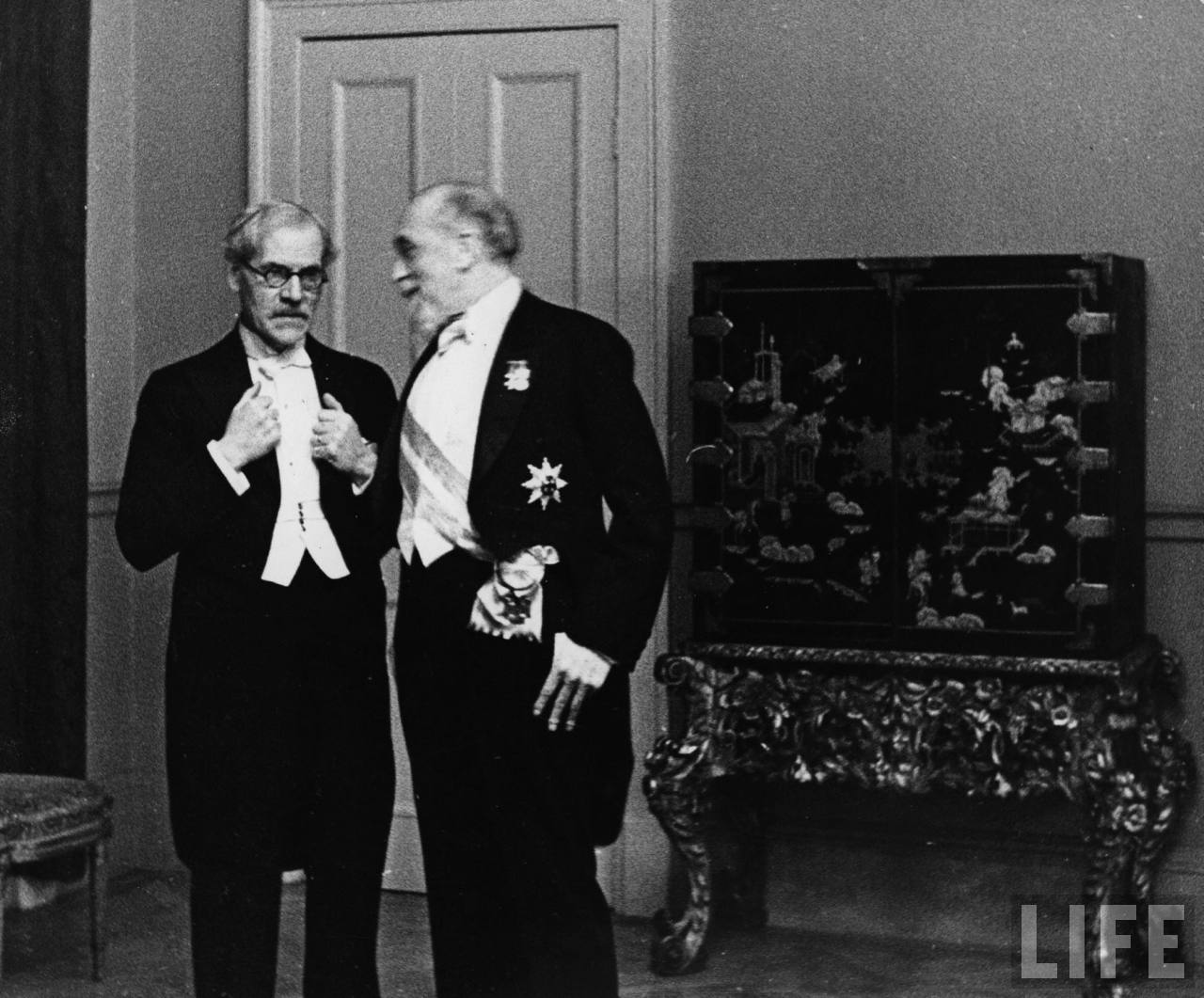
Governor of the bank of England, Montagu Norman talks to Ramsay Macdonald who has chosen, appropriately, to dress as an undertaker for the occasion

The bankers wanted £80m of cuts. So prime minister Ramsay Macdonald and chancellor Philip Snowden put together a programme to deliver them, including a painful reduction of over £40m to unemployment benefit.

(more…)

Facebook Twitter Digg Delicious StumbleUpon

Labour history uncut: How the man from the Pru turned an economic drama into a Labour crisis

30/07/2013, 04:19:25 PM

by Pete Goddard and Atul Hatwal

By 1931, prime minister Ramsay Macdonald had made his choice: he was going to cut his way out of Britain’s financial crisis. Austerity beckoned.

But first, as ever, a committee.

The national expenditure committee was set up on February and was due to report in July. So obviously it became known as the May committee. Admittedly this was because the committee chair was Sir George May, recently retired as company secretary at the Prudential, but did they have to make things so confusing?

Sir George May, formerly of Prudential Assurance. “I assure you, the nation is screwed.”

Oswald Mosley, who had been unsuccessfully touting his alternative, spending-based recovery plan around the party, couldn’t take it anymore. In February 1931, he voted with his feet, resigning from the Labour party completely.

Mosley then gathered a handful of his closest MP friends to form a new party. He showed that his new party had the imagination and vision that Labour lacked, by calling it the New party.

The New party betrayed a few hints of what was to come for Mosley by forming its very own militia. This might have been frightening had it not been for their choice of nickname: the “Biff Boys” sounded less a jackbooted menace and more a carefree gay subculture.

(more…)

Facebook Twitter Digg Delicious StumbleUpon

Letter from Wales: Still the establishment evasion goes on

26/07/2013, 09:49:33 AM

by Julian Ruck

Whatever one’s point of view in respect of political malfeasance where Westminster is concerned ,we still have the cleanest political system in Europe. It has its faults but that’s democracy for you, and call me naïve but I still believe that 99% of politicians do not set out to harm the country or voters.

They make mistakes, they are human but it’s so easy to sit an armchair and criticise. I know one thing, I wouldn’t want their job for all the political tea in China!

This being said, there is a profound difference between the political landscape of Westminster and that which obtains in Wales. Whatever else, Westminster enjoys a certain maturity, a certain sophistication of political endeavour and to a large degree, openness – one only has to consider the public accounts committee for evidence of this, not to mention the fact that scandals are at least exposed on a regular basis.

None of this is the case where Wales is concerned.

Allow me to give you just one out of many examples of Welsh political backwardness, immaturity and crude deliberation when faced with a public interest challenge.

A couple of weeks ago you may remember, I requested some interviews and comment from minister’s Edwina Hart (business and economy) and John Griffiths (culture). The former in respect of a £130m private investment in north Wales going AWOL and the latter in respect of millions being wasted on Welsh arts, more particularly book publishing.

After some blatant evasion, Welsh Labour’s head of news finally entered the fray, indeed he is now the only person who is allowed to deal with me, it seems. I suppose I should be rather flattered.

His response to my initial enquiries were, “We do not reply to blogs”, to which I replied as follows:- (more…)

Facebook Twitter Digg Delicious StumbleUpon

Sunday review on Thursday: Left Without A Future by Anthony Painter

25/07/2013, 10:56:34 AM

by Atul Hatwal

Breadth. That is the defining characteristic of Anthony’s book. Left Without A Future provides a clear-sighted overview of the forces – economic, societal and cultural – that are re-shaping our politics.

Daily, we see the results of these forces reported in the news, but stripped of context.  Left Without A Future provides the missing link: a narrative that explains what on earth is happening.

Whether it is the global societal changes that have enabled the Arab spring and are destroying how British political parties traditionally operate, or an economic predicament where austerity is not working yet market worries about borrowing prohibit a full-blooded state response, Anthony illuminates the common challenges that politicians across the world are struggling to address.

As the title of the book suggests, nowhere are these challenges being more keenly felt than on the left.  Europe’s leading left wing parties are in varying degrees of turmoil and the right is in the ascendant. Even in France, where Hollande defeated Sarkozy, the polls are bleak and spirits are low.

The failure of the left to understand, let alone appropriately respond to, the changing world we live in, is vividly brought to life. The analysis of Britain’s own tea party left as embodied in groups such as UK Uncut and Occupy – a rambunctious mix of uncompromising idealism and aggressive trade unionism – is as apposite as it is overdue.

Throughout the book, the insight is leavened with references to the key texts that are informing left thought (many of which have been reviewed by Anthony on pages of Uncut over the past three years.)The impression is of a left in ferment.  There is much commonality on the diagnosis but confusion on the prescription.

Left Without A Future contends that the answer lies in new institutions. Institutions  connect theory and practice, policy design and human experience. The right institutions will establish rules and an environment that shapes behaviour to meet policy goals.

It is a case that is made persuasively. Reformed, locally accountable institutions provide the only true joined-up response to an environment where the tidal currents of culture, society and economy merge and crash over our politics.

(more…)

Facebook Twitter Digg Delicious StumbleUpon

Ed saddles up the gift horse

24/07/2013, 01:23:32 PM

by Rob Marchant

It is difficult to be anything less than delighted at Ed Miliband’s announcement on Monday that he will call a special conference next Spring to consider the findings of the Collins review.

With this move, he has simultaneously done several things: he has, critically, kept the political momentum going on the project which has now been irreversibly framed as the acid test of his leadership; he has surprised his critics by his audacious speed of action, now looking to deliver it in time for the election; he has pacified the moaners by increasing the level of democratic consultation; and, perhaps most importantly of all, largely cloned a successful model for such changes – that of clause four in 1995 – to achieve all this.

In addition, the selection of former Millbank staffer and Sedgefield MP Phil Wilson, who was closely involved in the clause four campaign, for the campaign team is an inspired choice; and that is because he also understands both the party grassroots and the vital importance of the objective.

Despite the usual theories that the use of this model that is proof positive of a Blairite conspiracy to “kidnap” Miliband, it is blindingly obvious that he has not embarked on a policy suite to match.

But he is at least adopting political tactics which can work.

A mere two weeks ago, Miliband was unexpectedly presented with a gift horse which might just put his leadership back on track, not to mention save his party in the long term.

Rightly, without stopping to inspect the state of its teeth, he saddled up and got on.

(more…)

Facebook Twitter Digg Delicious StumbleUpon

Revealed: Party bosses open way for big money to dominate parliamentary selections with unlimited candidate mailings

22/07/2013, 07:33:22 AM

by Atul Hatwal

New guidance from party bosses has transformed the basis of Labour’s parliamentary candidate selections. Previously, candidates and their campaign teams had operated on the basis of a strict limit of three mailings to party members during a selection contest.

Now, it seems there is no limit on the number of times a candidate can mail members, as long as the mailings are supplied by endorsers. These endorsers could be unions, businesses, voluntary groups or individuals.

The Labour party’s rules governing parliamentary candidate selection were apparently water tight,

“2.4 Each candidate may produce for general distribution

  • one printed leaflet or letter no larger than A4, delivered plain or in an envelope
  • two items, each no larger than a double sided A3 page. If any item is delivered in an envelope it may consist of (at a maximum) 2 A4 sheets of paper rather than a single A3 sheet.”
  • Third party endorsers were allowed to supply mailings to the candidate for distribution to members, but these were previously thought to count as one of the three candidate mailings.

    However, a clarification from Alan Olive, regional director for the London Labour party reveals that the strict limit on mailings is not so strict after all.

    Queries were raised by candidates in a recent selection on the numbers of mailings allowed, following one candidate sending four mailings.

    Uncut has seen e-mail correspondence with the London Labour regional director which makes clear that the number of mailings is unlimited, as long as they are from an endorser. The key part of Alan Olive’s e-mail states,

    “That’s correct. A third party may produce whatever they like although they don’t have the membership details to enable delivery. Candidates cannot pass membership data on but of course a third party could give you their mailing including stamps, for you to attach membership labels and post.”

    The revelation that candidates can have de facto unlimited mailings would seem to contradict the intent of Ed Miliband’s recent speech on one nation politics. As well as announcing a reform of Labour’s relationship with the unions, Miliband dealt with fairness in the parliamentary candidate selection process, stating,

    (more…)

    Facebook Twitter Digg Delicious StumbleUpon