




Labour must look forward, not back, to win in 2015

28/05/2013, 09:51:49 AM

by Jonathan Todd

Peter Kellner reminded us in his recent hard hitting analysis for Progress that the Tories’ central message in 1992 was that Neil Kinnock was a dangerous man who would lead Britain down the road to ruin. He also recalled that the same trick completely failed in 1997. This was because, he argued, Tony Blair had reassured voters that their jobs, homes, pay and savings would be safe with him.

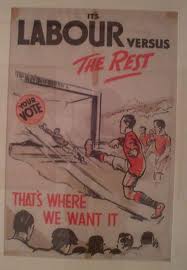
The “Demon Eyes” poster just seemed daft next to the reassurance that Blair had provided. Labour’s “Demon Eyes” football team, founded in 1997, plays on, but the need for reassurance from Labour has returned. Ed Miliband is, according to the Tories, the menace that Kinnock once posed. He must convince that his sums add up on the big challenges facing the country: the economy, welfare, immigration, public services and the cost of living.

While Miliband must seek to reassure, his capacity to do so is not entirely in his control. It can be argued that the tentative economic recovery of 1992 was a harder context in which for Kinnock to provide reassurance than the more upbeat economy in which Blair campaigned in 1997.

Taking a chance on an opposition party seems less of a risk in a stronger economy. Which is why a tepid recovery by 2015 may be the best backdrop to David Cameron’s “don’t let Labour ruin it” message.

Labour’s opposing message, of course, will be “it’s time for a change”. But why? We might say that it’s time for a change because if too far, too fast cuts had not been implemented then we’d now be better off. Unfortunately, this invites the Tories to remind the country why they deemed the cuts necessary: Labour’s profligacy. And there is evidence that this argument increasingly convinces the public.

As the opposition party, Labour has to argue for change in 2015 but this should be an argument about the change that could be achieved from 2015 under Labour, not the change that might have been achieved had Labour been in office from 2010. This might seem obvious but placing an attack on the depth and speed of the government’s cuts at the centre of our economic argument has us looking back to 2010.

Labour can only win with a positive argument for how things will be better from 2015. Yet not only is our main economic argument backward looking but it is backward looking in a tonally negative way. The implicit message of much of our rhetoric is fearful: the government shrinks and the economy collapses; the immigrants arrive and society implodes.

(more…)

Facebook Twitter Digg Delicious StumbleUpon

A return to growth may answer some of Labour’s tricky questions

25/05/2013, 03:17:52 PM

by Kevin Meagher

Confirmation from the Office of National Statistics that growth was indeed 0.3% in the first three months of this year – avoiding a triple dip recession – is good news for the economy – and potentially for Labour too.

Conventional wisdom has it that a return to growth is politically damaging for the opposition. At a stroke attacks on the government’s economic ineptitude lose their purchase. The gloom lifts. The Chancellor can puff out his chest and tell us the pain was worth it, the worst is past. Let, if not quite the good times, then certainly the better times roll.

But what if the opposite is true? What if rather than restoring the government’s fortunes the economy returning to growth is actually helpful for Labour?

After all we saw exactly this pattern through the mid-1990s when a reviving economy did little to refloat John Major’s political fortunes. In fact a return to growth may help Labour deal with its three big problems on the economy.

The first two are related to spending. Labour is committed to a temporary fiscal boost to kickstart the economy and knows it has little spare cash to meet its wider social democratic priorities. It remains elliptical about what it will do on either score and polls consistently shows the party simply isn’t trusted yet to run the economy, its third big problem.

Indeed, Ed Miliband’s reluctance to spell out how that stimulus would be paid for came glaringly unstuck during his interview with Martha Kearney on Radio Four’s World at One programme a few weeks ago.

Asked repeatedly if Labour’s approach would require an increase in short-term borrowing, he employed that classic Tony Benn tactic of answering a different question, maintaining debt would be lower in the long-term with Labour’s approach.

A spin of the news cycle later, Miliband was in safer environs on the Daybreak breakfast sofa conceding that, yes, short-term borrowing would increase as a necessary means of driving growth with in turn reduces longer term debt.

(more…)

Facebook Twitter Digg Delicious StumbleUpon

Labour history uncut: TFI its Red Friday

24/05/2013, 06:03:34 PM

by Pete Goddard and Atul Hatwal

“Every day they were in led us further from socialism.” Thus spake a disappointed Jimmy Maxton of the first, and brief, Labour government which had flopped out of power at the end of 1924 and was now back where it was most familiar, on the opposition benches.

Bitterness and recrimination reverberated across the Labour movement. Both the left and the right agreed that maybe it was time to replace Ramsay Macdonald as leader.

Philip Snowden, former resident of 11 Downing Street, tried to annoy his onetime prime ministerial neighbour by agitating for Arthur Henderson to challenge for the leadership, as well as mowing his lawn really early on Sundays.

Meanwhile, Jimmy Maxton and the red Clydesiders sounded out George Lansbury for similar purposes (the leadership, that is, not the lawn mowing).

The unions were busy grumbling too. The Labour government had proved just as happy to threaten them with the emergency powers act as the Tories and Ernest Bevin, leader of the T&G and one of politics’ all-time great haters, led the angry backlash from the brothers.

He had not forgiven Macdonald for the Labour government’s handling of the docks and tramway strikes in early 1924, telling all and sundry that he’d be happy with anyone but Macdonald as leader.

Bevin wasn’t alone either. They unions had shifted decisively left during the Labour government, partially as a result of their older leaders like Margaret Bondfield and dockers’ leader Harry Gosling, being made ministers in said government, clearing the way for more radical voices to take the reins.

Unfortunately for the serried ranks of the discontented though, they were to be disappointed. In line with the long PLP tradition of factional infighting, the only person each group of MPs disliked more than the current leader was the alternative favoured by the other lot.

(more…)

Facebook Twitter Digg Delicious StumbleUpon

As a piece of policy-making, same sex marriage sets a bad precedent

24/05/2013, 07:00:40 AM

by Kevin Meagher

Putting aside the question of whether same sex marriage is a modest extension of equal rights for gay and lesbian couples or the handcart society will be pushed to hell in – and judged purely as an exercise in policy-making – this week has been a disaster.

The refrain that the measure was not in any party’s manifesto at the last election and didn’t even make it into the coalition’s programme for government is no less important given the frequency with which it’s cited as a grievance by opponents of the bill.

Neither, for that matter, was there a green paper to allow proper deliberation; just a rushed public consultation, which saw a significant majority of respondents strongly opposed to the idea.  And as it now stands, the legislation is lopsided with the failure to extend civil partnerships to heterosexual couples.

Moreover, the law of unintended consequences means most religious communities who opposed the encroachment of the state into their affairs are left with threadbare assurances they will be unaffected by the change. Case law will in due course ensure that they are.

The church hall test will see priests and vicars forced to defend a policy of letting heterosexual couples use their premises while barring gays and lesbians. Meanwhile the charitable status of religious organisations who do not readily accept this new definition of equality will be endlessly challenged. The culture war will rage long after this week passes.

(more…)

Facebook Twitter Digg Delicious StumbleUpon

Letter from Wales: Welsh education is in the corner with its thumb in its mouth

23/05/2013, 04:00:41 PM

by Julian Ruck

Did you hear the one about the Welsh education system?

The Estyn Report of 2012 concluded that 40% of Welsh children entering secondary education are going to schools that are barely “adequate.”

Carwyn Jones, admitted that indeed “more work needs to be done”. His education minister, Leighton Andrews, followed this up with an insistence that Wales was not going to follow the English with a new ‘O’ Level type exam that is more rigorous and demanding than the present GCSE.

Can’t have that now can we?

Mustn’t upset the Welsh medium schools with some heinous British deliverance must we? Never mind the fact that Welsh children will be burdened with a third class education, as if their future isn’t grim enough.

Standards? They can go hang. No, the problem is all about money, we are told. It’s all Barnett’s fault. Westminster just isn’t dishing out enough money to Wales, you see.

It’s alright for 10 Welsh poets to enjoy a 10 day little jolly at the Smithsonian in Washington, all expenses paid plus a £100 a day pocket money.

It’s alright to give £4.4m to Welsh publishers to publish 10 books on Welsh place names and DIY manuals on how to fry a Welshcake (I jest not).

It’s alright to give millions of tax-payers’ money to a tiny number of people to write the 100th learned tome on the fanciful Mabinogion, What the hell, there’s no such thing as an ebook in Wales? Stop the tax-payer gravy train? You must be joking!

(more…)

Facebook Twitter Digg Delicious StumbleUpon

What makes yesterday’s barbarism so sickening is that it was not just bad, it was, quite literally, mad

23/05/2013, 11:53:26 AM

by Kevin Meagher

Yesterday a man appeared in court charged with murdering four soldiers in the IRA’s Hyde Park bombing three decades ago.

Hours later, in the same city, another British soldier met his death at the hands of those pursuing a markedly different political cause.

The comparison with the Provisional IRA is instructive in making sense of what happened in Woolwich yesterday afternoon.

The cause, (if not its modus operandi), of Irish republicans is a rational one, rooted in the Enlightenment and with a realisable end goal, namely a united Ireland. It can be negotiated with and is capable of compromise. It can, and largely has, rechanneled its efforts along peaceful, democratic lines.

What we saw yesterday afternoon in Woolwich was the opposite of this in almost every regard.

It is still early days, but it appears two young men, adhering to a radicalised version of Islam, were prepared to murder a random stranger by running him down in a car before decapitating him in broad daylight. Rather than flee the scene, they hung around, keen for some form of martyrdom, or at least notoriety, courtesy of YouTube.

It is now customary to say the perpetrators of these attacks have been ‘radicalised’. This is the nebulous term always used to describe the process of indoctrination that drives young muslims to these fanatical extremes.

(more…)

Facebook Twitter Digg Delicious StumbleUpon

The polling that shows why Labour’s lead is soft

22/05/2013, 03:32:53 PM

by Atul Hatwal

The terms of the debate are shifting within the Labour party. Since the underwhelming local elections, the question is no longer whether the poll lead is soft but why. Just this morning, one of Ed Miliband’s more doughty supporters in the media, Mary Riddell, penned her most pessimistic piece to date on Labour’s position.

This change has been partially obscured by the recent writhing of the Tory right over Europe and gay marriage but as the spending review approaches, it will come into sharp focus.

As ever, the answer to the question is to be found in voters’ views on the economy and specifically spending.

Labour’s case against the government has been clear: excessive Tory cuts killed off the flickering recovery of 2010 with the deficit rising as growth flatlines.

It is hard to disagree with the economics. But there’s a political problem.

More and more of the public back the cuts.

YouGov have asked a detailed series of questions on deficit reduction over the past three years and the shift in responses shines a light on why Labour’s poll lead isn’t so much soft as aqueous.

The public’s support for action on the deficit has been constant: at the start of March 2011, 57% felt that “the way the government is cutting spending” was necessary versus 32% who thought it unnecessary. Last week the figures were 57% and 29%, virtually no change over the past two years.

This should have been a warning that something wasn’t quite right with the poll lead: how could the public support Labour while also agreeing with the government’s approach to cuts.

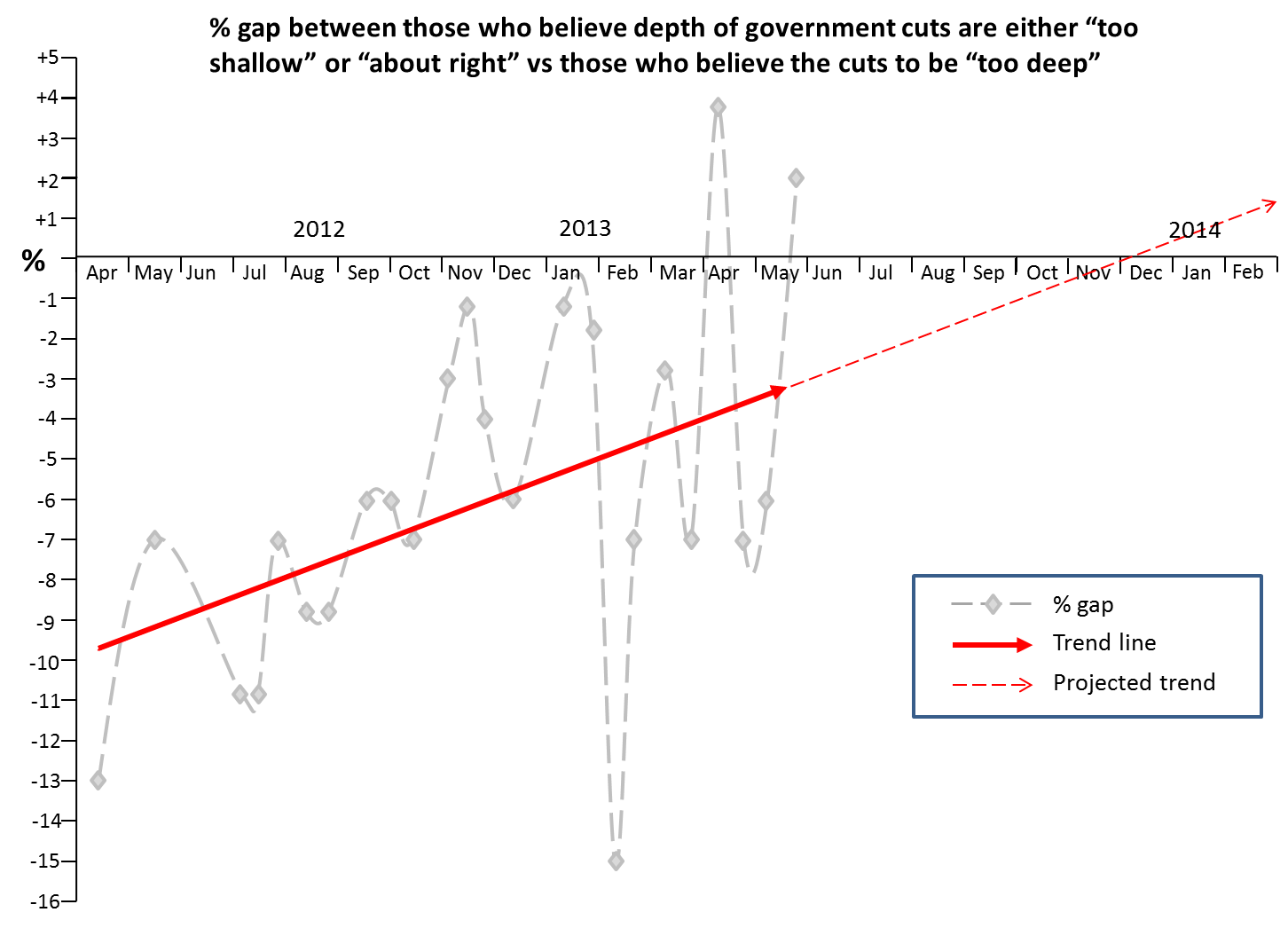
But the YouGov surveys also had seemingly contradictory responses. The key question is on whether the public believe the depth of the cuts to be “too shallow,” “about right,” or “too deep.” The answers to this question initially suggested a consensus that the cuts were too deep. But that is changing.

Source: YouGov

Since April 2012 when 13% more felt the cuts to be “too deep” than either “about right” or “too shallow”, the position has shifted radically. This week, the poll had the pro-cuts camp 2% ahead.

(more…)

Facebook Twitter Digg Delicious StumbleUpon

Labour history uncut: “We’re bunkered!” The red scare election of ‘24

20/05/2013, 07:17:07 PM

by Pete Goddard and Atul Hatwal

It was October 8th 1924 and Ramsay Macdonald was in high spirits. He noted in his diary,

“So the chapter ends after a great day when at the close we stood higher in the House of Commons than ever…We had knocked them all over the ring and they were ashamed of themselves”

Or to put it another way, “Good news everybody – our government has fallen,”

Parliament had voted for an inquiry into whether Labour pressure had caused the prosecution of the communist Workers Weekly editor, John Campbell, to be dropped. Macdonald had taken this to be a motion of censure, chucked himself out of office and called a new election for the 29th October.

He needn’t have, but there had been an election in each of the previous 2 years, so there was a certain symmetry to it at least.

Readers began to suspect a little bias in Shoot! comic

After a brief government characterised by caution and a gradual approach to social reform, Labour got its reward – accusations of communism and a campaign dominated by a virulent red scare.

The Times declared Labour’s commitment to establish a national network of electricity generating stations “a project dear to Lenin.” So think about that next time you’re boiling a kettle, you commie.

Conservative leaflets warned parents to be on their guard against “plausible men and women who invite their children to join Sunday school and clubs.” This was because such activities were, needless to say, a cover for children “to be baptised into the communistic faith.” Presumably the implausible men and women were absolutely fine.

(more…)

Facebook Twitter Digg Delicious StumbleUpon

Ed’s handling of Europe is eroding trust in his leadership

20/05/2013, 02:08:20 PM

by Dan McCurry

In 1997, Tony Blair won an election by occupying the traditional home ground of the Tories. In 2010, Gordon Brown fought off the Tories by creating a clear dividing line between us and them. Today, Ed Miliband’s strategy is less easy to define, but I contend that it involves avoiding debate with the Tories. This is not good. This can be extremely damaging.

Miliband said at conference 2012: “The Labour party lost trust on the economy. And under my leadership, we will regain that trust.” I don’t think he has increased trust in the Labour brand. In some ways it has been damaged since he made this speech.

The Tories have a far more coherent economic policy than we do. Even though the whole world agrees that we were right and they were wrong, they have a clear offer and we have a confused one. Ed Balls and Rachel Reeves did a terrific job of explaining the difference between austerity and Keynesianism, but our commitment to a Keynesian offer has been vague and tentative. This is in contrast to Gordon Brown who confronted and contrasted Tory policy with our own Keynesian plan.

Most of the debate on the economy is over now, and people have a settled view of the parties. It’s likely that we are returning to positive growth, although few would attribute this to the government’s policies, so it is questionable as to whether they will benefit at the polls, even if the feel-good factor returns. Trust, in general, is likely a more important issue at the next election.

The problem with trust is that it is a two-way relationship. Would you trust someone who doesn’t trust you? Of course not. Would you trust a politician who won’t tell you his policy? Of course not.

How about a politician who won’t tell you his policy, because the other guys will attack it, and he thinks that you are incapable of sifting the arguments? No, you wouldn’t take kindly to that either.

(more…)

Facebook Twitter Digg Delicious StumbleUpon

Miliband must make, not accept, the political weather

20/05/2013, 07:00:18 AM

by Jonathan Todd

“Are our problems so deep nobody can actually make a difference to them? My emphatic answer to that is yes.” The state of the nation was revealed in Ed Miliband’s slip of the tongue in the run-up to the local elections. Only one in three of those eligible to vote in these elections bothered to do so, down 10 points from when these seats were last contested in the halcyon days of 2009. Where given the opportunity, one in four voters gave their support to Ukip, which is as near as it gets to voting ‘none of the above’.

This is no glad, confident morning. It is a nervous twilight. “When Cameron talks”, as Rick Nye notes, “about the global race – the opportunities that lie ahead for Britain and the risks of being left behind” – those that voted Ukip “look at their very personal race, and fear it has already been run. They feel they have been abandoned by all political parties. It is no accident that Ukip does disproportionately well among older, non-graduate, white men.”

One Nation Labour is yet to convince that it can build hope in this cold climate. Politicians make, as well as experience, the weather, however. Perhaps voters would be more confident about the future if Ed Miliband seemed to them more of a prime minister in the waiting with answers to their problems.

Conservatives have long insisted that Cameron looks more prime ministerial than Miliband. Given that Cameron is presently the prime minister, this is to be expected. Yet Miliband is behind where Cameron and Tony Blair were at the same stages in their leaderships in terms of being perceived ready to be prime minister.

While 19 percent more voters thought Jim Callaghan “the best PM” than thought Margaret Thatcher in the last poll before the 1979 election, the sea change that was that election still swept Callaghan from office. His current polling may not be a barrier to Miliband being a similar sea change prime minister.

But Miliband should not assume such a sea change or that he would be its beneficiary. It’s hard to look at the rise of Ukip and feel we are living in a country moving to the left. This rise has contributed to Cameron finally abandoning his modernisation project and adopting policies reminiscent of their 2001 and 2005 general election campaigns: tough on welfare, strident on immigration and offering a referendum on the EU.

(more…)

Facebook Twitter Digg Delicious StumbleUpon