




The Sunday Review: Japan

06/11/2011, 01:57:32 PM

by Anthony Painter

Japan has a big society and blue Labourish solidarity. At the end of the 1980s and early 1990s it was seen as a competitor global economy to the US. Its ability to eschew individualism and embrace collectivism in pursuit of the long-term common good exemplified everything the Anglo-Saxon west wasn’t. This all went pop when its asset bubble burst and we haven’t heard much from it since – other than as a warning of what can go wrong.

Then, earlier this year, its east coast was decimated by a tsunami and the Fukushima nuclear reactor melted down as a consequence. Seemingly in a wave of sympathy, it was awarded the Guardian‘s long-haul tourist destination poll first place, with Tokyo taking top city spot. Germany, having weathered the financial storm better than most other major economies, now gets the most attention as an alternative social and economic model.

Japan has endured two decades of low growth as a consequence of a financial crisis which continued to have after-shocks throughout the 1990s and 2000s. But it has largely managed to adjust somehow – despite a rapidly ageing society, which in part contributes to ongoing low growth.

If the shorthand for conservative Labourism is “flag, faith and family”, then Japan’s motto can be summed up as “flag, firm, and family”. Its history can be summarised as a quest to maintain national independence.
(more…)

Facebook Twitter Digg Delicious StumbleUpon

By all means let’s be tough on crime, but let’s also be principled

04/11/2011, 01:00:40 PM

by Matt Cavanagh

During my years working on prisons policy, I used to think that if the government was being attacked at the same time from left and right, that wasn’t a bad place to be (at least if we were being attacked from the right for being too soft, and the left for being too hard, rather than from both for being incompetent). When I see the new government finding itself increasingly in this predicament – attacked from the right wing media, former home secretary Michael Howard and Conservative backbenchers for being too soft, and from the Guardian and the left for being too hard – I am instinctively inclined to sympathy.

Where does Labour stand? When the sentencing bill was first published in June, Labour was very critical – and justifiably so. This was the Cameron government at its worst: the familiar pattern of early nonchalance, followed by last-minute panic, with a hasty, botched result. Not for the first time the mess was covered up by a bravura performance from David Cameron, good enough to fool the media on the day, but merely delaying the unravelling – as some of us predicted at the time.

In contrast to this, last week’s final changes to the sentencing bill looked like government, if not at its best, then certainly in decent working order. A substantial disagreement between two ministers, May and Clarke, each with a legitimate stake in the policy, was carefully brokered by Downing Street into a coherent and balanced package. Media coverage predictably focused on the Cabinet “split” and the “humiliation” of Clarke, who was seen as the loser – gleefully by the right wing media, sorrowfully by the left. In fact, this was a genuine compromise. Clarke lost some battles, but won others, more than his disillusioned liberal friends gave him credit for. He successfully defended the distinction between adult and youth sentencing for knife crime, even if at a lower cut-off age, and insisted that new mandatory life sentences for second convictions for the most serious violent and sexual offences – the so-called “two strikes and you’re out” sentences – would be very tightly defined. The main reason Clarke was seen as the loser was because he was so unguarded about his bargaining position; in other words, because he showed the kind of honesty the media say they want from politicians, but tend to punish when they get it.

(more…)

Facebook Twitter Digg Delicious StumbleUpon

October shadow cabinet league table

04/11/2011, 09:09:24 AM

by Atul Hatwal

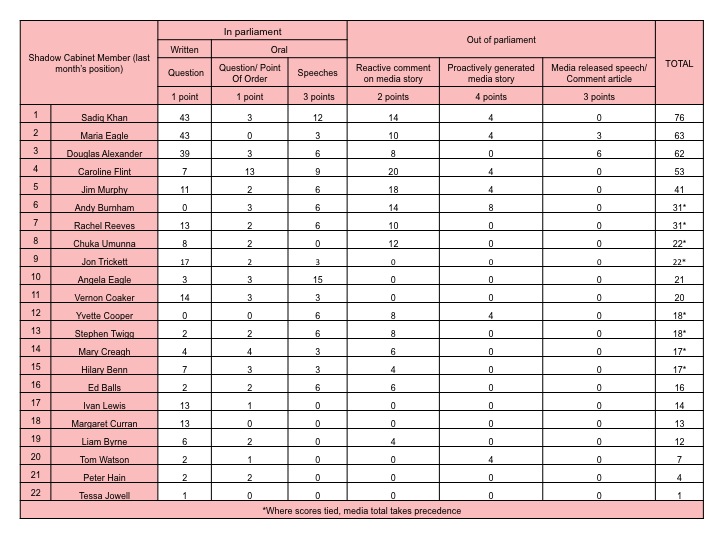
Back in June, based on a review of the first year’s performance in the shadow cabinet league, and the underlying politics of the party, I predicted four shadow cabinet exits – Meg Hillier, Anne Mckechin, Shaun Woodward and Tessa Jowell. Sure enough, the first three have departed, while Jowell has been moved down from Cabinet Office to shadow the Olympics and is expected to leave after the games next year.

The new shadow cabinet is four weeks old today. Contrary to Harold Wilson’s phrase, a week is not a long time in politics, and neither is a month. It takes years to build, or bring down, reputations.

Despite the anarchy at the top of the last Labour government over a period of years, Gordon Brown’s reputation for economic competence was remarkably resilient at the time. As is David Cameron’s despite his government’s economic record.

So the first month performance of the new shadow cabinet is unlikely to dramatically redefine the political landscape. But there are some hints at what the coming year might hold.

At the top, in amidst the familiar faces picking up from last term, Caroline Flint and Andy Burnham have pushed their way into the top six while three of the shadow cabinet newbies – Rachel Reeves, Chuka Umunna and Jon Trickett have staked out positions in the top ten.

(more…)

Facebook Twitter Digg Delicious StumbleUpon

Someone somewhere needs to paint a picture

03/11/2011, 07:30:07 AM

by Peter Watt

Boy oh boy do we need a vision. Let’s face it; our politicians look pretty rubbish at the moment. The Eurozone crisis means that to all intents and purposes, they are not free to act, not free to decide and implement and not free to make meaningful decisions.  Instead they, and we, are all now waiting for – well whatever the end game is in the Eurozone. All plans for growth are effectively just words. Office for budget responsibility forecasts are meaningless and future treasury planning looks pretty much fantastic.  Merkel and Sarkozy’s grand plan to save the Euro didn’t even last six days.

And this enforced paralysis is affecting all of the parties.

George Osborne, for instance, must be dreading his autumn economic statement. What the hell is he supposed to say? “Tax receipts are down, borrowing is up and the economy is stagnating but it would have been worse under Labour”. Well that will have them jumping up and down in excitement in marginal seats across the land. It may be true, or have an element of truth, but it’s hardly the stuff of political legend. (more…)

Facebook Twitter Digg Delicious StumbleUpon

The public bodies bill and sausages

01/11/2011, 08:47:52 AM

by Jon Trickett

There is a quote, whose origins allegedly range from Otto von Bismarck to an unknown Illinois state senator, that rings painfully true about the last year of the public bodies bill: there are two things you never want to let anyone see you make – laws and sausages. Quite. The process by which ministers have gone about reducing the number of quangos in the UK has been messy, and in many ways circumvented the norms of Parliamentary process.

I don’t disagree in principle with the aims of the bill. Indeed, in March 2010 we set out almost £500m of new savings by reducing the number of arms length bodies by 123 by 2012/13. Labour inherited 1,128 quangos in 1997 and axed almost 400 of them by the time we left office. There is certainly scope for consolidating them to reduce overheads but retain functions.

But the way in which this process has proceeded has been characterised by the same hasty, ill-thought-through approach to governing that we can see across all government departments.  The ideology of cutting without thinking, swinging without looking, with a lack of clear vision or philosophy on the functions of government, pervades the very core of this bill.

The majority of the bodies in the bill were set up as a result of reasoned and detailed debate in Parliament. The only appropriate way to consider abolition is with the same reasoned and detailed debate. Cabinet office ministers claim that detailed debate on each body will come at a later stage, but we know that secondary legislation isn’t typically dwelled on in Parliament to the extent that some of these bodies would deserve.

(more…)

Facebook Twitter Digg Delicious StumbleUpon

Cameron’s history notes 1: Achilles, revisited

31/10/2011, 09:48:16 AM

by Rob Marchant

Last week, David Cameron had a bad week. But it’s important to understand what kind of bad week. He’s had not a defeat, but a sour victory in the Commons against his own rebels. But so did Tony Blair on two memorable occasions – Iraq and tuition fees – when he feared that he might have to resign, and didn’t. These things, although nerve-wracking at the time, are to some extent part and parcel of being a prime minister.

The extent of the defeat, though large, was to be expected over an issue as touchy as Europe and the relative weakness of his electoral position. However, neither does his government look “in office but not in power”, as Norman Lamont described the Major government. And his rebuke by Sarkozy, for trying to interfere in a subject, the euro, which Britain long ago put on the long finger, was also to be expected.

Many have adversely criticised his handling of the Commons vote, saying that he was looking for a fight; but it is hardly his fault that half of his backbenchers defy rationality on this subject. And some believe that, despite the bad headlines, he called it right. (more…)

Facebook Twitter Digg Delicious StumbleUpon

Workforce reform will support not attack our public services

28/10/2011, 07:46:15 AM

by Kevin Meagher

The answer, we believed at first, was more spending. Our dilapidated public services had become so because the Tories had run them down during the 80s and 90s. Catch-up investment was necessary. And Labour delivered it with gusto: doubling the amounts spent on education and trebling the NHS budget.

Then we realised that investment was not enough; there was a need for reform of our public services too. So we introduced performance management and targets. Resented by some public sector professionals, they were at least an attempt to iron out the differences in the quality of service provision across the country.

But we never quite got round to the last part of the puzzle in improving public services: workforce reform. This was always a no-go area for Labour ministers, even for the most swivel-eyed Blairites. Where, broadly, Brownites emphasised resources and Blairites structural reform, no-one wanted to be seen to imply that our teachers, nurses and police officers were not doing a good job.

But the evidence shows that too many of them simply are not. (more…)

Facebook Twitter Digg Delicious StumbleUpon

“Same old Tories” trumps “same old Labour”

27/10/2011, 07:30:50 AM

by Peter Watt

Politically, life suddenly seems a little easier at the moment. Well from a tribal Labour perspective anyway. The last few weeks have been dominated, domestically, by stories and events that are, on the face of it, very bad for the government, and therefore good for Labour’s electoral prospects.

The economy is flat lining at best and possibly dipping into a downturn. Unemployment is rising and the private sector isn’t creating jobs as fast as the Tories hoped. And all of that before our friends in France and Germany finally decide, or more worryingly don’t decide, how to save the Euro and at who knows what cost to the rest of us.  Then there is the NHS which the Government seems intent on screwing up.

I actually don’t buy into the line that says the NHS is about to implode, but what is in little doubt is that the Lansley “reforms” have been a right cock-up from the start, unnecessary at best and gratuitously stupid at worst. And then there are rising crime levels, increased levels of public and business pessimism and Liam Fox reminding people of the impression of corruption that dogged the Tories in the past. (more…)

Facebook Twitter Digg Delicious StumbleUpon

Major was fearful, Cameron is hubristic – the result is the same

24/10/2011, 01:09:05 PM

by Jim Murphy MP

People watching political events unfold over the last few weeks will have felt a sense of familiarity. A minister resigns amidst scandal. Eurosceptic Conservative backbenchers threaten mass revolt. Inflation and unemployment are steadily high while the government looks on. A party of government turns inwards when the country seeks leadership. A prime minister appears at the mercy of events rather than in charge of them.  This is the Conservative government in the early 1990s, but now David Cameron has taken the role of John Major. And just to complete the set the Stone Roses have announced they are reforming.

We all remember the sleaze scandals of the 1990s. A minister resigned after lobbying on behalf of a businessman.  Two PPSs and two ministers resigned following ‘cash for questions’.  Current minister Alan Duncan resigned after making £50,000 from a deal on a council house. Jonathan Aitken was accused of secretly doing deals with Saudi princes and then sent to jail for perjury. And we do not need reminding of ‘toe job to no job’.

The Fox resignation was a different type of crisis.  Liam Fox was found to have broken the ministerial code on multiple counts. His unofficial adviser was used to orchestrate a shadow political operation which undermined the civil service. He appears to have solicited undeclared donations.  His and Mr Werritty’s funders have well established links to the Conservative party.

The nature of the wrongdoing has been clear for some time, but the full extent has yet to be revealed by a prime Minister who has refused to take responsibility for a crisis that happened on his watch inside the most sensitive of government departments. David Cameron will still not answer our questions.

In a similar way as John Major’s “back to basics” speech jarred with the actions of his ministers and MPs, so David Cameron’s words in the ministerial code “We must be…transparent about what we do and how we do it…above improper influence” jar with his actions during the Liam Fox scandal.

David Cameron may not have labelled some in his party as ‘bastards’ over Europe, but few would bet against him sharing that sentiment at the moment. Just as with John Major, at a vital moment for the future of the EU and therefore Britain a Tory government is debating internal party politics.  Rather than engaging seriously with the Treaty which led the EU to come into existence John Major was desperately scrabbling for votes in the House of Commons.  Rather than concentrating on the growing crisis gripping the European economy David Cameron is having showdown meetings with his MPs. (more…)

Facebook Twitter Digg Delicious StumbleUpon

Alone in Sirte

24/10/2011, 12:35:01 PM

by Jonathan Todd

Human rights, by definition, are held by all humans. In spite of Lockerbie, Yvonne Fletcher’s murder and his tyrannical 42-year misrule of Libya, Muammar Gaddafi was human. He, therefore, deserved a fair trial in a Libyan court or in The Hague. That he would certainly have been found guilty before such a court does not detract from the belittlement, both of those denied and those who deny, inherent in denying fundamental human rights.

Justice can never come from the mob; only vengeance. No matter how understandable the desire for vengeance, it is not justice. It is wonderful that Libya now has a chance for freedom, so long prevented by Gaddafi. The West should respond with a carrots and sticks offer of support as transformative as that offered to Eastern Europe by the EU after the fall of communism. But it would be a more fitting and solid foundation for this epoch had it begun with an act of justice, not with what seemed more like the fall of Mussolini than the Nuremburg trials.

No one is quibbling in Libya now, I know. Still, to have the despotic brought to heal by institutions of justice seems, in the longer run, likely to be a more cathartic basis for the oppressed to recover than to visit violence with violence. This catharsis is rooted in showing that order now comes from the rule of law, not from crude strength or even a golden gun. History teaches us that violence tends only to beget more violence. (more…)

Facebook Twitter Digg Delicious StumbleUpon