




As George rises, so do economic questions for Labour

03/10/2011, 12:59:56 PM

by Jonathan Todd

Ed Miliband’s speech leaves him better defined. George Osborne will be hoping the same doesn’t happen to him today. Definition is the last thing he needs at the moment. His strategy is clear: cut long and hard. It is his plan b that is anything but clear. Many of Miliband’s economic themes also remain to be fully unpacked. Perhaps his most consequential line on the state’s size was:

“If this government fails to deal with the deficit in this parliament, we are determined to do so”.

“Deal with” in the next parliament might mean the elimination of the deficit, as this is the government’s objective for this parliament. I’ve mused on the present status of Labour’s commitment to halve the deficit in this parliament, as has Ed Balls. This interpretation potentially enforces more aggressive deficit closure in the next parliament under a Labour government than we are prepared to support in this.
This is one of various potential strategies for addressing Labour’s enduring perception of profligacy:

First, the past: apologise for “over spending” in government. More contrition for particularly egregious spending, such NHS IT procurement, might help. But, if adopted wholesale, this seems likely to play into the hands of George Osborne’s narrative that Labour “over spending” caused the problem that he is now “fixing”.

(more…)

Facebook Twitter Digg Delicious StumbleUpon

How the mighty are fallen

03/10/2011, 09:10:35 AM

by Tom Harris

Annabel Goldie is a nice woman. She is intelligent, likeable and formidable in almost perfect proportion. And it is a cruel irony that only in a pre-devolution era could Annabel ever have been considered as a serious candidate for the post of Scotland’s first minister.

In the week when she delivers her swan song as Scottish Tory leader to her party conference, she will have cause to reflect on the past and future of the party she has led since 2005. And to consider whether or not it actually has a future.

And as my own party continues to come to terms with our defeat in our heartlands and whether or not we have a future, we might feel a twinge of sympathy with Annabel.

A feeling common to us both is frustration. There are capable, principled people in both our parties who continue to be denied ministerial office. In our case we hold out hope that the drought might end in four years’ time. For the Tories things are even worse; barring some unprecedented political earthquake or extinction-level event such as a collision with a stray asteroid, they are doomed to be neither the largest party in Holyrood nor the preferred coalition partner of any other party – even the Scottish Lib Dems wouldn’t be seen talking to them publicly. Things in the playground are rough indeed when even the weird kid who eats stuff for money won’t play with you.

The frustration of opposition is part and parcel of democratic politics, but we’re the Scottish Labour Party, for crying out loud. Scotland is where we weighed votes, went the old (and wrong) received wisdom. Annabel’s frustration has the same root: hers is the only party ever to win an actual majority of the popular vote in Scotland (50.1 per cent in 1955, for the anoraks among you). And now? (more…)

Facebook Twitter Digg Delicious StumbleUpon

You need more than courage to win

30/09/2011, 01:34:08 PM

by Dan Hodges

We have to understand. We need to grasp what has just happened to the Labour party.

Ed Miliband did not have a bad week. He had a grotesque, cataclysm of a week.

When the Leader of the Opposition finds himself having to rebut charges he’s “weird” you know something is amiss. But if you spend the whole of your own conference rebutting you know the wheels are detaching. And by Thursday morning there were more wheels bouncing around Albert Dock than a formula one pit lane.

Rebutting the idea the NEC was going to move to have Tony Blair indicted for war crimes.  That the party intended to licence journalists and kick out onto the streets those it caught misbehaving. That Ed Miliband planned to march into the Big Brother house and evict the lot of them.

And they were just the noises off. The fact Labour’s leader has no idea who his Scottish counterpart is was a mere footnote. The rapid unravelling of the tuition fees pledge a long forgotten irritant.

Just to put things into context, here are the responses from three shadow cabinet members to Ed’s speech on Tuesday. “I don’t understand what he was doing”, said one. “I feel physically sick”, said another. “I’m in shock”, said a third.

Those are members of a Labour shadow cabinet. Not minions of the Murdoch Empire, or Cameron cronies. Nor are they cartoon Blairites. They are serious politicians who want to see their party back in government. And they were, literally, in despair.

I just cannot understand Ed Miliband. He did not suddenly roll into town on a turnip truck, but worked at the very heart of the New Labour project. He may not have been a fundamentalist, and he saw at close hand the excesses and psychodramas.

But he is also a serious politician. He knows full well how an attempt to label elements of the business community as “predators” will be branded. What it means for a leader of the Labour party to turn his back on “consensus” politics. How, after a year of trying to cleanse the “Red Ed” stain, a speech which involved sticking two fingers up at the British establishment would be received. (more…)

Facebook Twitter Digg Delicious StumbleUpon

Post conference blues: Three dangers that will turn a leadership drama into a crisis

30/09/2011, 07:00:14 AM

by Atul Hatwal

So farewell then, Labour conference.

It’s done. The headlines were bad, the political management was poor and the top trending story for part of the last day was Ed Miliband’s denial that he is “weird“.

In amid the detritus of the retreat from conference, talking to folk leaving the security bubble, one apparent point of consensus was that Ed Miliband had definitively secured his grip on the leadership.

Andrew Sparrow even rated it the number one fact in his top ten list of things he learned about the Labour party at conference.

Hmm.

It’s true there is no cabal ready to mount a coup and there was no talk of imminent insurrection either in the bars or the fringes.

But appearances can be deceptive.

Conference has not given the leader the boost either within the party, or out in the country, that he needed. In the polls so far there’s been no bounce, not even the dead cat variety. In fact the fear in Liverpool was the reverse – that his ratings would slip slightly given the coverage of his big speech.

(more…)

Facebook Twitter Digg Delicious StumbleUpon

Vision and denial

29/09/2011, 03:02:32 PM

by Rob Marchant

“The system has failed”, ran the original headline for the speech write-up chosen by the BBC, though they later changed it. But it has not.Britain has problems, yes. But it is not, in Cameron’s words, broken, however politically convenient it might be for either party to use that as a basis for change. And this was by no means a terrible speech; but its fundamental premise of moral decline was flawed, and it became a disappointing, and slightly alarming one.

In fact, in the wonderfully reassuring and welcoming bubble of a party conference, it is rather difficult to give a truly bad speech. The trick is not to sink into the soft, comfy armchair of audience acclaim and be drowned in its melting, enveloping embrace, like in some bad horror movie. Crowd pleasing is easy but, as Ed is only too aware, the real audience is outside.

There were some good things in the speech. Although even an outline of the solutions was nowhere to be seen, ultimately, the “squeezed middle” theme is a broadly correct analysis. There was the “You can’t trust the Tories on the National Health Service” passage on the NHS, made for the TV bulletins and an effective attack line against the Tories which will resonate.

But the speech was not about worrying Cameron (who I doubt will have broken sweat at any moment during the speech), so much as about convincing the public that Ed is prime minister material, and setting out direction of travel. (more…)

Facebook Twitter Digg Delicious StumbleUpon

Fiddling while Athens, Lisbon and Rome burn

29/09/2011, 08:44:38 AM

by Peter Watt

I am worried, really worried. And not just about where the Labour party goes after this week’s leaders speech. Although I certainly am worried about that.

No, what really worries me is the economy. Although I am no economist I can read the runes. Europe and America’s economies are in trouble, big trouble. Unemployment is rising. And every day seems to bring a new round of the latest economic indicators – and they indicate that something really bad is happening.

Think back to when Gordon Brown was busy saving the world. We were shocked that banks, those rock solid bastions of capitalism, could actually fail. I remember the uncertainty and fear in those months, when it seemed that the economic system, as we knew it, could collapse. Shops started closing on our high streets. Where were you when Woolworths closed?

Interest rates and the stock markets were in free fall. And the numbers being used to describe the scale of bailouts were so big that they seemed meaningless. In fact, what we now know, thanks to the memoirs of Alistair Darling and others, is that in reality the situation was even worse. Some pretty big high street banks were hours away from turning off their ATMs. (more…)

Facebook Twitter Digg Delicious StumbleUpon

Labour’s change curve

28/09/2011, 03:30:53 PM

by Atul Hatwal

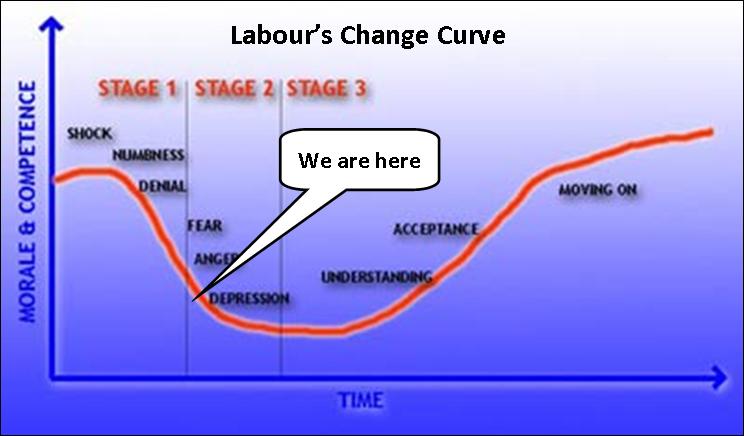
Originally conceived by psychologist Elizabeth Kubler-Ross in 1969, the change curve was formulated as a way to understand how people cope with catastrophic loss or terminal illness.

You get where this is going.

Subsequently, it emerged that the change curve accurately described the stages an individual or an organisation go through when they experience profound change. If you’ve been through a big change management programme at work, chances are, this will have played a big role in shaping it.

Defeat at the general election was as big a shock to the system as Labour has ever experienced. Since then, the party has recongnisably gone through the initial stages of the curve. Numbness, denial, fear and anger are all emotions the party has displayed in the past fifteen months.

This week, as Labour has gathered in Liverpool, the curve crystallises a sense I’ve had for a while and explains some of what the party seems to be feeling.

There’s been a curious insouciance about Labour this conference. The rules of political gravity appear to have been somehow suspended.

(more…)

Facebook Twitter Digg Delicious StumbleUpon

Cook and Prezza can teach the shadow cabinet how to do opposition

28/09/2011, 01:15:51 PM

by Kevin Meagher

“My top demand of my shadow cabinet, my party, my team, is this: ambition”.

So said Ed yesterday. But not all agree that message has been getting through.

“This is a Tory government that’s doing some outrageous things and we haven’t had many words of protest”, says a less than impressed John Prescott. “Ed, you’re the leader, get a shadow cabinet who’ll do that”.

Fortuitously, the rule change passed earlier this week now allows a Labour leader to dispense with the ritual shadow cabinet elections, thus presenting Ed with a tempting new freedom. But rather than release his inner Alan Sugar, he should withhold firing any of his coasting colleagues. For now.

Like any responsible manager, Ed should look to see how he can develop his team rather than hand them their marching orders. After all, that is what “good” business people do.

Anyway, a reshuffle at this stage looks like a panic measure, an implicit acceptance that this first year has not yielded all that it might have against the backdrop of the government’s swingeing cuts and inept economic management.

(more…)

Facebook Twitter Digg Delicious StumbleUpon

Victims’ rights: better but not good enough

27/09/2011, 03:00:33 PM

by Sally Gimson

Jenny Chapman and Jacqui Smith recognize, in their contribution, Cutting Crime and Building Confidence, in The Purple Book Cutting Crime and Building Confidence that victims need far greater power within the criminal justice system.

Understanding what it was like to be affected by crime helped make criminal justice a Labour issue. It was one of the big achievements of our 13 years in power.

As Chapman and Smith point out, Labour recognised that crime was a social problem which affects the poorest most. “Those,” they argue, “with the least clout and power suffer most from crime and antisocial behaviour”.

And it was these issues that Labour concentrated on, introducing anti-social behaviour orders and putting police officers back on the streets with a remit to report back to local people.

Neighbourhood policing teams were introduced in every area of the country and a policing pledge, now scrapped by the Tory-led government, laid down minimum standards such as targets for responses to 999 calls and monthly “beat meetings”.

Labour home and justice secretaries also boosted victims’ rights,  introducing a victims’ code and creating the post of victims commissioner, held by Louise Casey.

Chapman and Smith outline these achievements and the fall in crime which happened as a result.

But now they say Labour must go further. And that existing Labour councils can lead the way by getting local communities more involved in local policing.

(more…)

Facebook Twitter Digg Delicious StumbleUpon

The deficit: it’s double or quits all round

27/09/2011, 08:42:08 AM

by Jonathan Todd

The politics of the deficit has had two phases. The exposure on the FT’s front page last Monday (19 September) of a £12bn hole in public finances means we are entering a third.

The June 2010 budget divided the first and second stages. Up until then, and throughout the general election, the debate focused on whether to cut in 2010. Labour and the Liberal Democrats warned that Conservative plans to do so were reckless. Then we lost the election and the Liberal Democrats helped the Conservatives implement these cuts.

The debate that was long needed – how to approach the deficit beyond 2010 – didn’t open up until the June 2010 budget. The imprecision of Labour’s plans kept a lid on this debate until then. George Osborne lifted this lid with all the force of a dominatrix once he had the bully pulpit of the treasury. The message that Labour had mismanaged public finances and that Osborne would fix this over this parliament was incessant. It is, however, starting to become clear that Osborne won’t be able to do this.

The third stage of the deficit debate is about acknowledging this failure. The £12bn hole in public finances is a consequence of growth not keeping pace with that anticipated by Osborne. Anaemic growth produces shrivelled tax returns, which are the stuff of public finance holes. There is some debate about whether the holes are really so. But, short of sudden improvement in our growth, there will be inarguable holes before too long.

All parties face choices.

(more…)

Facebook Twitter Digg Delicious StumbleUpon