



Can trees really be more “sexy” than people?

07/07/2011, 08:49:18 AM

by Peter Watt

Prepare to be bored. This post will probably not particularly interest you. At a push, it may strike you as being earnest, but quite frankly, not very sexy. It doesn’t slag anyone off. It doesn’t condemn the leadership and it doesn’t insult Nick Clegg or a single Tory. It does though raise an important issue of social justice and fairness.

On Monday, just before the appalling revelations about the News of the World, hacking and Milly Dowler broke, and understandably dominated the headlines, the Dilnot report, “Fairer care funding” was published. It is the final report of the commission on funding of care and support, which has spent a year looking at how we can pay for the care of vulnerable adults over the coming years. It is a massively important and well-crafted report that sets out a realistic financial model of how we can pay for the costs of an ageing society in years to come. I have written about this issue before, because the status quo simply cannot continue – the system as it is, is broken.

Labour needs to take a fair bit of responsibility here. After all, we had thirteen years to fix the system and didn’t. We had a number of our own reports and commissions and then we quietly buried their conclusions. You can understand why. It is a brave politician indeed that stands up and says to the public, “You know that you think that the NHS will look after you when you are unable to look after yourself, well actually it won’t and in fact it never has”. But, as research undertaken by Dilnot makes clear, the truth is that people do assume that. And it really isn’t something that you spend a lot of time worrying about when the issue doesn’t affect you.

The cold hard reality is that the costs of paying for social care are, on the whole, borne by those that need the help. So if you need hot meals delivering, help at home, a few days a week at a local day centre or to move into residential care and you have more than £23,250 in assets, then you have to pay. Your savings are used up, your family may have to chip in and your home may be sold so that you can receive the care that you need.

With local councils’ budgets being tight, you have to be pretty infirm to be able to get any help provided at all. If you think that you need help, then your local authority should first carry out an assessment to determine how infirm that you are. This assessment will categorise your needs as being low, moderate, substantial or critical. Generally they will only help if your needs are substantial or critical. You will then be assessed financially and it will be determined how much, if any, of the help you are entitled to will be paid for.

If you need help and live in a home that you own, your assets will clearly exceed £23,250.  And just to bring it life, “moderate need”, for which you are very unlikely to get any help at all, means that you may not be able to get to the shops, bath or shower or get out to meet your family or friends independently.

Suddenly finding that you or a loved one needs help either at home or residential care can be frightening, stressful, emotional and financially catastrophic. Help at home can cost between £10 and £20 per hour. The average cost of a room in a nursing home is £36,000 per year. The bills really do start to rack up quickly.

So back to Dilnot. These are not proposals for the state to pay for everything. The commission accepts that individuals should contribute something from their own assets towards the cost of their care and accommodation. Instead, there is a proposal for a partnership between the state and individuals that removes the uncertainty. Under the proposals, we will each be responsible for meeting some of the costs of our care but the extent of our exposure will be capped at £35,000. The capital limit will be raised from £23,250 to £100,000. After that the state will kick in and pay the rest.

The proposal means an extra £2 billion or so in spending by the state a year, about 0.25% of public spending. And for that we get peace of mind that in our old age we won’t face the fear and uncertainty of not knowing how much or who will pay if we need it. Most people will still pay something towards their care. But for that £2 billion we can ensure that those with modest means will not be unduly penalized following a life of hard work and saving. And we can ensure that the poorest are protected.

It might not be at the sexy end of politics. But it matters. Right now the government is deciding on what to do with the recommendations. To be fair to them; it is a tough call. Like any balanced proposals, there are elements that will both appeal and repel the various strands of political opinion. And that is why we should all be helping to persuade them that this is not about party politics or point scoring. It is bigger than that.

Ed Miliband has promised to enter into all party talks and that is to be hugely welcomed. But we should all be writing and emailing our MPs to say that the government should, after considering and consulting, support and implement the commission’s findings as soon as possible. When there was a proposal to privatise a small proportion of the national forests there was uproar. Hundreds of thousands lobbied their MP. It sent a signal. Well this isn’t about trees; it’s about people. And that same uproar sadly appears lacking.

At the moment the government is promising a white paper by the spring. If the timetable slips, then it will be a sure sign of prolonged delay. Right now people are suffering, frightened and uncertain about their future because of a broken system. This is an opportunity to fix it.

Peter Watt is a former general secretary of the Labour party.

Facebook Twitter Digg Delicious StumbleUpon

Commons sketch: PMQs

06/07/2011, 01:33:42 PM

by Dan Hodges

It must have been a bit like this in Paris in 1793. The cruel expectation. Morbid anticipation. Come, witness the brutal righteousness of the mob.

For years MPs had lived in fear. Of the late night phone call, or knock on the door. “I’m calling from the News of the World. We’re running a story about you tomorrow, and I wondered whether you’d care to respond”.

Not today. The chamber was packed as MPs fought for the best position to view the spectacle. On the Labour front bench Harriet Harman took out her knitting. On the other side Ken Clarke was handing out souvenir postcards.

Then in walked David Cameron. Head of the Committee on Public Safety. Directly opposite sat Ed Miliband, his deputy. It’s an open secret the two men are bitter political rivals. But the Head of the Committee was confident that for now they would unite in the interest of the people against the common foe.

The prime minister pulled himself up to his full height. He looked sober and statesmanlike. Just as his former advisor, ex-News of the World editor Andy Coulson, had taught him.  Phone hacking was ‘absolutely disgusting’, he said. Everyone in the House and in the country would have been ‘revolted’ by what they’d seen and heard on the television screens.

It was a strong sound-bite, and Cameron sat back down confidently. His attack on the newspapers would read well in tomorrow’s newspapers.

Ed Miliband rose. The actions of the NOTW were, ‘immoral and a disgrace’. His delivery was strong and measured. His own senior media advisor, former News International journalist Tom Baldwin, had also prepared him well.

The prime minister’s assurances on a public and independent enquiry into the actions of the media were welcome. But what about other issues? Such as the impending BSkyB bid? He had argued it should be dealt with by the competition commission, not the new revolutionary council. It was what the people were demanding.

Cameron looked uneasy. It wasn’t supposed to be him on trial. As the crowd began to bay his face reddened. There were laws. They had to be followed. His rival was opportunistically playing to the gallery, ‘I note that the leader of the Labour party said yesterday that the issue of competition and plurality is a separate issue’.

Ed Miliband shook his head slowly. Weak. Very weak. The people do not like weakness. ‘The public see a major news organisation in this country where no-one appears prepared to take responsibility for what happened’, he said. There was no denial that Milly Dowler’s phone had been hacked. ‘Nobody is denying it happened on the watch of the current chief executive of News International, who was editor of the newspaper at the time. Will the prime minister, if he believes in people taking responsibility, join me in saying she should take responsibility and consider her position?’.

There was now fear in the prime minister’s eyes. What about due process. It had to be followed. We should let the police do their work.

It was useless. By now the mob was in full cry. And the mob belonged to Ed Miliband.

‘These events show a systematic set of abuses that demonstrate the use of power without responsibility in our country’, he said. It was in the interests of the public and democracy that these issues were sorted out. The Head of the Committee on Public Safety, ‘hasn’t shown the leadership necessary today. He hasn’t shown the leadership necessary on BSkyB. He hasn’t shown the leadership necessary on News International’.

David Cameron sat silently. Behind him, sunlight glinted upon cold steel.

Dan Hodges is contributing editor of Labour Uncut.

Facebook Twitter Digg Delicious StumbleUpon

As Huhne divides, Labour must conquer

06/07/2011, 10:06:50 AM

by Jonathan Todd

Stewart Lee describes David Cameron with his arm around Nick Clegg as being akin to “a bloke who has bred a prize pig”. The Liberal Democrats have been slaughtered to ten per cent in opinion polls and Cameron boasts of being “in a position in four years time where we win the general election and govern on our own”.

While Tories love this bullish talk, the plan for the “pigs” fight back is more obvious than that which will deliver Cameron this outcome. The NHS bill has shown what can be expected from the Liberal Democrats. Pick fights with their governing partners – even if this necessitates reneging on past commitments. Extract concessions. And present the outcomes as injecting Lib Dem sanity into the Tory madness.

In 2003, the Tories complained about the Liberal Democrats producing a “disreputable” campaign guide. It advised candidates to “be wicked, act shamelessly, stir endlessly”. The Tories might suspect that Lib Dem ministers have dusted it down. Chris Huhne seems eager to manoeuvre. He has attacked his Conservative colleagues as “rightwing ideologues”. He is, obviously, looking for a “win” on the environment.

Huhne’s constituency was Tory target seat number 12 last year. It is reported that Cameron will “not lift a finger to help” Huhne if he is found to have lied to the police. This disinclination may reflect bad feeling over the AV referendum. Huhne’s spoiling for a policy fight is unlikely to rebuild burning bridges. (more…)

Facebook Twitter Digg Delicious StumbleUpon

The big monkey and the emperor’s new rainbow

05/07/2011, 07:38:38 AM

by Dan Hodges

Enough now. We’ve had our fun.

Blue Labour. Purple Labour. Green Labour. A veritable kaleidoscope of renewal.

Each, in their own superficial way, has been easy on the eye. The force of nature that is Maurice Glasman, the Labour party’s very own Norman Mailer. The defiant defence of the Blairite bunker, and the refusal of the last tiny band of hard core New Labourites to march quietly into the night. The Compass-ite left’s touching unwillingness to relinquish their dream of a progressive realignment, even as Nick Clegg smashes it to pieces in front of them.

But now the colours which dazzled have become garish. Where once they complemented, now they clash. There is no structure, however abstract, emerging. We are simply producing a mess.

Too harsh? Go and dig out Sunday’s Murnaghan. Relive the spectacle of two Labour shadow ministers, Caroline Flint and Diane Abbott, knocking lumps out of each other as they scrap over Maurice Glasman’s latest pronouncements on immigration policy. It was like watching an episode of the Jeremey Kyle show; “Maurice has been flirting with both Caroline and Diane, and they’re not happy. So we’ve brought them all together to fight it out. Live”. (more…)

Facebook Twitter Digg Delicious StumbleUpon

The govt must swallow its pride and adapt to the Arab spring

04/07/2011, 09:32:38 AM

by Michael Dugher

The foreign secretary, William Hague, has said that the impact of the Arab spring is potentially greater in significance than even the attacks of 9/11. After 9/11, Labour in government produced a “new chapter” to the 1998 defence review, precisely to face up to the shifting strategic landscape and emerging threats to the UK. A new chapter to the 2010 SDSR is desperately needed today.  This would bring the review up to date and make a full assessment of the impact of the Arab spring on UK security.  As Jim Murphy has said: “It’s not about looking backwards, but about turning hindsight into foresight.”

Lord Levene’s more managerial review into MoD reform was published last week. As far as it goes, it is good. Labour welcomed many of its recommendations. Indeed, Bob Ainsworth, Kevan Jones and others deserve much of the credit, as several ideas in the report stem from the defence green paper, adaptability and partnership, which the previous Labour government produced in February 2010. As the official opposition, it is as much our responsibility to support the government when its proposals are right as to oppose when they get things wrong.

Changes such as a smaller defence board inside the MoD, and greater clarification of responsibilities and the accountability for the individuals within the department, are much needed, not least to overcome the sometimes fractious command structure that has too often been based on inter-service rivalry. As Labour suggested in the 2010 green paper, the creation of a joint forces command in particular should help to change the face of our armed forces for the better and play a crucial role in helping them combat future threats to the UK. It will encourage more joint operations and enhance our ability to integrate out activities across land, sea and air, enabling joined up logistics and better communication.

(more…)

Facebook Twitter Digg Delicious StumbleUpon

Sunday Review: The great stagnation: how America ate all the low hanging fruit, got sick, and will (eventually) feel better, by Tyler Cowen

03/07/2011, 10:30:20 AM

by Anthony Painter

There is a complacent assumption that austerity will pass. As soon as our course is corrected, then the upward charge begins again. The sunny uplands of things only getting better will return. Just in case you were feeling a wave of optimism, these assumptions that have served us well for a couple of centuries and more may no longer apply. We have entered a great stagnation. Or so Tyler Cowen thinks.

Whenever things are bad there’s always a Malthus on the scene and in his short book, The Great Stagnation, Cowen is one of the candidates for the vacancy of pessimist for our times. He tells America that it will eventually feel better, but that’s just the soothing words of a doctor refusing to dispirit a terminally ill patient. You’ll have more bad days than good with this illness. This is not to dismiss this pacy and powerful book or the argument he expounds within it. It’s just not ultimately convincing.

The thing about Malthus figures – and I’m using this in a broad sense of pessimistic accounts about our economic future – is that they are occasionally right. There are occasional disasters – economic or otherwise – so if you predict them you are going to be right now and again. When you are right then you become a global celebrity. Just ask Nicholas Nassim Taleb. It is important, though, to be right for the right reasons a much as it is to be right per se.

(more…)

Facebook Twitter Digg Delicious StumbleUpon

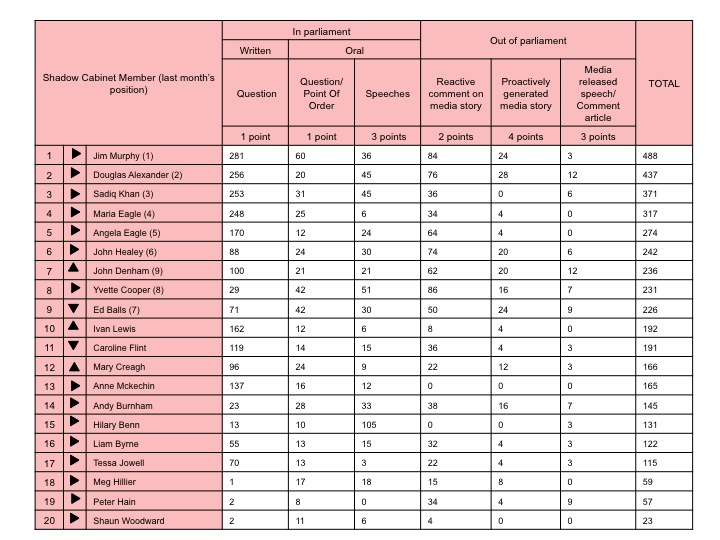
June shadow cabinet league table – and where the knife may fall in future

01/07/2011, 09:27:52 AM

Murphy holds onto top spot but all eyes on the bottom as relegation comes closer

by Atul Hatwal

June saw Jim Murphy retain his position at the top of the league, albeit with a reduced lead as Douglas Alexander closed the gap between first and second. But the real interest lay in what was happening at the bottom following the news that the leadership intends to scrap shadow cabinet elections.

Assuming Ed Miliband’s writ runs, the prospect of relegation this year for shadow cabinet under-performers has suddenly become a real possibility.

It’s something that Uncut readers backed overwhelmingly last month with over 70% voting in favour of relegation before the next shadow cabinet elections. And it would certainly be peculiar for Miliband to fight for this change and then not use his new power.

(more…)

Facebook Twitter Digg Delicious StumbleUpon

Pub quiz question: who is the leader of the Labour party?

30/06/2011, 08:42:14 AM

by Peter Watt

I don’t know what’s wrong with me this week. I just feel miserable. I have even got to the point that I can barely be bothered to tweet, and that really is a bad sign. But why am I feeling flat now? I mean, for months now, I have been worried about what seemed to be the direction of travel of the party with dog whistles to the left. For months I have worried that the outcomes of the party reform debate would be a damp squib. And for months I have worried that we seemed to be all but leaderless.

So on that basis, surely in the last few weeks things have started to look up? Ed has begun to define himself and his philosophy of “social justice with a hard edge” and an end to the “take what you can culture”. And he has shown real leadership on party reform by demanding an end to elections to the shadow cabinet and hinting at reforming the relationship with the trade unions. For me, these still don’t go far enough and probably could have, and should have, been said months ago. And, crucially, we still have little or no credibility on the economy.

But it absolutely has to be welcomed, and with four years to go until the next general election it is a start. Despite some people feeling uncomfortable about the new approach, on the whole the party seems buoyed after a difficult few months. David Cameron has looked rattled at PMQs and the U-turn taunts hurt because they reflect a very real problem for him and his government. We can probably relax just a bit until conference season. The beach beckons. (more…)

Facebook Twitter Digg Delicious StumbleUpon

David Miliband – a geek tragedy

29/06/2011, 03:30:50 PM

by Kevin Meagher

Let me save some time and skip straight to my conclusion: the vicissitudes of David Miliband’s political career do not amount to a tragedy. He is a man who stood for the leadership, lost, and the world moved on. As he, of all people, does not need reminding, there are no silver medals in politics.

Yet here we are, nine months on, with Labour still haunted by the rupture in the hitherto relentless rise of David Wright Miliband. The reverberations continue to ring out. Mehdi Hasan and James Macintyre’s book, Ed: The Milibands and the Making of a Labour Leader is but the latest instalment in what has already become a tiresome soap opera (to the less charitable, it is simply a “geek tragedy”).

Enough of this emotional spasm. David Miliband proclaimed that he was “fine” when he spoke after the result had been declared at last year’s party conference. So we can put away the black armbands. There is no need for a period of official mourning. But if this saga is to drag on a bit further, then perhaps there is a need for an inquest into why David Miliband finds himself where he is.

Intelligent, optimistic, hard working and decent: David Miliband’s appeal should have spanned right across the Labour party. Despite also being a bit grand and stand-offish, he really could have personified the post-Blair and Brown generation better than anyone else. He should have been the logical choice, the unifying figure that married free-flowing Blairite pragmatism with Brownite social democratic moorings.

(more…)

Facebook Twitter Digg Delicious StumbleUpon

Commons sketch: PMQs

29/06/2011, 01:15:07 PM

by Dan Hodges

Strikes. Splits in the shadow cabinet over the response to strikes. Anger from the unions at Ed Miliband’s response to the strikes.

Welcome to leader of the opposition’s question time.

David Cameron, helpfully, offered to field some of the questions on Ed Miliband’s behalf. What message, Karen Lumley from Redditch asked, should be sent to the teachers in her constituency who weren’t going on strike. ‘Scabs!’ screamed the prime minister. Actually, he didn’t. ‘I would congratulate them on doing the right thing and keeping their school open’, he said.

Ed Miliband stood up confidently. He knew how to play this game. Week after week he fired questions pointlessly across the dispatch box. Week after week David Cameron refused to answer them.

He wasn’t going to be talking about strikes. He was going to be talking about the issues that really mattered to people. Like how many people under the height of 5 ft 6 were employed in the NHS. Or something like that.

David Cameron looked weary. Of course he didn’t know the answer to that. That was a question on detail. He didn’t do detail. Anyway it wasn’t his job to answer the questions today.

No problem said Ed Miliband. ‘Let me give him the answer to the question’. This was fun. Ed Miliband question time. He asked the questions. He answered the questions. Perhaps if he could catch John Bercow’s eye he’d let him have a go at being Speaker as well; ‘Order! Will the leader of the opposition stop interrupting the leader of the opposition. Let the leader of the opposition speak’.

By now David Cameron was becoming frustrated at Ed Miliband’s evasiveness. Mainly because he was actually proving quite good at it. ‘What the whole country will have noticed’, the prime minister taunted, ‘is that at a time when people are worried about strikes he can’t ask about strikes because he’s in the pockets of the unions’.

Ed Miliband rolled his eyes. Dear oh dear. Was this the best the prime minister could do?

Apparently it was. ‘He can’t talk about the economy, because of his ludicrous plan for tax cuts’, shouted Cameron. There was another first, a Tory prime minister attacking a Labour leader for cutting taxes because he was in hock to militant trade unionists.

Just when it looked as if things couldn’t possibly get any more surreal, up popped someone called Guto Beeb. ‘Would the prime minister agree’, asked the Conservative member for Aberconwy, ‘that Aneurin Bevan would be turning in his grave as he sees a Conservative secretary of state increasing spending on health in England whilst a Labour government in Cardiff cuts spending on NHS’.

He’d love to. But first he had to check with the chair. Was it in order, he asked, ‘to talk about Labour’s record in Wales?’.

On the other side Ed Miliband sat serenely. If the prime minister fancied answering questions about Labour policy he was welcome to.

Leader of the opposition’s question time was proving quite fun. A chap could get quite used to this.

Dan Hodges is contributing editor of Labour Uncut.

Facebook Twitter Digg Delicious StumbleUpon