




This government couldn’t outsource a booze-up in a brewery

15/03/2011, 10:00:14 AM

by Dan Cooke

If the Tory-Lib Dem administration has one big, transformative vision, it is that government should do less itself – and enable others to do more. Even in accepting that public goods cannot be delivered by the unfettered market, the government contends that they will only ever be delivered shoddily by the unmediated state. So it proposes a more modest role for itself as funder, procurer and regulator of services, with delivery transferred as far as possible to the private or charitable sectors.

Apparently unafraid of taking this vision to its extreme, David Cameron argued last month that there should be a:

“presumption – backed up by new rights for public service users and a new system of independent adjudication – that public services should be open to a range of providers competing to offer a better service”.

Acknowledging a couple of caveats about the judiciary and the security services – an encouraging sign of at least a few seconds brainstorming before opening his mouth – the prime minister promised that a full white paper setting out more detail would follow within a fortnight. However, four weeks later it is yet to materialise.

Leaving aside the fundamental questions about whether profit-making businesses should be running core public services, it is clear that any material shift in the direction proposed by Cameron would require an enormous practical change in the operation and required skills of government. Much of a civil service built on a tradition of management and direction would need to convert into procurement and contracting functions.

The procurement of high value, long-term and complex services is a difficult and risky business. It requires the buyer to engage with contractual counterparties in a way that adequately weighs – among other things – value, incentives, risk transfer, compensation rights and change management. Achieving successful outcomes by these metrics is a task that regularly defeats the teams of specialised and well-paid analysts and lawyers who run big-ticket procurement in our major private companies. And this is hardly surprising. Contracting is a zero sum game where one party’s protection from risk is the other’s assumption of risk – whether in relation to time slippage or cost overruns, change in demand, adjustments in scope or any of the other infinite uncertainties the future may bring.

In the past, under all parties, the record of government in navigating these shark- infested waters has been woeful. PFI was sold as a way of transferring long-term operating risk to contractors in a way that outweighed the additional costs of private sector borrowing compared to public debt. And, yes, it also took liabilities off the government’s balance sheet. However, the reality was public lock-in to exorbitant rental payments and the transfer of exclusive rights to provide lucrative services from car-parking to Christmas trees. The story with government purchasing of IT services has been no more encouraging and the procurement travails of the ministry of defence require no repeating.

If we add to the mix the challenges of maintaining transparency and accountability if the scope of contracting out of core services is increased, then it is clear that the risks of failure are even greater. The government’s first significant effort, with the expansion of private involvement in health planned under the NHS bill, is far from encouraging. Identifying conflicts of interest among bidders would be high on the list of concerns for a private sector procurement manager, but Andrew Lansley and his team simply forgot to think about the issue until others pointed it out.

So are ministers now thinking deep thoughts about how to manage the necessary transformation in contracting capacity? Is the civil service being primed to become expert in sophisticated procurement?

Well, they did fly in Philip Green from Switzerland to review the government buying process. He generated headlines with examples of inconsistent pricing for paper and phones. And some more with the dubious advice that government should save cash by paying its suppliers late: “there is no reason why the thinking in the public sector needs to be any different from the private sector”.

But this is no more commercial wisdom than could be gleaned from watching half a series of Only Fools and Horses. Great if the government wants to organise a car boot sale. But a pitiful start to recalibrating the public sector to achieve acceptable outcomes from the mass outsourcing of services so glibly proposed.

Once again, it is clear that our current leaders – in their own eyes, born to rule but, in reality, not trained to run a whelk-stall – simply do not grasp the complexity of governing. Private companies which contract out a fraction of their own activities have a “chief procurement officer” on the board. But this government, which boasts of an open door to competition in services, just has a “cheap promises officer” in No.10.

So here’s a prediction: when they do publish the delayed white paper it will be followed by at least one more on the same topic for every year of the government’s term. But none of them will describe how the presumption of competition promised by Cameron will actually work. In short, none of them will be worth the paper they are written on. And the government will probably still be paying over the odds for the paper.

Dan Cooke is a Labour activist and lawyer.

Facebook Twitter Digg Delicious StumbleUpon

Labour’s not a naked emperor – it’s a girl in a too-short skirt.

14/03/2011, 03:00:39 PM

by Rob Marchant

With his LSE lecture, David Miliband is back. We should be delighted: not, one would hope, because there are too many partisan squabblers who wanted him to lead the party and can’t accept that he lost, but because we are all grown-ups and he is a huge talent which we cannot afford to waste. But some of his speech is both disturbing, and remarkable, nonetheless.

First, it is disturbing because you realise how constrained he is by the awful combination of filial loyalty and media scrutiny. So, whatever he says needs to be said in a code so opaque that it seems asking the impossible for any speech to break new ground. As Sunder Katwala points out, when talking about British politics he is carefully higlighting points of convergence with his brother, determined not to provide a credit-card-breadth of difference between them.

But these contortions ultimately twist his message. For example, one of the other points of convergence seems to be on the befuddled topic of community organising, which even the more committed members of David’s own campaign team thought its weak point. Much as we try to think otherwise, it is painful to watch David attempt to locate and reinforce these points of brotherly convergence. The ultimate conclusion of all of this must be the obvious one: that it cannot be good for Labour for one of its true remaining heavyweight talents to be thus hobbled; to be neither in the shadow cabinet nor truly enjoying the freedom of the back benches. (more…)

Facebook Twitter Digg Delicious StumbleUpon

Why Sheffield hated having the Lib Dems for the weekend

14/03/2011, 11:30:16 AM

by Kevin Meagher

Last May, I stood on the periphery of a throng of hyped-up students, Lib Dem activists (you can always spot them) and passers-by outside Sheffield City Hall waiting for Nick Clegg to disembark from his general election battlebus.

I had come to witness the true scale of Cleggmania as the Lib Dem leader arrived back in the city he represents to make his final speech at an open air rally. After an encomium – for the benefit of the television cameras – about “the new politics”, the crowd melted away and the rest, well, is history.

Fast forward ten months.

The hope and pluralism that the public felt Clegg personified have given way to anger and resentment towards him. “I agree with Nick” was a sentiment the apolitical, urban middle classes took to their hearts. His fall from public affection has been dramatic and real. No one seems to agree with Nick any more. He is the corporeal representation of that most loathed characteristic of the modern politician: career over principle.

Meanwhile, the Lib Dems rejoice at opinion polls that put them in double digits; with neighbouring Barnsley the scene of their sixth place in the Parliamentary by-election just a week and a half ago.

The contrast in Lib Dem fortunes from those heady days last spring is hard to overestimate. At the weekend, I again stood outside the City Hall, the venue for their spring conference. The free and easy atmosphere of last May was gone; with the square encased behind a six-foot steel fence (supplied, it turns out, by a Sheffield company). (more…)

Facebook Twitter Digg Delicious StumbleUpon

The right posture can really help a squeezed middle

14/03/2011, 07:00:37 AM

by Michael Dugher

There were some interesting polls this weekend. The latest YouGov one on voting intentions for the Sunday Times put Labour on 44 per cent, the Tories on 33 per cent and the Lib Dems clinging onto double figures on just ten per cent.  In fairness to the Lib Dems, the survey of voting intentions was conducted prior to their spring conference held in Sheffield this weekend.  They may receive a post-conference boost – and pigs might fly. ComRes also had a poll on voting intentions for the Independent on Sunday and the Sunday Mirror. That put Labour’s lead at three points, not eleven. But at this stage of the electoral cycle, polls on voting intentions don’t really count for much. It’s a bit like deciding who is going to win the premier league by looking at the table after the first six matches have been played.

Far more interesting was the ComRes data about attitudes to the economy, which suggests that public opinion is going against the Tory-led coalition. Only 23 per cent agree that George Osborne is “on my side” in dealing with the country’s economic problems. By contrast, nearly half of our respondents think that, when Ed Miliband talks about the “squeezed middle”, he is talking about “people like me and my family”.

As the Independent on Sunday’s John Rentoul wrote at the weekend: “the Labour leader seems to have struck a chord with his warning of a ‘cost of living’ crisis”.  But Rentoul is no fan of Ed Miliband and he likes Ed Balls even less. In fact, he may just have a problem with people called Ed. When Ed Balls wrote an article in the Sun, siding with hard-pressed motorists and arguing against the VAT rise – something Balls has done more consistently perhaps than almost anyone else – Rentoul denounced the move on Twitter as “opportunism”.  If Tony Blair had written a similar piece for the Sun, Rentoul would undoubtedly have said how “in touch” the former prime minister was. (more…)

Facebook Twitter Digg Delicious StumbleUpon

The Sunday Review: Waiting for “Superman”: an inspiring companion to the acclaimed film edited by Karl Weber

13/03/2011, 02:05:44 PM

by Anthony Painter

Tobacco manufacturer, banker, arms dealer, big pharma, big oil, sweat shop multinational, teacher. Waiting for “Superman” finally confronts the latter evil (yes, I’m being ironic.) It’s the latest documentary from Davis Guggenheim, the filmmaker behind An Inconvenient Truth. As he modestly explains in the introduction to this series of essays that accompanies the film:

“The only way we’re going to address this [education] crisis is if these uncomfortable truths are spoken out loud. And the only person who can say is someone independent of the system, like maybe a documentary film-maker”.

So perhaps Davis Guggenheim is Superman? He probably sees himself in that stratum if the above quote is anything to go by. Nonetheless, the Superman in the film’s title doesn’t seem to be Guggenheim. Perhaps it’s Geoffrey Canada, the founder of the Harlem children’s zone? This inspirational educational initiative centred around charter schools has transformed the life chances of some of the most deprived kids in New York. The film’s title is taken from Canada:

“One of the saddest days of my life was when my mother told me that Superman didn’t exist….I was crying because no-one was coming with enough power to save us”.

Unusually for an educationalist, he can be seen on Oprah, in Congress, in the press, on bookshelves, and now in the cinema also. The Harlem children’s zone is incredible: it is a full spectrum intervention to raise educational standards in the ghetto. It includes support for families as well as students, a demanding and rigorous programme, and entry is ruthlessly egalitarian – via a lottery. Canada does merit superhero status. And every superhero needs a villainous adversary. (more…)

Facebook Twitter Digg Delicious StumbleUpon

The coalition’s new clothes

11/03/2011, 04:40:38 PM

by David Seymour

One of the first rules of politics is that the big lie is the one you get away with. If you tell a little fib, bend the truth a bit, you will be savaged, mocked and denigrated, while the utterer of the breathtakingly dishonest outrage will escape unchallenged. Rather like the foolish citizens who were embarrassed to point out in the emperor’s new clothes that his majesty was actually walking around stark naked because they thought there must be something wrong with them not to be able to see his finery, no one wants to be the first to stand up and boldly proclaim that a monstrous untruth is just that.

The government’s big lie is that the cause of the historically large deficit is entirely due to Labour’s profligate spending on public services. That simply is not true, but almost no one is contradicting the Tories when they say it. And they say it all the time.

Not only ministers but backbenchers never miss an opportunity to utter the mantra that this is all Labour’s fault. How this big lie works is simple, as most big lies are. All that has to be done is to proclaim it with absolute certainty and ridicule anyone who dares to contradict. It is crucial for the big liar that serious analysis is avoided. So let’s analyse how we got this size of deficit. (more…)

Facebook Twitter Digg Delicious StumbleUpon

New figures from Number 10 reveal how government has lost grip of delivery already

11/03/2011, 12:00:27 PM

by Atul Hatwal

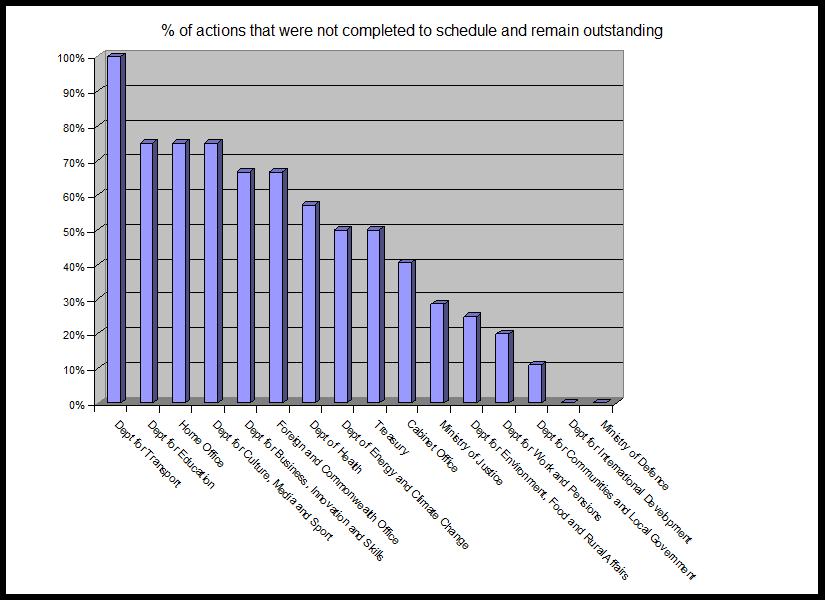
Uncut analysis shows almost half of delivery targets missed just three months after the launch of departmental business plans.

New figures sneaked out by Number 10 in the past week reveal the extent to which government has lost control of its delivery programme. Just three months after the prime minister personally launched the government’s departmental delivery plans, an Uncut analysis of the latest monthly updates shows that 43% of delivery targets were missed in February.

Looking at the activities due to be completed in February as well as those goals still outstanding from previous months, the department for transport managed to miss its one deliverable and the departments for education, home office and culture, media and sport each missed 75% of their targets.

Vince Cable’s ailing department for business, innovation and skills (BIS) and the gaffe prone foreign office failed on 67% of their targets while the department for health hit less than one in two of its objectives.

The initiative to develop and publish updates for departmental delivery plans was hatched by cabinet office minister Francis Maude, but his own department is among the worst offenders, missing 41% of its targets in February.

The story behind these failings is one of government U-turns and departmental spats derailing delivery. (more…)

Facebook Twitter Digg Delicious StumbleUpon

The prime minister’s human shield – William Hague – is going nowhere.

11/03/2011, 08:07:50 AM

by Jamie Reed

As speculation intensifies in westminster-media circles about the future of foreign secretary, William Hague, a reality check is called for. For now, at least, William Hague is unsackable.

To be clear, experts in the field and foreign office officials must cringe in times of international crisis as Westminster politicians and commentators alike become lay-experts in diplomacy and the detailed realities of any given troubled region. This in mind, it doesn’t stop the often ugly truth from emerging.

Gordon Brown was rarely more prophetic than when he declared of our vainglorious prime minister that this is “no time for a novice”. But a novice is what the country has been landed with and what the rest of the international community now has been burdened with as well.

A laconic Hague has been blamed for the shambolic, shameful and humiliating response from Britain to the crisis in Libya – yet Hague’s performance illustrates the behaviour of a man not in control of Britain’s response. Not because he lacks the ability, but because an undeserving prime minister – driven by domestic political considerations instead of international policy objectives – is desperate to cast himself as a world leader and take control of affairs of which he has little understanding. As a result, his diplomatic ineptitude has been laid bare.

Cameron’s late response to the crisis (despite being in neighbouring Egypt at the onset) led to the bellowing of naive threats which were as excruciating in their delivery as they were destructive in their consequence. It was left to the foreign secretary to attempt to clean up after this intemperate and ill-advised outburst, with the US also slapping down the would-be world leader. It was No.10, too, who authorised the recent ludicrous deployment of the SAS, again to counter-productive and even humiliating effect. Little wonder that President Obama believes our dear Prime Minister to be a “light weight”.

It is painful for MPs on all sides of the House to watch Britain’s diplomatic standing cheapened in the way in which it has been in recent weeks. In his increasingly embarassing attempts to emulate Tony Blair, Cameron has exposed himself as a third division Anthony Eden. Hague is Cameron’s first and last line of defence in foreign affairs. His removal would expose the prime ministers naked incompetence. This latest human shield will be around for a while yet.

Jamie Reed is Labour MP for Copeland and a shadow environment minister.

Facebook Twitter Digg Delicious StumbleUpon

It’s not too late for Cameron to learn from his shambolic foreign policy failures

10/03/2011, 11:30:55 AM

by Matt Cavanagh

Over the last fortnight, David Cameron’s approach to foreign policy has suddenly come into sharp and unforgiving focus. Not all his problems have been of his own doing, and veterans of previous crises will have felt sympathy at times. But the public, our armed forces and diplomats, our allies, and even our enemies have been left confused by contradictory messages.

A long-planned trip to the Middle East to promote trade and defence exports was hastily re-branded as a pro-democracy tour. A sluggish and uncoordinated response over Libya was suddenly replaced by unilateral sabre-rattling about no-fly-zones and arming rebels, only to be replaced in turn by another retreat to a more conventional multilateral approach. Even the SAS’s involvement – over-briefed by government sources the weekend before – turned into another fiasco, whether through bad planning or bad luck. And in the background, the government’s handling of defence cuts and military redundancies has continued to look botched as well as badly timed.

Some of the lessons here are about basic competence, both in pulling the levers of government, and in communicating the message. Cameron had already accepted the need to overhaul his Downing Street operation; it must be worrying that much of the new team was already in place, and must therefore share responsibility for the recent shambles. Perhaps he will also heed recent advice that he apply himself a bit harder, rather than trying to get by on intelligence and instinct. But there are more substantial lessons too.

Underneath the inconsistent messages, there has been a real shift in policy – indeed, yet another U-turn. Previously, Cameron had signalled a new approach, arguing that we should “think through much more carefully whether Britain should get involved in foreign conflicts”. Sympathetic commentators were encouraged to interpret this as a rejection of Labour’s “wide-eyed interventionism” in favour of a “new Tory realism”. The foreign office was told to focus on trade rather than geopolitics, and bilateral relationships rather than multilateral organisations. (more…)

Facebook Twitter Digg Delicious StumbleUpon

Let’s leave the anti-cuts rallies and join the fuel protests

10/03/2011, 07:00:04 AM

by Peter Watt

Cuts, cuts cuts. Across the country, local parties are campaigning to defend libraries, schools and jobs at hospitals. Every cut announced nationally and locally is condemned and the heartlessness of the government blamed.  In fact, to listen to Labour at the moment you would think that the only thing that people are talking about is cuts to public services. But I’m not sure that that is right. In fact, I think it may be a very dangerous assumption to make.

Sure, if you ask people do they agree with closing or their local library, children’s centre or whatever they will say “no”. But that doesn’t mean that they oppose “the cuts” in general. As Atul Hatwal powerfully pointed out on Uncut last week:

The net result of six months of battle on the economy has been literally nothing. No change whatsoever in the 23% majority who view the government’s approach to cutting the deficit as necessary”. (more…)

Facebook Twitter Digg Delicious StumbleUpon