




Spain faces up to unpleasant economic realities, says David Mathieson

25/07/2010, 11:20:54 PM

The celebratory soccer binge over, Spaniards are once again having to face up to some unpleasant economic realities and along with the rest of Europe Spain has just published the results of a stress test on its banking system.   A report on financial services would not normally be the stuff of conversation in the bars of Madrid but most people are aware that the consequences could be serious.   Apprehension has again replaced euphoria.  For Prime Minister Zapatero the findings will have far reaching political consequences: confidence in his socialist (PSOE) Government is at a record low and the revealed weaknesses in parts of the Spanish financial system will not improve the national mood.  So far, Spain has avoided a Greek style meltdown but renewed trust in the Spanish banking system is essential if Madrid is not to become the new Athens.

Up to now debate on the crisis in Spain has focussed on the state of the public finances and the growing fiscal deficit – the difference between the Government’s income and spending – which is now around 11.5% of annual income.   Over the last couple of years unemployment has soared to 20% – the fastest increase in Europe – and nearly two million people have stopped contributing to the social security system.  Consumption and investment have slowed (trade between the UK and Spain, for example, fell by more than 30% last year) and Government revenues have collapsed. 

(more…)

Facebook Twitter Digg Delicious StumbleUpon

Opposition has a lure like crack cocaine to some Labour activists, writes Helen Liddell

24/07/2010, 02:30:36 PM

I turn my back for five minutes – well, four and a half years – and meerkats rule the advertising world and the Lib Dems show their true colours. Enough to  make me turn around and head back to Australia.

Those halcyon days with Labour Governments in Australia and Britain did help us leverage a progressive agenda together on the world stage. Who can forget Kevin Rudd, within days of his election as Aussie PM, signing the Kyoto protocol, neutralising the last alliance the Bush administration had on denying climate change.

 The financial crisis saw Brown and Rudd redefine world economic geography by creating a more meaningful G20 with the world’s emerging nations instead of the Rich Man’s Club of the G 8.

Labor chose the first ever woman Governor General, a human rights lawyer at that – and she took her oath of office wearing the purple of the suffragettes. Some Sheila.

(more…)

Facebook Twitter Digg Delicious StumbleUpon

I don’t want a new best friend. I want a Labour Prime Minister

24/07/2010, 12:00:21 PM

Back  in 1994 Tony Blair sealed the deal with many of us when he was billed as “the man the Tories most fear”. After the crushing blow of losing in 1992 we wanted a winner. Damn his policies! As the late Tony Banks exclaimed “my members will eat shit to see a Labour government”.

Blair was given enormous latitude. The party was desperate to break its losing streak. We got hooked on successful – but corrosive – habits about stifling internal debate and adopting an approach to discipline that would make a Gordonstoun headmaster blush. But that approach helped keep us in power for 13 years; albeit with a long trail of political capital and supporters leaching out on the road behind us.

We now find ourselves in the middle of Labour’s first truly modern leadership campaign; one that eschews the left/right factionalism of the past and the fatalism we used to have about whether we could actually win power at all. It is opening up debate in a way that we are unused to.

But we have to be careful we don’t overuse our new gifts. There is a balance to be struck between embracing the party’s new glasnost and forgetting the old ways – and why we adopted them in the first place.

At the moment, there’s a lot of tummy tickling going on but not much vision. We need a discussion about how do we equip ourselves for a world where coalition governments may become commonplace. Where there is less money to spend our way to our social democratic nirvana. Where we articulate our own version of The Big Society. Where we back up our grand rhetoric on localism and environmentalism with real commitments next time. But these kind of hard-edged issues are simply not breaking through. (more…)

Facebook Twitter Digg Delicious StumbleUpon

Today’s growth figures vindicate the action Labour took, argues Alistair Darling

23/07/2010, 02:30:44 PM

Today figures show the results of the Labour Government’s balanced approach to supporting the recovery. And they remind us of the threat posed by the coalition’s willingness to take risks. 

This is the fastest growth we have seen for over four years. It shows that confidence was returning. And you can see the success of maintaining support for important sectors like construction. This is the final nail in the coffin of the Coalition’s argument that things are worse than they believed before the election. Today’s figures show that growth was twice as fast as expected.

The Coalition’s economic policy is not inevitable – it’s the choice they’ve made. And they will have to accept responsibility for the risks they are taking with the economy.

As I have consistently argued, withdrawing help to the economy now puts growth in jeopardy and could be more costly in the long run if more people lose their jobs. It is increasingly clear that we’re seeing the return to politics of a serious ideological debate. This  government’s clear and overriding priority is to cut back the state. Otherwise they would not announce cuts with such relish (more…)

Facebook Twitter Digg Delicious StumbleUpon

Labour must show it could cut the deficit and drive growth and the jobs of the future, argues Pat McFadden

23/07/2010, 10:49:13 AM

The Tories have a clear plan for their austerity programme which is to discredit Labour’s economic record, blame the situation they inherited from Labour for all the cuts they will make and suggest that anyone who doesn’t support their programme has no worthwhile economic proposition at all. 

 It is a plan which should be challenged at each point.  But it would also be a mistake to suggest that anyone on the centre left who wanted to address the issue of the deficit was somehow endorsing the Tory plan.  That isn’t true and would appear to suggest that there was no worthwhile difference between the plans on which Labour and the Conservatives fought the election. 

Yet the difference between the two parties is being felt every day in issues from the abandoned school building programme to cancelled regeneration projects and support for key industrial projects such as the Sheffield Forgemasters plan to make Britain a key player in the worldwide civil nuclear supply chain.

Labour won power in 1997 partly because we had worked hard to develop economic competence, to move on from a reputation for having big hearts but soft heads when it came to the nation’s finances.  We didn’t lose that focus in government.  We presided over the biggest increase in GDP per head in the G7 between 1997 and 2009, even after taking into account the financial crisis.

Of course the global financial crisis and our response – designed to stop recession turning into depression – meant borrowing was raised but this was a choice, a judgement we made. 

Labour fought the election on a plan to reduce the deficit over a longer timescale, with a different balance between spending reductions and tax measures and with key priorities protected.  That plan would have required some tough decisions and there’s no getting away from that.  We had already announced some spending reductions in the PBR last year and had proposed for example changes to civil service redundancy terms.  But Labour’s approach would have been very different to the Tory plan now being rammed through, a plan characterised by deep cuts started before recovery is established, with no regard for the impact on the private sector or future industrial opportunities for the country.

Labour’s plan would have had, at its heart, an active role for Government in promoting growth and ensuring Britain tried to develop key capability in areas of future employment growth such as low carbon vehicles, the digital economy, green energy and other areas.

The Tory deficit plan pays no regard to these areas.  This week’s document issued on this had little to say.  In fact, in addition to cancelling the Forgemasters loan the Government seems to be giving up on plans for a Green Investment Bank.  And their plans for abolishing the RDAs and cutting support for the regions will make recovery and growth even harder to achieve.

Cutting the deficit in the way they are doing is faith based economics, with the Tories playing the role of high priests and the Lib Dems displaying the zeal of the recently converted.

The challenge for the Labour Party is to address the deficit in a way that also includes a drive for the growth and jobs of the future.  And that’s a far cry from what the Tories and Lib Dems are doing.

The Rt Hon Pat McFadden is MP for Wolverhampton South East  and Shadow Secretary of State for Business

Facebook Twitter Digg Delicious StumbleUpon

We’re finally starting to see who should lead the Labour Party, observes Dan Hodges

22/07/2010, 02:30:56 PM

The legendary American football coach Vince Lombardi once confided to an assistant that he found analysing match replays more stimulating than sex. “Either you don’t know how to have sex”, the assistant replied,  “or I don’t know how to watch game footage”.  I was reminded of that quote when someone at Saturday’s Labour Friends of Searchlight leadership hustings gushed to me how the leadership election was “energising the movement”. Either I have unrealistic expectations of what it means to be energised, or elements of the movement  have to get out there and get some excitement into their lives.

This leadership election is dire. The candidates are exhausted. The contest is mired in tedium. There  is lots of sound, but precious little fury. We are a beaten party going through the motions, and it shows.

And yet…and yet. Despite the banality, the drudgery, the parsing, the positioning; somewhere through the gloom, the odd chinks of light are starting to seep through. Patterns, barely discernable, are beginning to form. Gradually we are unearthing the first clues  to who could, and should, be the next leader of our Party.

(more…)

Facebook Twitter Digg Delicious StumbleUpon

Cuts in Housing Benefit will cause hardship and increase homelessness, says Karen Buck

22/07/2010, 12:53:48 PM

Beveridge, intellectual giant, architect of the post war welfare state, threw in the towel when it came to sorting out rent subsidy. The Beveridge report argued, not unreasonably, that any coherent national system of subsidising housing costs for those who could not afford them was not feasible while rents varied so greatly between different part of the United Kingdom.  The problem which confounded him has, if anything, intensified over the years. In the last three decades, to add to the intractable problem of regional variations in costs, governments of both colours pursued a deliberate policy of allowing Housing Benefit to ‘take the strain’ generated by decline in the provision of social rented housing.   Today, housing need is one of the great policy challenges of the century, with demand for affordable homes far outstripping supply and subsidy, in the form of Housing Benefit, going instead into the pockets of private landlords supplying the roof over the head of an ever increasing number of low income households.

Taken in isolation from wider housing policy, one can understand the concern at the rising bill, and recognise the sense of injustice amongst working families at the small number of very extreme cases of households claiming Housing Benefit in our most expensive neighbourhoods. Intuitively, it seems as though we have got it wrong and the system is ripe for reform.

Yet seeing where a policy is wrong does not necessarily help us get it right. The measures set out in the Coalition budget for cutting subsidy to low income households is draconian, runs counter to all attempts to create mixed communities and could easily create a crisis of homelessness.

To summarise the proposals, a cap on the highest  rents (mostly in  London) will be followed by a reduction in Local Housing Allowances everywhere in the country, with future up-rating limited too.  Working age households in private and social housing alike will see their benefit cut if they are deemed to have any spare bedrooms, and, in 2013 anyone on Jobseeker’s Allowance for a year loses 10% of their benefit.

(more…)

Facebook Twitter Digg Delicious StumbleUpon

“Marvin … What do we do now?” Hopi Sen’s advice for the next leader

22/07/2010, 10:26:03 AM

The passage of time being what it is, some Uncut readers won’t be familiar with “The Candidate”, a 1972 film featuring Robert Redford as an insurgent Senate candidate struggling to retain his idealistic purity while trying to beat a popular Republican incumbent.

The film was written by Jeremy Larner, a speechwriter for Gene McCarthy in the 1968 Election campaign.  McCarthy didn’t win the Presidency, but Larner did win an Oscar.

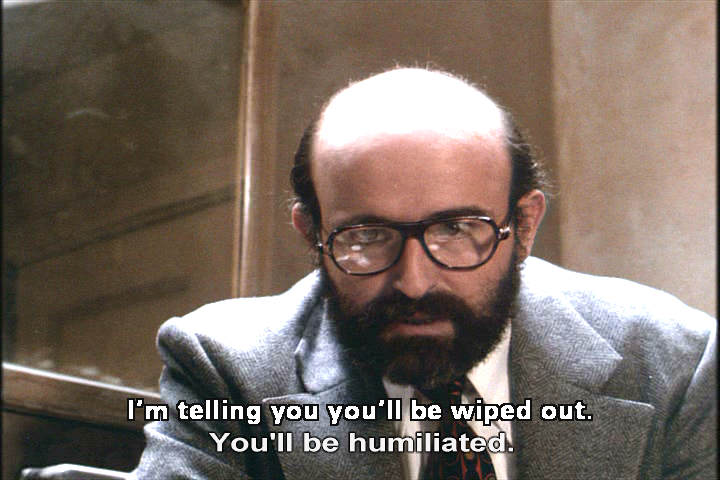
It’s a great film, not least because of the perfomance of Peter Boyle, playing political consultant Marvin Lucas. Once you’ve seen Lucas, all gleaming pate, glasses, beard and calculated cynicism, it’s hard not to see the West Wing’s Toby Ziegler as a tribute act.

Why do I raise a forty year old American film?

Because the challenges that face the next leader of the Labour party mirror those facing the fictional Bill McKay. At the end of the film, McKay turns to the man who has reshaped and remoulded him and asks “Marvin, What do we do now?”  

On the 25th of September, when the last vote has been wrung out of the campaign, when the challenge to inspire the party alone has ended, one of the teams will need a great answer to that question. 

It could be Spencer, Stewart, Polly, or Jim, Douglas, Blair or Kate, or Alex or another Jim who get asked. Their answer might decide the fate of the Labour party for years.

The questions the new Labour Leader will be confronted with won’t be much different to the ones they’ve faced over the campaign, but the attention paid to their answers will be.

These first months can kill when you’re a new opposition leader, unknown to most of the public and with years to run before an election, as Kinnock, Hague and IDS all discovered. Each was defined early in their leadership. None quite recovered.

So in an attempt to be helpful, here are five things to do, and two disasters to avoid for the next leader. (more…)

Facebook Twitter Digg Delicious StumbleUpon

The Coalition government has no coherent strategy for growth, argues Rachel Reeves

21/07/2010, 04:36:26 PM

Wednesday morning saw the first evidence session under the new membership of the Business, Innovation and Skills Select Committee.  As a Committee, we chose to use this opportunity to put Vince Cable (as Secretary of State for the Department), and David Willetts (as his Minister of State for Universities and Science) through their paces, and put their recent announcements and departmental plans for the future in the spotlight.

This was the chance for Vince Cable to set out how the government was going to rebalance the economy.  It was his big opportunity to spell out their desperately-needed strategy for growth, and his vision for how we would rebuild an economy that was sectorally and regionally diverse, with strong, sustainable growth.  I looked forward to hearing about the evidence behind the decisions and announcements that had already been made, and his rationale and thinking for future plans.

With these expectations, what we actually heard from the Secretary of State and his Minister was a disappointment.  This disappointment started before the meeting had even begun, when we received copies of the Department’s Strategy for Growth, contained in what Vince himself said ‘could not be described as more than a pamphlet’.  His opening rhetoric may have sounded good, but his assertion that a new economy should be rebalanced rings somewhat hollow when, as I pointed out to him, the only mention of a regional strategy to rebalance the economy comes on page 14 of a 16 page document.

(more…)

Facebook Twitter Digg Delicious StumbleUpon

We were elected as New Labour, we will govern again as New Labour, argues Peter Mandelson

21/07/2010, 01:22:40 PM

In London, Manchester, Leeds and Newcastle (and Hartlepool) this week,  thousands of party members and the public have heard or will hear the third man speak about his book.  They were interested and most bought copies. It seems a far cry from the condemnatory statements made by some of the Labour leadership contestants upon the book’s publication. They hadn’t read it, of course, but since then many others have.

After the party has suffered electoral defeat, it is timely to debate our past as well as our future. The two are linked. And we don’t have to dismiss  one in order to make progress in the other.

In The Third Man, I take the reader back over twenty five years of our party’s fall and rise, not simply the thirteen in government and not just that period after the Iraq war until  2006 when relations between our Prime Minister and Chancellor entered a trough and when their policy differences over NHS and schools reform, university financing and pension policy flared.

Political change on the scale we undertook it, in the creation of New Labour, required intense and sustained teamwork and partnership, trust and mutual support, over a long period of time.  Tony and Gordon were at the centre of this – in the main – productive and creative activity.  But in a truthful memoir and autobiography, when I was personally a part of this relationship over so many years, you cannot explain the good and the bad times without describing what the participants said and did, to as well as with each other. And it is better to tell the story earlier rather than later, before preparing for the next election.

If I have one abiding memory of the period when we were creating New Labour it is the friendship and comradeship amongst all those who made it happen. And that friendship endures, including in the election campaign this year. It has been a happy time and a very successful one. We must have been doing a lot right, although you might not think so to listen to those hastily announcing the ending of New Labour as if you can turn its principles and precepts on and off like a tap.

Millions of voters didn’t think this way and we have to ask – as my book does – why so many of them decided not to support us in this year’s election. Was it because they thought all of a sudden that we were too New Labour? I think not. And that is the central message of The Third Man.

Peter Mandelson is a Labour peer, a former cabinet minister, and author of The Third Man: Life at the heart of New Labour.


Facebook Twitter Digg Delicious StumbleUpon