


SNP-backed Miliband or a return to the John Major years? Only the Lib Dems can stop it

22/04/2015, 05:44:47 PM

by Samuel Dale

He’s back. The most successful prime minister – nay politician – ever to grace British parliamentary democracy.

A man of such grace, skill and power that he swept all before him in his pomp. Adored by his own. Feared by rivals. Yesterday, he spoke and we – humble electorate – must heed his wise counsel.

I speak, of course, of Sir John Major. Well, that seems to be the absurd narrative pedalled by the electorally-charged right-wing press that once lampooned Major’s premiership. Times change. Major’s speech gave warning of the higher taxes, fewer jobs and general mayhem of a Labour government supported by the SNP.

Firstly, he’s right. A Labour/SNP deal would be a disaster for Britain and the Labour party as well.

There would be an economic chilling effect around new investment into the UK while the PLP would be split over any arrangement with the nationalists. In fact, I was warning about it on this blog before it was cool.

But, as many have pointed out, it was John Major’s Government in the 1990s that actually did deliver higher taxes, fewer jobs and general mayhem.

Look at the facts. There’s Black Wednesday, when a self-inflicted economic crisis pushed the Bank of England’s interest rates to a crushing 15% in September 1992.

(more…)

Facebook Twitter Digg Delicious StumbleUpon

Labour’s kidding itself about this campaign. The Tories are winning the strategic battles

22/04/2015, 07:00:10 AM

by Atul Hatwal

Labour chiefs are happy with progress in the campaign so far. Most activists are upbeat. Even PLP pessimists have been given to moments of optimism.

But for all the pleasant mood music – from the poll averages which suggest Ed Miliband is within touching distance of victory to the parliamentary number-crunching which seems to offer manifold routes into Number 10 – Labour’s campaign strategists have misread their three biggest strategic challenges: how to deal with the Tories’ SNP scare, which voters to target with the ground operation and what retail offer to make.

Over the next fortnight, the impact of these mistakes will become clearer.

Most immediately, Labour has utterly failed to understand the Tories’ intent with their scaremongering over SNP support for a Labour government.

The view of Labour staffers has been that the Tories are principally trying to frighten Ukip voters back into the Tory fold. But that for every vote the Tories get back on their right flank the more they accentuate their negatives as the nasty party with wavering voters.

The Labour analysis is correct about appealing to kippers but wrong about the impact on swing voters, specifically English swing voters.

Labour’s more frantic recent statements, denouncing the Tory attacks as “smears” – a sure sign that a political party is becoming panicked and does not have a line to take – suggest that the impact of what’s happening has started to dawn on party strategists.

The Tories’ objective is to fuse the SNP and Labour in English voters’ minds.

This vision of McLabour as an unabashed, economically left-wing party that will prioritize Scotland’s interests over England not only scares ex-Tory Ukip voters into switching back, it resonates with right leaning and centrist Lib Dems not to mention the quarter of 2010 Labour voters who have since abandoned the party.

(more…)

Facebook Twitter Digg Delicious StumbleUpon

The entwined challenges that the SNP and UKIP may pose PM Miliband

21/04/2015, 10:59:14 AM

by Jonathan Todd

Scotland is diminished inside the UK, argues Alex Salmond. The UK is diminished inside the EU, says Nigel Farage. Scotland did not vote for David Cameron, insists Salmond. The UK didn’t vote for Jean-Claude Juncker, maintains Farage. It would be “nae bother” for Scotland to break up the UK, asserts Salmond. It would be “no problem” for the UK to leave the UK, claims Farage.

Salmond briefly seemed a broken man after the defeat of Yes last September. Having promised to resign the leadership of UKIP if he doesn’t win South Thanet, defeat for Farage on 7 May would also leave him broken. But Salmond has been reborn, as support for Yes has wholly transferred to the SNP. Farage might be reborn too.

Salmond’s rebirth has been enabled by glacial shifts in Scottish opinion that now appear to have unstoppable momentum but which built up over a long period, going undetected by those focused on Westminster. No Scottish seats in the UK parliament changed hands in 2010. The SNP gained two seats at the 2005 general election and lost one at the 2001 general election. The churn over the same period in elections to the Scottish Parliament, however, was much more dramatic. The SNP gained 20 additional seats in 2007, 23 in 2011.

If we look only at the lack of 2010 seat change in Scotland, the SNP’s rise appears inexplicable. If we look instead at recent elections to the Scottish parliament, it seems less so. Perhaps for reasons wrapped up with the referendum, decisive numbers of Scots are now prepared to entrust the SNP with their support in the UK Parliament, as well as in the Scottish Parliament. The decision factor for voters may have migrated from “who is best to lead the UK?” to “who will get the best deal for Scotland?”

(more…)

Facebook Twitter Digg Delicious StumbleUpon

How Ukip’s Doncaster conference revealed the divisions that would derail their election campaign

19/04/2015, 08:35:17 PM

by Samuel Dale

Ukip is losing and its future is bleak. Its poll rating is being squeezed and its manifesto was an aimless ragbag of populist ideas.

It wants to attract lefty Labour voters and right-wing Tories so it ends up with an incoherent, hollow message.

The manifesto wanted increases to the carers allowance and an end the bedroom tax while slashing income tax for the wealthiest.

The only thing they can all agree on is leaving the EU and attacking immigrants.

This unholy alliance will boil to the surface after the election, especially if Nigel Farage loses in South Thanet and has to quit.

The seeds of the discontent were sown at the party conference in Doncaster last year with the party riding high amid defections and rising polls.

At an Institute of Economic Affairs fringe event on economic policy was the libertarian immigration spokesman and MEP Steven Woolfe and the economics spokesman and MEP Patrick O’Flynn.

MEP Tim Aker and Tory activist Tim Montgomerie were sat by their side and the session was hosted by ex-Lib Dem and IEA director-general Mark Littlewood.

Earlier in the day, O’Flynn had set the conference tone by unveiling income tax cut proposals for middle earners by raising the 40p threshold and introducing a new 35p band.

But he also unveiled a “wag tax” proposal to increase VAT to 25% on luxury goods such as expensive cars and shoes.

(more…)

Facebook Twitter Digg Delicious StumbleUpon

Week 3 of the campaign: the good, the bad and the ugly

19/04/2015, 01:07:23 PM

In our second installment, Uncut’s weekly review of the campaign looks at the events of week 3.

The good

Labour’s costed policies

Sunday 12 April – Marr and Osborne. The core Tory strength is a reputation for fiscal probity. Yet here was prime time Osborne appearing anything but.

After more than five years when it has usually seemed that only one party, the Tories, know how to make their sums add up, Marr suddenly left the impression that this party is Labour, not the Tories.

Sam Dale has previously argued on Uncut that the Tory advantage on fiscal credibility is so well established that they can afford, as they certainly now are, to play fast and loose with it. In doing so, though, they deepen a theme of the Tory campaign identified by Jonathan Todd: taking people for idiots.

If Labour keeps showing how our policies are costed, the Tories might just find a trump card slipping away at the last, crucial moment.

The manifesto launch event

The team managing Labour’s events deserve some recognition. Often overlooked as the plaudits go to the more flashy spinners, events folk only tend to get mentioned when something has gone wrong.

But for Labour, trying to shift some pretty entrenched pre-campaign stereotypes, the backdrop and staging of the set-piece events needs to provide the pictures that validate the message.

If anything were to go wrong – as at Ukip’s campaign launch when the blu tak came unstuck and the backdrop fell down – then it’s a lock for the news bulletins as a metaphor for a campaign in trouble.

This week’s manifesto launch was another in a growing list of impressive events.

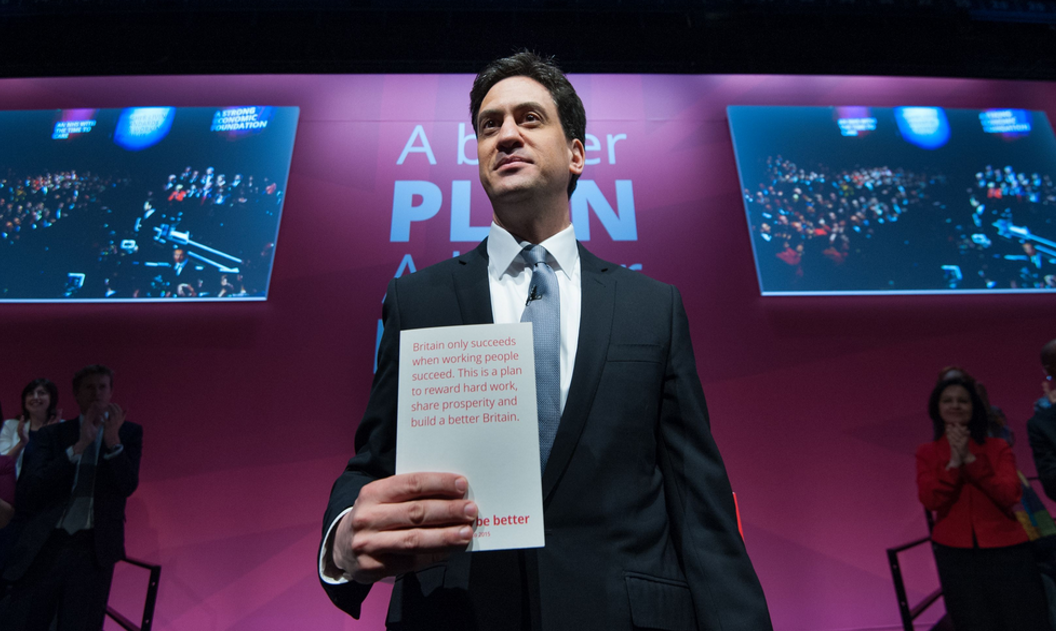
The message was about responsibility and fiscal discipline and the pictures of Ed Miliband at the event reflected this exactly.

Ed M


(more…)

Facebook Twitter Digg Delicious StumbleUpon

This election needs a soapbox or an Irn Bru crate

18/04/2015, 11:47:04 AM

by Atul Hatwal

Paralysing fear has infected every aspect of the parties’ campaigns.

Strategists fear the voters, so they stage tightly controlled events, away from the truculent public. Junior staffers fear any slight mishap that might make the news, so even the most minor decision is dictated by a safety first doctrine.

And Ed Miliband and David Cameron fear everything and anything, otherwise they would not accept the counsel of caution from their advisers which shackles all that they do.

The result is an arid campaign, a dismal parade of media moments contrived for broadcasters that lack the incident and passion to galvanise anybody but the already committed.

A news vacuum is developing. The manifesto launches commanded attention earlier in the week, but now what?

The front pages are already drifting away from the election. Soon, as is always the way in politics, this lacuna will be filled with the grumbles of worried candidates and plotting leadership contenders, taking aim at their leaders.

It doesn’t have to be this way. For the party bosses running the party campaigns, there is an alternative.

1992, which has already provided much of the template for this contest, also offers a lesson in how to fill that vacuum without the need to scramble out new half-baked policy announcements dreamt up the night before or to escalate the ferocity of personal attacks to shock a path into the news.

Imagine if one or more of the party leaders took a leaf out of John Major’s book and didn’t just do managed Q&As with pre-vetted, politically emasculated supporters, but actually went out to meet the British public on the high street, in the shopping centre and at the market.

If they went to where the public are, rather than hiding in a hall ringed with security, put down a soapbox, stood on it and spoke to real voters.

Jim Murphy is Scottish leader in no small part because of his one man campaign across Scotland in the independence referendum, speaking to the Scottish public from atop his Irn Bru crate.

There were baying nationalist mobs, protesters, eggs, but also, fabulous pictures for print and broadcast, personal guts and raw emotion.

The plaudits from journalists or every persuasion – right, left, nationalist and unionist – after the clip below was shared were extraordinary. It’s hard not admire Jim Murphy’s passion, resilience and commitment.

(more…)

Facebook Twitter Digg Delicious StumbleUpon

The smaller parties should be careful what they wish for. It always ends badly for the kingmaker

16/04/2015, 09:57:12 AM

by Atul Hatwal

We are approaching peak minnow for the campaign. Yesterday the Lib Dems and Ukip launched their manifestos and this evening there is the five-way debate featuring the smaller parties minus Nick Clegg but inexplicably with Ed Miliband guest starring at the front of the coconut shy as the designated representative of Westminster’s failed big party duopoly.

But as much fun as the SNP, the Greens, Plaid and Ukip will have beating up on Ed Miliband the smaller parties should be careful what they wish for.

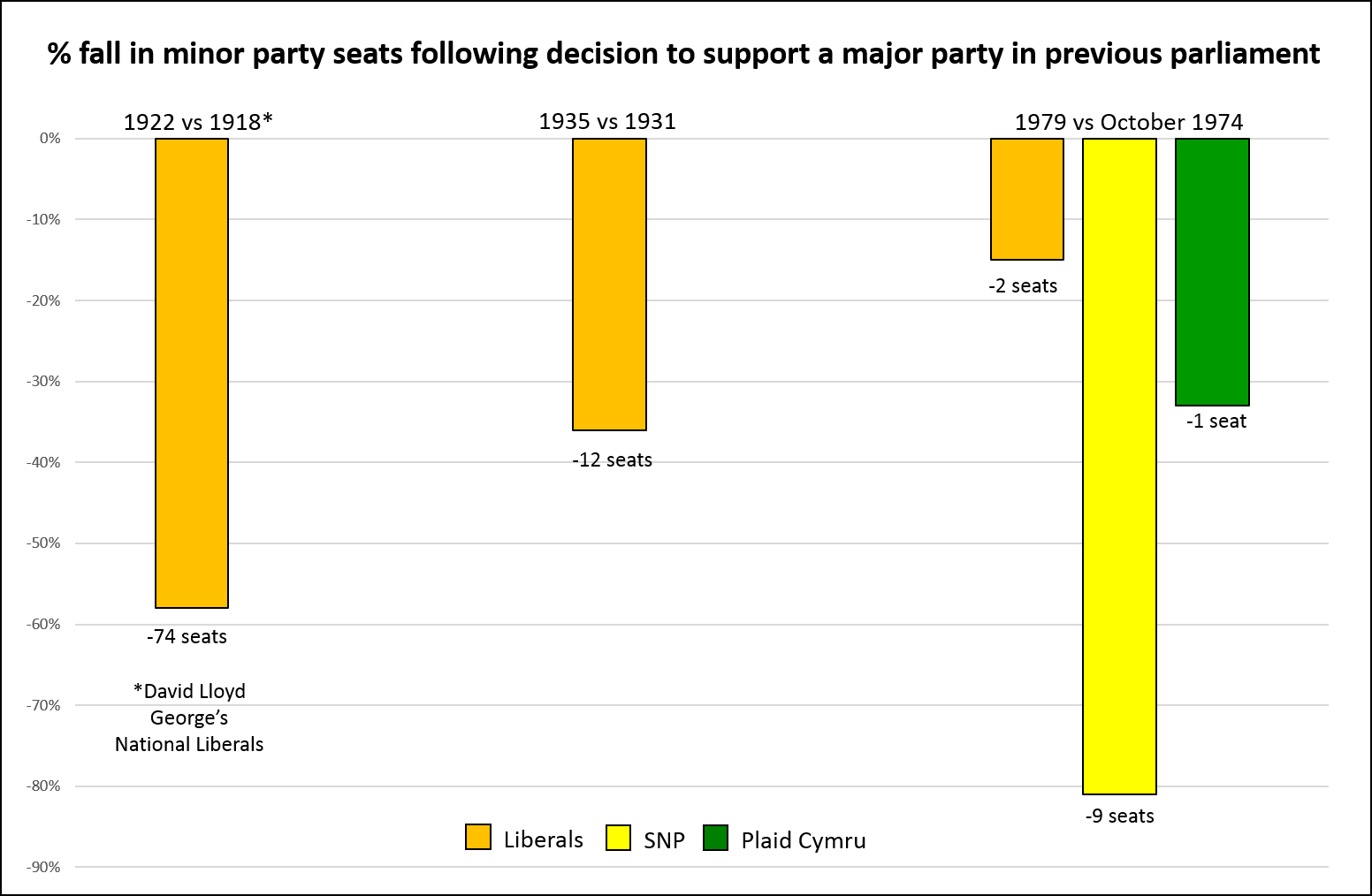
They might be eyeing eventual roles as kingmakers or junior partners in government, but history has a harsh lesson: it always ends badly.

In peacetime, every time there has been a coalition, confidence and supply agreement or any type of deal for support in the last 100 years, it has been electoral poison for the minor party.

On three occasions there have been coalitions in the last century and one period of less formal support to sustain a government.

All involved the Liberals, with the SNP and Plaid Cymru also becoming mired in the mess of the 1970s Callaghan government.

The results speak for themselves.

Minor party fall

(more…)

Facebook Twitter Digg Delicious StumbleUpon

Labour’s blind spot on right to buy will prove costly

14/04/2015, 10:49:10 PM

by Atul Hatwal

Three words: right to buy. Three simple words that unhinge the Labour party.

The Tories have set the most obvious and well sign-posted trap for Labour by extending right to buy to social housing tenants. A trap that was first set over thirty years ago to lethal political effect.

As news of this latest 80’s revival broke online on Monday night, Labour activists, MPs and Labour supporting journalists tweeted themselves into angry apoplexy.

Meanwhile, the leadership ran for cover. Emma Reynolds, Labour’s shadow housing minister, released a statement with the headline, “Another uncosted, unfunded, unbelievable announcement from the Tories.”

The Tories’ sudden pledge to spend £8bn on the NHS might not be believable, but does anyone seriously think they will not extend right to buy? Come on.

Right to buy is more than just a housing policy; it embodies a set of values and delivers a precision targeted retail offer. Labour’s guttural online reaction demonstrates a desperate lack of understanding by the party on both counts.

In terms of values, right to buy is about aspiration and personal freedom: the dream of owning your own home and taking control of your life, outside of the purview of the welfare state.

The media debate about extending right to buy is not about technocratic policy but whether the parties are for or against home ownership, whether they believe the state should or should not allow people in social housing to buy their property.

Labour complaints about the policy might be well founded. It does indeed do nothing for the growing army of private renters who will not benefit.

(more…)

Facebook Twitter Digg Delicious StumbleUpon

Labour’s manifesto launch went well but it’s tin ear on aspiration could prove costly

13/04/2015, 09:04:49 PM

by Samuel Dale

Labour’s manifesto launch went well. The focus on tackling the deficit was right and Ed Miliband’s performance was assured.

But on Tuesday it’s the turn of the Tories and how Labour responds to their retail offer will be critical to deciding the outcome of the election.

We already know one of the centre-pieces of the Tory prospectus: inheritance tax cuts were widely trailed across the media, over the weekend. And so far, Labour has seriously mishandled its response.

George Osborne first floated a £1m inheritance tax-free allowance in the autumn of 2007 when its popularity saw off the election that never was.

The latest plan removes family homes worth up to £1m from inheritance tax from 2017.

It comes hot on the heels of big cuts to inheritance taxes related to pensions and Isas.

The current inheritance tax rules offer a £325,000 individual allowance with an additional £325,000 transferable allowance from your husband or wife. In effect £625,000 can be passed tax free to a married couple’s children.

Labour has been keen to point out that only 4% of people will benefit from the changes. The IFS says “over 90%” of estates are unaffected.

The implication has been that only the rich will benefit and as such this can’t turn an election.

So why do the Tories think it is a big vote winner? The £1bn centre-piece of their manifesto.

Firstly, it gives a bottom-line financial incentive to the wealthy estates who will directly benefit. They are the better-off pensioners who vote in large numbers (and the Ukip vote the Tories desperately need back).

Secondly, and more importantly, it is about aspiration.

(more…)

Facebook Twitter Digg Delicious StumbleUpon

This curious Tory campaign is coming to us from another country

13/04/2015, 09:06:27 AM

by Jonathan Todd

Famously, the past is a foreign country: they do things differently there. In that country, they have naked women on Page 3 of The Sun. That publication peddles lies about football fans crushed on the terraces of Hillsborough. And claims to be able to determine the outcome of general elections.

That which largely went unquestioned in 1992 would not do so in 2015. The Sun has changed to survive in a changed country. In such a country, it may not necessarily follow that treatment for Ed Miliband akin to that which Neil Kinnock endured in 1992 will contribute to the same electoral outcome.

The fears about Kinnock that the Conservatives and their supporters in the media were then able to arouse chimed with underlying public perceptions. It may be that attacks like those of Michael Fallon on Miliband will again tap into deep seated fears about Labour.

Equally, reflecting on Miliband’s improving personal ratings, Damian Lyons Lowe, founder and chief executive of Survation, concluded, “people like the happy warrior”. If Fallon were mainlining fears in the same way that the Tories did during the 1992 campaign, we might expect Miliband’s ratings to be going in the other direction.

The Tory brand is also not as robust as it was in 1992. This weakness – the persistence of the “nasty party” perception – is one of the reasons that I have anticipated Labour victory this year. When brands have limited purchase, their capacity to impact how other brands are perceived is also undermined.

If you go round slinging dead cats on tables, people will think, “these are the kind of people who sling dead cats on tables”. Boris Johnson – whom David Aaronovitch recently described as being “like a man who breaks wind in a lift and everyone wonders what smells so good” – could sling a dozen dead cats on the table. And we’d all laugh. Then ask him to do it again.

(more…)

Facebook Twitter Digg Delicious StumbleUpon