


UNCUT: The Tories have recovered a poll lead exactly when we predicted. Time for Labour’s optimistic alternative

15/05/2014, 07:22:11 AM

by Jonathan Todd

Last October, Uncut ran a regression on economic sentiment and Labour’s poll lead. This indicated that the Conservatives would start to overhaul Labour in the polls when a quarter of the electorate feel that the economy is “doing well”.

The last two times YouGov asked people whether they think the economy is doing well on 1/2 May and 8/9 May, 24% of them indicated that they think it is. By Monday evening, 12 May, the Guardian was reporting two polls that showed the Tories ahead of Labour.

It could be that between the last YouGov tracker on economic sentiment and the polls reported by the Guardian an extra 1% of the electorate decided that the economy is doing well. It might be that Uncut got something wrong with our regression or our interpretation of it.

But 24% is pretty darn close to 25% in most people’s books. So, while Labour’s slipping lead may have produced surprise in some quarters, what has happened is virtually exactly what Uncut postulated would happen.

The economy is improving. Voters can see this and are rewarding the Conservatives. This has happened sufficiently to give them a poll lead. While this should be placed in political context, Labour would be foolhardy to not recognise the direction of travel and recalibrate accordingly.

The political context is that in both polls in which the Tories led, they were only polling just above a third of the electorate, well below the 40% that they may well need to win an overall majority. Given the economic headwinds now blowing in the Tories favour, this should, however, be scant consolation for Labour.

Read the rest of this entry »

Facebook Twitter Digg Delicious StumbleUpon

UNCUT: The Euros are the elections that don’t matter. Except they do.

14/05/2014, 08:50:50 AM

by Rob Marchant

It’s complicated. Next week’s election will not change very much in itself. We will send members of our favourite parties off to Brussels again in greater or lesser numbers to vote on things that, we tell pollsters on a regular basis, we care little about. Everyone’s eyes will be on the greater prize of a general election, less than twelve months away.

And you can forget the polling around this election; it means very little. Rarely has there been an election with so much of the electorate avowedly committed to protest voting, often for parties they don’t even really like.

A friend of mine, traditionally to the left of me, is voting UKIP. Why? Not because he likes them. Because he’s fed up with both right and left. “Because there’s a chance, just a chance”, he says, “that something might change”.

Now, I believe him to be wrong. But his vote forms part of an anti-establishment effect, which transcends right and left and which has blossomed in recent troubled times right across the developed world. It is not just UKIP, but Respect. It is the People’s Assembly, UK Uncut and other anti-austerity groups. The Occupy crowd. The other nationalists and secessionists. The Spanish “Indignados”. The Tea Party. The list is long.

The principal common trait of all these groups is being against the political establishment and, with the possible exception of the nationalists, if ever confronted with the tedious demands of actually having to do something in office, most would surely run in horror in the opposite direction.

So, forget the Euro-election polling and results. They tell us nothing. Things will blip up for UKIP and punish the main parties, and then in all probability blip back down by the end of the year, well in time for a distinctly lukewarm performance at the general election.

Read the rest of this entry »

Facebook Twitter Digg Delicious StumbleUpon

UNBOUND: Policy in the pub is back! This evening, plot the digital revolution over a pint

13/05/2014, 04:55:49 PM

What are you doing this evening? Well, if you’re in and around Westminster, cancel your plans and get yourself down to the Two Chairmen (39 Dartmouth St, London SW1H 9BP – nearest tube St James’ Park) for a spot of policy in the pub from 18.30.

You know the format: pitch a policy idea in just ONE minute, followed by TWO minutes of questions from the audience’s Q&A, culminating in a vote for ONE Top Policy. The Policy must be fiscally neutral, funded and well thought out to sustain scrutiny from the floor/Chair.

This week its all about the digital revolution, with Labour Digital’s Lord Parry Mitchell in the chair and sponsored by O2 (who are paying for all those lovely non-digital pints).

So what are you waiting for? Stop reading this on your computer or checking twitter on your phone and get down the pub for some face to face digital policy-making.

Facebook Twitter Digg Delicious StumbleUpon

UNCUT: As Labour’s poll ratings dive, finally, the scales begin to fall from the Milibelievers’ eyes

13/05/2014, 07:00:30 AM

by Atul Hatwal

The biggest surprise is the surprise. Shock and consternation were in plentiful evidence across Labour’s twitter base yesterday at the news that the party was lagging the Tories in two polls.

But this was not some bolt from the blue.

Over the past months Labour’s lead has been slipping steadily. Yesterday was the first polling evidence of the logical denouement of a long established trend. Labour will almost certainly bob back into the lead in future polls, but with every passing month, the party’s electoral waterline will dip ever lower.

Some will point to the shambolic European election campaign as a cause of the drop in ratings. But, poor as the campaign has been, its impact has surely just been to accelerate the inevitable.

The problems underlying Labour’s predicament remain the same as they were this time last year, and the year before that, and the year before that.

Labour has still not satisfactorily answered the two questions asked by the electorate at the 2010 election: Can we trust you with the economy? And is your leader a prime minister?

At the last election, in both cases, the answer was a narrow but clear no. According to ICM’s polling just before election day, David Cameron and George Osborne held a 1% lead on the economy over Gordon Brown and Alistair Darling. And on preference for prime minister, YouGov registered a 6% lead for David Cameron over Gordon Brown.

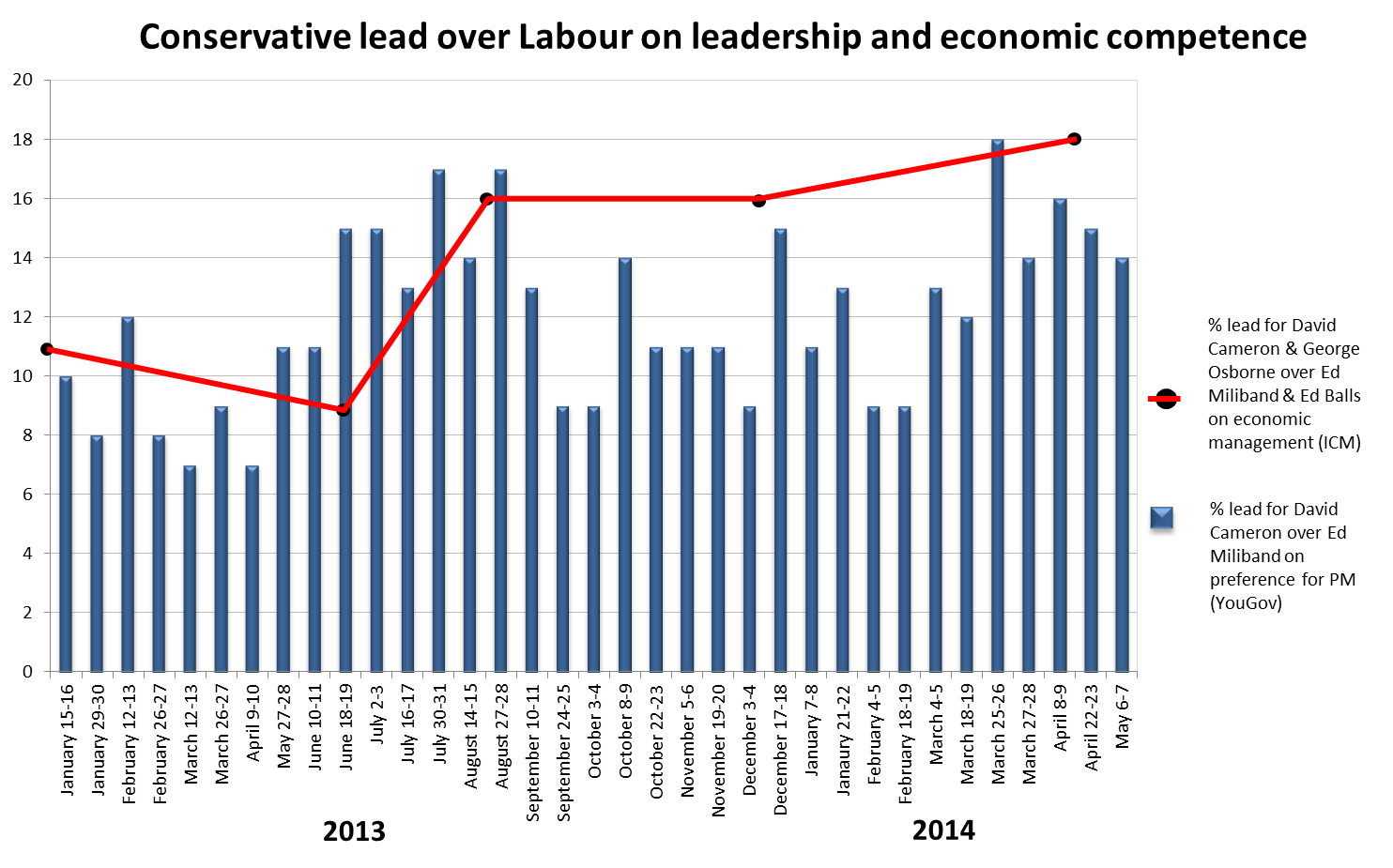
The chart below shows Labour’s performance on these two indicators since the start of 2013.

David Cameron and George Osborne now lead Ed Miliband and Ed Balls by 18% on the economy while David Cameron bests Ed Miliband on preference for PM by 14%.

At no point in the past four years has Labour narrowed the gap on either the economy or leadership to the level it achieved on the eve of the election in May 2010. An election where Labour polled a miserable 29%.

Read the rest of this entry »

Facebook Twitter Digg Delicious StumbleUpon

GRASSROOTS: Negative campaigning works. But on the issues not the personalities

12/05/2014, 11:02:07 AM

by Pete Heskett

Labour’s task for May 2015 is complex. Clearly the party needs a powerful narrative that gives people positive reasons to vote Labour. However, history also shows that in many instances the electorate vote the incumbents out as much as the vote a new party in – Mrs Thatcher’s victory in 1979 was to a large extent a rejection of Labour, unemployment and the three-day-week, Tony Blair’s victory in 1997 was boosted by a rejection of sleaze, and John Major’s benign under-panted leadership.

If Labour’s recent party political broadcast is anything to go by then we seem to be asking the electorate to get rid of the coalition because Nick Clegg is shallow and weak and the Tories a bunch of mean toffs. Now I’m sure there are many Labour loyalists who agree with this character assessment. However, it’s communication that speaks to the prejudices of those already converted not the broad-based liberal coalition that Jonathan Todd rightly identifies as the target Labour needs to attract to form a government in 2015.

For me this raises an important strategic point for Labour’s communications team. Negative campaigning in the UK at least tends to be most effective when it makes a political point rather than when it tries to make a personal point. Or to use a gender-biased footballing analogy, Labour is now looking guilty of playing the man and not the ball.

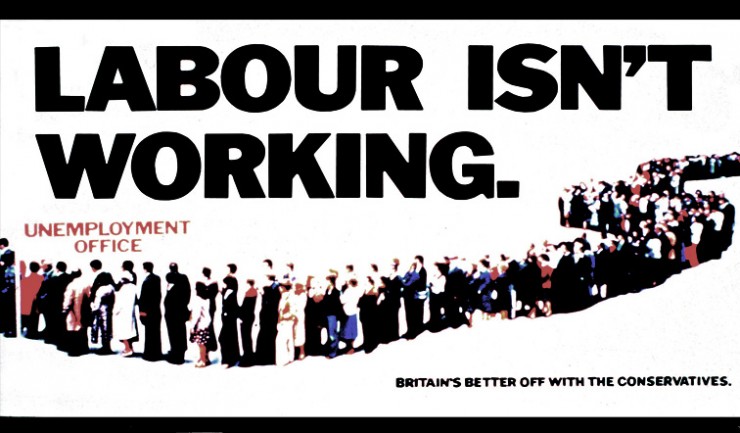
Let’s look at some of the most effective political ads in UK history. “Labour isn’t working” was a poster that helped bring Thatcher to power. It didn’t attack Jim Callaghan as a person – wise as he was generally rightly perceived as nice guy – but it linked the Labour government with unemployment. A strategic masterstroke that hit straight at the heart of Labour’s credibility – how could a party of ‘labour’ be responsible for extending the dole queue? Mrs Thatcher rose to power with a greater proportion of working class votes than even the worst nightmares of the Labour leadership would have thought possible.

Labour working not

Read the rest of this entry »

Facebook Twitter Digg Delicious StumbleUpon

UNCUT: Labour’s populism is all about redistributing wealth. Creating it matters too

09/05/2014, 10:47:18 AM

by Jonathan Todd

Labour forms a majority government, Alan Milburn wrote in the FT on 13 April, when focused as much on creating wealth as distributing it. Pat McFadden used a very similar line when speaking to Newsnight the same week. McFadden used to work with Peter Mandelson as a minister at BIS. Now Chuka Umunna is shadow secretary of state to this department and consciously echoed Mandelson when he recently said: “I don’t have a problem with people making a lot of money, so long as they pay their taxes.”

Similarly, I’ve argued that Labour should focus on growth as well as the cost of living; in other words, making the economic pie bigger, in addition to sharing it more equitably; being a party of increased production, not simply fairer distribution. Whether when Harold Wilson proclaimed ‘the white heat of technology’ or when Tony Blair unrelentingly championed aspiration, Labour has advanced as a party of growth and production. This is not to downplay the redistributive gains that Labour made during these periods. We had our first statutory minimum wage under Blair and got rid of the eleven-plus under Wilson.

These redistributive gains were facilitated by Labour’s strength on production. In crude policy terms, when economic growth is robust, it’s easier to find resources to redistribute to the less well-off. The politics are simpler too. Voters are less likely to withdraw their support from a redistributive party for self-interested reasons if they are reassured that this party is also capable of delivering the growth that will help their back pockets.

Read the rest of this entry »

Facebook Twitter Digg Delicious StumbleUpon

UNCUT: Enough is enough. Labour should kick out Ken Livingstone

08/05/2014, 03:44:44 PM

by David Talbot

In January 2004 a controversial member of the Labour family was readmitted to the fold. Ken Livingstone, the hitherto independent Mayor of London, had submitted his application before Labour’s NEC in order to run as the official Labour candidate in the forthcoming second London-wide ballot.

Livingstone had been expelled from party membership for five years in 2000 when, having been blocked by the party’s hierarchy from running as its official candidate for Mayor, he stood as an independent. Labour’s gerrymandering of the selection procedure, coupled with its heavy-handedness in throwing out the longstanding MP, merely resulted in Livingstone beating Labour’s official candidate into a humiliating fourth place.

Upon his return to the Labour column a jubilant Livingstone described it all as an unfortunate misunderstanding and of a marriage that had temporarily broken down. It is near long-forgotten that this fiercely independent firebrand lobbied extensively for his readmission to the party. But since then Livingstone has abused this “marriage of convenience” with the Labour party to the point where many right-minded Labourites can no longer willingly tolerant his membership of their party.

He has taken all he could from the relationship, and given scant in return. The charge sheet of abuse, varying in seriousness, is so extensive and so oft-repeated it is barely worth the bandwidth to detail further; campaigning against an official Labour candidate in 2010, admitting that he never voted Labour under Tony Blair’s leadership, whilst throwing in the customary charge that he should be tried for war crimes; his tax avoidance, his penchant for the mullahs of Tehran, telling the Reuben brothers to go “back where they came from”, likening a journalist to a concentration camp guard – even after he knew he was Jewish, his distaste for the Jewish community in general, and his patronage of Shaykh Yusuf Al Qaradaw, who denies the Holocaust, promotes female genital mutilation, and urges the throwing of homosexuals from rooftops as a punishment for their sin.

Read the rest of this entry »

Facebook Twitter Digg Delicious StumbleUpon

UNCUT: Left-wing populism is not the answer for Labour

07/05/2014, 10:51:28 AM

by Renie Anjeh

Energy price freeze, scrapping the bedroom tax, rent controls, 50p tax rate – all part of Labour’s offer to the British people next year.  No more Old Labour, definitely no more New Labour – it’s all about Radical Labour.

The party is beginning to set out its popular, and increasingly populist, stall for the British electorate in the run up to the election next year.  Those who are arguing for Labour to ‘shrink the offer’, are losing the internal debate in the party – the radicals have come out on top.  It’s unsurprising that there are those who want the party to go even further by promising to renationalise the railways, introduce a graduate tax, abolish zero-hour contracts and borrow more to pay for spending commitments.  However, this strategy could hinder, rather than help, the Labour party.

Look at the Tories in Opposition. In 2001 and 2005, both William Hague and Michael Howard championed rightwing populism.  Hague – a fervent Eurosceptic – campaigned against the prospect of Britain joining the euro, saying that there were ‘twelve days to keep the pound’.  Although his policy on the euro was undoubtedly very popular, Hague lost the election and became the first Tory leader not to become Prime Minister.

Howard, having given up on his early attempts to modernise the Conservative party, campaigned on tougher controls on immigration, a tough stance on crime, more stringent discipline in schools and lower taxes.  These policies were also very popular with the public but he lost the 2005 election.

This was partly because the Tories were simply not trusted with public services, they looked uncomfortable with modern Britain and people felt that some of its policies reinforced the ‘nasty party’ label.

Labour’s critical weaknesses are on the economy, welfare and leadership and if the party fails to address these issues then, like the Tories in 2001 and 2005, it could end up in opposition for another five years.

Read the rest of this entry »

Facebook Twitter Digg Delicious StumbleUpon

UNCUT: When did the Labour party give up on fighting racism?

06/05/2014, 09:03:14 AM

by Atul Hatwal

There was a time when Labour was the party that stood for equality. For people in a minority community, those of a different colour or heritage, Labour was the party that would fight for them.

No more.

The basic principle of confronting racism, once an irreducible element of Labour’s core, has been greyed into a guideline.

During the past few weeks Labour politicians have been complicit in allowing Ukip to redefine what is acceptable in our national debate.

When Nigel Farage used an interview in the Guardian to brand Romanians as having a “culture of criminality,” and said that British people were right to be worried if Romanian families moved in on their street, there was barely a murmur from Labour.

The party’s silence has helped validate an extraordinary shift: it’s now politically legitimate to say Britons should be scared of foreigners moving in next door.

Politics has just regressed 40 years.

Back then, as now, fear of the foreigner was a defining aspect of political debate. Rather than eastern Europeans, the targets in the 1970s were Asian and Afro-Caribbean immigrants, but the sentiment was exactly the same.

Read the rest of this entry »

Facebook Twitter Digg Delicious StumbleUpon

UNCUT: Northern Ireland can’t afford another week like that

05/05/2014, 02:00:55 PM

by Kevin Meagher

By now, you’ve probably heard of Jean McConville, the Belfast mother of ten who was brutally murdered and “disappeared” by the IRA in 1972. You’ve probably not, however, heard of Joan Connelly.

She was another Belfast woman, a mother of eight, who was also brutally killed back in the early 1970s. She went to aid a young man who had just been shot in the street before the same British soldiers turned their rifles on her, shooting her in the head and body.

Her injuries were so serious that half her face was blown off. Joan’s husband could only identify her, on the third attempt, as he recognised her red hair.

This was in August 1971 during Operation Demetrius when internment without trial was brought in to target “IRA ringleaders”. Weak intelligence and the sectarianism of the Stormont government instead saw hundreds of ordinary Catholics arrested and jailed, (but not a single loyalist).

Northern Ireland erupted and in the ensuing tumult, eleven people were killed by the British army over a two-day period in the Ballymurphy area of Belfast. As well as Connelly, soldiers also shot dead a Catholic priest.

Although the Police Service of Northern Ireland has just spent 96 hours grilling Sinn Fein President Gerry Adams about Jean McConville’s heinous murder, there will be no similar effort expended investigating Joan Connelly’s.

We know this because Northern Ireland Secretary Theresa Villiers last week ruled out setting up an inquiry into the Ballymurphy killings.

Read the rest of this entry »

Facebook Twitter Digg Delicious StumbleUpon