




GRASSROOTS: The left should focus on the prejudice BAME Brits face instead of playing political football with Mandela’s death

12/12/2013, 12:11:05 PM

by Rene Anjeh

Tuesday was the day of Nelson Mandela’s memorial service. World leaders, politicians, celebrities and ordinary South Africans gathered in Soweto’s FNB stadium.   It is worth remembering that over 37 years ago, in that very town, the Soweto riots took place.  It was not just a day of mourning but a day of celebrating the life of truly magnificent individual.

I remember when I heard the news of Mandela’s death.  I was playing pool with a friend but the game was interrupted by a text. “Apparently Nelson Mandela is dead,” my friend said in disbelief.  I put down the pool cue and checked the BBC website to see for myself.

Tears started to stream down my face as if a close relative, or even a grandfather, had passed away.  Nelson Mandela was a hero who personified the last great struggle for racial equality in the twentieth century.   Mandela set an example to the four black Labour MPs elected in 1987. Mandela arguably paved the way for Barack Obama to become president of the United States almost twenty years after his release.  Mandela reminds everyone – especially the BAME community – that many of the rights that we enjoy have been fought for and won.

Which is why it was saddening to see certain members of the Twitterati play political football with this great man’s death.

One prime example was from Michael Chessum. For those of you who don’t know, Chessum is the president of University of London Union (a fellow London Young Labour comrade too) who has recently been arrested for protesting against the closure of ULU in this academic year.  He tweeted:

Nelson Mandela was made honorary President of ULU when the British government said he was terrorist. He’d be on our side #copsoffcampus

Personally, I could not care less about Chessum’s protests, in fact I am completely unsympathetic as it was he who banned ULU student officials from wearing poppies or attending a remembrance day service.  However, it was his decision to use Mandela’s death to make a petty point that was really annoying.

Read the rest of this entry »

Facebook Twitter Digg Delicious StumbleUpon

UNCUT: The Tories who failed to support Mandela’s “long walk to freedom” were not bad, merely wrong

11/12/2013, 11:24:54 AM

by Rob Marchant

With the thousands of pieces being written around the world about the death of a political giant, this is not about the great man himself – there are plenty of people better-qualified to write that one.

But it’s worth pausing to think about Mandela’s relationship with Labour.

Like many, I grew up in the late 1970s and 1980s constantly hearing about some or other horrific injustice from apartheid South Africa on the 6 o’clock news. We were too young for the Sharpeville massacre or the imprisonment of Mandela himself, but not too young to learn of the death of Steve Biko in police custody. In fact, you had only to listen to switch on Radio One – Peter Gabriel’s “Biko”, Little Steven’s “I Ain’t Gonna Play Sun City” or The Specials’ “Free Nelson Mandela” – to be aware of what was going on.

It’s probably fair to say that one of the things which made me realise that it was Labour, and not the Tories, that would be my party of choice was the fact that the Tories seemed perfectly content with tolerating a regime where black people were not valued the same as white people. In 1985, Margaret Thatcher was rather dragged kicking and screaming into agreeing limited sanctions against the all-white Botha regime, whilst black citizens were still not eligible to vote. Others in her party continued to resist even that token action.

Different reasons appealed to the Tories for why it was best not to upset the applecart with Pretoria. There was, of course, the odd not-very-nice Tory who had business interests to protect, or simply a quasi-identification with the idea of blacks as second-class citizens. But more common were those who had not yet experienced the fall of communism and genuinely thought that “engagement” was the way to gradually improve things; or – a little less forgivably – that we should not interfere in “foreign cultures” which we didn’t understand.

Read the rest of this entry »

Facebook Twitter Digg Delicious StumbleUpon

UNCUT: Labour’s poll lead is slipping again. Here’s why

10/12/2013, 12:28:22 PM

by Atul Hatwal

In a momentous week for news, one development has understandably slipped by without major comment: the shift in the polls since the Autumn Statement.

The Sunday Times YouGov poll had Labour’s lead at 5 points, today’s Sun YouGov poll similarly has the lead at 5 points and today’s ICM poll in the Guardian also registers a lead of 5. In comparison, the average YouGov lead in the week before the Autumn Statement was 8 while the November’s ICM poll also had Labour 8 points up.

A drop of 3 points in Labour’s lead, across 3 different polls suggests something has changed since the Autumn Statement.

Although caution is advisable given it is just a week’s polling, this shift has been expected by many and if confirmed in the coming weeks, will presage significant problems for the party.

In the two months since Ed Miliband’s conference speech, politics has been defined by Labour’s energy price freeze commitment.

Regardless of the economics, it has been politically successful in driving debate within the Westminster bubble. Countless column inches and interview minutes have been expended on the fall-out from the announcement. So much so that politics became polarised around support or opposition to the price freeze.

And this is part of the problem.

Labour’s year long slide in the polls appeared to have been arrested in October and November, but the profile of the price freeze has been such that the polls in these months virtually became referendums on whether action should be taken to reduce energy prices rather than predictions of voting at the next election.

The shift in the polls over the past week suggests the impact of the energy price freeze is now diminishing.

There is a precedent for this type of development.

In September 2000, for one month, politics was turned upside down. William Hague’s Conservative opposition reversed months of double digit ICM poll deficits to leap into a 4 point lead. The cause was the fuel crisis.

Read the rest of this entry »

Facebook Twitter Digg Delicious StumbleUpon

UNCUT: Cameron’s conduct in China was bad politics, bad ethics and exceptionally bad foreign policy

09/12/2013, 01:34:28 PM

by Sam Fowles

It’s that time of year again: Winter enough for the christmas lights to go up on Clapham High Street but still autumn enough for everyone to complain about it. The time of year when the fact that the hot water cylinder in my four person house only produces enough hot water for three stops becoming “something we’ll laugh about later in life” and starts becoming a significant cause of frostbite. Basically it’s getting cold. It’s the time of year when we all start wistfully staring at summer breaks in between the usual workplace internet pastimes of Buzzfeed and cat videos.

David Cameron, of course, isn’t restrained by such limitations. With winter descending on London he took 100 of his closest friends on a field trip to China. There to engage in such hi jinks as fungus banquets, playing with puppet horses (actually this one sounds pretty fun) and not talking about human rights.

I’m being flippant but there’s a serious point here. Cameron’s trip to China and his pledge that Britain will be China’s “biggest advocate in the West”, was bad politics, bad ethics and exceptionally bad foreign policy.

I’m not about to join in the various comparison’s of China to a string of historical baddies (although the Kaiser simile in the FT is particularly fun). China is a danger to the world because of it’s actions in the here and now. Even more of a threat are international lightweights like Cameron who think that jet setting around the world’s ugliest regimes with a carpet bag full of British products and a plastic smile makes them a statesman. Those with democratic mandates were conspicuous by their absence amongst the Prime Ministers “representatives of Britain. Evil may flourish when good men do nothing, but it’s certainly helped when mediocre men give it a round of applause.

The bad politics has been fairly well covered. Cameron came into office advocating a tougher stance on China’s human rights violations. He met with the Dalai Lama, prompting a diplomatic freeze from Beijing. Then he tried to row back, prompting some particularly unstatesmanlike groveling. This is amateur. You can’t imagine Barack Obama, Angela Merkel or even Francois Hollande accepting the sort of snubs that Cameron has suffered while in China. Yet our Prime Minister smiles and laps up what scraps of friendship the Chinese are prepared to toss his way like the desperate cousin at a wedding. Cameron’s obsequiousness has raised the status of the Chinese leaders at his own expense. You don’t need a degree in international relations to see that this is a pretty poor negotiating tactic.

Read the rest of this entry »

Facebook Twitter Digg Delicious StumbleUpon

UNCUT: Autumn Statement review: It’s Reagan ’84 vs Reagan ’80

06/12/2013, 12:05:49 PM

by Jonathan Todd

Barack Obama’s second term was meant to pivot. From the Middle East which has sapped American military resources and moral authority, to the Pacific, the new crucible of economic and political power. Then the Arab Spring was followed by the disintegration of Syria, the reassertion of Egyptian military rule and such intense strife that the US could not pivot from the Middle East. Even as the rivalry between China and Japan gets hotter.

Barack Obama couldn’t pivot but George Osborne wants to. From pessimism to optimism. From recession to renewal. From the micro to the macro. There are a series of pivots that the Autumn Statement attempts, which are a claim for the most prized piece of political real estate that no one in this parliament has been able to make their own: the future.

88% of Chinese have an optimistic economic outlook, according to Pew. In contrast, only 15% of Britons do. This doesn’t tell of the innate sunny outlook of the Chinese and the persistent gloominess of the British. It tells us that people can see what is in front of their eyes.

The dizzying skyscrapers and rapid economic change convince the Chinese that the future is theirs. The British fear that our best days are behind us. That our children will not enjoy the opportunities that we’ve had. That the country that gave the world the industrial revolution can no longer earn its crust in the era of the digital revolution.

In advance of the Autumn Statement, David Cameron led a trade delegation to China. The Statement revealed improving growth and public finances figures. It remains to be seen whether these figures and initiatives like this delegation come to convince us to believe in the future.

Labour’s successful campaigning on the cost of living militates against this. Last month, a Populus survey found that 38 per cent of voters agree that there is a national economic recovery under way but that only 11 per cent feel part of it, as Matthew D’Ancona has noted. We increasing see a recovery, which the Statement re-stressed to us, but it seems a recovery for the few, not the many, which Labour’s cost of living campaign wants us to think.

Read the rest of this entry »

Facebook Twitter Digg Delicious StumbleUpon

UNCUT: Letter from Wales: Understanding the threat from Plaid

05/12/2013, 06:30:26 PM

by Julian Ruck

The Welsh Labour government has 30 seats in the Assembly, with the opposition parties holding the other 30. Its grip on the electorate is as firm as the arthritic hands of an ageing amateur golfer. It will only take one of the opposition parties to clobber another seat in the Welsh Assembly for old Labour torpor, towering complacency and democratic violation to be nobbled once and for all.

Red water no longer comes into it, neither indeed does a thin red line of political obstinacy.

Old Welsh Labour is out of ideas, out of imagination and most certainly out of touch. This may have something to do with Carwyn’s honourable escape from the insecure financial vicissitudes of the Bar, to the less frenetic and undoubtedly more salubrious corridors of the Cardiff university madrassa – those who can’t, teach perhaps? Either way, lawyers are hardly renowned for creative energy and innovative thinking, albeit that Parliament is awash them. Well trained and sophisticated impudence and slyness may well have something to do with this.

Last week I interviewed Leanne Wood, leader of Plaid Cymru in the Welsh Assembly. A Valleys girl to her core, with the sense of humour to match. It was a straight, no nonsense and honest interview, which is a damn sight more than can said for Welsh government ministers and their apparatchiks.

I had trouble getting a word in, that’s a Valleys girl for you but let’s not hold this against her. The lady did come up with a policy that even I have to admit, is both laudable and well thought out – Ruck agreeing with Plaid? Yes I know, but indulge me for a moment or two.

Read the rest of this entry »

Facebook Twitter Digg Delicious StumbleUpon

UNCUT: Letter from Wales: Understanding the Tory threat in Wales

04/12/2013, 07:08:49 PM

by Julian Ruck

Some might argue that without the Falklands War and internal Labour warfare Margaret Thatcher might never have imposed her ‘revolutions’ upon British society. Politics is always about luck (and of course Machiavellian expediency) and let’s face it, she had plenty of it. The grand irony perhaps being, that she dared to increase state control way beyond the temerity of any of her Labour predecessors, a fact often forgotten or ignored by the 21st Century politeness of please all and even their poodles, political endeavour.

No-one would argue that Thatcher’s sons ie Major, Blair and Brown carried her No 10 torch around the globe in one way or another.

So, how has Welsh Labour, and more particularly the Welsh Labour government, evolved over the years of  modern, innovative and more realistic Labour social democracy vs Tory Mammon worship?

It hasn’t, must be the only sensible answer. Years of complacent take for granted mandate has demolished new thinking and allowed the Welsh Labour political elites to wallow in unchallenged bowers of old Labour bucolic detachment and arrogant disregard for the norms of democratic oversight and scrutiny. Welsh Labour has undoubtedly added a new dimension to de Tocqueville’s ‘… socialism seeks equality in restraint and servitude.’

Carwyn Jones, his cabal of Ministers (although to be fair as far I know, there isn’t one Nell Gwyn amongst them), his pliant media apparat have managed to build up a reputation of non-engagement with the Welsh media, such as it is, that would shame even Paul Flowers into going straight!

Read the rest of this entry »

Facebook Twitter Digg Delicious StumbleUpon

UNCUT: The shadow cabinet league: Sadiq takes an early lead

04/12/2013, 12:53:58 PM

by Alan Smithee

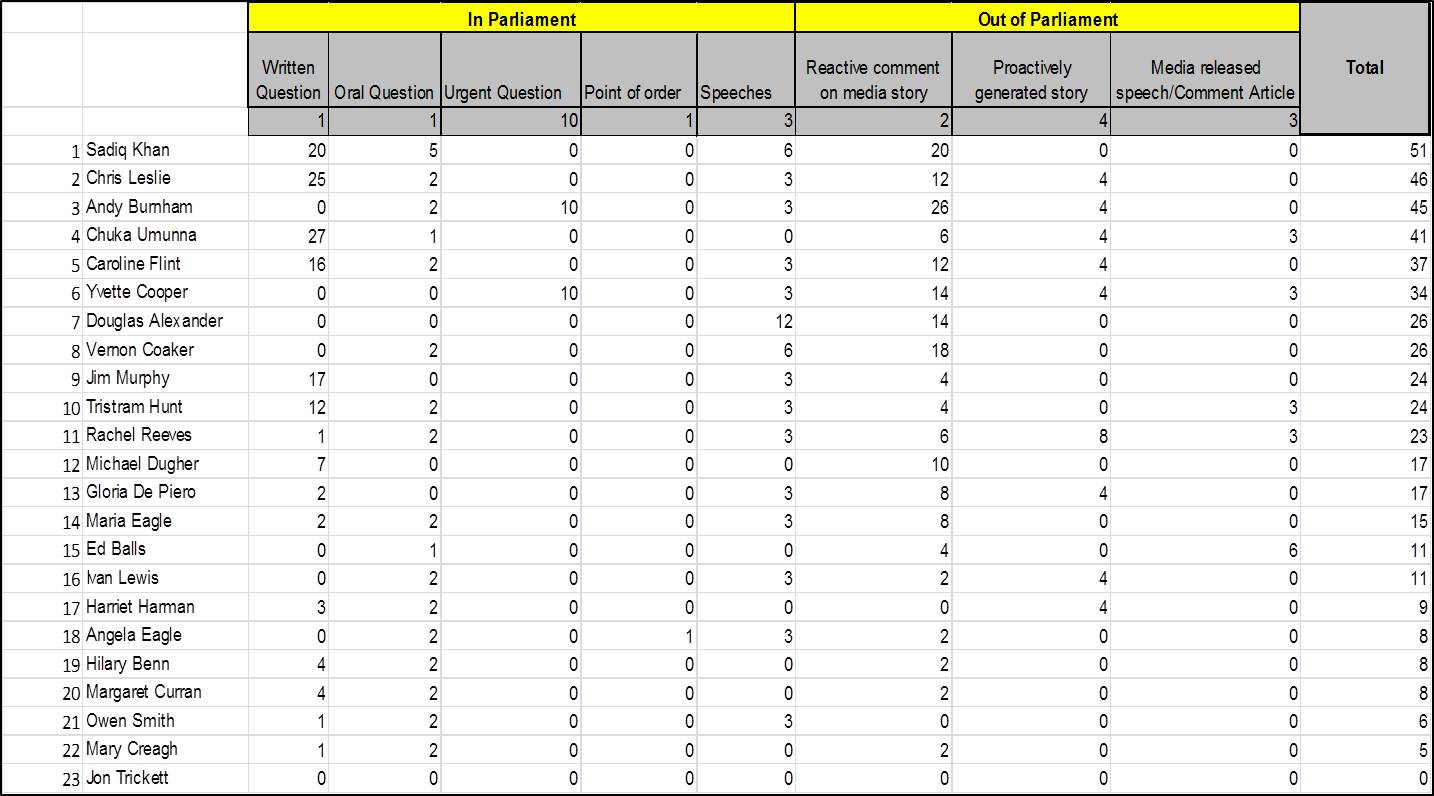
Rebooting a franchise is always a tricky task; for every Batman Begins, there is a Phantom Menace or Superman Returns. This reboot is rather cheaper and less sexy than your average Hollywood blockbuster, having been calculated on open-source software. As it is the first month back, it is hard to draw major conclusions from such a small data of pool. However, there are data points that bear discussing.

Shadow cabinet work rate table - November 2013

Shadow cabinet work rate table – November 2013

Storming into a surprise lead is Sadiq Khan, shadow justice secretary. Much of his media comment and written answers that underpinned his high score have been under-the-radar. He has constantly hammered away at the DoJ on prisons, focussing on rising costs and issues with places. His mayoral ambition seems to be drifting, but he has mastered the skills of opposition and could well turn up a political gem with his relentless digging.

Read the rest of this entry »

Facebook Twitter Digg Delicious StumbleUpon

GRASSROOTS: Labour must hope that Cameron and Osborne do not have Merkel’s political nous

03/12/2013, 07:00:45 AM

by Callum Anderson

On Thursday, George Osborne will give his penultimate Autumn Statement before the 2015 general election. It is likely to be a highly political Autumn Statement. But whilst most of its content has yet to be leaked (at least at the time of writing), save for the likely rolling back of green levies – an attempt by the coalition to tackle the “cost of living” crisis – there is still scope for the prime minister and the chancellor to create huge problems for Ed Miliband and Ed Balls, if they can demonstrate that they are beginning to understand the economic concerns of voters, and shift to the centre ground.

Hopi Sen has already entertainingly set out how Osborne and the Conservatives could steal a march on the two Eds on the ‘cost of living crisis’. Increasing the minimum wage above inflation each year for the next five years, subject to the advice of the Low Pay Commission; raising the tax free personal allowance by £500 each year, and thus lifting millions of people from the burden of tax; reintroducing the 10p tax rate temporarily, benefitting all full-time workers on the minimum wage; and announcing an immediate cut in domestic energy bills, funded by a tax on overseas buyers of expensive property, are just a few measures that would leave the Labour hierarchy scratching their heads as to how to respond.

Indeed, such a strategy has been expertly executed by Angela Merkel, the German Chancellor, since she was elected in 2005. Her Christian Union party (CDU) – Germany’s conservative party – has been the lead partner in the previous two coalition governments: first with the Social Democrats (SPD) between 2005 and 2009, and second with the Liberals (FPD) between 2009 and 2013, and is set to enter another Coalition with the SPD within the next month.

Ms Merkel has been particularly adept in not only keeping the CDU resolutely on the centre ground of German politics, but also shifting the balance of responsibility disproportionately to her junior coalition partners. For instance, during her first term, Ms Merkel astutely took advantage of the unwillingness of SPD members to enter a coalition government with her own CDU to, in the first instance, solidify the “Hartz” labour market and welfare reforms of her SPD predecessor, Gerhard Schroeder, as well as ensure that both parties shouldered the responsibility for the substantial austerity measures taken in response to the 2007-08 financial crisis.

Likewise in her second term, Ms Merkel has been, perhaps too successful, in allowing the FDP to shoulder much of the blame in the slow response to the Euro crisis of the last few years. I say too successful because the FDP, who have traditionally had more in common with the CDU than any other party in the German parliament, crashed at the federal elections in September to such an extent that they have no seats for the first time since 1945.

Read the rest of this entry »

Facebook Twitter Digg Delicious StumbleUpon

UNCUT: Labour history uncut: the Socialist League is sent packing

02/12/2013, 05:55:31 PM

by Pete Goddard and Atul Hatwal

When Stafford Cripps got up to speak to Labour students in Nottingham on the 6th January 1934, the reporters in attendance did not expect too much excitement. A brisk refresher on the Socialist League’s plan for an imminently Socialist Britain, then tea and biscuits if they were lucky.

Addressing the audience, Cripps declared,

“I do not believe in private armies, but if the Fascists started a private army it might be for the Socialist and Communist parties to do the same. When the Labour party comes to power, we must act rapidly and it will be necessary to deal with the House of Lords and the influence of the City of London. There is no doubt we shall have to overcome resistance from Buckingham palace and other places as well.”

The press sat up and took notice.

Because Cripps was airing the possibility of a Labour party private army? No. Because he was suggesting Labour join forces with Communists? No.

The Rubicon that Cripps had crossed was in voicing the great unmentionable, “Buckingham Palace.”

Outrage abounded. Within a day, Cripps had had to issue one of the finest political clarifications ever,

“There seems to have been some misconception of what I intended to convey by the term ‘Buckingham Palace’. I most certainly was not referring to the Crown…I cannot understand why anyone should have thought I was referring to the Crown.”

Indeed, the fools. Its obvious Cripps was talking about resistance to socialism from all those other people in Buckingham Palace. The servants maybe. Or the corgis.

Among the NEC there was a collective rolling of eyes at the gaffe. Dalton was apoplectic while Bevin was disgusted. Fortunately for Cripps though, one senior member of the party continued to back him – a member who also happened to be the acting leader – Clement Attlee. Thus Cripps swapped his red flag for a red face but remained free from formal censure.

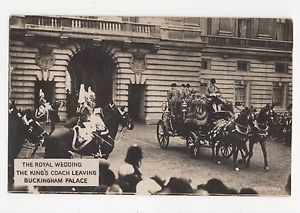
1934 – Riding out to battle the impending socialist army, Buckingham Palace wondered if it should maybe have modernised its forces

1934 – Riding out to battle the impending socialist army, Buckingham Palace wondered if it should maybe have modernised its forces

Read the rest of this entry »

Facebook Twitter Digg Delicious StumbleUpon