




UNCUT: The reverberations from April 1992 still ring out

05/04/2013, 01:44:11 PM

by Kevin Meagher

Next week sees a grim anniversary for Labour people of my generation. Losing the general election on 9 April 1992 was a gut-wrenching experience and the memory is seared into our collective minds. A government long in the tooth and mired in a recession of its own making couldn’t win a general election, we confidently told ourselves. Only it did.

The argument about how Labour “snatched defeat from the jaws of history” in 1992 is well rehearsed. Neil Kinnock wasn’t trusted. The Sun and the right-wing press were unrelentingly hostile to Labour; and John Major was a newish face who was worthy of a second chance, voters felt.

But a loss is a loss and Major’s unexpected victory had as big a psychological effect on the Labour party as Ramsey McDonald’s ‘betrayal’ for establishing the National Government had on earlier generations.

It seems another age given the three election victories the party would go on to win, but there was serious talk Labour was completely finished after its record fourth defeat. As Tony Blair put it in his autobiography, ‘A Journey’: “The party had almost come to believe it couldn’t win, that for some divine or satanic reason, Labour wasn’t allowed an election victory no matter what it did.”

This defeat and the self-loathing which followed, paved for the way for New Labour’s decade of iconoclasm. Dumb before the shearer, the party more or less acquiesced as reform after reform to party structures and policy were pushed through. As the late Tony Banks succinctly put it, “my constituents will eat shit to get a Labour government.”

But 1992 represented a triumph for Conservative politics too. A party that held its nerve in the face of massive odds prevailed. Just two years previously the poll tax riots were in full swing and 18 months earlier they had dethroned Margaret Thatcher. However their instinct to fight to the bitter end was rewarded with victory. The Tories’ iron nerves triumphed yet again.

So is history going to repeat itself? Will the Tories’ 2015 campaign plan simply re-run 1992?

Read the rest of this entry »

Facebook Twitter Digg Delicious StumbleUpon

GRASSROOTS: Erosion of universal benefits is destroying public support for the welfare state

05/04/2013, 07:00:15 AM

by Robin Thorpe

Earlier this week George Osborne stated that “this month, around nine out of 10 working households will be better off as a result of the changes we are making”.

The BBC report on this speech (before it happened, which frankly annoys me, why can’t politicians just give a speech and have it reported after the event? Why must it be released beforehand?) states that;

“This month saw the start of sweeping changes across public services including reform of the benefits system.

Mr Osborne argues that the government has had to take difficult decisions to cut the deficit and the current benefits system is fundamentally “broken”.

Changes include:

  • The introduction of a £26,000 cap on the amount of benefits a household can receive
  • A cut to housing benefit for working-age social housing tenants whose property is deemed to be larger than they need
  • Disability living allowance replaced by personal independence payment
  • Working-age benefits and tax credits uprated by 1% – a below-inflation cap

The chancellor believes the changes to benefits and tax will be fairer and help ensure that the country can live within its means and compete globally”

For all the rhetoric both in favour and against these cuts I would agree with Osborne on the limited claim that the vast majority of the public are in favour of these changes to the benefit system and do not agree with Labour or other critics of the changes. The very fact that 9 out of 10 people will purportedly be better off underlines the reason why most people agree with the changes. This, however, does not make it the right thing to do.

Read the rest of this entry »

Facebook Twitter Digg Delicious StumbleUpon

UNCUT: Labour history uncut: Labour takes a New approach to fighting elections

04/04/2013, 06:02:04 PM

by Pete Goddard and Atul Hatwal

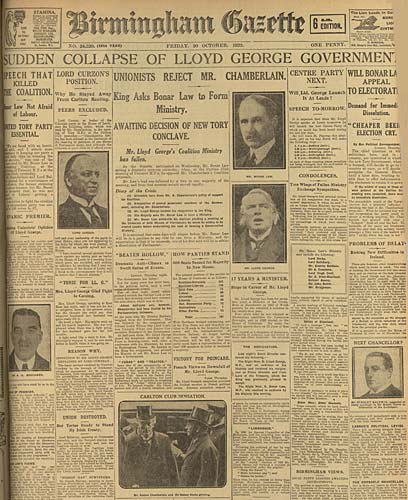
“Thanks for winning the last election for us,” said the Tories to Lloyd George, “now bugger off.”

After cheerfully  defenestrating their Liberal coalition partner,  they installed Andrew Bonar Law in October 1922 as the new prime minister. Law immediately fired the starting gun on the  general election, setting the 15th November as the date for the poll.

The Birmingham Gazette demonstrates the range of visuals that made their picture desk the envy of the world

Unfortunately, he forgot to mention this to his own party’s campaign machine, which was taken by surprise when the poll was announced.

Wrong-footed, they hurriedly selected candidates, grabbed a handful of key words from “Attacking Labour for Dummies” and rushed a selection of posters to the printers with the instruction “Anything with words ‘tax’, ‘socialism’, ‘debt’ and ‘spending’ is fine”.

Read the rest of this entry »

Facebook Twitter Digg Delicious StumbleUpon

UNCUT: Labour has got itself into a mess on welfare

04/04/2013, 07:00:01 AM

by Peter Watt

I don’t know what Labour’s position on welfare reform is.  I know that the Tories want to cut welfare bills and make work pay.  I know this because they keep saying it and because they have just spent the last few weeks pushing changes to the welfare system that appear to confirm this.  It doesn’t matter at this stage whether the policies will actually achieve this or not because at this stage what matters is that their rhetoric is matched by actions that appear consistent with their words.

But Labour has in the past also talked tough on welfare and that it would like to reduce welfare bills.  The problem is that it is currently fighting a battle in which it is opposing the government’s attempts to achieve this.  So Labour appears confused.

The truth about the current crop of welfare reforms will not be known for some time.  Both the government and the opposition have talked up the changes brought in on April 1.  The government wants the changes seen as being a turning of the corner in the ever increasing rise in welfare payments.

The opposition wants the changes to be seen as evidence of the inherent nastiness, unfairness and cynicism of the government.  The truth is of course somewhat more complex.  The so called “bedroom tax” for instance is probably flawed as there is not enough social housing stock for people to actually downsize to.

People will therefore either be worse off or have to move to smaller premises in the private sector which will of course cost the state more in housing benefit.  But other aspects of the changes seem reasonable like the benefits cap; even if the government is crudely talking up the tiny numbers of families able to actually claim hundreds of thousands in benefits.

Read the rest of this entry »

Facebook Twitter Digg Delicious StumbleUpon

UNCUT: David Miliband and the big beast famine

03/04/2013, 10:08:04 AM

by Rob Marchant

The most important news about David Miliband’s departure is, of course, that it is by no means news.

Journalists were last week making all kinds of wild claims, that this would somehow upset the delicate balance between Miliband’s core team and the remaining Blairites in the cabinet, as if the latter’s secret leader had suddenly been whisked away in the midst of plotting revolution.

The truth is more mundane, of course: Miliband senior was hardly, at this point, at least, the ringleader of some turbulent band of plotting Blairites. He was merely decently trying to stay out of everyone’s way and put together an alternative political life, in which he was not constantly examined for signs of fraternal betrayal. In his decision to emigrate, he has merely been a grown-up and recognised his own failure in that most impossible of tasks. What would have been extraordinary news would have been for him to accept a place in his brother’s cabinet. The die was cast in October 2010; this is just the inevitable endgame.

Where it leaves us, let’s be honest, is exactly where we were before: in a world where the big beasts who bestrode earlier generations are all but extinct.

This is ever more tricky in a world where politicians do not have what Denis Healey’s wife, Edna called “hinterland”. As the great man told Rafael Behr in a recent interview:

“None of them have that in either party. In my time, people didn’t start earning money until well into their life in politics. Now people can get a career out of politics as soon as they leave university. They don’t have experience of the real world.”

Indeed, this phenomenon is not just confined to Labour – after all, aside from Ken Clarke, who has Cameron got in the “silverback” category? – but if we want to win and win properly, we need to act with a little more mature wisdom than the prime minister has over the last twelve months.

Read the rest of this entry »

Facebook Twitter Digg Delicious StumbleUpon

UNCUT: Labour will need both Darling and Johnson at the next election

02/04/2013, 08:18:51 AM

by Jonathan Todd

Unity should run through Labour like a stick of rock. Following David Miliband’s departure, we should reflect on what this might mean for figures like Alistair Darling and Alan Johnson in the general election campaign.

It seems that Ed Miliband left the door open for his brother to serve on his frontbench but David preferred to run the International Rescue Committee. It also seems to me that Jonathan Freedland has called this correctly by saying this was the best decision for David but may not be for Labour.

Things are not quite so desperate that all Ed can offer the British people is blood, toil, tears and sweat. But it might not be so far off. We are in the slowest economic recovery on record and the fiscal position becomes ever more horrific.

The only quick and easy road for Ed will be to the kind of unhappy position of Francois Hollande, which he created for himself by having “rather pretended to the French that he and they wouldn’t have to make any difficult choices”, as Andrew Rawnsley put it.

We should level with people that life under PM Ed will be a hard slog. But less so than under this government because of the one nation approach that Ed would bring to his task. Yet Gaby Hinsliff has observed of this thematic frame:

“For all I know it may embrace raindrops on roses and whiskers on kittens, and feel warmly towards brown paper packages tied up with string: it’s not that these ideas are impossibly contradictory, just that cramming too many of them beneath one umbrella term renders it faintly meaningless.”

Read the rest of this entry »

Facebook Twitter Digg Delicious StumbleUpon

GRASSROOTS: David Miliband has gone. We now need more “star strikers” in our top team

01/04/2013, 05:58:50 PM

by Renie Anjeh

As Chuka Ummuna put it on twitter “one of Labour’s strikers has left the field”. Many Tory MPs were jubilant at David Miliband’s departure from British politics to run the IRC. They tried to spin this as evidence of Labour lurching to the left, but I could not help thinking that it their joy was really about Labour losing a big beast who Ed Miliband could bring back before 2015.

Last week’s mini-reshuffle showed that Cameron is in constant fear of his backbenchers as they move his party further to the right, but to contrast that Ed needs his own reshuffle to show that he is in command of his ship.

Firstly, he must promote the big beasts of the future. Top of that list should be Stella Creasy and Tristram Hunt as shadow cabinet office minister and shadow universities minister. Caroline Flint could be promoted to another domestic policy brief to allow the entry of Luciana Berger and perhaps Gregg McClymont could join as shadow Scotland secretary with Margaret Curran becoming the new chief whip – as she did a similar job in the Scottish Parliament.

Secondly, Ed needs some good former ministers.  David Lammy is a prime candidate. He is a great thinker especially on social policy, his book “Out Of Ashes” is testament to that and he is full of refreshing ideas especially on social policy.  He could be a reforming Justice Secretary in a future Labour government.

Read the rest of this entry »

Facebook Twitter Digg Delicious StumbleUpon

UNCUT: Cameron’s flirtations with the UKIP agenda are grist to Ed Miliband’s mill

01/04/2013, 12:15:45 PM

by Mark Stockwell

At the Conservative party conference back in October, David Cameron gave a strong speech reiterating his commitment to modernisation and ongoing detoxification of the Conservative brand.  It was an encouraging indication that in spite of all the rumblings about Boris Johnson and a return to a more traditional Conservative agenda (whatever that means), wise heads still prevailed within the prime minister’s inner circle.

It was always questionable whether Cameron could translate the warm reception his speech received into a firmer grip on his rambunctious backbenchers, and the outcome of the simultaneous by-elections in Middlesbrough and especially Rotherham in November put paid to any such hopes.

A sizeable caucus of right-wingers seized on the supposed “UKIP surge” to try to hijack the Conservative agenda and shift it their way. Some – bizarrely – even talked openly of suing for peace with Nigel Farage’s motley crew and trying to persuade him to stand down UKIP candidates come 2015.

Despite the fact that another by-election, in Croydon North, the same day showed very little sign of a similar pattern, they were (eventually) rewarded with the prime minister’s speech in January, promising a referendum on the UK’s membership of the EU.

Then came the Eastleigh by-election at the end of February, widely portrayed – not least by the same ideologically-driven section of the Conservative Party – as a humiliating setback for the prime minister and a rejection of the “metropolitan liberal” agenda they believe he stands for. This despite the fact that the seat was won by, er, the Liberal Democrats – a governing party in mid-term, mired in scandal and with a personally very unpopular leader, a pro-EU platform and a ‘liberal’ stance on immigration.

Cue more wailing and gnashing of teeth from the right about the supposed threat from UKIP, further fuelled by traditionalist angst over the vote on same-sex marriage earlier in the month. Although given that this issue was apparently going to tear the Conservative party apart, it would be remiss not to note that less than two months down the line, nobody much is talking about it anymore – this side of the Atlantic at any rate.

Read the rest of this entry »

Facebook Twitter Digg Delicious StumbleUpon

UNCUT: Whip’s notebook: Does Cameron now have two Chief Whips?

28/03/2013, 05:56:03 PM

by Jon Ashworth

Any self respecting whip has to go and see the superb This House by James Graham at the National Theatre bringing to the stresses and strains as Labour whips tried desperately to keep the Wilson/Callaghan show on the road while their Tory counterparts plot to bring it all crashing down.

While the lapels might have changed and the culture is certainly less macho, there still is a lot that remain the same.  We all work the phone and prowl the corridors to make sure all our flock are there to vote at the right time because simply as John Smith used to say ‘votes is the currency of politics.’

A prime minister can’t govern if he or she can’t command a majority. David Cameron has already lost big major votes on Europe, on the boundaries and everyone knows he would have lost on Leveson. With a group of Tory backbenchers more rebellious than ever Cameron desperately needs a whips office he can trust but who also crucially enjoy a the goodwill of his backbench troops.

But we all know that his troops aren’t happy. Whispers persist that 20 odd Tory MPs have fired off missives of no confidence to the Graham Brady, the chairman of the 1922 committee. The rebels openly talk with Tory MPs and Labour MPs (me included) of their frustrations with the prime minister in Commons corridors.

Meanwhile the chancellor who used to be cheered to the rafters by Tory MPs looks increasingly deserted at his Commons outing at Treasury questions and budget debates. Incidentally I’ve noticed more Tory MPs showing up for the Home Office questions.

Perhaps it’s rumblings and low morale that has forced the prime minister to switch John Hayes from his role as energy minister to become his “senior parliamentary adviser.” But it’s not entirely clear how the role differs from the unpaid post of prime minister’s parliamentary private secretary. I’m surprised therefore that Jeremy Heywood has agreed this new post should be remunerated with a ministerial salary. But such matters don’t seem to worry Cameron too much, he has now appointed three MPs to effectively none jobs –  “ministers without portfolio”  – but all with handsome government salaries. Talk about all being in it together eh?!

Read the rest of this entry »

Facebook Twitter Digg Delicious StumbleUpon

UNCUT: Our politicians should tell the truth about immigration: it’s good for Britain

28/03/2013, 07:00:01 AM

by Peter Watt

The immigration debate is very much alive again.   UKIP in particular have attempted to tap into the rise in concern amongst some of the issues.   Lurid headlines warn of hordes of Bulgarians and Romanians about to pour across the sea, hot on the heels of the Poles and the Lithuanians.  And in response the three main party leaders have followed suit as they all seek to be tough on the issue.  The result is a lot of heat and not a lot of light.

The debate focuses on a number of key themes:

  • Does immigration benefit or costs the economy?
  • Do immigrants get preferential treatment?
  • The extent to which we can “control” our borders as members of the EU.
  • Is there an increase in pressure on public services?
  • The alleged abuse of asylum status.
  • The extent to which immigration changes communities and people’s attitudes to this change.

The answers are complex and much debated in homes, streets and indeed by our politicians.  The truth is that of course we are economically benefitting from immigration.  On the whole those arriving are younger and are employed.  They pay taxes and don’t really need to access health services and rarely claim benefits.  But also that there are some areas where there has been pressure on local services that were initially ill prepared like GPs and schools.   The impact of “changing communities” is however harder to gauge.

Personally I am completely unconcerned that the number of accents that I hear in shops or on the bus has increased massively.  I like the fact that my children have friends from a huge variety of different backgrounds – certainly they aren’t worried! And I am very proud of our history of welcoming those fleeing persecution.  I suspect that many people feel the same as me.

But I also know that there are plenty of people who are increasingly wary of the changes that they see.  They worry about losing control of their way of life and feel that their area is being “taken over”.

They are nostalgic about the good old days and feel strongly that someone is to blame for letting this happen because they sure as hell weren’t asked.  For them, the proliferation of eastern European accents is a manifestation of their worries and reinforces a sense of powerlessness in the face of change.

Read the rest of this entry »

Facebook Twitter Digg Delicious StumbleUpon