




GRASSROOTS: This “no change” Budget fails to inspire

21/03/2013, 01:34:06 PM

by Simon Fitzpatrick

We were warned that this would be a no-change Budget, and it seems that was no bluff.

Yes, Osborne is cutting a little more from departmental budgets and yes, he’s spending a little more on housing and infrastructure.

He will accelerate the rise in personal income tax allowances, cancel the planned fuel duty rise for a second year and go further on cutting corporation tax.

But predominantly these are measures that were already in place, and going a little further on them in no way alters the direction of travel.

And try as he might, the chancellor cannot disguise the fact that that direction of travel is not pretty. By every one of his self-set tests, George Osborne’s plan is not working.

A chancellor who pledged to eliminate the budget deficit in this Parliament now concedes that we will still be running a deficit of 2.2% in 2017-18. Debt as a percentage of GDP will not begin falling until the same year. And growth forecasts are down again – just 0.6% is forecast this year. If the OBR’s track record on forecasts is anything to go by, we’ll be lucky if there’s not a “negative” in front of that figure.

In the face of so much bleak news, Osborne seemed determined to win himself some positive headlines regardless by announcing some populist measures for the ‘man on the street’. The man on the street George Osborne has in mind drinks beer and drives a Vauxhall Astra, though hopefully not in quick succession.

Read the rest of this entry »

Facebook Twitter Digg Delicious StumbleUpon

UNCUT: Osborne chooses Tory politics over one nation economics

21/03/2013, 11:42:11 AM

by Jonathan Todd

Daniel Finkelstein is a leading commentator and one of David Cameron’s most articulate defenders. No other columnist has the economic gravitas of Martin Wolf. Pieces from Finkelstein and Wolf in the week before the Budget exposed the tensions at the heart of the government’s economic and political strategies.

Finkelstein argued that the Conservatives have three assets: David Cameron; a Labour Party that “has pitched itself too far to the left”; and “the large constituency of voters who … don’t want to borrow more”.

On the same day Martin Wolf demolished David Cameron’s “there is no alternative” speech.

“What truly is incredible is that Mr Cameron cannot understand that, if an entity that spends close to half of gross domestic product retrenches as the private sector is also retrenching, the decline in overall output may be so large that its finances end up worse than when it started.”

What Wolf considers economically indefensible – not taking advantage of rock bottom interest rates to borrow more to stimulate recovery – is what Finkelstein considers to be a political strength. Those who join Wolf in advocating stimulus include: Labour, TUC, CBI, BCC, Vince Cable, IMF, NIESR, Bloomberg, The Economist, and Oxford Economics.

Equally, the political rationale that Finkelstein appeals to is not groundless. That 10 per cent more voters blame the last Labour government for the cuts than the current government speaks to the reputation for dangerous profligacy that continues to attach to Ed Miliband’s party (YouGov, 17/18 Feb). These voters believe that the Conservatives are doing the tough but necessary, while Labour offers only a risk, not a sound alternative.

This popular view, which sustains Finkelstein’s political logic, is, however, challenged by a growing economic consensus in favour of an approach quite different from that offered by Osborne.

He talks of supply-side reform when it is an absence of demand that holds the UK back. He claims fiscal responsibility when the stuff of genuine fiscal responsibility would involve recovering this demand. He pins his hopes on active monetary policy – near zero interest rates and QE – when the experience of recent years provides amble justification for Keynes’ view that loose monetary policy amounts to pushing on a piece of string in a depressed economy.

Read the rest of this entry »

Facebook Twitter Digg Delicious StumbleUpon

UNCUT: And the real winner of yesterday’s budget is…Nick Clegg

21/03/2013, 07:00:58 AM

by Peter Watt

For many in the Labour party one of the few pleasures of opposition has been that they have been able to indulge in a much loved pastime – Lib Dem hating.  It is a visceral thing that stems from the scars of countless bloody local election battles.  “They don’t fight fair and once you’ve got them they’re bloody hard to get rid of,” as one hardened Labour activist from a marginal seat said to me a few weeks ago.  Their ranks are seen by many in Labour as a cynical but ragbag mix of the politically directionless, the anarchic and a sizeable chunk that are basically Labour or should be.  Oh, and of course the odd orange Tory!   Lib Dem politics is dismissed as opportunistic as opposed to Labour’s politics of principled idealism.

So the anger and betrayal was very real for many on the left when Clegg took the Tory shilling.  Indeed according to the polls, many formerly Lib Dem voters felt the same as they quickly switched to Labour.  Clegg went from hero-to-zero in weeks as he became Cameron’s Poodle and was widely ridiculed for having sold out his and his Parties principles for a stint in a Ministerial car.  My particular favourite Calamity Clegg joke is:

“Q. What does Nick Clegg stand for?

“A. When David Cameron walks in the room.”

It may be cruel but it sums up the view of Labour party activists across the country.  And to be fair, he did seem pretty determined to confirm this view as he was outmanoeuvred on the AV referendum and then clumsily supported the increasing of tuition fees allowing himself to be branded a hypocrite.

His party’s polling numbers went into free fall and Clegg’s personal ratings fell further still.  He and his party often looked a bit amateurish and they were blamed over and over by Labour politicians for propping up Cameron’s cuts.  The possibility of House of Lords reform came and went as once again the Tories scuppered a favourite Lib Dem policy.   And then UKIP started occasionally, and then consistently, pipping the Lib Dems for third place in the polls.  The consensus within the Labour Party has been that Nick Clegg lacks principle, is a busted flush, a bit of a joke and that his party should and will dump him before the next election.

But I think that this view is wrong and that Labour has let its own prejudice cloud its strategic judgement.  Nick Clegg entered government with two very clear aims.  Firstly to prove that the Lib Dems could be a responsible party of government prepared to take tough decisions.  And secondly to deliver as much of the Lib Dem manifesto as possible.

And on both he has succeeded.

Read the rest of this entry »

Facebook Twitter Digg Delicious StumbleUpon

UNCUT: Wanted: a 21st century internationalism for Labour

20/03/2013, 02:16:22 PM

by Rob Marchant

Society, and not just in Britain, is increasingly dividing up into two parts: the first, those who work in a national context: public sector workers, most lawyers, a lot of media and small businesses. Those for whom “abroad” mostly means a holiday. Their day-to-day is dealing with other Brits, who in turn deal with other Brits. That’s one part.

And the second comprises those who work in an international context. This need not mean people constantly jetting around the world or spending their lives in videoconferences. It also means people in ordinary jobs working for global businesses (an awful lot of us) whose livelihoods depend on international sales; on dealing with other countries; on understanding how things work there.

If you are a UK manufacturing worker, you may be aware that raw materials are arriving in your workplace from Russia, part-made goods from the Far East and that the finished product is destined for, say, Dubai, and you don’t so much as blink.

The risk is for Labour, that some of those opinion-formers it needs to win back, like some of the Tory switchers from 2010, are in the second bracket: people who are more aware, if sometimes only by osmosis, of the world outside. Myopia can scare off these people.

One Nation, as I have commented before, is a great strategy for Labour. It is a unifying banner, around which its core supporters, along with those Labour needs to win back, can rally.

The Tories, by contrast, as evidenced by Cameron’s weekend speech (and previous conference speech), are staking their claim in two ways: one is through “aspiration”; the other through the “global race”. These are the battle lines, already starting to be drawn for 2015.

Read the rest of this entry »

Facebook Twitter Digg Delicious StumbleUpon

UNCUT: Ed, on Leveson: you say compromise, I say stitch-up

20/03/2013, 11:34:40 AM

by Ian Stewart

Before New Labour, in the mists of time before the red rose and “Meeting the Challenge, Making the Change” (remember that?), we used to have a wonderful little enamel badge, now beloved of collectors. Round, in red and white with gold detail – the pen, the shovel (workers by hand and brain), the torch and three simple words. “Labour”, “Party” and perhaps most importantly “Liberty”.

Yes Ed, “Liberty” – not “censorship”, not “revenge”, not even “royal charter”, just liberty pure and plain. It is a word that is threaded through the tale of radical and socialist politics of these islands for hundreds of years.

Every assault on power and privilege since the middle ages has met with repression and censorship together. Under the tyrant Charles 1st, Freeborn John Lillburne and William Prynne were imprisoned, censored, flogged and in Prynne’s case publicly mutilated.

In the early nineteenth century, owning Tom Paine’s “Rights of Man” would get you a free trip to Australia. Early feminists who wished to spread sex education and contraception were prosecuted under obscenity laws. Every faltering step forward by our side has seen gagging acts, libel actions by the wealthy, repression and imprisonment.

You know this, you are not an ignorant man. So why have you conspired with Nick Clegg and David Cameron to limit not only press freedom, but also the right to free speech and free investigation for everyone who blogs or writes in this country? The hacking scandal, exposed by Nick Davies at the Guardian is a fine example of investigative journalism – so why have you now made Nicks job harder? Who benefits from this? Sure, Hugh Grant is probably a nice guy, a plank of wood on the screen, but ok enough for a lunch.

Last week the government you oppose announced that for the international wealthy, British justice is the best money can buy. With our repressive libel laws that treat corporations as individuals, this is so for every dictator, every oligarch, every tax-avoiding press baron out there. Your response? To further gag and limit journalists, on the pretext of aiding ordinary people. So please tell me:  how exactly does this help the patients of South Staffs NHS?

Read the rest of this entry »

Facebook Twitter Digg Delicious StumbleUpon

UNCUT: Cameron caves on Leveson

18/03/2013, 06:58:13 AM

by Atul Hatwal

It was a weekend of fraught Leveson lobbying and negotiation. After a pugnacious performance from the prime minister last Thursday, when he abruptly curtailed the cross-party talks, the reality of his political position has slowly dawned on him.

The votes in parliament weren’t there. Specifically, David Cameron was headed for one of the biggest defeats for a sitting prime minister, on a fully whipped vote, ever.

With a potential pro-Leveson majority of over 40 in prospect, no previous prime minister in the past 90 years, not Gordon Brown, John Major, Jim Callaghan or Harold Wilson, would have suffered such a reverse on a party political issue.

Late Sunday night negotiations were still ongoing but the outline of a weekend deal hammered out by Nick Clegg, mediating between Cameron and Ed Miliband, had emerged.

For David Cameron it will represent an astonishing volte face from his position on Thursday. If the new deal is confirmed this morning, as expected, he will have U-turned on three central points:

  • Statutory underpinning for the royal charter – the charter will be embedded in law. A super-majority in parliament will be required to change its terms, rather than the charter being amendable by the privy council
  • The editors’ veto on membership of the regulator – the editors will no longer be able to block appointments. A majority decision of the appointment panel will be able  to confirm membership of the regulator
  • The editors’ control over the code of conduct – the editors will no longer write the code. It will be drafted by a joint team of editors, journalists and members of the public

David Cameron will ultimately accept 90% of the case made by the victims’ lobby group Hacked Off, as embodied in the Labour and Lib Dem proposals for a royal charter. The one compromise by the pro-Leveson coalition is likely to be to cede the option of exemplary damages against egregiously non-compliant organisations.

Read the rest of this entry »

Facebook Twitter Digg Delicious StumbleUpon

INSIDE: Cameron’s GCSE history fail as he gets facts on Churchill wrong at spring forum

16/03/2013, 01:05:20 PM

Oh dear. What would Michael Gove say? In David Cameron’s speech today to Conservative spring forum, he reaches back into the annals of history to describe how past Tory leaders have supported aspiration.

The speech has been briefed to the media as being about an “aspiration nation” and given its  to the Tory grassroots, who better to cite than Churchill? The prime minister states,

“Great Conservatives down the generations have put those ladders in place. When Churchill invented the labour exchanges that helped people into work. When Macmillan built new homes. When Thatcher fired up enterprise so people could start their own businesses.”

Except when Winston Churchill legislated to create labour exchanges in 1909, he was of course a Liberal MP and President of the Board of Trade in one of the great progressive governments of the last century.

A government that was opposed tooth and nail by er…the Conservatives. A government whose plans for pensions and social insurance in that year’s budget were repeatedly defeated by the House of Lords prompting a constitutional crisis, at the behest of er…the Conservatives.

On the specific issue of labour exchanges, Tory grandee and MP, F.E.Smith, summed up the views of many of his colleagues in 1909,

“Not only will the establishment of labour exchanges not add to employment, but if they are to serve the only purpose which they can economically serve the necessary consequence of their establishment must be actually to diminish employment.”

David Cameron doesn’t  just get his facts wrong, in his speech he is attempting to re-write history, implying by rhetorical sleight of hand the Tories were in favour of an agenda that they actually viscerally opposed.

Following on from his rebuke by the UK Statistics authority for confusing the terms debt and deficit, and his upbraiding by the Office for Budget Responsibility for his misleading words on the impact of austerity on the deficit, this is just the latest in a series of events where David Cameron has been caught out being economical with the truth.

The teaching of history in schools is an issue particularly close to Michael Gove’s heart. Eighteen months ago he described it’s importance in developing the abilities of GCSE students  saying,

“One of the skills I would like to see students develop is the ability to argue and separate falsities from the truth.”

Perhaps a little chat with the prime minister after the next cabinet would be in order.

Facebook Twitter Digg Delicious StumbleUpon

UNCUT: Labour history uncut: Britain teeters on the brink of martial law

15/03/2013, 12:58:30 PM

by Pete Goddard and Atul Hatwal

By August 1919 one thing was clear about Lloyd George’s coalition: it might have had a Liberal figurehead on the prow, but the Conservatives were steering the boat.

Labour were the official opposition in Parliament, but with such a large coalition majority there was little they could actually do in the House of Commons beyond squeaking the odd, small and ineffectual “no.”

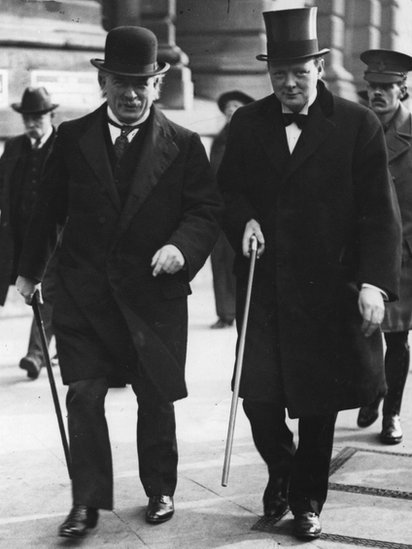
Lloyd George couldn’t help wondering, with his preference for a bigger hat and longer cane, if Churchill was trying to compensate for something

The government had been given the biggest mandate in living memory eight months earlier. That huge public support calibrated Labour’s approach. Splenetic opposition to the government’s platform would have placed Labour firmly on the wrong side of public opinion. Instead, respectable, reasoned disagreement seemed to be the outer limit of what was electorally practicable.

But politics, in common with both nature and a first year student, abhors a vacuum. The unions shifted into the space the party would not inhabit – the voice of visceral resistance to a government seemingly determined to roll back the clock for organised labour.

In August 1919 Lloyd George’s team had ignored the Sankey commission on mining, snubbing the union. Now they turned the anti-union spotlight on the boys in blue.

The Police Act of 1919 banned policemen from joining their union, replacing it with the Police Federation. “It’s almost exactly like a union,” they explained, ignoring the tiny detail that the Federation was not allowed to go on strike.

Read the rest of this entry »

Facebook Twitter Digg Delicious StumbleUpon

UNCUT: Yes they’re right wing, but UKIP is not fascist

14/03/2013, 02:48:43 PM

by Kevin Meagher

David Cameron famously described UKIP members as a collection of “fruitcakes, loonies and closet racists”. But are they fascist too? This is the question being posed by campaign group Hope Not Hate.

It is asking its supporters whether their successful efforts at taking on the far right in the shape of the BNP and English Defence League since 2004 should now extend to UKIP ahead of next year’s European elections.

“Should we begin to oppose them or should we stick to extremist groups like the BNP?’ they ask on their website:

‘The case for opposing UKIP:

‘UKIP is increasingly taking an anti-immigrant tone and as anti-racists we cannot ignore that. They are whipping up fears over new immigration and as we approach next year’s European Elections this will even get worse.

“The growing support for UKIP is scaring the mainstream parties and it will push them to adopt more hard line policies on immigration and multiculturalism. We need to prevent this and offer a positive alternative to the politics of hate and division.

‘The case against opposing UKIP:

‘We might not like some of UKIP’s policies but they are not a fascist or far right party. They are embedded to the democratic system and have more in common with the right wing of the Conservative Party than the fascists of the BNP. And, despite their current anti-immigrant rhetoric, they are still basically a single issue party.”

Read the rest of this entry »

Facebook Twitter Digg Delicious StumbleUpon

UNCUT: Our parties and politicians don’t understand how the world is changing

14/03/2013, 08:08:28 AM

by Peter Watt

There doesn’t yet appear to be an existential crisis at the heart of our political establishment but there quite possibly should.  Right across Europe from Germany to Greece and Italy there has been a rise in new, fringe and occasionally comic parties.  They are all benefiting from a sense of disenchantment with the established parties.

In the UK it was traditionally the Liberal Democrats that farmed the protest ‘none of the above’ votes but the advent of the coalition appears to have put a stop to that.  The result is the rise of other smaller parties – Respect in Bradford, UKIP in Eastleigh or a whole series of independents.  In fact increasing numbers are choosing to either not vote or vote for whichever other party or candidate is best placed to deal the establishment parties a bloody nose.

The political assumption appears to be that this malcontent has at its heart the prolonged economic crisis.  Financial uncertainty combined with an already rapidly changing world has meant that people are looking for an answer to an increasingly complex set of questions.  Where we used to assume that we would be better off in the future we now expect to be worse off and we worry for the economic plight of our children.  Following this logic through and when the economy upturns, then political business as usual will resume.  Labour and the Tories will battle it out for supremacy with Lib Dems battling for scraps or possibly further coalition.

The result of this assumption is essentially conservative; it is the politics of no change in how we do our politics.  The countdown has begun to May 7 2015 and the only question is which of the big two will be the largest party the day after.   Whilst others may be suffering from the economic situation or the rapidly changing world, the world of politics appears unaffected.

Candidates are being selected from those who have most faithfully played the traditional political game within each of the parties.  And the political cycle of conferences, budgets, parliamentary rebellions, briefings and gossip has not been interrupted one dot.  The political elite may feel a little battered reputationally but they are certainly not unduly concerned; patience will be rewarded with the maintenance of the status quo.

Read the rest of this entry »

Facebook Twitter Digg Delicious StumbleUpon