




UNCUT: Labour needs to remember how to make an argument

10/01/2013, 07:00:47 AM

by Peter Watt

So, after five hours of heated debate the government got its way and parliament voted to limit annual increases in working-age benefits to 1%, for the next three years.

Only a handful of Lib Dems rebelled.  But put aside the rights and wrongs of the argument for the moment.  Just consider the arguments used in the first big political battle of the second half of this parliament.

To be effective an argument has to be heard, resonate, be noticed and be believable.  It critically has to be understood.   I spent much of Monday and Tuesday listening to party spokespeople making their arguments in advance of and in the aftermath of the welfare vote.  I was struck by just how hard it was for Labour to get to the point and to make their argument.  The government spokespeople on the other hand seemed to get to the point quickly.  I wonder if this is why?  When you go to the respective websites and try to get a distillation of the arguments you find:

Government argument:

“Today Labour are voting to increase benefits by more than workers’ wages.  Conservatives: standing up for hardworking people.”

Labour argument:

“Labour will today challenge the government to back its plan for a compulsory jobs guarantee for the long term unemployed as new figures from the IFS show 7 million working people will be hit by the government’s ‘strivers tax’. The new report from the IFS shows that 7 million working families will lose out under the government’s real terms cuts to tax credits and other benefits. It follows Children’s Society research which shows that a second lieutenant will lose £552 a year, a nurse could lose £424 a year and a primary school teacher could lose £424 a year.  Labour will oppose the bill and call for the government to bring in a compulsory jobs guarantee, which would give people out of work for 24 months or more a job which they would have to take up or lose their benefits.”

Remember, put aside the merits of the respective arguments, and judge them on their effectiveness.

Read the rest of this entry »

Facebook Twitter Digg Delicious StumbleUpon

UNCUT: The polling facts about Labour’s mid-term lead

09/01/2013, 12:02:49 PM

by Rob Marchant

Much has been made during 2012 of Labour’s solid poll lead, which has been of the order of 10% ever since the government’s disastrous Budget. For some it seems difficult to refrain from mentally converting this into a line on Peter Snow’s election night model of the House of Commons, showing a majority for Labour.

What this fails to account for, quite apart from the changed circumstances which may prevail in two years’ time (and which may be much more attractive for the Tories, as Peter Kellner cheekily points out here), is that incumbents tend to have a dip at mid-term anyway. Quantifying this effect would obviously help us to make more accurate forecasts, to the extent that this is possible.

Last week at Uncut, Atul Hatwal showed the numerical arguments against a win for any party which failed to establish a poll lead on the economy. In a complementary way, we can try and allow for this mid-term effect, to try and get a better idea of where things might end up, all other things being equal.

There are various ways of trying to gauge it*. A year ago, an excellent piece of analysis was carried out by Leo Barasi (and for which I am indebted to John Rentoul for pointing out) on post-war polls both eighteen months into a parliament and two years out from the next, which concluded, rightly, that Labour’s prospects were numerically better than many seemed to think.

Interestingly, this conclusion now looks a little less secure, not because Barasi’s model has changed or become less applicable, but because the polls have actually improved for Labour in the last year and therefore many commentators, who were very negative at the end of last year, have gravitated towards a much warmer view of Labour’s prospects.

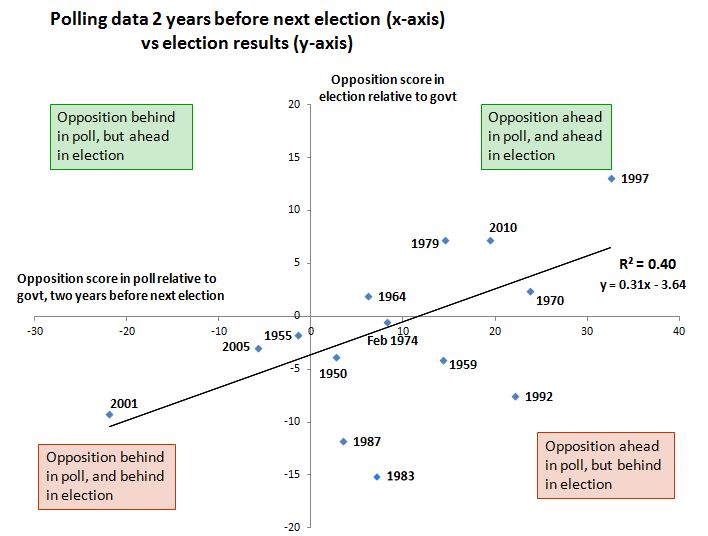
To revisit the second part of that analysis – that of two years out from the next election – is now both timely and illustrative, which we do now in this graph:

It is interesting to look at the regression line but the data points, too, tell a story. It is also useful to apply a little political history to the figures.

First, the most striking thing to note is that over four-fifths of postwar oppositions have had a lead in the polls at this point, two years out from an election. Irrespective of whether they go on to win or lose. So having a lead in itself is hardly remarkable: in fact, allowing for outliers**, they almost all do. It is the size of the lead that counts. Conclusion: don’t get excited about being ahead in the polls at this point. It seems to be a necessary, not a sufficient condition. Not being ahead, now that would be something.

Read the rest of this entry »

Facebook Twitter Digg Delicious StumbleUpon

UNCUT: Forget strivers vs skivers, it’s the uncosted spending that will hurt Labour on welfare

09/01/2013, 07:00:51 AM

by Atul Hatwal

Yesterday Labour voted against the welfare uprating bill after a debate in the House of Commons dominated by the four horseman of the welfare apocalypse, “scrounger,” “shirker,” “striver” and “skiver.”

These are highly charged, emotive terms, laden with implicit meaning. The focus of the debate in the run up to the vote has been on the values inherent in these words. The Tories are slapping a tax on strivers. No, Labour wants to sign a blank cheque for scroungers. Back and forth it has raged.

But amidst the sound and light about who was actually on the side of the hard working majority, the real impact on voter perceptions, and damage to Labour, has received comparatively little attention. Only yesterday, as the Tories rowed back from the sharper exigencies of their scrounger rhetoric did they alight on the most pointed attack on Labour.

Voters were already pretty clear that Labour will by and large try to protect benefits for the less well-off while the Tories are tougher on cheats. The values debate will not have altered this perception, except maybe to entrench it for both sides: the Tories cut with too much relish and Labour is more likely to fall for a hard luck story.

The one incontrovertible fact of Labour’s vote against the welfare uprating bill is that the party has now backed higher spending on benefits than the government.

Read the rest of this entry »

Facebook Twitter Digg Delicious StumbleUpon

UNCUT: Labour history uncut: Labour sets a new record for by-election losses

09/01/2013, 12:21:31 AM

by Pete Goddard and Atul Hatwal

“Do something!”

This was the message to Ramsay Macdonald from the unhappy troops in his the party. Having become leader in 1911, Macdonald had arrived to find the workers of the nation ready for a Millwall wave of industrial unrest rippling across dockers, miners and rail-workers. This was like a Mexican wave, but with less cheering and more broken noses.

It left Macdonald in a tricky position as, at the same time as being the representatives of the working man, he was determined to establish Labour as a “respectable” party (as opposed to a Respect party, which is something different). Consequently, he was less than keen to be seen to be on the side of rioters and militant strikers.

As part of his plan to establish Labour, Macdonald had operated an informal electoral pact with the Liberals since 1903, each giving the other a clear run at the Tories. For Labour it had helped build the parliamentary party to 42 seats.

With the Liberals now in government, it also meant Labour could get scraps of their legislation through in return for continued support.

While this did rather make them the dog at the Liberal party banquet, that was of more practical benefit than being the starving man outside, watching everybody else eat.

But on the other hand, who wants to be a dog, aside from people with a burning desire to lick their own genitals? Certainly not the party rank and file, who quite reasonably felt that being on the side of the workers sort of came with the job description for Labour – the clue is in the name after all.

If all Labour was doing was backing the Liberals, what was the point of setting up a different party in the first place?

So Macdonald subtly shifted strategy. He didn’t turn his full rhetorical fire on the government, but he did change the approach on by-elections. After 1911, Labour’s leadership exercised a little more willingness to run candidates where a Liberal was standing.

Partially Macdonald’s hand was forced by pressure from within the party, but there was also merit in gauging Labour’s strength. Even if they didn’t beat the Liberals, a strong electoral showing might strengthen his hand when negotiating with the government – after all the Liberals weren’t even the largest party.

So, between 1911 and summer 1914, out of 50 by-elections in Liberal seats, Labour contested an unprecedented 14 seats.

“Say ‘cheese’? Whilst workers are starving? Never.” ’William Cornforth Robinson, Labour candidate in the 1911 Oldham by-election

Read the rest of this entry »

Facebook Twitter Digg Delicious StumbleUpon

UNCUT: Teachers, if you don’t like being measured, fix the problem yourselves

08/01/2013, 07:00:03 AM

by Kevin Meagher

As schools started back yesterday for a new term, it must have felt like another upward trudge with a boulder for our leather elbow-patched Sisypeans. We know this, after all, because a recent poll found 55 per cent of teachers describe their morale as “low” or “very low”.

The gripes are familiar enough. As well as the usual complaints about pay and working conditions, 77 per cent of teachers in the poll commissioned by the national union of teachers thought academies and free schools were taking education in the wrong direction; while 71 per cent said they rarely or never felt trusted by the government, (up from 54 per cent in April 2010).

But it’s the issue of school standards that still seems to grate most. Last November, Sir Michael Wilshaw, the new chief inspector of schools, presented Ofsted’s annual report. It found that schools in England are getting better – although there is still a long way to go before the nation catches up with the best in the world. There are also wide variations in the performance of schools across different local authority areas, leading to serious inequities for children in some parts of the country.

The product of nearly 25,000 inspections across schools, nurseries and colleges, it is a rigorous and useful reminder of the challenges we face in making all our schools the best that they can be. However Sir Michael’s analysis of the problem is not entirely shared, it is fair to say, by the teaching unions.

Read the rest of this entry »

Facebook Twitter Digg Delicious StumbleUpon

UNCUT: On welfare, Labour needs to be the party of work

07/01/2013, 07:59:11 AM

by Jonathan Todd

Labour debating the Conservatives on welfare is not a clash between two settled bodies of opinion. As public opinion evolves, so does internal debate within both parties. Casualties will come from “friendly fire” and the fog of war is thick.

There are those within Labour who think that George Osborne has snookered our party with the welfare uprating bill. In contrast, others think Osborne has overplayed his hand and we will be rewarded for principled opposition to the bill.

The latter are in sympathy with the rhetorical question of John Harris: If every Labour politician cannot oppose Osborne’s strivers and skivers plan in its toxic entirety, what exactly are they here for?

The former both dismiss this as naive and discount the capacity of the more nuanced opposition that Gavin Kelly has articulated and which Labour’s guarantee of a job for those out of work for 2 years is a variant of.

This guarantee seems a step away from the Harris position, which rejects absolutely the welfare uprating bill, and towards a position that argues the bill is unnecessary as there are better means of reforming our welfare system. Taking this step has the advantage of reducing the extent to which we seem to defend a discredited status quo. Equally, it will disappoint those attracted to a more visceral rebuttal of Osborne.

While there is diversity of opinion within Labour, it would be mistaken to think that the Conservatives are united. Indeed, they are at war, if a Peter Oborne piece from just before Christmas is to be believed. Soon after Christmas a cabinet minister was speaking in less than glowing terms about Iain Duncan-Smith’s universal credit. “The information technology for the new system is nowhere near ready. It’s a disaster waiting to happen.”

Read the rest of this entry »

Facebook Twitter Digg Delicious StumbleUpon

UNCUT: Sunday Review: “the Victory Lab: the secret science of winning campaigns” by Sasha Issenberg

06/01/2013, 08:00:52 AM

by Anthony Painter

Sometimes you find yourself picking up a book with a degree of scepticism and ambivalence. This was one such occasion. Issenberg’s pacy Moneyball-style look at the evolving statistical and psychological science of winning campaigns had potential for ‘overstatement of case’ written all over it. It didn’t help matters when the final sentence of the introduction argued that this new application of science had enabled campaigns to ‘start treating voters like people again.’

And yet, I ended up convinced by Issenberg’s argument against my own expectations. The techniques and approaches he outlines within the Victory Lab, if applied with imagination, have the potential to re-engage millions in democracy – up to a point. His core contention is that voting is a behavioural act. As he eloquently puts it:

“What if voting wasn’t only a political act, but a social one that took place in a liminal space between the public and private that had never been well-defined to citizens? What if toying with those expectations was key to turning a person into a voter? What if elections were less about shaping people’s opinions than changing their behaviours.”

There is an old rational choice puzzle that all undergraduate students of political science are presented with. Why do people vote when, from an instrumental point of view with a low chance of influencing the outcome, it’s an irrational act? Rationalistic models of human behaviour have shown themselves in economics, politics and in psychology to be completely inadequate. Issenberg reaches instead for the behavioural science of the likes of Daniel Kahneman, Amos Tversky, Robert Cialdini, and Richard Thaler  – all names that will be familiar to those who have been following these debates.

The answer to the rational choice puzzle is, of course, because human beings aren’t just instrumental calculating machines. Any (political) science that can’t cope with that insight is for the birds.

Read the rest of this entry »

Facebook Twitter Digg Delicious StumbleUpon

UNCUT: Alex Salmond wants to disenfranchise millions of Britons. Don’t let him.

04/01/2013, 11:56:58 AM

by Ian Stewart

Forgive me, this is all going to get a bit Simon Heffer, but in a good way, I promise.

Sometimes it seems that the political class is intent upon the out-and-out destruction of Great Britain. Witness the lack of support for our national broadcaster, even before the Saville scandal, and its supreme lack of care at the ruthless gutting of the welfare state, let alone the NHS sell off. If you value your eardrums, never get me started on education either…

Yes, the political class – a thing that back in the fifties and sixties most of us would have thought near to death – has, by the grace of Margaret and Tony, been placed firmly back in control. I suppose that we should all be glad that we have no need to worry our little heads about the issues of the day, despite that pesky universal suffrage thingy. Let us all sit back and let assorted witless media-types, lawyers, bankers, tame academics, the odd ex-oil company exec and career politicians lull us all to sleep.

Large sections of this privileged, educated elite show supreme indifference as to the fate of the United Kingdom, whether they wield power in London or Edinburgh.

Despite leading the Conservative and Unionist party, and despite presenting themselves as inheritors of Macmillans’ one nation mantle to get elected, Cameron, Osborne, Gove et al have no love for the union. Why should they, when Scotland rejects modern Toryism by such a large degree? Yet a common cynical cause has been made with the fat, failed economist in Hollyrood. An outside observer might possibly see that however unlikely it may have seemed given the SNPs anti-Tory stance at previous elections, for nationalists, they main enemy has been Labour all along.

It goes like this – Labour lost the Scottish parliament because we deserved to. For far too long we practiced the kind of machine politics that belong to Tammany Hall rather than a modern state. Hopefully we are learning the lessons and reconnecting. However the result of the stitch-ups, the graft and the internal censorship has been plain to see.

So Alex Salmond, never one to exhibit an ounce of shame, was given an open goal. Never mind that his policies on the economy were in tatters by 2009, never mind the backing of religious reactionaries, or his blatant courting of dear Rupert, he beat us fair and square.

Read the rest of this entry »

Facebook Twitter Digg Delicious StumbleUpon

UNCUT: Politicians in the Westminster bubble don’t understand how real people feel

03/01/2013, 07:00:01 AM

by Peter Watt

There are a lot of clever people who have recently been analysing the relative merits of the political parties and their respective political fortunes.  Over the Christmas and new-year period pundits have written article after article about the ramifications of the latest polls, changes in demography and so on.  I even penned a piece myself although I certainly wouldn’t put myself in the “clever” bracket!

The consensus seems to be that the Tories are very unlikely to form a majority after 2015 and that the most likely outcome is the formation of a government of some sort lead by Ed Miliband.  There have though been one or two siren voices.  These are saying that Labours position is less certain and that it needs to watch its economic polling numbers which appear to be going in the wrong direction following the chancellor’s autumn statement.

Just before new year I tweeted that:

“@PeterWatt123 I always hate the last few days of the year. Makes me feel sad.”

It was meant as a slightly maudlin reflection on the emotional highs and lows of the festive period.  But in response, Ian Austin MP, who I respect and occasionally joust with on Twitter, quipped that:

“@IanAustinMP Surely you could write piece for Labour Uncut about how end of year is all Labour’s fault, proof of unfitness to govern etc.”

It was a good riposte and I guess indicates that Ian is not a fan of my blogs!  But Ian does make a fair point that on the whole I am not comfortable with some of the direction of travel of the Labour party at the moment.

I worry that most of our poll lead is solely down to current government unpopularity, that Ed is still not seen as prime ministerial and that our stock with the electorate is dangerously low when it comes to the economy, welfare reform and immigration.  And I honestly think that our economic message is disingenuously trying to look both ways on the central issue of deficit reduction and the scale of cuts required whoever wins next time, regardless of whether we have economic growth.

But most of all I worry that no political party is seen by voters as having the answers to their worries and concerns.  Because at its heart, current political discourse is still being conducted between the political parties inside the rarefied world of the political bubble.  It certainly isn’t being conducted with voters.

Read the rest of this entry »

Facebook Twitter Digg Delicious StumbleUpon

UNCUT: Sunday review on Wednesday: the Great Rebalancing, by the Fabian Society

02/01/2013, 07:00:26 AM

by Jonathan Todd

Heavy words are lightly thrown in the Great Rebalancing, the Fabian Society’s new collection of essays on the economy. Three telling examples are “change the rules of the game”, “a mainstream north European economy” and “market failure”. The different interpretations that might be made of these largely undefined terms go to the heart of Labour’s dilemmas.

Twice in Stewart Wood’s relatively short introduction he refers to “changing the rules of the game”. This may tell us that he is putting these words into Ed Miliband’s mouth but I remain unclear as to what exactly is meant.

Does it mean legal and/or regulatory rules, some market intervention to change the dynamics of competition and thus the rules of the market, or the rules formed by cultural and social norms?

Should, for example, the living wage be a legal right for employees, something that is incentivised for employers by tax or other mechanisms, or something that it is considered culturally unacceptable not to respect?

Wood cites Jacob Hacker’s definition of predistribution: “a more equal distribution of economic power and rewards even before government collects taxes or pays out benefits”. Given that this would not seem to extend to incentivising the living wage through tax breaks for employers, predistribution routes to a living wage would seem to encompass enforcing it as a legal right or seeking to make it a cultural norm. The former comes with more risk of pricing workers out of employment and the later is less likely to effectively secure the living wage.

Read the rest of this entry »

Facebook Twitter Digg Delicious StumbleUpon