


UNCUT: Hezza’s one man stand needs stronger sense of place

01/11/2012, 05:38:40 PM

by Ed Cox

It is always good to see a lone ranger riding into town, kicking wide the swing doors of the last chance saloon and calling on the assembled laggards to put their hands up high in the air. This is exactly what Lord Heseltine has done with No Stone Unturned – “one man’s vision” for national economic growth.

Amidst its 233 pages and 89 recommendations there is much to cheer about. The simple challenge that the country needs more than a plan for austerity is a welcome start. The strong emphasis on “reversing more than a century of centralisation” not simply with localist rhetoric and piecemeal initiative but though a £49 billion “single pot” for growth is a step-change in the debate that should make all political parties gulp. And there are many other very sensible recommendations on procurement, local business support and schools which have not made the headlines but could make a significant difference at the local level.

What is striking though for such a gun-slinging, private sector champion is the report’s preoccupation with structure. No stone unturned could equally read “no deckchair unmoved” as the detailed schema in the report’s annex set out in fine detail. Heseltine’s plans for a fundamental reorganisation of central government bodies and local structures are to allow for greater private sector involvement and a greater focus on growth. The emphasis on functional economic areas makes good sense and with it the bolstering of Local Enterprise Partnerships and Combined Authorities – something that Labour would do well to back at the earliest opportunity and put to bed any notion of reinventing RDAs.

Read the rest of this entry »

Facebook Twitter Digg Delicious StumbleUpon

UNCUT: Labour history uncut: the Hardie boys

01/11/2012, 03:00:45 PM

Continuing our series on the history of the Labour party, Pete Goddard and Atul Hatwal look at the runners and riders who founded the Labour representation committee (LRC) in 1900. First up, the Independent Labour party.

Before the Labour party there was the Independent Labour party.

In January 1893, 120 delegates met in Laycocks temperance hotel, Bradford (now new Guiseppe’s restaurant “Nice home made food in a relaxed atmosphere”, TripAdvisor) to found the Independent Labour party.

The socialist intent of this group was evident from the start. It’s aim was to “to secure the collective ownership of the means of production, distribution and exchange”. The Bradford Observer recorded that “The number of socialists among them was apparent from the large proportion of wideawakes (stand up collars).”

A fact which raises the intriguing notion that Saturday mornings on ITV in the 1980s were part of a cunning socialist indoctrination programme for children. Sadly, records do not show if there was a Comrade Mallett at this first meeting of the Wide Awake Club.

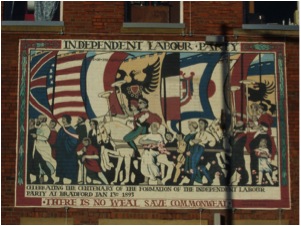
A Bradford mural celebrating the ILP depicting their twin passions of workers solidarity and plate-spinning

The inaugural meeting was lit up by the left’s glitterati such as James Keir Hardie, Tom Mann and George Bernard Shaw.

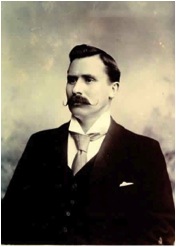
ILP Founder Tom Mann could impale two capitalists at once on his deadly moustache

Hardie had been elected MP for West Ham South a year earlier thanks to combining a broad message that appealed to radicals, trades unions and the local Irish community alike, effective organisation and, perhaps most significantly, his Liberal opponent conveniently dying just before the election.

Rather than turning up to Parliament, as all new MPs have through the ages, with shiny shoes and slicked-down hair, Hardie did things differently. He rocked up riding a wagonette, accompanied by a trumpeter playing La Marseillaise, rather alarming the older generation of Tories who assumed that Napoleon was on the march again.

Read the rest of this entry »

Facebook Twitter Digg Delicious StumbleUpon

UNCUT: Labour needs to put families first. Here’s how.

01/11/2012, 07:00:33 AM

by Peter Watt

With years of austerity in prospect, the search is on for things to put on Labour’s famous blank piece of paper.  As health, welfare and education budgets come under pressure there is one institution above all others that a future Labour government should prioritise; the family.

The family is the best form of welfare there is from the cradle to the grave.  The family is a great place to provide a healthy environment for children and adults alike.   And a huge proportion of learning takes place in families as knowledge is passed literally from generation to generation.

Traditionally Labour family policy has focused on families who, for whatever reason, are down on their luck and who need some help with day-to-day essentials.  So the priority has been using the welfare state to target resources.  Free school meals, targeted benefits, Sure Start and so on.

But as Ed Miliband rightly points out, many other families with modest incomes have been offered little help and have been struggling.  So Labour should go into the next election with an unashamedly pro-family agenda that tries to make life a little easier for our millions of working families.  This doesn’t mean withdrawing support for some; it does though mean consciously prioritising the majority.  So here is a short list.  They should not cost much and some of them may seem small things.  Some will require us to possibly decide to stop doing something else and others may pay for themselves.  But collectively they will add up to a significant package of help.

Labour should introduce tax breaks for those with children.  It doesn’t have to be huge but as the cost of living goes up every little helps.  Increasing the tax free allowance for a nominated parent by £500 per child would make a significant difference to many household budgets.   And of course, the money would be spent by those who earned it boosting the economy.

Read the rest of this entry »

Facebook Twitter Digg Delicious StumbleUpon

UNCUT: We now know where Labour’s five million lost votes went, but the party doesn’t seem to like the answer

31/10/2012, 01:14:23 PM

by Rob Marchant

As any economist will tell you, we live in a world of incomplete information. A change in information can serve as a shock, and change the economic landscape all by itself.

But this is also true of politics. Changes in information can also change the political landscape, and Labour has just experienced one of what ought to be seismic proportions: it now knows which voters it has lost.

However, surprisingly, this fact went almost unreported in the press: in fact, in the broadsheet press it was initially only reported by the Telegraph; on the left, barely a whisper.

So there are two stories here: the event itself; and the lack of attention it has received.

Why is this event so important? Well, during the last half-parliament, conventional wisdoms as to why Labour lost the last election have built up, fallen and built up again. On the left and on the right of the party, we have all had our theories but, as so often in politics, based more on intuition than hard facts. A rigorous post-mortem has been noticeable by its absence.

Until now.

On Monday last week, YouGov pollster Peter Kellner released a detailed polling study of the now-celebrated five million votes lost between 1997 and 2010. And the results might be really rather surprising to Labour’s high command.

Read the rest of this entry »

Facebook Twitter Digg Delicious StumbleUpon

UNCUT: Savile’s is not the only face of child abuse in modern Britain

31/10/2012, 07:00:25 AM

by Kevin Meagher

If you remember the 1960’s the old counter-culture quip goes, you weren’t really there.

Jimmy Savile certainly was; and as his torrent of victims attests, they do remember. Perhaps we didn’t have a name for what Savile was doing back then, leaving his victims to face an inarticulate inner torment about what had even happened to them. But they have suddenly found their voice. And now we do know what to call it.

But Jimmy Savile is not an adequate public face for contemporary paedophilia. In fact creepy old bogeymen like Savile, Gary Glitter or Jonathan King actually hamper our understanding of the far more prosaic dangers facing children and young people.

The recent child abuse cases in Rotherham and Rochdale involving gangs of predominantly Pakistani men offers a very different face of 21st century child abuse in Britain, with scores of young girls used as little more than sex slaves passed about by groups of vicious, inhuman child rapists.

But the problem is not confined to just predatory celebrities, or, for that matter, particular ethnic groups. Indeed, the NSPCC says that the majority of child abusers sexually assault children known to them, with about 80 per cent of offences taking place in the home of either the offender or the victim.

But to truly understand and tackle this vile problem in our midst we need to cast the net wider than just the perpetrators.

Just as the BBC must face up to allegations that its premises were systematically used by Savile to procure and abuse young people, so, too, the social workers, teachers, police officers and youth workers who allow vulnerable young people in their charge – like those in Rochdale and Rotherham – to enter into abusive “relationships” under that wretched dogma of making “informed choices” deserve similar sanction.

Read the rest of this entry »

Facebook Twitter Digg Delicious StumbleUpon

UNCUT: Labour history uncut: in the beginning

30/10/2012, 03:00:44 PM

by Peter Goddard and Atul Hatwal

Education. Education. Education. You don’t have to be Blairite to believe in it. Here at Uncut we support the old dictum “those who don’t know history are destined to repeat it.” A solid understanding of the our past is important to understand where the party is today and what we need to do tomorrow.

But it occurred to us, aside from comparatively recent events, we didn’t actually know that much about Labour history. To summarise: there was a splendid fellow called Keir Hardie, a bad’un called Ramsay Macdonald, the glorious founding of the NHS, something about the pound in your pocket and then we’re all singing “things can only get better.”

Tragically we cannot look to the education system to fix our ignorance. The national curriculum devotes little time to the history of the party. Nor does it contain much in the way of jokes. And there are exams.

Labour Uncut would like to remedy these manifold problems so we are pleased to present an uncut history of the Labour party.  This will be an ongoing series of articles taking us from the birth of the party and the circumstances behind it, right up to the present day. Prepare to be educated.

***

The Labour website declares that the Labour party was created in 1900. And who are we to disagree?

This milestone in political history was not some random event. It came about because the demographics, political climate and industrial landscape of Britain were being transformed.

First, the working classes were just beginning to realise there was more to life than forelock-tugging and starvation. Conveniently, increasing numbers of them were also being given the vote, although not the female ones, obviously, for fear that their feeble thinking should lead to a kitten being elected prime minister.

Second, there was increased interest in socialism in Britain. A number of left wing groups were springing up with various aims ranging from having a bit of a think about social progress to storming barricades and kicking off the revolution.

And finally, there was a rise in union activity as the new mass of urban workers began to flex their industrial muscle.

Unions had enjoyed increasing membership and legitimacy over the previous 50 years, but they were well aware that their position was far from secure.

A successful dock strike led by Ben Tillett had made the Conservatives nervous. As a result, they had been busy doing what Conservative governments like doing best; using the full force of the law to mount an offensive against unions.

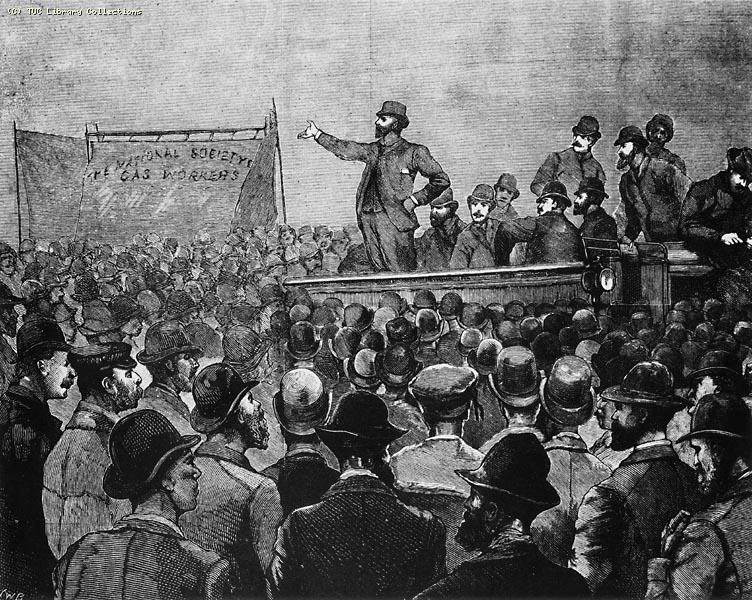
Gas workers’ union meetings traditionally finished with a rousing rendition of “I’m a little teapot”

Read the rest of this entry »

Facebook Twitter Digg Delicious StumbleUpon

UNCUT: Obama’s campaign started going wrong at the DNC

30/10/2012, 07:00:37 AM

by Jonathan Todd

My most recent visit to the USA coincided with the two weeks of the Democrat and Republican national conventions. This was an immense treat. I could flick through the TV channels and find opinions to suit any taste. Every evening ended with a big speech forming the next chapter of the election.

My standard patter came to be that president Obama needs to do three things to retain power:

First, define Mitt Romney before he defines himself. Second, defend his record in office. Third, own the future.

These are hardly earth shattering insights. They are the components of almost any successful political campaign. But my understanding of the race is formed by thinking them through.

Romney made it absurdly easy for Obama to define him in terms that favoured the incumbent. Romney is a religious man in a religious country who won’t talk about his religion. He is also a successful businessman who struggles to talk about his business career in convincing terms.

Just as military hero John Kerry was traduced to swift boat John Kerry in 2004, so too CEO Romney regressed to a tax dodging embodiment of the one percent. The key strengths of the challenger were decapitated and inversed by a brutal onslaught by the president.

Romney’s heavy use of TV advertising was important to him finally securing the Republican nomination in a race defined by the party flirting with any candidate other than the unloved and wooden Romney. He got a taste of his own medicine when David Alexrod targeted him in TV adverts on behalf of Obama. So successful was this phase of the campaign that it appeared Obama might win comfortably by not being Romney. And, ultimately, this may yet be just enough for Obama.

Read the rest of this entry »

Facebook Twitter Digg Delicious StumbleUpon

UNCUT: Why the Tories are rooting for Obama

29/10/2012, 10:28:36 AM

by Mark Stockwell

Each year, as autumn descends, nature-lovers’ thoughts turn to the russet and auburn vistas of New England. Every four years, an altogether different breed joins them in gazing longingly across the Atlantic as the leaves crispen and fall at home. But the only colours they care about are primary colours – red and blue.

With the end of the party conferences and the return to a dank, dreary Westminster, Britain’s political classes huddle round to bask in the reflected glow of a US presidential election.

The states of New England, for the most part solid blue Democrat territory, are but a passing concern. These peculiar beasts garner what warmth they can from the battleground states of the mid-West and the sunshine state of Florida.

With the axis of US politics tilted so far to the right, there are quite a few UK Conservatives who back the Democrats in general and Barack Obama in particular. It is, on the other hand, vanishingly unlikely you will come across anyone on the British left cheering for a Republican.

There are all sorts of good policy reasons why both left and right in the UK should welcome the Obama victory which seems the likely outcome of next Tuesday’s poll. But if Labour is looking to Obama to win vicarious battles on deficit reduction, the size of government, or the role of the state in the provision of public services, they are missing an important point.

As a guide to its own electoral prospects, Labour should be cautious about celebrating Obama’s re-election.

Read the rest of this entry »

Facebook Twitter Digg Delicious StumbleUpon

UNCUT: The Sunday review: The Social Conquest of Earth by Edward O Wilson

28/10/2012, 08:00:57 AM

by Anthony Painter

A few months ago an almighty row broke out in the world of evolutionary biology. Unsurprisingly, on one side was Richard Dawkins. On the other was Edward O Wilson who had co-written a piece in the journal, Nature, rejecting a view of evolution advocated by Richard Dawkins. He followed it up with a book: The Social Conquest of Earth. The row broke out on the pages of Prospect. With characteristic reserve, Dawkins concluded (borrowing from Dorothy Parker): “this is not a book to be tossed lightly aside. It should be thrown with great force.”

Edward O Wilson responded with two curt paragraphs. Dawkins had pointed to objections to the Nature piece from over 100 evolutionary biologists. Wilson replied: “If science depended on rhetoric and polls, we would still be burning objects with phlogiston and navigating with geocentric maps.”

This was full-on war; mud-wrestling rather than clinical dissection. Over at the Huffington Post, David Sloan Wilson (no relation to Edward O.), reprimanded them both. Their debate was almost half a century out of date. Not only that, but Dawkins was “unbecoming.” And you thought politics was bad.

Read the rest of this entry »

Facebook Twitter Digg Delicious StumbleUpon

INSIDE: Andrew Mitchell plots his revenge on the police federation

26/10/2012, 03:49:22 PM

At the start of last week, Uncut predicted Andrew Mitchell’s demise. On Monday 15th October we said he would be gone on Thursday. In the event it turned out his departure was announced on Friday, though he actually made his decision to quit on Thursday.

Now, Uncut hears he is plotting his revenge.

It has been widely reported that he quit after concluding that he had lost the confidence of the 2010 intake of Conservative MPs. True. But this is only half of the story.

Andrew Mitchell had also concluded that, given the state of the media firestorm, he could not mount the robust defence needed to clear his name, while still chief whip.

He remains convinced that he has been the victim of a political hit job by the police federation. Friends of Mitchell say that despite the battering he took at the hands of the media, he will not give up.

More than his notorious temper or a desire for revenge, his primary motivation is his career. Andrew Mitchell is not prepared to accept this as the end.

In 1997, he was a rising star, destined for the cabinet when he lost his formerly safe seat in Gedling. That could have been it. Many others accepted their fate. But not Mitchell, he came back from that disaster, returned to parliament and made it into cabinet.

The former chief whip accepts it will be difficult, but he sees a route back to centre stage and is more determined than ever to get his side of the story across.

Mitchell’s defence will rest on a stopwatch.

Read the rest of this entry »

Facebook Twitter Digg Delicious StumbleUpon