UNCUT: The Tory party: idealists welcome

21/05/2012, 01:30:53 PM

by Kevin Meagher

For JS Mill, the Tories were famously the stupid party. By the 1980s they were definitely the ideological party. But under David Cameron are they are becoming something else: the home for political idealists?

We casually think of idealism as the preserve of the Left, but the lodestar of this government is to reshape the state in as profound a way as Attlee or Thatcher managed.

From the NHS reforms to free schools. From academies to police commissioners. From the big society to big city mayors. Austerity cuts through to the massive welfare shake-ups; there is an abundance of idealism. Or ‘tip-up-the-apple-cart-ism.’

Much of it is to be regretted of course; a lot of it feels impractical, even reckless, but idealism it most definitely is. As is George Osborne’s “faith based” economic policy. In the face of overwhelming evidence to the contrary, he presses on.

It’s like watching one of those old bits of film of a man flapping giant cardboard wings and jumping off a pier, expecting to fly. The chancellor is the ultimate expression of optimism over reason.

Read the rest of this entry »

Facebook Twitter Digg Delicious StumbleUpon

UNCUT: The truth about the thinnest Queen’s Speech in modern times

21/05/2012, 06:00:57 AM

by Steve Bassam

Much commentary has already been made about the government’s wafer thin agenda for the 2012-13 parliamentary session. The thing is, it is actually far worse than most observers have noticed, not least because of the uncertainty created by putting Lords reform at the heart of the programme.

The recent Queen’s Speech identified just 15 bills in a programme designed to accommodate the LibDems’ pet obsession. Yet ministers are likely to press through even less legislation, as 5 of these bills have already been identified for carry over until the next session. We are not talking minor matters here, but big issues such as energy, banking reform, children and families, and pensions, as well as an EU Accession Bill for Croatia.

This amounts to third of the government’s new legislative programme to be subject to carry over motions. None of these bills will have been drafted yet, and some may even need a white paper to launch them.

We also know that despite the best efforts of the joint committees on Lords reform, that bill is currently being re-drafted to try and make it more acceptable – the question is for whom?

So, for much of the rest of this calendar year we, we will have just 9 bills in play in the Lords. At this stage in most parliaments, governments are just getting into their stride.

Our analysis of the period since the late 1970s suggests a government in its third year of power can expect to push up to 40 to 45 bills, 30 of which will be part of a core programme.

Read the rest of this entry »

Facebook Twitter Digg Delicious StumbleUpon

UNCUT: Profiles of Labour’s candidates for the Bristol mayoralty: Marvin Rees

18/05/2012, 03:14:51 PM

In the first of a series of profiles of the mayoral candidates, Amanda Ramsay talks to Marvin Rees

With an election on 15 November for Bristol to have an elected mayor, Labour South West announced a short-list of candidates yesterday for the Bristol mayoral selection: former city councillor Kelvin Blake, current Labour group leader Cllr Peter Hammond, former council leader Cllr Helen Holland, former Bristol City Councillor and MP for Wansdyke in Somerset Dan Norris and party activist Marvin Rees.

First off the blocks for Labour, the weekend after Bristol voted yes, was Marvin Rees, who had actively campaigned for a yes vote in the 3 May referendum. He appeared on the BBC Sunday Politics show and cuts an impressive figure.

Rees is a manager for race equality in mental health with NHS Bristol and a former journalist and BBC Radio presenter. Hailing from the Yale Global Leaders Programme, he has an intriguing CV and was apparently once the executive assistant to President Clinton’s Spiritual Advisor. Rees stood unsuccessfully for the Bristol West selection in 2010.

Rees speaks with authority about life in Bristol’s inner city, coming from a poor background and says: “I was one of two brown-skinned children of a single white woman.”

Despite the poverty in some parts, during the referendum campaign the prime minister pointed to Bristol being the second richest UK city outside London, but local people feel the city could do much more.

“Bristol is a premiership city performing at championship level,” explains Rees, who blames poor leadership at a council level.

“Core to that underperformance has been a vacuum of leadership, the lack of an aspirational long term vision for where Bristol wants to be and how it will get there and the absence of a coherent city narrative, that genuinely results from and reflects the lives of all Bristol residents.

“There is an on-going challenge in making best use of the council officer-elected member relationship particularly around the charge that it is officers not politicians who lead or manage the city.”

Read the rest of this entry »

Facebook Twitter Digg Delicious StumbleUpon

GRASSROOTS: Labour’s European quandary

18/05/2012, 07:00:13 AM

by Alan Lockey

“There is no subtler, no surer means of overturning the existing basis of a society than to debauch the currency. The process engages all the hidden forces of economic law on the side of destruction, and does it in a manner which not one man in a million is able to diagnose.” John Maynard Keynes The Economic Consequences of the Peace (1919)

And so the Eurozone crisis lurches on. Of course it has been a long time since we wondered whether anybody at the European Central Bank has read any Keynes.  If little else we can be certain of that. But as the crisis moves into a new and potentially decisive phase, with the possibility of ‘Grexit’ openly discussed, it is time to ask: what are the political implications for Labour’s policy on Europe?

The economics themselves remain as intractable as ever. Indeed, in a startling interview on Tuesday’s Today programme, Dr Michael Fuchs, vice-chairman of Angela Merkel’s CDU, practically admitted as much, suggesting that restoring Greek competitiveness through lowering their cost base was “impossible” but that Greece “must follow the rules” set out by the so called ‘troika’ of the IMF, ECB and EU.

But aside from shouting from the sidelines, Labour can do little to affect any of this. If the next election comes in 2015 then this crisis, for better, or more likely for worse, will have been resolved. What we might have done differently will be largely irrelevant. Of course it helps to associate the government with a reputation for austerity’s failings – but we need little impetus from Europe to do that.

And yet the sheer volatility of the crisis means we should not take anything for granted, particularly when it comes to Europe. It has long been conventional political wisdom that Europe represents promising terrain for Labour. This is based on two assumptions.

First, that whilst basic polling data might indicate that public opinion on Europe is, at best, divided, the Tories repeatedly fall into the trap of over-exaggerating its importance.

Second, that it can be used as a ‘wedge issue’ with which we can drive our opponents into a factional, frothy-mouthed frenzy, as we look on with united, pragmatic glee.

Read the rest of this entry »

Facebook Twitter Digg Delicious StumbleUpon

GRASSROOTS: Now we’ve got more councillors, here’s how we show the difference they make

17/05/2012, 02:48:56 PM

by Tom Keeley

A major challenge for Labour’s 824 newly elected councillors is to prove to their electorate that the right choice has been made.  In local politics this is easier said than done.  Even the hardest working councillor can be made to look like a one-trick-pony come election time. Avoiding this depends largely on how work done and successes achieved are perceived by the electorate.

Most councillor accomplishments will be small.  Road signs cleaned.  Bulky waste collections increased.  Alleyways cleared.  Double yellow lines painted.  Police patrols rerouted.  And, while there is much more to council politics than this, this is what the majority of the electorate will see the majority of the time.  The little things.  The challenge for local councillors is to present their successes to the local electorate in a way so as to maximise results at the ballot box.

The traditional way of presenting successes is that as double yellow lines are painted we rush out leaflets to the surrounding roads claiming credit.  As potholes are resurfaced, pictures are circulated of the candidate standing by the newly smoothed piece of road.  Night-time door knocks in areas where new street lights have been installed.  The usual.

This traditional way presents success as one-off individual accomplishments.  The problem is that residents do not and will not vote for a councillor simply because there are new street lights on their road.  This is a naïve and commonly held misconception.  Residents want more than this.  Therefore we need a new way of promoting Labour councillor success.  This should present individual accomplishments as part of a larger body of work, maybe even as part of a vision for the local area.

In my professional life I work as a qualitative researcher, which essentially means I make sense of what people say on a given subject; in my case the subject is health and health care.  Stay with me here, I am coming back to politics.  To make sense of what people say you need a structure.  You build this structure by initially pulling out broad themes within what people say, and then attaching or attributing people’s individual statements and opinions to the broad themes.  The structure allows you to make sense of a huge amount of opinions and present a coherent case or argument.  A similar method can be used in presenting local political success.

Read the rest of this entry »

Facebook Twitter Digg Delicious StumbleUpon

UNCUT: As Greece melts down, is anyone meeting in Cabinet Office Briefing Room A (COBRA)?

17/05/2012, 12:23:22 AM

by Peter Watt

Over the years, you always knew when there was a real crisis on, when you heard there was a meeting in COBRA.  Whenever a news reader announced that the prime minister had chaired a meeting of COBRA it was generally pretty serious stuff.  Apparently, in the interests of accuracy, the meetings are actually called COBR meetings – room A refers to just one of the secret command and control centres in and under Whitehall.

Wikipedia describes COBRA as:

“A term used to describe the formation of a crisis response committee, coordinating the actions of bodies within the government of the United Kingdom in response to instances of national or regional crisis, or during events abroad with major implications for the UK. The constitution of a COBR will depend on the nature of the incident but it is usually chaired by the Prime Minister or another senior minister, with other key ministers as appropriate, and representatives of relevant external organizations such as the Association of Chief Police Officers and the Local Government Association.”

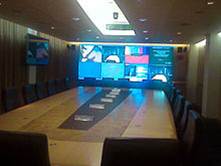
These meetings and their venues were once so secret, it was only in 2010 that a single photograph of “room A” was released.

In recent years, and I may be wrong about this, it seems that COBRA has convened more often:  summer riots, foot and mouth, terrorism, contingency planning for fuel strikes and volcanic ash clouds have all prompted the COBRA to raise its head. It is all perfectly sensible that the government has the ability to bring the right people together with the information they need to make effective decisions quickly. Not a panic move, but a good example of our government working to maintain essential services and keep us safe.

Read the rest of this entry »

Facebook Twitter Digg Delicious StumbleUpon

UNCUT: The fall in unemployment is based on p/t working & self-employment

16/05/2012, 12:55:19 PM

by Tony Dolphin

The news that unemployment fell by 45,000 in the first three months of this year, compared to the last three months of 2011, is very welcome. It suggests the current recession in the UK – if it is not revised away when the next set of GDP data are released – is likely to be a very mild one. The drop in youth unemployment – by 18,000 in the latest three months – is further good news.

But there is reason to be cautious.

The labour market is not improving because firms are recruiting more full-time employees. It is improving because more people are taking part-time work, reluctantly, and because more people are setting themselves up in self-employment, possibly also reluctantly.

The 105,000 increase in employment in the latest quarter was more than accounted for by part-time workers. The number in full-time employment fell by 13,000. We know many of these part-time workers are unhappy because the Office for National Statistics asks part-time workers if they would prefer to be working full-time and 1,418,000 said ‘yes’ in the latest three months – the highest number since comparable records began in 1992.

Looking at the numbers differently, 90,000 of the 105,000 increase in employment in the last quarter is due to an increase in self-employment. Unfortunately, the ONS does not ask the self-employed if they would rather be working as an employee – but it is a fair bet that some of the recent increase reflects people who would rather not be self-employed but cannot find a company to employ them.

These are not new trends. The following table shows the change in employment over the last four years (i.e. comparing the first quarter of 2008, just before the recession, with the first quarter of 2012).
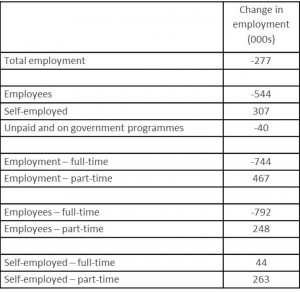
The big picture over this period is that total employment in the UK has fallen by just under 300,000. But the number of full-time employees is down by 800,000, while the number of part-time employees and the number of part-time self-employed people are both up by about 250,000. There has also been an increase over this period of over 700,000 in the number of people working part-time who say they are doing so because they want a full-time job.

The continuing legacy of the recession, therefore, is a labour market characterised by companies that are reluctant to take on more full-time employees and workers who are reluctantly working part-time – either for companies or for themselves.

Tony Dolphin is Chief Economist at IPPR
Facebook Twitter Digg Delicious StumbleUpon

UNCUT: The status quo in London is not an option

16/05/2012, 07:00:59 AM

by Rob Marchant

As the post-election dust settles, we must hope that the party is, somewhere, currently holding a quiet post-mortem, to take away the lessons for next time. There are many positives we can take away, of course: that the locals went swimmingly and so did the London Assembly. And that we held Glasgow, that vital first step in turning around the Scottish party, a task which is, in turn, a sine qua non for preserving the very Union.

However, in a post-mortem, the biggest lesson to learn – and the easiest to forget if, as in this case, things have gone well – usually comes from what went wrong, not what went right.

In this case, it’s staring us in the face: we lost the mayorals to a mediocre candidate whose party was fairly unpopular, while our London result overall was a resounding win. And what went badly wrong was not the policy offering or the party’s campaign tactics, but the Livingstone candidacy itself.

What is the long-term lesson for Labour, then? How should we be fine-tuning our London strategy? There’s no need to go through again how the election was thrown by the candidate (although, if you need one, there’s a summary here). But he is just one man, and now he is gone. So, job done, right?

Well, no. Labour’s pressing task now is to ensure this can never happen again. And, by the way, he is not gone.

Read the rest of this entry »

Facebook Twitter Digg Delicious StumbleUpon

UNCUT: Gus O’Donnell gives Leveson his prescription for media mismanagement

15/05/2012, 07:00:22 AM

by Atul Hatwal

A little tidbit from Gus O’Donnell’s written evidence at the Leveson Inquiry yesterday:

“When Alastair Campbell was appointed Director of Communications at Number 10, an Order in Council granted him the power to instruct civil servants. I thought that the power was an inappropriate one for a special adviser to have. I felt it was important to have a good civil servant as the Prime Minister’s official spokesperson, without any outré Orders in Council. Civil servants are more able to achieve impartiality in briefing and avoid being drawn into political briefing. They have conducted all press briefings on behalf of the Government since that time – Gordon Brown stuck with that approach and so has his successor.”

O’Donnell clearly felt he was making a telling point. A political appointee directing civil servants was such a self-evidently bad thing that neither of Tony Blair’s successors had chosen to repeat this ill-starred experiment.

That’s one view.

Alternately, part of the reason that press coverage of each of Tony Blair’s successors has careened off the rails so violently is that there hasn’t been a single, partisan media chief in control of the government communications machine since Alastair Campbell.

Gordon Brown and David Cameron have each appointed media advisers, but with a limited reach across Whitehall.

The vast empire of hundreds of departmental press officers has been outside of Number 10’s purview. This army of media managers reports up through the civil service hierarchy, independent of the government’s political operation.

It’s an important distinction. Despite the frequent and genuine pleas from civil servants to their ministers that all they want to do is serve them effectively, ultimately, departmental press officers’ future career advancement is in the hands of the mandarins.

That means they are beholden to different masters.

Read the rest of this entry »

Facebook Twitter Digg Delicious StumbleUpon

UNCUT: The Sunday review on Monday: Ed Miliband’s speech and Phil Collins’ hook at the Progress conference

14/05/2012, 07:00:07 AM

by Jonathan Todd

Bliss was it in that dawn to be alive, but to be Ed Miliband was very heaven.

Rejection of our Tory government has given us 824 new Labour councillors. Rejection of austerity by French and Greek voters presages a new chapter in Europe’s history. Everything seems to be moving in Miliband’s direction. He said this would be a one-term government and maybe it just might.

He began as leader by talking about the squeezed middle and was derided for doing so – but not now. As Alison McGovern noted, when introducing him as key note speaker to the Progress annual conference on Saturday, squeezed middle was the Oxford English Dictionary’s word of 2011. Just as it is undoubtedly worrying that the definitive English dictionary conflates the plural with the singular, even if these two words demonstrate our leader’s capacity to capture the zeitgeist, so too the potency of Miliband’s omnishambles line has been undeniable. No wonder Mary Riddell told the conference: “Ed Miliband has proved himself to be so far ahead of public opinion.”

A new dawn has broken, has it not?

Phil Collins opened his remarks to the conference with this quip. And the sun was shining on Saturday. But it was chillier in the sun than might have been expected.

Collins suspects the Tories will try to turn the general election into a leadership referendum. Recent polling gives some support to this view. He also expressed a “slight worry that the return of growth will let Labour off the hook of answering the key question: What does it mean to be Labour when there is no money?” We’ll need a return to growth, which seems elusive, before that becomes a live concern. But there are several crucial points here.

First, the possibility of pro-growth rhetoric, rather than the reality of growth, creating a false sense that Labour can get off Collins’ hook.

Read the rest of this entry »

Facebook Twitter Digg Delicious StumbleUpon