




GRASSROOTS: Michael Gove, Nelson Mandela and the King James bible

05/12/2011, 08:23:09 AM

by Stephanie Peacock

It is often said that the only way a politician can leave a legacy is to name a building after himself. I say “him” because, other than a hundred Conservative clubs in the provincial towns of England, I cannot think of a building that carries the name of a former female politician. There is the Centre Pompidou in France, The Reagan National airport. You can’t walk through a Labour borough in London without finding at least one tribute to Nelson Mandela.

Michael Gove, though, got an ‘A’ for originality last week. Michael has created a whole new genre of political legacy. Without any sense of irony, Mr Gove has personalised his very own version of the bible. For ever more, the Michael Gove King James bible will be a sought after piece of ebay memorabilia.

Of course it was Mrs Thatcher who once said that “No-one would remember the good samaritan if he’d only had good intentions; he had money as well”.  Of all of Mrs Thatcher’s biblical quotes, this is the one that most showed her to be out of touch. The Michael Gove King James bible may be the education secretary’s good samaritan moment: an act of political messaging that spectacularly misses the mark.

Pupils and parents will see this for what it: a misguided and expensive piece Govian spin. According to reports, the gesture could cost the taxpayer £375,000. At a time when dinner ladies are striking over their pension increases this is an appalling piece of mixed messaging. There are a lot of dinner ladies you could make happy with £375,000.

Read the rest of this entry »

Facebook Twitter Digg Delicious StumbleUpon

UNCUT: Sunday review: The autumn financial statement and “In the black Labour” by Graeme Cooke, Adam Lent, Anthony Painter and Hopi Sen

04/12/2011, 02:20:54 PM

by Anthony Painter

There’s no hiding place. The autumn financial statement outlined in full the dire economic situation that this country will face for much of this decade. Squeezed living standards, high borrowing, cuts in public services and the shrinking of the welfare state, ongoing uncertainty, and high unemployment will define the 2010s: the austerity decade. What’s worse is that all of the risks are on the downside.

George Osborne has made the situation worse – unnecessarily so. Cutting short term programmes and investments such as the future jobs fund and building schools for the future which don’t add to the structural deficit was myopic. Once his model of economic recovery – driven by exports and private sector investment – was faltering early this year he should have intervened. He didn’t and that has made things worse. We are all paying a price as a consequence.

The choreographed dance so far this parliament has been for the Tory-Lib Dem government to blame the last Labour government for all our economic ills. And for Labour to blame the government austerity. The reality is far more complex. The government bears some, but by no means all, of the blame: a strong stance on fiscal consolidation has reduced the risk of government debt in the eyes of investors; world oil prices and food prices that have increased by 30% in a year have also been a drag on growth; eurozone crisis is starting to be a drag on confidence and demand; but an early and inflexible fiscal consolidation, especially the VAT increase, has made matters worse.

Read the rest of this entry »

Facebook Twitter Digg Delicious StumbleUpon

GRASSROOTS: Socialism for today

03/12/2011, 05:27:56 PM

by Robin Thorpe

“It is necessary and possible to create an altogether different society in Britain, a society whose organising principles will be co-operation, fellowship, democracy and egalitarianism…a society free from every form of domination and exploitation, of class, of sex and of race”.

That statement is hard to argue with. However, when one realises that these are the words of Ralph Miliband speaking at a socialist conference in the mid 1980s, then the statement becomes more controversial. Following 30 years of neo-liberal dogma and 60 years of anti-communist propaganda, the term socialism carries such pejorative connotations that no mainstream politician would dare mention it. Yet I think that the core of socialist philosophy has a lot to offer contemporary society even if the methods of implementing such a paradigm shift have yet to be determined.

The three principles of socialist international are freedom, justice and solidarity. They define the goal of democratic socialism as “to achieve a peaceful world where these basic values can be enhanced and where each individual can live a meaningful life with the full development of his or her personality and talents and with the guarantee of human and civil rights in a democratic framework of society”. The fundamental difference between the various political groups is the emphasis on individual and collective rights. Liberalism and its modern mutation neo-liberalism value individual freedom over justice and solidarity; by contrast the communist movements claimed to have created an equal society but sacrificed individual freedom. The conservative right espouses both stronger communities (in a nostalgic, village green kind of way) and the freedom of the individual. During the 80s the Conservative government even started their very own revolution; a revolution of ideas that has all but removed the notion of “class” from public discourse.

Read the rest of this entry »

Facebook Twitter Digg Delicious StumbleUpon

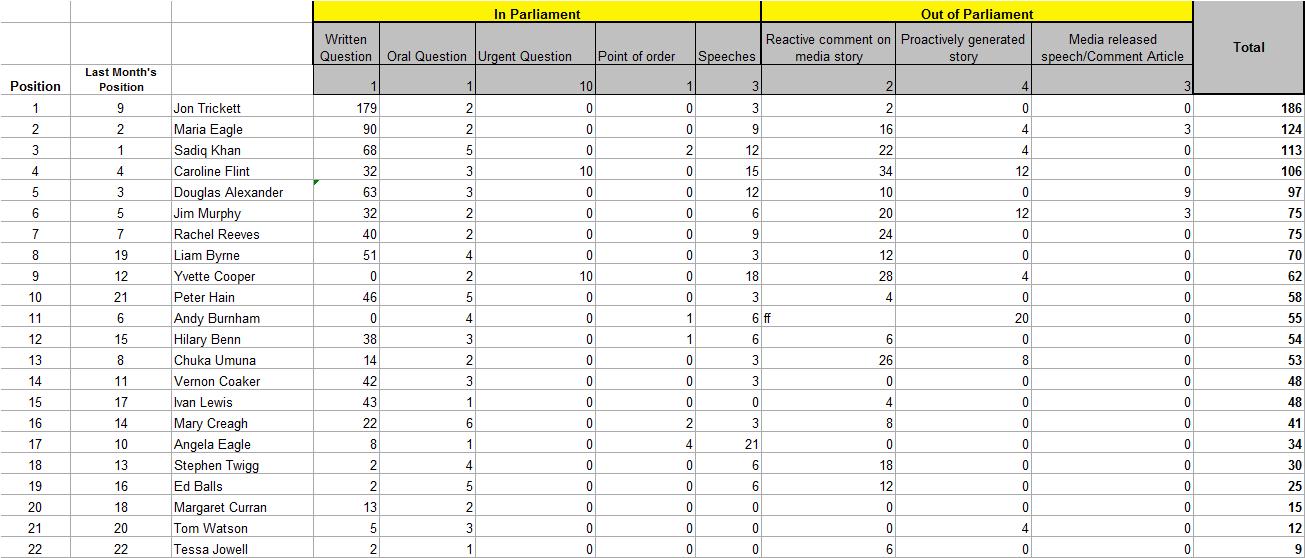
UNCUT: November Shadow Cabinet League

02/12/2011, 09:06:45 AM

by Atul Hatwal

Have they put something in the tea at shadow cabinet meetings?

Because they seem to be a team transformed – in work ethic at least.

Despite doubts about Labour’s strategic positioning on the big issues, Ed Miliband’s new shadow secretaries of state have set about their task with a vigour not seen for months.

The days when Jim Murphy and Douglas Alexander gazed down on their colleagues from a distant summit appear to be past. Instead there is a genuine competition across the top ten with any and all capable of mounting a challenge for top spot.

Read the rest of this entry »

Facebook Twitter Digg Delicious StumbleUpon

UNCUT: Abuse of vulnerable adults should be criminalised

01/12/2011, 08:00:30 AM

by Peter Watt

“Where, after all, do universal human rights begin? In small places, close to home… Unless these rights have meaning there, they have little meaning anywhere”.

So said Eleanor Roosevelt at the united nations in New York on 27 March 1958. It is a powerful message and one that is used to open an important report from the equalities and human rights commission (EHRC) “Close to home, an inquiry into older people and human rights in home care”. The report was launched last week. It followed a year long inquiry looking at the protection and promotion of human rights of older people in England who require or receive home-based care.

What is so so depressing is that once again a report comes out that details a litany of abusive behaviour towards vulnerable older people. In this case the abuse is taking place in people’s own homes when they are in receipt of home-based care. The report says that around half of those giving evidence to the inquiry were satisfied or happy with the care that they or a relative received. Great; but that leaves the other half where there was plenty of evidence of:

Read the rest of this entry »

Facebook Twitter Digg Delicious StumbleUpon

UNCUT: Government pubs report fails to stand up for the little guy

30/11/2011, 02:07:29 PM

by Toby Perkins

Pubs are businesses at the heart of their communities; so it is a cause for great concern that pubs are now shutting at the alarming rate of 25 a week, and the government is failing to live up to its promises to take action to support this great British institution.

The pub sector is also an area which starkly illustrates the difference between the active, intelligent government working in partnership with business which Labour stands for, and the ‘government getting out of the way’ approach, favoured by Osborne, Cable et al.

The business, innovation and skills select committee has investigated in detail the relationship between the pub companies (or PubCos) – the branded chains of pubs which account for the majority of pubs in the UK – and their tenants. It has produced three reports on the subject over the past three years.

Most significantly, they found an unfair relationship between the huge companies which dominate the market and the small business owners who run individual pubs, alongside restrictive practices preventing smaller breweries from accessing huge swathes of the trade.

This week, after months of dither and delay, the government finally responded to the long-standing call for a fairer relationship between pubs and their owners. Sadly, it is a case of too little too late, and comes up short of the action needed.

The previous Labour government gave the industry a year to reform itself, putting in place a voluntary code, and made it clear that a statutory code would be put in place if the industry did not get its act together.

Read the rest of this entry »

Facebook Twitter Digg Delicious StumbleUpon

UNCUT: Miliband: seeing into the future or shouting at the sea?

30/11/2011, 07:30:01 AM

by Rob Marchant

Last Thursday, Ed Miliband was speaking at the IPPR on the economy, doughtily willing that Labour’s alternative can soon be heard again in light of Britain’s increasingly dreadful prospects. In spite of the response of many commentators that here was a battle he couldn’t win, his words indicated that he genuinely believes things are going his way on the economy and that Labour merely needs “one more heave”, as Dan Hodges puts it. He and Ed Balls need only to keep saying the same thing, and the political tectonic plates will have shifted their way by the general election.

Never mind that Labour’s economic polling is awful and has shown little sign of shifting over the last year, in spite of the crisis. Never mind that the Tories have two fairly foolproof deflection strategies for this mess: blame Labour, blame Europe. Team Miliband is convinced that the tide is turning and it is just a matter of time.

Why? It is instructive to examine the psychology behind this. There seem to be two factors at play. One is about the vision thing. There are a few people in any generation – a very few people – who have the extraordinary gift of seeing the future. Not literally, like a soothsayer, but the visionaries: the Steve Jobses or the Thomas Edisons. Or  the political figures who define a generation: the Mandelas, the Luther Kings, the FDRs, the Kennedys. People who see the trend lines in today’s thinking and can extrapolate them out, accurately, into the future, along with a road map. They anticipate, and they get it right. These people are extraordinary (not to mention usually pretty successful in their chosen field).

Read the rest of this entry »

Facebook Twitter Digg Delicious StumbleUpon

GRASSROOTS: Tom Harris’s election email to Scottish Labour members

29/11/2011, 01:00:35 PM

As leadership ballot papers arrive through members’ letterboxes, I want to remind you of the task Scottish Labour now faces.

Political recovery starts with acceptance: not just acceptance that we lost, or even acceptance of the reasons why we lost. But acceptance that we deserved to lose, that the electorate is never wrong.

Too often, Labour gives into its instinct to blame the electorate for our failings and we spend the next four years telling the voters that it was they, not us, who got it wrong. And when we do that, we lose again. And deservedly.

And if it wasn’t the voters who got it wrong, then we blame the leadership. They ignored the wider party, says received wisdom, and produced a manifesto that the grassroots had no say in. An easy excuse, but just that: an excuse, with very little truth to support it.

The fact is that May 2011 was a rejection, not of a manifesto or of a leadership: but a rejection of our party. A party so set in its ways, so convinced that it and only it has the answers to the challenges facing Scotland, that it stopped saying anything interesting or relevant to the Scottish people years before that cataclysmic election defeat six months ago. The seeds of our 2011 defeat were sown many years earlier, not in the few weeks of the campaign.

There persists a myth – and it is a myth – that Scottish Labour rejected New Labour and Blairism because we were too socialist. Wrong. Scottish Labour rejected Blairism and New Labour because we were too conservative.

The ability to change has never been one of our strong suits. That’s why we’re in this mess now.

Read the rest of this entry »

Facebook Twitter Digg Delicious StumbleUpon

UNCUT: Osborne has dug his hole; Balls shouldn’t dig one too

29/11/2011, 08:00:26 AM

by Jonathan Todd

“What he is now doing is the equivalent of ripping out the foundations of the house just as the hurricane is about to hit”.

Ed Balls said this of the government’s economic strategy in August 2010. It is curious, then, that last week David Cameron told the CBI that controlling Britain’s debt was “proving harder than anyone envisaged”. That’s anyone besides Balls and an increasing number of others convinced by him.

The day after Cameron’s CBI speech The Financial Times reported that it now looks impossible that George Osborne will be able to fulfil the boast made in the March 2011 budget that the structural deficit will be eliminated by 2014/15. Indeed, The Financial Times went on, achieving that goal in 2015/16 also appears unlikely.

To acknowledge that the structural deficit can’t be closed this parliament, John Redwood concedes, “is a defining moment … This, after all, was said to be the (government’s) fundamental point”.

Read the rest of this entry »

Facebook Twitter Digg Delicious StumbleUpon

UNCUT: We’re getting serious on enterprise

28/11/2011, 01:00:05 PM

By Luke Bozier

I wrote in March, in an article for LabourList, that Labour had “in effect become the party of the public sector”, in response to Ed Miliband’s speech to the TUC rally in Hyde Park.

Soon after, Alex Smith & I met to discuss our concerns on the party’s declining credibility; in our own ways, both socially and commercial, we are entrepreneurs, and it was – and still is – pretty clear that Labour has lost its voice on enterprise. That’s not a luxury we can afford; the future economy, which we are already entering – post-recession, post-credit crunch, post-crisis – is an economy which will be built more than ever on the back of entrepreneurs, self-employed people, micro-enterprises, social enterprises and other independent economic actors.

The “means of production”, in the old language of socialism, is now in the hands of every individual with a computer. Instead of being afraid of enterprise, and recoiling away from the opportunities it presents to create a fairer society with more opportunity for all, Labour under Ed Miliband must embrace enterprise and put it at the heart of everything we do as a party.

Read the rest of this entry »

Facebook Twitter Digg Delicious StumbleUpon