




UNBOUND: Wednesday News Review

06/07/2011, 06:42:50 AM

Cameron under pressure to hold investigation

David Cameron was today facing growing pressure to back calls for a public inquiry into the phone hacking scandal. The Prime Minister was urged to act as MPs held an emergency debate on the issue after more alarming claims emerged to the extent of the interception of mobile phone messages. Mr Cameron said the alleged hacking of murdered teenager Milly Dowler’s mobile phone had left him shocked. Mr Cameron said: “On the question of the really appalling allegations about the telephone of Milly Dowler, if they are true, this is a truly dreadful act and a truly dreadful situation. What I have read in the papers is quite, quite shocking, that someone could do this actually knowing the police were trying to find this person and trying to find out what had happened, and we all now know the tragedy that took place.” The News of the World said last night they had passed “significant new information” to police in connection with the hacking investigation. MPs will today hold a debate on whether to launch a public inquiry into the scandal. The row intensified as Labour MP Chris Bryant, 49, yesterday accused the News of the World of “playing God with a family’s emotions”. – Daily Mirror

Ed Miliband has called for Rebekah Brooks, the chief executive of News International, to “consider her position” and called for a public inquiry after it emerged the News of the World hacked into Milly Dowler’s mobile phone while Brooks was editor. It comes after David Cameron described the hacking as a “truly dreadful act” and urged police to “pursue this in the most vigorous way”. Police were due to meet with senior executives from News International on Tuesday morning, according to reports, with Brooks’s role coming under increasing scrutiny. The current News International chief executive has insisted she would not resign. Miliband joined the Labour shadow home secretary, Yvette Cooper, in calling for a public inquiry into the Guardian’s revelations that Milly Dowler‘s mobile phone was repeatedly targeted by the News of the World. The Labour leader said Brooks should “consider her conscience and consider her position”, as pressure mounts on the News International chief executive. Miliband said the latest revelations in the News of the World phone-hacking saga were a “stain” on news reporting in the country. He added that the hacking “represents one of the darkest days in British journalism”. – the Guardian

The revelations followed extraordinary allegations that, months earlier, Milly Dowler’s phone messages were hacked into and deleted by the News of the World, giving her family false hope that she was still alive. All this came on a day when: There was intense speculation that the newspaper might also have eavesdropped on Sara Payne, mother of eight-year-old Sarah, whose murder in 2000 prompted then editor Rebekah Brooks’s controversial campaign for the right to know if a paedophile is living locally; Labour leader Ed Miliband led calls for the resignation of Mrs Brooks, who is now Mr Murdoch’s most senior UK executive; Senior politicians threatened a public inquiry, led by a judge, into press standards and regulation; Pressure grew on Culture Secretary  Jeremy Hunt to block Mr Murdoch’s  bid to take full control of the broadcaster BSkyB; Ford announced it was withdrawing advertising ‘indefinitely’ from the News of the World, while  other leading firms – including Easyjet and Tesco – said they might do the same; Commons Speaker John Bercow granted a highly unusual emergency debate on the affair today; Glenn Mulcaire, the private investigator at the centre of the scandal, issued a public apology but claimed he had been under ‘constant demand for results’ from the News of the World; There were reports that detectives are contacting some of the 52 families of the victims of the July 7 bombings in London in 2005, whose names or phone numbers appeared as part of their enquiries. Journalists may have been seeking to access messages left on phones as family members waited to hear news about their loved ones. – Daily Mail

Ed’s first landslide

The PLP have backed Ed Miliband’s plans to abolish shadow cabinet elections. Turnout was 92.2%, and 83% of the PLP voted in favour of the plans (196 in favour, 41 against and 20 did not vote). Ed Miliband responded, saying: “This is an excellent result for the party. We have an important job to do in holding the government to account and preparing for the next election. To do that job properly we need to spend our time talking to the public and not ourselves. “Labour under my leadership will be a party that looks outwards and not inwards.”Labour List

Ed Miliband won the first round of his battle to modernise Labour’s traditional practices last night when the party’s MPs voted overwhelmingly to allow him to choose his own Shadow Cabinet. Mr Miliband, who has described the elections as a distraction, wants to sharpen up the performance of his top team and ensure they spend less time lobbying for the votes of backbenchers. Last night his proposed reform was approved by a margin of 196 votes to 41. The turnout among Labour MPs was 92 per cent. Mr Miliband said: “This is an excellent result for the party. We have an important job to do in holding the Government to account and preparing for the next election. To do that job properly we need to spend our time talking to the public and not ourselves. Labour under my leadership will be a party that looks outwards and not inwards.” The move needs to be approved by Labour’s National Executive Committee this month and its annual conference in September. After that, Mr Miliband will be free to reshuffle his frontbench team whenever he wants. Although aides played down the prospect of a shake-up immediately after the conference, the Labour leader is expected to reshape his Shadow Cabinet to give fast-track promotions to the “new generation” of MPs he would want to see in his first cabinet if he wins power. – the Independent

Rank hypocrisy over Bombardier contract

Britain’s last train maker slashed 1,429 jobs yesterday – sparking fears the firm could hit the buffers. Troubled Bombardier’s main contracts run out in two years. But the Government last month awarded the £1.4billion Thameslink project to German rival Siemens. Furious MPs and union leaders yesterday called on the Tory-led coalition to reverse the decision in the wake of the job cuts. They argued the contract could keep Bombardier’s 3,000 Derby workers busy for years. Labour’s Derby North MP Chris Williamson said: “This is one U-turn well worth making. The lame excuse Siemens offered better value for money simply won’t wash.” Bob Crow, of the RMT transport union, blasted: “We will fight this stitch-up tooth and nail.” Campaigners are furious after ministers met in Bombardier’s home city of Derby just four months ago and praised it as the best of British manufacturing. The Canadian-owned firm said 446 full-time engineers and 983 temporary staff must go. But it is feared 20,000 jobs in the supply line could be hit. The firm said it would have made lay-offs even if it had won the Thameslink deal to build 1,200 carriages. Transport Secretary Philip Hammond said: “Bombardier has had a fantastic run of success.” – Daily Mirror

Bob Crow may not be to everyone’s taste. The RMT union chief has a fine track record of bringing chaos to commuters. But when he’s not starting a fight, he can also start a debate. Yesterday’s subject? The plight of British manufacturing and whether the Government, for all its “Made in Britain” rhetoric, has anything resembling an industrial policy. A “scandal” was Mr Crow’s pithy assessment of the sobering news from the Canadian train manufacturer Bombardier. It reflected, he claimed, “a policy of industrial vandalism that would wipe out train building in the nation that gave the railways to the world”. Bombardier had just axed 1,400 jobs at its Derby plant after failing to win a contract. Not any contract, either, but one awarded by the British Government to build 1,200 train carriages for the Thameslink commuter service into London. Having assessed the bids, ministers awarded the £1.5 billion prize to a consortium led by Germany’s Siemens. German workers and component manufacturers will now get the work. The upshot is lay-offs at Bombardier, not to mention the wider supply chain – and the risk that Britain’s last remaining train builder could now be heading for the buffers, effectively closing a 200-year-old British industry. Another shipbuilding, perhaps. – Daily Telegraph

Scottish Labour to become a fizzy drink

Scottish Labour is to rebrand itself as the “Irn-Bru of modern politics” with distinctive “made in Scotland” policies that will set it apart from the main UK party, party insiders have revealed. The radical overhaul of the Labour image aims to turn the party into an iconic Scottish brand that will outflank the SNP’s appeal to patriotism. The plans are being considered in a radical review of the party after its devastating defeat at the Scottish elections, led by shadow defence secretary Jim Murphy and MSP Sarah Boyack. In their determination to root the party in Scotland, senior Labour figures have even studied how Scottish products like whisky and Irn-Bru retain a solid Caledonian identity while appealing to a wider market. Their ideas include creating an overall leader for the Scottish Labour Party who will be in charge of MSPs in Edinburgh and Scottish Labour MPs at Westminster for the first time. The Murphy and Boyack review will present its conclusions on reform by the autumn but the first stage of the party overhaul is set to be approved by MSPs and Labour MPs at Westminster this week. It will include a new contract for Labour council candidates in next year’s crucial local government elections, specifying minimum responsibilities for the party and voters. Iain Gray, the current Scottish leader, is under pressure to stay on as a caretaker until full agreement can be reached on a new party structure that will bring Westminster MPs and Holyrood MSPs together into one force. – Daily Record

Nothing indicated the nervous state of the Scottish Labour Party more clearly than its fear that it might lose the Inverclyde by-election. On the face of it, the fear was ridiculous. Unpopular governing parties have sometimes seen comparable majorities melt away at a by-election; opposition ones should have no fear of that. Admittedly, there was a 15 per cent swing to the SNP. So, while Labour feels relief, the SNP can also be happy. So Labour should remember that the wheel turns, the pendulum swings, and that one of the most common of political errors is to suppose that what is happening now will continue to happen and that tomorrow will be just like today. Consequently for Labour the first requirement is to hold its nerve. The party may need to change, but it should think carefully before deciding what changes are needed and not rush to judgment. Iain Gray, savaged by the media, had a poor election, and immediately announced that he would resign the leadership. This was in keeping with what is becoming a convention: that a party leader is allowed only one go. If the SNP had adhered to it, Alex Salmond would have been replaced as leader years ago, perhaps as far back as 1992 when the party’s slogan “Scotland free by ’93” proved so ludicrously wrong. If Labour engages in a Scottishness competition, it is being lured into a trap. The SNP will always win. The only way you can beat the SNP in a Scottishness competition is by becoming more narrowly nationalist, anti-English and anti-European, even racist, denouncing the “social union” that Salmond tells us will survive the end of political union. It would be ridiculous for Labour to take this course. – the Scotsman

Facebook Twitter Digg Delicious StumbleUpon

UNCUT: The big monkey and the emperor’s new rainbow

05/07/2011, 07:38:38 AM

by Dan Hodges

Enough now. We’ve had our fun.

Blue Labour. Purple Labour. Green Labour. A veritable kaleidoscope of renewal.

Each, in their own superficial way, has been easy on the eye. The force of nature that is Maurice Glasman, the Labour party’s very own Norman Mailer. The defiant defence of the Blairite bunker, and the refusal of the last tiny band of hard core New Labourites to march quietly into the night. The Compass-ite left’s touching unwillingness to relinquish their dream of a progressive realignment, even as Nick Clegg smashes it to pieces in front of them.

But now the colours which dazzled have become garish. Where once they complemented, now they clash. There is no structure, however abstract, emerging. We are simply producing a mess.

Too harsh? Go and dig out Sunday’s Murnaghan. Relive the spectacle of two Labour shadow ministers, Caroline Flint and Diane Abbott, knocking lumps out of each other as they scrap over Maurice Glasman’s latest pronouncements on immigration policy. It was like watching an episode of the Jeremey Kyle show; “Maurice has been flirting with both Caroline and Diane, and they’re not happy. So we’ve brought them all together to fight it out. Live”. Read the rest of this entry »

Facebook Twitter Digg Delicious StumbleUpon

UNCUT: The govt must swallow its pride and adapt to the Arab spring

04/07/2011, 09:32:38 AM

by Michael Dugher

The foreign secretary, William Hague, has said that the impact of the Arab spring is potentially greater in significance than even the attacks of 9/11. After 9/11, Labour in government produced a “new chapter” to the 1998 defence review, precisely to face up to the shifting strategic landscape and emerging threats to the UK. A new chapter to the 2010 SDSR is desperately needed today.  This would bring the review up to date and make a full assessment of the impact of the Arab spring on UK security.  As Jim Murphy has said: “It’s not about looking backwards, but about turning hindsight into foresight.”

Lord Levene’s more managerial review into MoD reform was published last week. As far as it goes, it is good. Labour welcomed many of its recommendations. Indeed, Bob Ainsworth, Kevan Jones and others deserve much of the credit, as several ideas in the report stem from the defence green paper, adaptability and partnership, which the previous Labour government produced in February 2010. As the official opposition, it is as much our responsibility to support the government when its proposals are right as to oppose when they get things wrong.

Changes such as a smaller defence board inside the MoD, and greater clarification of responsibilities and the accountability for the individuals within the department, are much needed, not least to overcome the sometimes fractious command structure that has too often been based on inter-service rivalry. As Labour suggested in the 2010 green paper, the creation of a joint forces command in particular should help to change the face of our armed forces for the better and play a crucial role in helping them combat future threats to the UK. It will encourage more joint operations and enhance our ability to integrate out activities across land, sea and air, enabling joined up logistics and better communication.

Read the rest of this entry »

Facebook Twitter Digg Delicious StumbleUpon

UNBOUND: Monday News Review

04/07/2011, 06:04:55 AM

A care revolution

The Dilnot Report will suggest an overhaul to the system which is intended to benefit Britain’s ageing population. Under the current system elderly people only start to receive state support when they are down to the last £23,250 of their assets. People would instead pay up to a capped amount – expected to be around £35,000 – before state-funding kicks in. It’s possible that a tax rise or further cuts in public spending would be necessary to pay for this. Estimates suggest the proposals would cost the Treasury £2bn at the start before rising further. Experts estimate that a maximum liability of £50,000 could be insured for a one-off premium of around £17,000 on retirement. The report has partly sought to make clearer the burden of cost facing the elderly so people can prepare and save for it during their working life. Charities working with elderly and vulnerable people have cautiously welcomed the report and suggest changes are long overdue. The Labour leader Ed Miliband has publicly offered to hold talks with the Prime Minister to achieve cross-party agreement on the proposals. The government is not expected to make any changes immediately, instead weighing up the best course of action and deciding who will pay and how. The current system of support for the elderly is widely regarded as a lottery, as one quarter of 65-year-olds will not need to spend significant sums on care, while another quarter will face bills of more than £50,000 and one in 10 – often those who spend long periods in residential homes suffering from dementia – will have extensive needs costing more than £100,000. Some 20,000 people a year are thought to sell their homes to pay for care. – Sky News

A long-awaited shake-up of the way elderly people contribute to their care home bills will be announced today. The report is expected to ­recommend OAPs should pay no more than £50,000 towards their stay. The Treasury would pick up the rest of the bill – meaning fewer people will be forced to sell their homes. Care would remain free for those with very few savings or assets. But millions of people will be urged to take out insurance costing up to £17,000 to cover care fees. The measures drawn up by Andrew Dilnot are seen by many as the last best hope to pay for our growing elderly population. Health Secretary Andrew Lansley yesterday signalled the measures could come into force by the end of Parliament in 2015. But there are fears the £2billion-a-year cost of the plans could see Chancellor George Osborne strangle the proposals at birth. Labour leader Ed Miliband said: “The last thing Britain needs is for Andrew Dilnot’s proposals to be put into the long grass. We three party leaders are of similar age and the same ­generation. This is a once-in-a-generation opportunity which our generation must address.” – Daily Mirror

Local councils are poised to take on a major financial services role under proposed reforms to be unveiled on Monday of the funding system for the care of elderly and disabled people. Under the scheme, local authorities will be empowered to make a loan at a preferential rate against the value of a property owned by someone entering a care home. The loan would be redeemed on the sale of the property after the person dies. The plan is part of a series of ideas drawn up by a government commission led by the economist Andrew Dilnot. The proposals seek to inject more funding into the care system by tapping into people’s assets. The typical 55- to 64-year-old in the UK has a total wealth of £200,000. Although the centrepiece of Dilnot’s report will be a recommended cap of about £35,000 on individual liability for care costs, which would require underwriting by the government, other proposals will seek to make it easier for people to draw on their assets without having to sell their home during their lifetime. According to the Joseph Rowntree Foundation, about a million elderly homeowners have properties worth more than £100,000 yet qualify for means-tested benefits. Charities and welfare groups are calling on the government and Labour to seize the opportunity presented by Dilnot to begin a shakeup of the care funding system. An open letter from 26 leading charities declared on Sunday: “We expect all parties to deliver on this.” Ed Miliband, the Labour leader, has reiterated his offer to engage in cross-party talks on the Dilnot proposals with an “open mind”, setting aside his party’s previous policy of a national care service. – the Guardian

Goldsmith gloats

Ed Miliband’s faltering leadership suffered a fresh blow yesterday as a close ally of Tony Blair warned it was ‘not clear what he stands for’. Former Attorney General Lord Goldsmith launched a withering attack on the Labour leader, warning that nine months after his election he still has to ‘prove himself’. He said the party’s Blairites were ‘standing back’ to give Mr Miliband a chance. But asked whether the Labour leader was connecting with the public said: ‘He doesn’t at the moment. It is not clear what he stands for.’ Shadow Home Secretary Yvette Cooper – seen by many at Westminster as a future Labour leader – yesterday insisted that Mr Miliband’s leadership was not ‘faltering’. She said he was doing a ‘good job’ but urged critics to give him more time to impose himself and connect with the public in the wake of last year’s election defeat. Lord Goldsmith’s intervention came amid reports that the Blairite, ex-Cabinet minister James Purnell was being urged to return to Parliament to help rescue Labour from the leftwards drift seen under Mr Miliband. – Daily Mail

Lord Goldsmith suggested Mr Miliband was harming Labour by excluding major figures from the Blairite wing of the party. He named former minister James Purnell, who quit as an MP last year, as a “loss” and “potentially a very important figure in the party”. It came amid reports that Mr Purnell – who quit the Cabinet in 2009 in a failed bid to oust Gordon Brown and now heads a think tank – is being urged by figures close to Mr Blair to return to Westminster to stave off another election defeat. Lord Goldsmith, who was Attorney General under Tony Blair, said he did not believe the rifts had been healed between Left wingers seen as loyal to Mr Brown – such as Mr Miliband – and those from Mr Blair’s camp. “I think people are standing back, letting Ed Miliband have an opportunity to prove that he can do it – and that, at the end of the day, is what matters,” he told Sky News’s Murnaghan programme. Asked if the Labour leader was connecting with voters, he replied: “He doesn’t at the moment. It is not clear what he stands for.” The question, he said, was whether Ed Miliband had healed the Blair-Brown split and “whether there are enough Blair heavy hitters in his shadow cabinet”. He went on: “I think many of us would like to see more of them back. There are very powerful figures still able to help Ed Miliband and they are being excluded and that is a problem.’’ – Daily Express

Huhne under increased pressure as son’s phone becomes evidence

Chris Huhne’s former marital home has been raided as part of a police investigation into allegations he persuaded his wife to take responsibility for a speeding offence that he had committed so he could avoid a driving ban. Officers from the Kent and Essex Serious Crime Directorate visited the home in Clapham, south London, where the Energy Secretary’s former wife, economist Vicky Pryce, lives. They confiscated the mobile phone of the pair’s son, Peter, 18. The phone is alleged to contain an exchange of text messages between Mr Huhne and his son in which the pair discuss the investigation into the March 2003 speeding offence. – the Independent

Pressure was mounting on Chris Huhne last night after it emerged that police raided his ex-wife’s home and seized his son’s mobile phone. The Cabinet minister is fighting for his political career over claims he persuaded Vicky Pryce to accept a speeding conviction on his behalf. Detectives with a search warrant raided Ms Pryce’s £2million home at 7am, woke 18-year-old Peter and asked him to hand over the mobile, which reportedly contained a text message exchange in which the pair discuss details of the case. Energy Secretary Mr Huhne currently has the backing of Lib Dem leader Nick Clegg but insiders say patience is running out due to the constant trickle of stories about him. Ms Pryce, 57, told friends of her shock when the three Essex Police officers turned up unannounced at her South London home. Mr Huhne, 56, denies persuading her to take three points for him but a photograph of her licence shows an endorsement for speeding on March 12, 2003 – the date his car was allegedly caught on camera. Relations between the couple broke down when he left her for media consultant Carina Trimingham last year. – Daily Mirror

It’s that lady again

Voters rate Margaret Thatcher the most capable Prime Minister of recent decades, but Tony Blair was the most likeable, according to a poll. Only ten per cent regarded David Cameron the most capable and 17 per cent the most likeable. Current Conservative voters overwhelmingly preferred Lady Thatcher, with two-thirds saying she was the most capable compared with one-fifth for Cameron. Overall, 36 per cent of those questioned said Thatcher – Tory Prime Minister from 1979 to 1990 – was the most capable leader of the past 30 years. She was followed by Mr Blair on 27 per cent, Gordon Brown on 11 per cent, Mr Cameron, ten per cent and Sir John Major, seven per cent. When asked about likeability as a person, some 26 per cent put Mr Blair first, followed by 22 per cent for Lady Thatcher, 17 per cent for Mr Cameron, 13 per cent for Mr Brown and ten per cent for Major. – Daily Mail

Facebook Twitter Digg Delicious StumbleUpon

UNCUT: Sunday Review: The great stagnation: how America ate all the low hanging fruit, got sick, and will (eventually) feel better, by Tyler Cowen

03/07/2011, 10:30:20 AM

by Anthony Painter

There is a complacent assumption that austerity will pass. As soon as our course is corrected, then the upward charge begins again. The sunny uplands of things only getting better will return. Just in case you were feeling a wave of optimism, these assumptions that have served us well for a couple of centuries and more may no longer apply. We have entered a great stagnation. Or so Tyler Cowen thinks.

Whenever things are bad there’s always a Malthus on the scene and in his short book, The Great Stagnation, Cowen is one of the candidates for the vacancy of pessimist for our times. He tells America that it will eventually feel better, but that’s just the soothing words of a doctor refusing to dispirit a terminally ill patient. You’ll have more bad days than good with this illness. This is not to dismiss this pacy and powerful book or the argument he expounds within it. It’s just not ultimately convincing.

The thing about Malthus figures – and I’m using this in a broad sense of pessimistic accounts about our economic future – is that they are occasionally right. There are occasional disasters – economic or otherwise – so if you predict them you are going to be right now and again. When you are right then you become a global celebrity. Just ask Nicholas Nassim Taleb. It is important, though, to be right for the right reasons a much as it is to be right per se.

Read the rest of this entry »

Facebook Twitter Digg Delicious StumbleUpon

UNBOUND: Sunday News Review

03/07/2011, 04:55:45 AM

War on the homeless

Deep-seated concerns within Government over the Chancellor’s plan to cap benefit at £500 a week per family have been laid bare in a leaked letter apparently seen by The Observer newspaper. The letter, from Communities Secretary Eric Pickles’s private secretary to his opposite number in the Prime Minister’s office, will be deeply embarrasing to the coalition. It suggests that the estimated £270m saving from the cap may end up as a net loss, because 40,000 people could be made homeless. In addition, it suggests, half the 56,000 affordable homes the Government expects to be constructed by 2015 will not be built because developers will not be able to recoup enough money from tenants. Both Downing Street and the Communities department have already mounted a damage limitation exercise. A spokesman for Mr Pickles said: “We are fully supportive of all the Government’s policies on benefits. Clearly action is needed to tackle the housing benefit bill which has spiralled to £21bn a year under Labour.” And a Downing Street spokesman said: “The entire Government is behind the policies on welfare and housing benefit. The bill has been growing enormously in recent years and needs to be tackled.” Nonetheless, Labour will seek to capitalise on what it sees as confusion and division at the heart of Government. Shadow work and pensions secretary Liam Byrne is quoted by the newspaper as saying: “We were assured by ministers that costs wouldn’t rise. Now top-level leaks reveal the truth. – Sky News

The warning came in a letter from the private office of Communities Secretary Eric Pickles and appears to reflect deep concern in his Department for Communities and Local Government over the plan to cap total household benefits at £500 a week. Written by Mr Pickles’ private secretary, Nico Heslop, to his opposite number in 10 Downing Street and obtained by The Observer, the letter warns that the estimated £270 million annual savings from the plan could be wiped out by the cost to local authorities of rehousing families who can no longer afford to pay for their accommodation. Far from contributing towards the Government’s deficit reduction programme, the scheme could end up generating a “net cost” to the Exchequer, it says. And it warns that the welfare cuts will put at risk at least half of the 56,000 affordable homes to rent which the Government hopes will be built by 2015, as contractors doubt whether they will be able to recoup their costs from tenants. – Daily Telegraph

In case you did not remember (27.02.2011)

The Tories have a new policy on homelessness: make it illegal. That is the extraordinary intention of a Conservative flagship council. Worse, they want to ban Salvation Army soup kitchens. Westminster city council, the richest and most powerful council in the UK, is proposing a new bye-law to ban rough sleeping and “soup runs” in the Victoria area of London. The proposed new bye-law will make it an offence punishable by a fine to “sleep or lie down”, “deposit materials used as bedding” and to “give out, or permit another to give out, food for free”. If these proposals are passed, they will also prohibit companies with a proud record of corporate social responsibility from doing good things. Companies like Pret a Manger, who have, very quietly, for many years, given away their unsold food to London’s homeless. If the Tories get their way, companies like Pret will be forced to throw the food in the bin. Remember, this is the council of Lady Porter. – Labour Uncut

Jog on jobsworths

Misguided “jobsworths” are preventing children from enjoying traditional playground games through the over-zealous application of health and safety laws, says the watchdog for the legislation. Judith Hackitt, head of the Health and Safety Executive (HSE), accusedschools and councils of using health and safety rules to avoid providing activities that might cost money or expose them to being sued. She said children’s play and education had been damaged, with some playgrounds becoming joyless no-go areas, while science lessons had been hampered by bans on practical experiments. Hackitt warned the HSE would challenge bureaucrats who attribute “daft decisions” to ban innocuous activities to safety rules. Warning that “the gloves are off”, she said the rules were wrongly blamed for decisions to make children wear goggles when playing conkers and ban running at a pancake race. “The creeping culture of risk aversion and fear of litigation … puts at risk our children’s education and preparation for adult life,” she told the Telegraph. “Children today are denied – often on spurious health and safety grounds – many of the formative experiences that shaped my generation. Playgrounds have become joyless, for fear of a few cuts and bruises. Science in the classroom is becoming sterile and uninspiring.” – the Guardian

Education Secretary Michael Gove will today reveal a streamlining of guidance which has hit children’s chances of enjoying activities from science ­experiments to pancake races. The shake-up, with rules cut from 150 pages to just eight, means teachers will no longer have to fill in lengthy “risk assessment” forms before school visits.  Instead teachers will need only to tell parents of a planned ­activity and give them the chance to withdraw their child rather than fill in a consent form. “Daft” orders which compelled youngsters to wear goggles to play conkers and banned running at pancake races will also be binned. Mr Gove said: “Children should be able to go on exciting school trips that broaden their horizons. That is why we are cutting unnecessary red tape.” Judith Hackitt of the Health and Safety Executive ­accused schools and council ­officials of “daft ­decisions”, often as cover to cut the cost of special activities. She said: “Children are denied – often on spurious health and safety grounds – many formative experiences. Playgrounds have become joyless for fear of a few cuts and bruises. Science in the classroom is becoming sterile and uninspiring.” But teaching union NASUWT said the decision could increase legal action against teachers. – Daily Mirror

Lets find common ground

Last Christmas, I met a lady called Mary Ryan at a party and her story about her mother has haunted me ever since. Paula Ryan was widowed 50 years ago and struggled to bring up her four children as a single parent. She was far too busy to think of her old age. Her priorities were making sure she worked hard to put food on the table and teaching her children the right values. She never asked for help from the State. Mary told me that even though they were poor and entitled to free school dinners, her mother was too proud to let the children have them. In her old age, she could look back with pride on her achievements: four successful children, her own house and savings, a lifetime of doing the right thing. Tragically, this admirable woman was struck down, aged 63, by Alzheimer’s, a condition a quarter of the people reading this will probably develop. As the disease progressed, it became impossible for her to live independently and she moved into a care home. Her children found her somewhere that was nice, although expensive. She was expected to survive between four and seven years. Most people still believe a woman in these circumstances would be cared for by the State. They couldn’t be more wrong. A report published tomorrow will highlight the challenges we face. Currently, if you have housing, savings or income of more than £23,250 in total, you are charged the full cost of your care.   Fortunately, Paula Ryan is made of strong stuff and has just celebrated her 80th birthday. Unfortunately, this has meant her children have used up all her savings and had to sell her house. Her care has cost the family more than £300,000. Mary told me her mother would be horrified if she knew the family had spent their inheritance but, naturally, her welfare came before any other consideration. – Emily Thornberry, Daily Mail

Facebook Twitter Digg Delicious StumbleUpon

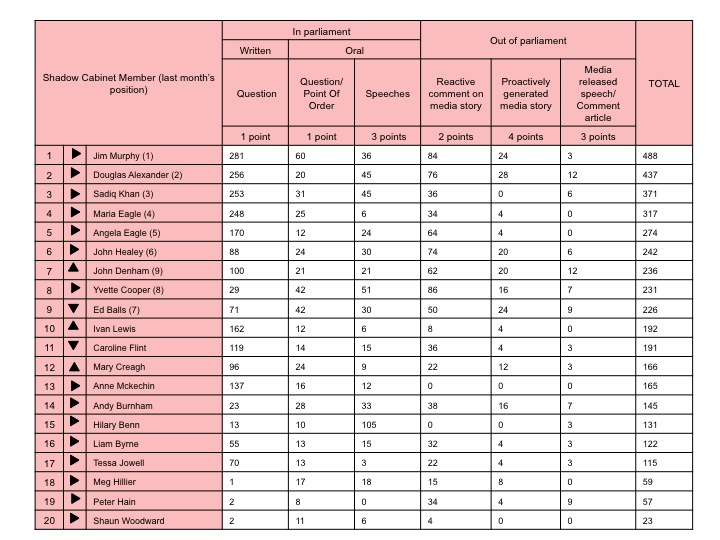
UNCUT: June shadow cabinet league table – and where the knife may fall in future

01/07/2011, 09:27:52 AM

Murphy holds onto top spot but all eyes on the bottom as relegation comes closer

by Atul Hatwal

June saw Jim Murphy retain his position at the top of the league, albeit with a reduced lead as Douglas Alexander closed the gap between first and second. But the real interest lay in what was happening at the bottom following the news that the leadership intends to scrap shadow cabinet elections.

Assuming Ed Miliband’s writ runs, the prospect of relegation this year for shadow cabinet under-performers has suddenly become a real possibility.

It’s something that Uncut readers backed overwhelmingly last month with over 70% voting in favour of relegation before the next shadow cabinet elections. And it would certainly be peculiar for Miliband to fight for this change and then not use his new power.

Read the rest of this entry »

Facebook Twitter Digg Delicious StumbleUpon

UNCUT: Pub quiz question: who is the leader of the Labour party?

30/06/2011, 08:42:14 AM

by Peter Watt

I don’t know what’s wrong with me this week. I just feel miserable. I have even got to the point that I can barely be bothered to tweet, and that really is a bad sign. But why am I feeling flat now? I mean, for months now, I have been worried about what seemed to be the direction of travel of the party with dog whistles to the left. For months I have worried that the outcomes of the party reform debate would be a damp squib. And for months I have worried that we seemed to be all but leaderless.

So on that basis, surely in the last few weeks things have started to look up? Ed has begun to define himself and his philosophy of “social justice with a hard edge” and an end to the “take what you can culture”. And he has shown real leadership on party reform by demanding an end to elections to the shadow cabinet and hinting at reforming the relationship with the trade unions. For me, these still don’t go far enough and probably could have, and should have, been said months ago. And, crucially, we still have little or no credibility on the economy.

But it absolutely has to be welcomed, and with four years to go until the next general election it is a start. Despite some people feeling uncomfortable about the new approach, on the whole the party seems buoyed after a difficult few months. David Cameron has looked rattled at PMQs and the U-turn taunts hurt because they reflect a very real problem for him and his government. We can probably relax just a bit until conference season. The beach beckons. Read the rest of this entry »

Facebook Twitter Digg Delicious StumbleUpon

UNBOUND: Thursday News Review

30/06/2011, 05:53:38 AM

Strike day

Thousands of furious workers are staging a mass walkout today to fight Government plans to savage their pensions. The strikes by around 750,000 teachers and civil servants will be the biggest day of industrial action since Margaret Thatcher was PM in the 1980s. Hard-pressed staff have already been hit by savage Coalition cutbacks and are incensed over proposals to hammer their pensions. Thousands of schools in England and Wales will be closed today while ports and airports will be disrupted. Driving centres, courts, job centres and even Downing Street will also be affected. Last night Dr Mary Bousted, general secretary of the Association of Teachers and Lecturers, said the Government was morally responsible for the strikes because it was trying to steamroller through unfair changes to pensions and had failed to negotiate. She added: “Deciding to strike is not a decision we take lightly. This is the first time ATL members will be involved in a national strike in our 127 years. – Daily Mirror

The coalition government faces the first industrial uprising against its austerity measures today as up to 750,000 public servants strike over planned changes to their pensions. A third of schools are expected to close and two-thirds of universities have cancelled lectures. Benefits will go unpaid, court cases will be postponed, police leave has been cancelled in London and airports are bracing themselves for backlogs at immigration. Mark Serwotka, leader of the Public and Commercial Services union, said it was the most important strike in his union’s history. “Everything we have ever worked for is under attack,” he added. The government was trying to avoid inflaming the situation. David Cameron told the Commons: “What we are proposing is fair: it is fair to taxpayers but it is also fair to the public sector because we want to continue strong public sector pensions.” He said Labour was avoiding the issue, accusing the party of being “paid for by the unions [so] they can’t discuss the unions”. None of the four striking unions, with members in schools, colleges, universities and the civil service, is affiliated to the Labour party. Nearly every other union is poised to move towards strike action by the end of the year if the bitter standoff over public sector pension reforms is not resolved. Roads in central London will shut as thousands of people march in demonstrations that will be echoed across the country. Police leave has been cancelled so officers can cover for striking police community support officers, call handlers on the 999 lines and security staff. – the Guardian

As many as 750,000 teachers and civil servants are expected to join today’s strikes. Millions of others face severe inconvenience or financial loss: from parents who stay at home because their children’s schools are closed to people wanting to enter or leave the country. It should be stressed that not all public-sector staff will be striking. Many NHS staff, transport workers and others are not involved, although their unions do not exclude action in future. This is nothing like a general strike, nor even a strike by the whole public sector – though there are those on both sides of the public-private divide with an interest in presenting it as such. There is no doubt that many public sector workers are angry, frustrated and disillusioned on the very specific issue that is the focus of today’s protest: moves by the Government to change the terms and conditions of public-service pensions. And they are not completely wrong when they argue that long-standing terms of employment are threatened or that pensions have been a plus for the public sector in recruiting and keeping staff. But these arguments ignore the bigger picture. In pension provision, Britain is rapidly becoming two nations. One nation can look forward to a pension which, while not necessarily qualifying for the description “gold-plated”, is secure and bears a predictable relation to salary and years of service. The other nation – which comprises the vast majority of the working population – increasingly cannot. In most private companies, secure final-salary schemes are a thing of the past. Contributions are higher, the returns mostly lower, and the pensionable age higher than in the public sector – if there is a pension scheme at all. – the Independent

Prezza hits the campaign trail as election day looms

Former deputy prime minister John Prescott put tackling unemployment at the top of the agenda as he joined Labour’s Inverclyde by-election candidate on the campaign trail on Wednesday. Speaking just hours before the polls open, Mr Prescott said Iain McKenzie’s message was “jobs, jobs, jobs”. He added: “I am delighted to be out and about in Inverclyde today supporting Iain McKenzie to be a strong, local voice in Westminster. He’s a local man who knows this area like the back of his hand. Iain didn’t just arrive in Inverclyde for the by-election. It’s about jobs, jobs, jobs. Unemployment here is too high. The Tories are ruining the economy, punishing families and hurting decent people just looking for work. Inverclyde needs a local champion to go down to Westminster and fight the corner. That’s why I’m here to back Iain.” – stv.tv

Voters in Inverclyde go to the polls later to elect a new member of the UK Parliament. Polling stations in the constituency will be open from 0700 BST until 2200 BST. Labour is defending a 14,416-vote majority in the Westminster seat, also being contested by the SNP, Tories, Lib Dems, and UKIP. The by-election is being held to find a replacement for David Cairns, who died from acute pancreatitis in May. Sophie Bridger is standing for the Liberal Democrats, Iain McKenzie for Labour, Anne McLaughlin for SNP, Mitch Sorbie for the UK Independence Party and David Wilson for the Conservatives. – BBC News

EU budget grab

David Cameron is facing pressure to veto the latest ‘ludicrous’ cash demand from Brussels after it  announced plans to slap three new taxes on Britain. The European Commission yesterday revealed budget demands which would cost UK taxpayers £10billion. In what Treasury officials viewed as one of the most outrageous power grabs in recent memory, they demanded the right to raise a Europe-wide sales tax. Brussels bosses also called for a new financial transaction tax, which critics say will hurt the City of London and leave consumers with higher borrowing costs.  And they unveiled plans to let Brussels grab a chunk of green taxes which are already being levied on polluters. In total, the commission demanded nearly £100billion extra for the EU’s budget between 2014 and 2020. British taxpayers would have to pay £10billion more over the seven-year period – an increase of £1.4billion a year on the current British annual payment of £13.3billion. – Daily Mail

Which one are you again?

One in four people thinks Ed Miliband is his elder brother David. A similar proportion of voters believe that David is actually Ed. Nine months into his leadership of the Labour Party, the findings of the ComRes survey for The Independent do not paint a flattering picture for Ed Miliband, as he steps up his efforts to convince the people that he is a prime minister-in-waiting. Other members of his Shadow Cabinet are even more anonymous. The only good news is for Ed Balls, the combative shadow chancellor who stood against the Milibands for the Labour leadership last year, and who appears to have made more of an impact on the electorate than the two brothers. He was correctly identified by 68 per cent of the 2,000 voters who were shown photographs of eight senior Labour figures and asked to put one of five names to their face. Ed Miliband was named accurately by 64 per cent of those questioned but 23 per cent thought he was his brother David. David was identified by 61 per cent but 26 per cent thought he was his brother. The other five Shadow Cabinet figures tested by ComRes were recognised by only three or four in 10 voters, suggesting that the Opposition team is struggling to be noticed and many Shadow Cabinet members remain in the shadows. – the Independent

Facebook Twitter Digg Delicious StumbleUpon

UNCUT: David Miliband – a geek tragedy

29/06/2011, 03:30:50 PM

by Kevin Meagher

Let me save some time and skip straight to my conclusion: the vicissitudes of David Miliband’s political career do not amount to a tragedy. He is a man who stood for the leadership, lost, and the world moved on. As he, of all people, does not need reminding, there are no silver medals in politics.

Yet here we are, nine months on, with Labour still haunted by the rupture in the hitherto relentless rise of David Wright Miliband. The reverberations continue to ring out. Mehdi Hasan and James Macintyre’s book, Ed: The Milibands and the Making of a Labour Leader is but the latest instalment in what has already become a tiresome soap opera (to the less charitable, it is simply a “geek tragedy”).

Enough of this emotional spasm. David Miliband proclaimed that he was “fine” when he spoke after the result had been declared at last year’s party conference. So we can put away the black armbands. There is no need for a period of official mourning. But if this saga is to drag on a bit further, then perhaps there is a need for an inquest into why David Miliband finds himself where he is.

Intelligent, optimistic, hard working and decent: David Miliband’s appeal should have spanned right across the Labour party. Despite also being a bit grand and stand-offish, he really could have personified the post-Blair and Brown generation better than anyone else. He should have been the logical choice, the unifying figure that married free-flowing Blairite pragmatism with Brownite social democratic moorings.

Read the rest of this entry »

Facebook Twitter Digg Delicious StumbleUpon