



UNCUT: Labour’s kidding itself about this campaign. The Tories are winning the strategic battles

22/04/2015, 07:00:10 AM

by Atul Hatwal

Labour chiefs are happy with progress in the campaign so far. Most activists are upbeat. Even PLP pessimists have been given to moments of optimism.

But for all the pleasant mood music – from the poll averages which suggest Ed Miliband is within touching distance of victory to the parliamentary number-crunching which seems to offer manifold routes into Number 10 – Labour’s campaign strategists have misread their three biggest strategic challenges: how to deal with the Tories’ SNP scare, which voters to target with the ground operation and what retail offer to make.

Over the next fortnight, the impact of these mistakes will become clearer.

Most immediately, Labour has utterly failed to understand the Tories’ intent with their scaremongering over SNP support for a Labour government.

The view of Labour staffers has been that the Tories are principally trying to frighten Ukip voters back into the Tory fold. But that for every vote the Tories get back on their right flank the more they accentuate their negatives as the nasty party with wavering voters.

The Labour analysis is correct about appealing to kippers but wrong about the impact on swing voters, specifically English swing voters.

Labour’s more frantic recent statements, denouncing the Tory attacks as “smears” – a sure sign that a political party is becoming panicked and does not have a line to take – suggest that the impact of what’s happening has started to dawn on party strategists.

The Tories’ objective is to fuse the SNP and Labour in English voters’ minds.

This vision of McLabour as an unabashed, economically left-wing party that will prioritize Scotland’s interests over England not only scares ex-Tory Ukip voters into switching back, it resonates with right leaning and centrist Lib Dems not to mention the quarter of 2010 Labour voters who have since abandoned the party.

Read the rest of this entry »

Facebook Twitter Digg Delicious StumbleUpon

INSIDE: Labour’s BAME manifesto was a missed opportunity

21/04/2015, 05:07:20 PM

The problem with Labour’s ‘BAME manifesto’ – and its approach to understanding minority communities more generally – boils down to this: In the Labour lexicon, BAME (Black and Minority Ethnic) is simply a question of skin colour.

The term is exclusively meant to denote non-White groups. It’s an approach that makes as much sense as assuming you need to be a wheelchair user to be a disabled person.

The party shows a poor grasp of the complexity of the UK’s contemporary racial and ethnic mix and the often very specific and nuanced issues they face.

As a result, the document falls back on 1980s norms. Hence, all the photos in the document show group shots of smiling Black and Asian people. So far, so clichéd.

The manifesto shows little understanding of just how fluid it is to be a member of, say, the Afro-Caribbean or Muslim communities these days, while seeming utterly oblivious to the concept that there may be White ethnic minorities out there and they, too, may have needs.

For instance, the numbers of Polish-born people living in the UK have increased 10-fold in a decade, from around 60,000 in 2001 to 580,000 at the time of the 2011 census. To this we can add a further 200,000 ethnically Polish children and grandchildren.

Nearly a million-strong. Yet, the manifesto utters not a single word about their particular needs.

At the very least, the manifesto could have included promises to crackdown on unscrupulous gangmasters and tighten regulation of the casual labour market, an issue that disproportionately affects migrant eastern Europeans coming here in large numbers to work.

Neither is there any mention about Gypsies and Travellers. This is especially remiss given the massive cultural and social disadvantages they face, including a level of overt public ridicule and discrimination for their lifestyles and customs that would (rightly) be beyond the pale if targeted against any other minority group.

Read the rest of this entry »

Facebook Twitter Digg Delicious StumbleUpon

UNCUT: The entwined challenges that the SNP and UKIP may pose PM Miliband

21/04/2015, 10:59:14 AM

by Jonathan Todd

Scotland is diminished inside the UK, argues Alex Salmond. The UK is diminished inside the EU, says Nigel Farage. Scotland did not vote for David Cameron, insists Salmond. The UK didn’t vote for Jean-Claude Juncker, maintains Farage. It would be “nae bother” for Scotland to break up the UK, asserts Salmond. It would be “no problem” for the UK to leave the UK, claims Farage.

Salmond briefly seemed a broken man after the defeat of Yes last September. Having promised to resign the leadership of UKIP if he doesn’t win South Thanet, defeat for Farage on 7 May would also leave him broken. But Salmond has been reborn, as support for Yes has wholly transferred to the SNP. Farage might be reborn too.

Salmond’s rebirth has been enabled by glacial shifts in Scottish opinion that now appear to have unstoppable momentum but which built up over a long period, going undetected by those focused on Westminster. No Scottish seats in the UK parliament changed hands in 2010. The SNP gained two seats at the 2005 general election and lost one at the 2001 general election. The churn over the same period in elections to the Scottish Parliament, however, was much more dramatic. The SNP gained 20 additional seats in 2007, 23 in 2011.

If we look only at the lack of 2010 seat change in Scotland, the SNP’s rise appears inexplicable. If we look instead at recent elections to the Scottish parliament, it seems less so. Perhaps for reasons wrapped up with the referendum, decisive numbers of Scots are now prepared to entrust the SNP with their support in the UK Parliament, as well as in the Scottish Parliament. The decision factor for voters may have migrated from “who is best to lead the UK?” to “who will get the best deal for Scotland?”

Read the rest of this entry »

Facebook Twitter Digg Delicious StumbleUpon

INSIDE: Prime Minister Miliband’s first U-turn: scrapping gender equality around the cabinet table

20/04/2015, 06:48:36 PM

Any coalition deal with the other parties that involves sharing cabinet positions, will inevitably mean the percentage of women sat around Labour’s top table will get smaller.

This is not due to backsliding on Ed Miliband’s part. Far from it. He promised during the Labour leadership contest – and has consistently repeated it since then – that he will deliver 50:50 gender equality around the cabinet table (and has more or less done so with his current shadow team).

It is simply that the stock of female ministers from the other potential coalition partners is extremely low. And despite watery protestations to the contrary, all the current polls indicate that Miliband will need either the SNP or the Lib Dems to join his administration in order to form a stable working majority in the Commons.

Only one of the SNP’s six MPs in the last parliament was female and, although led by a woman, just 36 per cent of their parliamentary candidates are women. (And given Nicola Sturgeon is rather preoccupied serving as Scotland’s First Minister, she would not, presumably, be available herself?)

Similarly, just seven of the Lib Dems’ 57 MPs in the last parliament were women and five of them are likely to lose their seats (although, to be fair, it’s perfectly possible this number will be replenished with newcomers).

But from day one of the next government, there will be precious few women MPs from among either the Lib Dems or SNP experienced enough in frontline politics to be considered for cabinet positions.

The only choice open to Miliband, if he’s serious about honouring his pledge, is to appoint a greater number of Labour women to meet the shortfall. This, in turn, means appointing fewer men who currently sit in the shadow cabinet.

The in-tray of an incoming prime minister is deep enough without creating that kind of explosive row and in the process generating an officer-class of senior, overlooked men who have slogged away on the frontbench for years only to have their careers ripped away from them.

No, look instead for Miliband to pepper the junior and middle ministerial ranks with women as cover for the Labour-led government’s first U-turn.

Facebook Twitter Digg Delicious StumbleUpon

UNCUT: How Ukip’s Doncaster conference revealed the divisions that would derail their election campaign

19/04/2015, 08:35:17 PM

by Samuel Dale

Ukip is losing and its future is bleak. Its poll rating is being squeezed and its manifesto was an aimless ragbag of populist ideas.

It wants to attract lefty Labour voters and right-wing Tories so it ends up with an incoherent, hollow message.

The manifesto wanted increases to the carers allowance and an end the bedroom tax while slashing income tax for the wealthiest.

The only thing they can all agree on is leaving the EU and attacking immigrants.

This unholy alliance will boil to the surface after the election, especially if Nigel Farage loses in South Thanet and has to quit.

The seeds of the discontent were sown at the party conference in Doncaster last year with the party riding high amid defections and rising polls.

At an Institute of Economic Affairs fringe event on economic policy was the libertarian immigration spokesman and MEP Steven Woolfe and the economics spokesman and MEP Patrick O’Flynn.

MEP Tim Aker and Tory activist Tim Montgomerie were sat by their side and the session was hosted by ex-Lib Dem and IEA director-general Mark Littlewood.

Earlier in the day, O’Flynn had set the conference tone by unveiling income tax cut proposals for middle earners by raising the 40p threshold and introducing a new 35p band.

But he also unveiled a “wag tax” proposal to increase VAT to 25% on luxury goods such as expensive cars and shoes.

Read the rest of this entry »

Facebook Twitter Digg Delicious StumbleUpon

UNCUT: Week 3 of the campaign: the good, the bad and the ugly

19/04/2015, 01:07:23 PM

In our second installment, Uncut’s weekly review of the campaign looks at the events of week 3.

The good

Labour’s costed policies

Sunday 12 April – Marr and Osborne. The core Tory strength is a reputation for fiscal probity. Yet here was prime time Osborne appearing anything but.

After more than five years when it has usually seemed that only one party, the Tories, know how to make their sums add up, Marr suddenly left the impression that this party is Labour, not the Tories.

Sam Dale has previously argued on Uncut that the Tory advantage on fiscal credibility is so well established that they can afford, as they certainly now are, to play fast and loose with it. In doing so, though, they deepen a theme of the Tory campaign identified by Jonathan Todd: taking people for idiots.

If Labour keeps showing how our policies are costed, the Tories might just find a trump card slipping away at the last, crucial moment.

The manifesto launch event

The team managing Labour’s events deserve some recognition. Often overlooked as the plaudits go to the more flashy spinners, events folk only tend to get mentioned when something has gone wrong.

But for Labour, trying to shift some pretty entrenched pre-campaign stereotypes, the backdrop and staging of the set-piece events needs to provide the pictures that validate the message.

If anything were to go wrong – as at Ukip’s campaign launch when the blu tak came unstuck and the backdrop fell down – then it’s a lock for the news bulletins as a metaphor for a campaign in trouble.

This week’s manifesto launch was another in a growing list of impressive events.

The message was about responsibility and fiscal discipline and the pictures of Ed Miliband at the event reflected this exactly.

Ed M


Read the rest of this entry »

Facebook Twitter Digg Delicious StumbleUpon

UNCUT: This election needs a soapbox or an Irn Bru crate

18/04/2015, 11:47:04 AM

by Atul Hatwal

Paralysing fear has infected every aspect of the parties’ campaigns.

Strategists fear the voters, so they stage tightly controlled events, away from the truculent public. Junior staffers fear any slight mishap that might make the news, so even the most minor decision is dictated by a safety first doctrine.

And Ed Miliband and David Cameron fear everything and anything, otherwise they would not accept the counsel of caution from their advisers which shackles all that they do.

The result is an arid campaign, a dismal parade of media moments contrived for broadcasters that lack the incident and passion to galvanise anybody but the already committed.

A news vacuum is developing. The manifesto launches commanded attention earlier in the week, but now what?

The front pages are already drifting away from the election. Soon, as is always the way in politics, this lacuna will be filled with the grumbles of worried candidates and plotting leadership contenders, taking aim at their leaders.

It doesn’t have to be this way. For the party bosses running the party campaigns, there is an alternative.

1992, which has already provided much of the template for this contest, also offers a lesson in how to fill that vacuum without the need to scramble out new half-baked policy announcements dreamt up the night before or to escalate the ferocity of personal attacks to shock a path into the news.

Imagine if one or more of the party leaders took a leaf out of John Major’s book and didn’t just do managed Q&As with pre-vetted, politically emasculated supporters, but actually went out to meet the British public on the high street, in the shopping centre and at the market.

If they went to where the public are, rather than hiding in a hall ringed with security, put down a soapbox, stood on it and spoke to real voters.

Jim Murphy is Scottish leader in no small part because of his one man campaign across Scotland in the independence referendum, speaking to the Scottish public from atop his Irn Bru crate.

There were baying nationalist mobs, protesters, eggs, but also, fabulous pictures for print and broadcast, personal guts and raw emotion.

The plaudits from journalists or every persuasion – right, left, nationalist and unionist – after the clip below was shared were extraordinary. It’s hard not admire Jim Murphy’s passion, resilience and commitment.

Read the rest of this entry »

Facebook Twitter Digg Delicious StumbleUpon

GRASSROOTS: Miliband could have a legacy even if Labour lose

17/04/2015, 08:04:26 PM

by David Ward

Most people don’t realise that the guy who invented the computer was a bloke called Tommy Flowers who worked for the Post Office.

Sure Turing made some logic sketches, but it was Flowers who designed and  actually built the machine that broke the German codes. After the war he thought there might be something in it. He wasn’t allowed to say he’d built one before but he took his idea to British banks for funding to build another one. Of course they laughed him out of the office, the Americans took over the industry and the rest is history.

I mention this story because it shows big ideas can quickly become bigger than their creators, and I think Ed Miliband could be on the verge of a big change too.

It’s not exactly news that the post-Thatcher consensus is coming to an end. You only need to look at the fracturing of politics a la the late 1970s to see that the predominant mood out there is uncertainty.

As we know, the entire case Ed has been making since 2010 is that the left doesn’t have to accept rampant capitalism on its own terms. We don’t have to accept that those at the top should reap unsustainable rewards. We don’t have to accept that markets and big corporations can’t be reformed so society and employees benefit too. And we don’t have to accept that people in work still don’t earn enough to live on.

That’s been the pitch. It’s seen him derided in many quarters – even in his own party on occasion. In any normal circumstance Labour should be expecting a chastening during this campaign.

But the funny thing is it hasn’t quite happened. It’s taken a few years of sharpening to get the pitch right but Labour’s message is beginning to cut through. Take a look at this Ipsos Mori published a word cloud of the issues that people have remembered from the last few days. Since the first few debates Ed’s approval ratings have improved markedly.

Read the rest of this entry »

Facebook Twitter Digg Delicious StumbleUpon

INSIDE: Cameron beware: Benefit claimants lose money when they don’t turn up to an interview

16/04/2015, 05:42:54 PM

As the only national political leader taking part in tonight’s “challengers’ debate,” is it a mistake for Ed Miliband to put himself on a par with the nationalists and minnows of British politics?

We’ll soon find out, but assuming he does well enough (in a format that usually favours his softer public style) it will bolster an already confident Labour campaign and throw the spotlight on the absent Prime Minister’s reluctance to defend his own record.

Indeed, Miliband has a neat line on David Cameron’s failure to turn up: “I think if you are applying for the job of Prime Minister, the very least the British people expect is for you to turn up to the interview.”

Such bad form, especially when Employment Minister Esther McVeigh has been very clear on this point: “…jobseekers have a responsibility to do everything they can to get back into work. We are ending the something for nothing culture,” she has previously opined.

For the first offence of failing to turn up to an interview, an unemployed benefit claimant faces losing four week’s Job Seekers’ Allowance.

Cameron should beware, the penalties increase with every no-show.

Facebook Twitter Digg Delicious StumbleUpon

UNCUT: The smaller parties should be careful what they wish for. It always ends badly for the kingmaker

16/04/2015, 09:57:12 AM

by Atul Hatwal

We are approaching peak minnow for the campaign. Yesterday the Lib Dems and Ukip launched their manifestos and this evening there is the five-way debate featuring the smaller parties minus Nick Clegg but inexplicably with Ed Miliband guest starring at the front of the coconut shy as the designated representative of Westminster’s failed big party duopoly.

But as much fun as the SNP, the Greens, Plaid and Ukip will have beating up on Ed Miliband the smaller parties should be careful what they wish for.

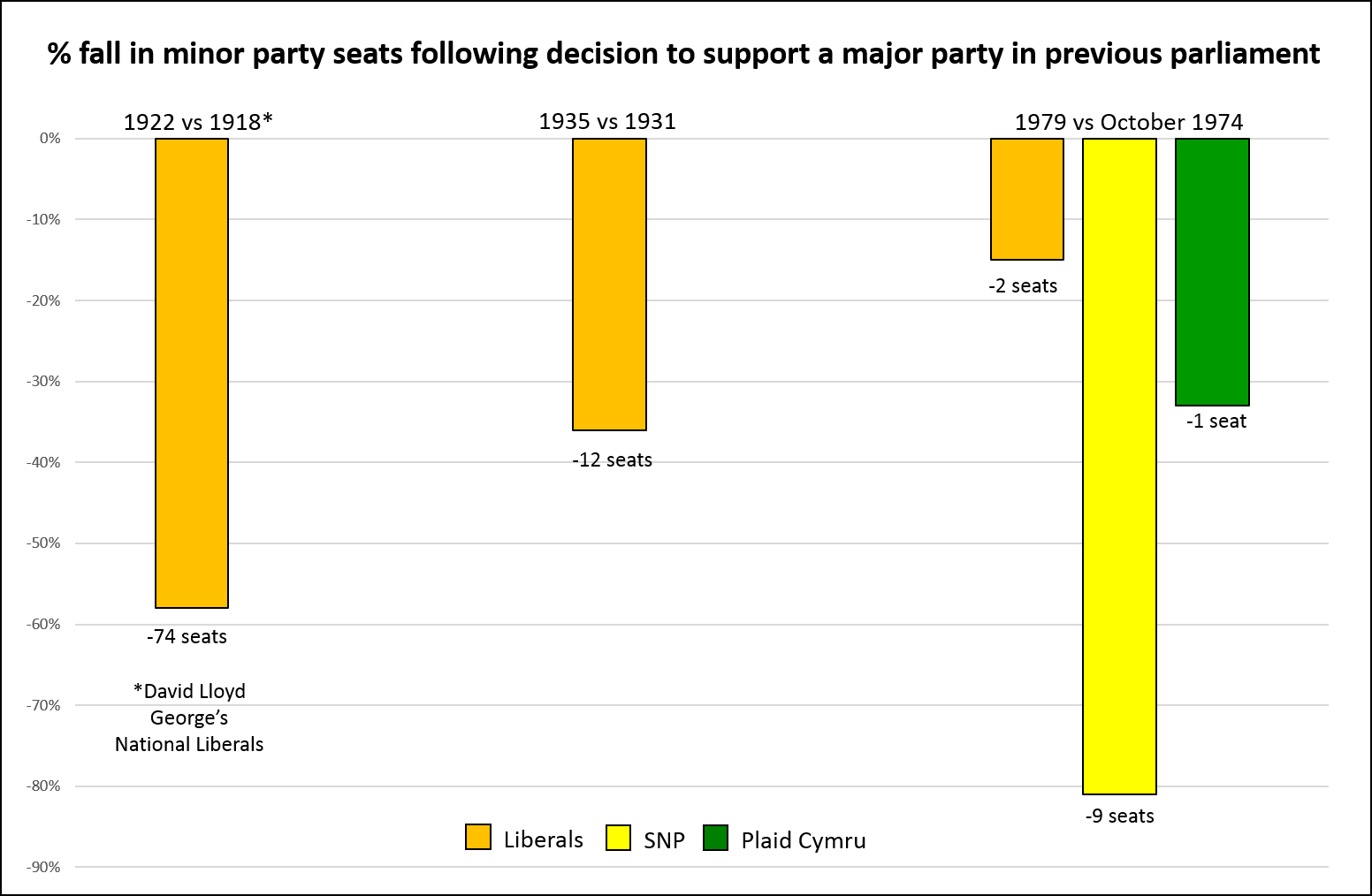
They might be eyeing eventual roles as kingmakers or junior partners in government, but history has a harsh lesson: it always ends badly.

In peacetime, every time there has been a coalition, confidence and supply agreement or any type of deal for support in the last 100 years, it has been electoral poison for the minor party.

On three occasions there have been coalitions in the last century and one period of less formal support to sustain a government.

All involved the Liberals, with the SNP and Plaid Cymru also becoming mired in the mess of the 1970s Callaghan government.

The results speak for themselves.

Minor party fall

Read the rest of this entry »

Facebook Twitter Digg Delicious StumbleUpon