




UNCUT: Budget 2015: The quiet moments matter

19/03/2015, 02:27:16 PM

by Jonathan Todd

Budgets are supposed to be big moments. The kind that determine general elections. But maybe they are decided by millions upon millions of quieter moments. When payslips are inspected, profits turned, and housing wealth accumulated.

In these quieter moments judgments are made on the economy’s performance. In turn, these bear upon general election votes. It is a eighteen months since Uncut spotted a gradual rise in the proportion of the electorate reporting the economy as doing well and a steady decline in Labour’s poll lead. We ran a regression to assess the relationship between these data series and postulated that the Tories would overtake Labour when a quarter of the electorate came to the view that the economy is doing well.

In May last year, when YouGov’s tracker on economic sentiment first started to bump up against a quarter of the electorate being of this belief, we noted that Tory poll leads had started to emerge. These leads were faltering and slow to confirm themselves. Like the upward trajectory in the proportion of the electorate positive about the economy.

24 per cent of the electorate thought the economy was doing well last May and Labour held an average of a 3 point poll lead, as the table below illustrates. Occasional Tory leads then existed but the average favoured Labour. The Tories weren’t consistently ahead but nor was economic sentiment resoundingly over a quarter. At 30 per cent, economic sentiment now comfortably clears the quarter threshold, and Labour’s poll lead is less impressive than last May.

If we simply compare the data in May 2014 and March 2015, they seem to confirm the original Uncut hypothesis: the more the economy improves, the narrower Labour’s lead. The pattern of these series between these two months, however, rewards inspection.

Read the rest of this entry »

Facebook Twitter Digg Delicious StumbleUpon

UNCUT: The budget was Labour’s last chance. History is clear about what happens next

19/03/2015, 12:08:19 PM

by Atul Hatwal

Labour desperately needed George Osborne to produce another omnishambles budget. Something to reverse the ebbing tide of Labour’s poll lead.

It didn’t happen.

Osborne may have concocted an utterly ludicrous public spending profile for the next parliament – savage, penal cuts immediately followed by lavish expenditure, which led even the Office for Budget Responsibility to describe it as a “rollercoaster” – but he managed to kill Labour’s most potent attack line: that spending would be taken back to levels last seen in the 1930s.

Now, with under two months until the general election, history is very clear about what happens next.

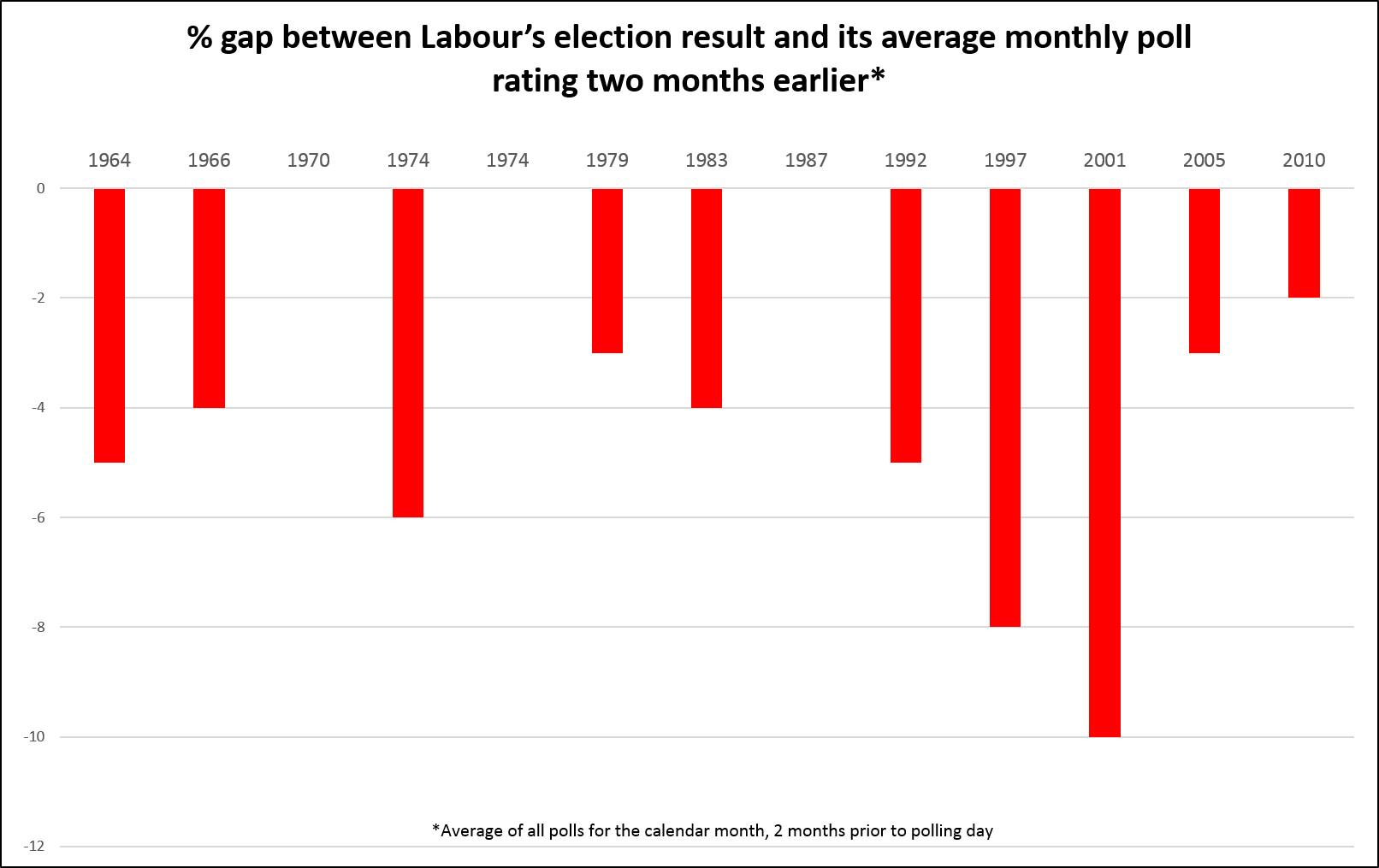
Labour’s poll rating will almost certainly slide. Over the past fifty years of elections, Labour has lost an average of 4% in the last two months before an election.

Given an average poll rating in March (so far) of 33%, this would take Labour back to square one on May 7th with 29% of the vote, the same as 2010.

Poll rating1

Read the rest of this entry »

Facebook Twitter Digg Delicious StumbleUpon

UNCUT: UKIP and the Greens are united by one thing: voodoo economics

17/03/2015, 09:55:30 AM

by Callum Anderson

Just a few weeks remain of the 2010-2015 UK Parliament. On Wednesday, the coalition government rolls its dice one last time, in an attempt to woo undecided voters.

Meanwhile last weekend, Ed Miliband unveiled Labour’s election pledge card at Birmingham’s ICC. The first two pledges – building a strong economic foundation and raising the higher living standards for working families – have sought to serve as indicators of Labour’s simultaneous commitments to fiscal prudence and growing the economy.

Indeed, it is the economy that will decide this election, with Mr Miliband’s Labour set to ask the electorate that famous question: “are you better off than you were five years ago?”

Whilst much of the scrutiny has rightly been reserved for the main three Westminster parties, it is the economic policies of the two most significant ‘insurgent’ parties – UKIP and the Green Party – that serve as the most unknown factor of the election.

So, where do UKIP and the Greens stand on economic policy?

Traditionally, UKIP has positioned itself as a libertarian party. However over the last year, in pursuit of widening its appeal, the party has drifted leftwards on economics, if not in social affairs. The UKIP of 2010 offering a flat income tax is a distant memory. But the result has been the same: economic illiteracy.

Read the rest of this entry »

Facebook Twitter Digg Delicious StumbleUpon

UNCUT: Uncut review: Labour’s Spring rally was a tale of two Britains

16/03/2015, 10:42:33 AM

by Jonathan Todd

On Saturday, I met a friend for coffee and took my son swimming. Normal life, that simple, that complicated. Labour’s Spring Rally came in-between. This made the coffee and swim seem Damascus living: normal life accompanied by artillery’s distant thud.

There is not one nation but two Britain’s. The Britain of my coffee and swim. The Britain of the rally. Here the artillery is loud. War has been waged against the country by the government . “Britain can’t afford another five years of Tory government,” Shaun Dooley, the actor and one of Ed Miliband’s warm-up acts, implored.

“If we go on at this rate, the nation must be ruined,” Adam Smith was told by a student following a reversal for British troops in the American revolution. “There’s a great deal of ruin in a nation,” retorted Smith. It would take more than a prime minister as second rate as David Cameron to ruin us.

In rally Britain, however, all is at stake. We might be ruined. Or milk and honey might flow. A country where the next generation can do better than the last. Where the NHS has time to care. And working families have higher living standards.

Read the rest of this entry »

Facebook Twitter Digg Delicious StumbleUpon

UNCUT: Nigel Farage has destroyed himself and Ukip. He might yet take the whole Eurosceptic movement down too

13/03/2015, 07:00:55 AM

by Atul Hatwal

When the history of Ukip is written, yesterday, Thursday 12th of March, will go down as the day the bubble burst.

It wasn’t just the banal manner in which Nigel Farage admitted he was a racist in his interview with Trevor Phillips.

To believe in discrimination based on someone’s background, to admit to wanting to scrap anti-discrimination laws and legalise racism, would have been damaging enough.

But it was his blustering, obfuscating and dishonest reaction that made matters so much worse. Claiming he was being “wilfully misrepresented,” when the original interview was widely available and the evidence so stark, was utterly incredible.

Five points are salient for the election campaign and beyond: the impact on Ukip’s brand, the opportunity for the Tories, the reaction of the journalists, the danger for Eurosceptics and the broader lessons for politicians talking about immigration.

First, Farage has injected arsenic into Ukip’s already toxified brand.

It’s hard to imagine who will be convinced to switch their votes to Ukip as a result of his latest intervention. Maybe some of the BNP’s dwindling support will be reassured that Farage is a true racist and peel off to join the purple army.

But many who might have considered Ukip will take fright.

According to a ComRes poll a few weeks ago, 44% already thought that the party was racist. As yesterday’s events percolate into the public consciousness, the number who think Ukip racist will rise to cross 50%.

A leader embodies their party and a vote for them says something about the elector. Not many would like that to be “I am a racist.”

Read the rest of this entry »

Facebook Twitter Digg Delicious StumbleUpon

INSIDE: Clarkson may be obnoxious, but Cameron’s loyalty to his friends is admirable

12/03/2015, 06:29:26 PM

“I don’t know exactly what happened” says David Cameron about motoring motormouth Jeremy Clarkson’s ‘fracas’ with a Top Gear producer, but “he is a constituent of mine, he is a friend of mine, he is a huge talent.”

Yet again the Prime Minister stands by his friends and allies, even when their backs are against the wall, despite brickbats from his critics and for no discernable short-term advantage to himself.

There’s a pattern here and, in the snake-pit of British politics, something of a curiosity.

Think of the way Cameron kept Andy Coulson under his wing until the bitter end, despite early warnings about his seamy conduct as editor of the News of the World.

The Prime Minister is a reluctant butcher in a business where carving up enemies and allies alike is second nature. Look no further than the way he has kept ministers in cabinet jobs for the full run of this parliament.

It is inconceivable that Iain Duncan-Smith and his, as yet, unfurled universal credit reforms would have been given so much latitude under either Blair or Brown.

Or that Andrew Lansley would have stayed in post long after it was abundantly clear he had made a complete hash of the politics of his NHS reforms.

Or that a figure like Oliver Letwin, the brainy but bumptious ‘Minister of State for Government Policy,’ would become a mainstay of the government frontbench.

Read the rest of this entry »

Facebook Twitter Digg Delicious StumbleUpon

UNCUT: Six reasons why Labour should rule out an SNP deal

11/03/2015, 02:26:41 PM

by Rob Marchant

There is a rule in electoral pact-making, and pretty much any card game, which is fairly universal: don’t show your hand to the other players.

That is, don’t rule anything in and don’t rule it out. You have nothing to gain (you can fritter away your negotiation leverage when agreeing the pact) and everything to lose, in the event that you find yourself in a different situation from that expected and have to eat your words. Obvious, really. Wait until the moment comes and deal with things when you have all the information.

But it could also be argued that there one sensible exception to that rule: if the mere hint of a pact with another party could be damaging to yours even before the election. Especially when things are balanced on a knife-edge and almost anything could affect the result.

That has never really been the case with the Lib Dems: until 2010 they were a slightly dull, modestly successful and broadly respectable opposition party, whether we liked it or not. Now they are bloodied with the hard work of actual government and potentially facing a big hit at the polls, they are possibly less attractive partners. But neither are they toxic.

The same cannot necessarily be said for some other parties. Cameron would have to tread very carefully indeed in the unhappy event of ending in a coalition with UKIP, unlikely though that might seem – the toxicity of some of its members could sit ill with his (mostly) respectable party.

But worse still is the idea of a partnership between Labour and the SNP. Here’s why.

Read the rest of this entry »

Facebook Twitter Digg Delicious StumbleUpon

UNCUT: Enjoy your daily paper during the campaign. It might not be there next time round

10/03/2015, 01:17:46 PM

by Atul Hatwal

This election will be the swansong of an institution which has dominated the media landscape for well over a century: the daily newspaper.

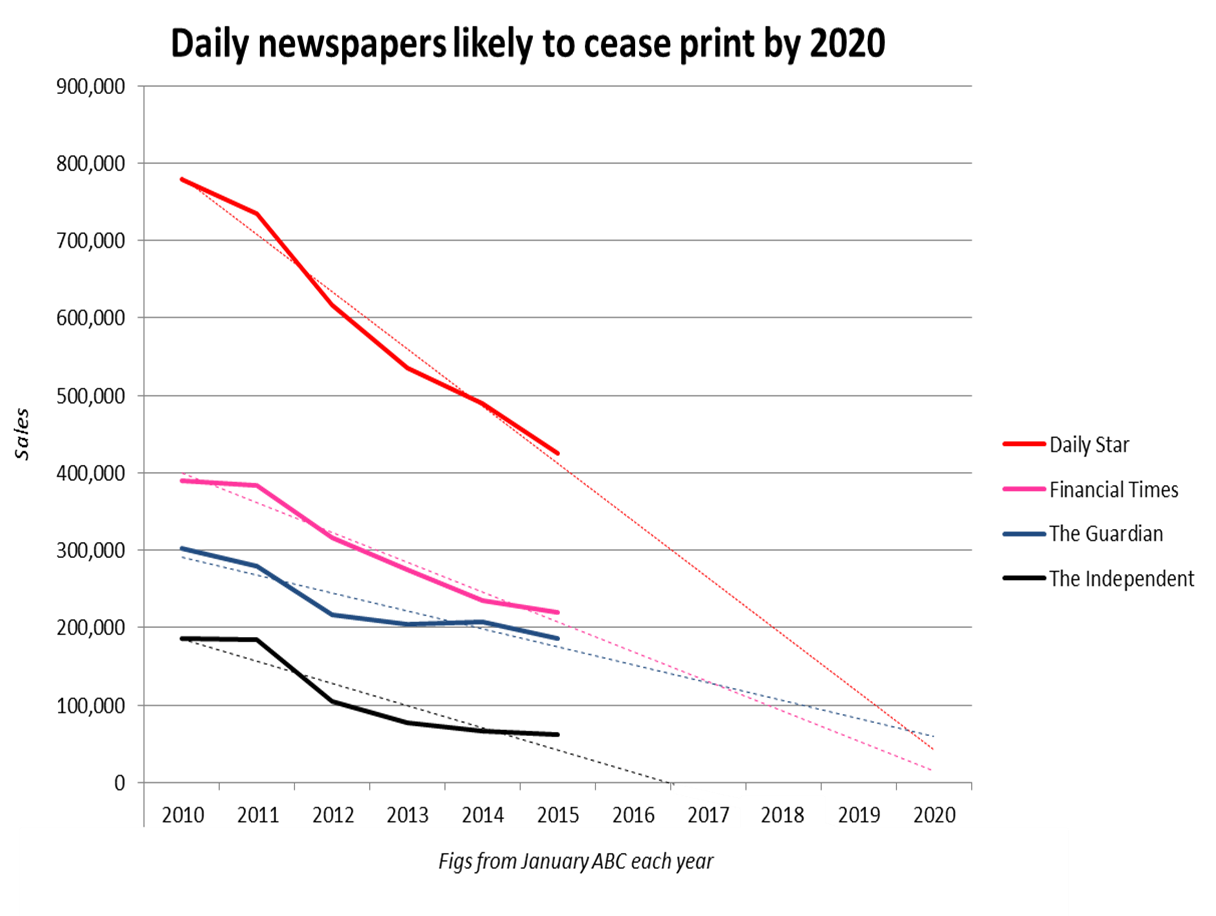
By 2020, if the trends established over the past five years continue, four out of 11 daily newspapers will likely have ceased print production.

Old certainties will crumble: the Sun will set – it will no longer have the biggest daily print circulation – and the Telegraph’s commanding lead as the most popular of the old broadsheets will almost entirely evaporate.

The papers likely to cease publication by 2020 are the Independent, the Guardian, the Financial Times and the Daily Star.

Dailies cease print 2020 v2

The Independent will probably be the first to end its print run. If the trend in print sales over the past five years continues, then it will literally run out of readers at the start of 2017.

This does not of course mean the Independent will cease to exist. It can continue online but unless the Lebedev family, or a new owner, is prepared to fund the print run of a paper that absolutely no-one buys, there will be no Independent newspaper in a couple of years.

Compared to the Independent, the Guardian seems relatively healthy. With 185,000 daily sales it still has a significant audience. However, by 2020 a combination of the high operating costs of print and declining sales will tip the balance towards the end of the physical newspaper.

Read the rest of this entry »

Facebook Twitter Digg Delicious StumbleUpon

UNCUT: The northern road to prime minister Miliband

09/03/2015, 01:09:09 PM

by Jonathan Todd

You wait an eternity for a female Cumbrian MP and then two seem set to come along at once. Lee Sherriff, Labour’s candidate in Carlisle, is regularly applauded in speeches by shadow ministers. Sue Hayman has more recently been selected by Labour to fight Workington, a seat the party has invariably held throughout its history.

Polling by Lord Ashcroft suggests that Sherriff is set to turn around the 853 majority of Conservative MP John Stevenson. Iain Dale also calls the seat narrowly for Labour. Assuming Labour suffer no Cumbrian losses, this would give Labour at least four of the six Cumbrian seats.

Labour faces tougher fights in Westmorland and Lonsdale, where Tim Farron defends a majority of over 12,000 for the Liberal Democrats, and Penrith and the Border, a Conservative citadel, granting Rory Stewart a majority of over 11,000. These seats have never been red and cover much of the Lake District National Park, which draws visitors from across the globe. The more Labour inclined seats have their charms but are less well travelled.

Stevenson is Carlisle’s first Conservative MP since Ronald Lewis won the seat back for Labour in 1964, the year Harold Wilson first became Prime Minister. In 1983, an unhappier general election year for Labour, the party’s commitment to unilateral nuclear disarmament allowed Cecil Franks, the Conservative candidate in Barrow and Furness, where the building of nuclear submarines has long been a major source of employment, to ask at every opportunity: “If Labour gets elected, what will the lads do on Monday?”

John Hutton defeated Franks for Labour in 1992, meaning that four of the six Cumbrian MPs again were Labour, but it took another five years for the government to become so too. If Sherriff were to win Carlisle, it might herald another period in which four of the six Cumbrian MPs are Labour but the government is not. Equally, Carlisle is the kind of seat to give Ed Miliband hope.

As average weekly earnings in Carlisle lag the average for Great Britain by around £120, it is a place where Labour’s cost of living focus is likely to have had resonance and decisions taken by the Tory-led government are unlikely to always have been well received. With diligent local campaigning, it should be possible to transfer this grievance with the government into support for Labour. A recent profile in the New Statesman indicates that Sherriff is providing such campaigning with aplomb.

Read the rest of this entry »

Facebook Twitter Digg Delicious StumbleUpon

GRASSROOTS: Just not good enough – a story of Labour selection

06/03/2015, 03:49:55 PM

by Paul Wheeler

I had an interesting conversation with a well connected Labour councillor recently. We both had an interest in a recent Parliamentary selection contest.

His preferred candidate won and it was clear why. He had the better website, he had been full time contacting members for months, he was bright, articulate and union sponsored. In fact he was so well organised he even got his supporting union to provide a breakfast to ensure his supporters turned up for the early morning selection meeting. As my new friend put it cruelly but accurately my preferred candidate ‘just wasn’t good enough’

And he was right. He ran a slip shod campaign with a pretty poor website and relied on old contacts and promises. All he had going for him was that he was born and bred in the constituency and as a leading councillor had helped turned the town around when everyone else had written it off.  Critically for a lot of new members to the area he hadn’t been to university and was therefore not ‘quite up to the job’ of being an MP.

Read the rest of this entry »

Facebook Twitter Digg Delicious StumbleUpon