




Posts Tagged ‘Atul Hatwal’

What Lord Ahmed’s suspension reveals about Labour’s relationship with minorities

17/04/2012, 11:36:15 AM

by Atul Hatwal

The Lord Ahmed affair neatly encapsulates Labour’s problem with minority communities. It illustrates the dangers of a decades old neo-colonial deal that the central party has concluded with several so-called community leaders.

This isn’t just an issue for the Muslim community, a trip to Leicester, Southall or Harrow would reveal similar arrangements with the Hindu and Sikh communities.

The key to the deal is votes. This is what the community leader brings to the table.

Ahmed has long been one of Labour’s gatekeepers to the Pakistani community in the north. His position in the early 1990s as one of Labour’s leading Muslim councillors combined with his links to Mirpur in Pakistan (where the vast majority of Pakistani migrants to the northern mill towns originally came from) made him a kingmaker across northern parliamentary seats with large Pakistani communities, particularly when it came to Labour candidate selections.

He sat atop the pyramid of biraderi or clan based community politics which traditionally delivered result-swinging vote banks, happily doing the bidding of the central machine for several years.

In return for these votes, the party bestows two privileges on the community leader: establishment legitimacy that distinguishes them from other local leaders and a free hand within their community to do what they will – as long as nothing bad leaks out into the national news.

In Ahmed’s case, Tony Blair elevated him to the peerage. Lord Ahmed was the nation’s first Muslim peer. The party coddled and respected him and asked few questions about what he said or did within the community.

Until of course news of his offer of a “bounty” on President Obama’s head surfaced. Within hours of the story hitting the news, as per the deal, he was in trouble.

But the reality is that Ahmed has held and espoused similar views for several years. In this particular instance, whether he did or did not say what is claimed about Obama is irrelevant. He should have been suspended and potentially expelled because he was sharing a platform with and supporting Hafeez Saeed: an international terrorist who heads Lashkar-e-Taiba, the group which killed over 150 people in the terror attack on Mumbai.

(more…)

Facebook Twitter Digg Delicious StumbleUpon

Livingstone’s scripted tears

13/04/2012, 08:00:54 AM

by Atul Hatwal

16/04/12 10.30 Update: Fair’s fair: it looks like the party press officer who told the Guardian that the PEB used actors, was wrong. We know that some weren’t and the Guardian piece was at least partially incorrect.

So the record needs to be set straight for this article. It looks likely that the people featured in the PEB weren’t professional actors, they were supporters. It is certainly the case that no-one has contradicted the Livingstone team’s contention that they were supporters.

But whether these were actors or carefully selected supporters, the central point of the piece remains the same: to cry in response to a video montage of your own supporters, reading your script , about how much they want you to be mayor, that you have already seen, is more Pyongyang than London.

13/04/12 10:51 Update: Well, there’s been quite the flap following this piece. The Livingstone campaign are resolutely denying that any of the people in the PEB are actors. This is the relevant section from the Guardian on which the article is based:

On Wednesday Ken Livingstone revealed his emotional side, sniffling at a launch of his new party political broadcast. “The people you saw on the screen represent hundreds of thousands of Londoners who desperately want a mayor who is going to make their life easier in this city,” Ken said, as Ed Miliband patted him on the back. For sure, the broadcast is slicker than anything his team has previously produced; it features a boxer, a groundsman, one posh woman and an extremely cute baby. But who exactly are they? The Labour party confessed yesterday that the Londoners are all actors – but actors who support Ken. Of the crying, it said: “It was very genuine. It really was.”

Clearly there has been some form of breakdown in communication between the Livingstone campaign and the Labour party press office. The issue at the heart of this article is authenticity. The key question is: were  the people in the PEB were scripted?

If their words were drafted by the campaign team then it is disingenuous to claim these are the authentic responses of ordinary Londoners that prompted a heartfelt reaction from Livingstone. If their words were their own, then patently that is more powerful.

At the moment it looks like team Ken are saying that people were scripted. We will update as we receive more information.

***

Another week, another new depth plumbed in the mayoral campaign.

In yesterday’s Guardian diary, there was a little snippet about Labour’s latest party election broadcast (PEB).

For those who haven’t seen it, the PEB is very effective. Engaging and well-paced, above all it shows rather than tells. It features Londoners speaking about their issues, directly into camera, edited tightly together. The climax at the end where they each ask Ken to win for them carries some real emotional weight.

I’m no fan of Labour’s candidate but even I was impressed.

Until, that is, I read the Guardian diary. This told me that the plaintive and persuasive Londoners were in fact all actors. Not a boxer, a mother, a groundsman or a businessman. Just actors, hired to do a job.  “Labour supporting actors” is how the party press office described them, as if this somehow helped.

This mini-revelation robs the PEB of its authenticity. It remains a very good piece of political communication, but watching the broadcast again, knowing that these folk were shipped in from London’s version of central casting, drains the emotion out of the piece.

Oh well. “Disappointing” was my take. And then I thought, “hang on.”

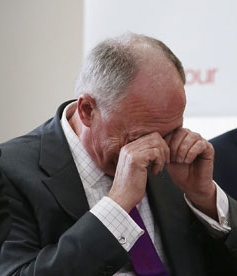
Most people will have seen this photo of Ken Livingstone, overcome by emotion, crying at the screening of his election broadcast.

At the time the explanation given to reporters was that Ken was moved by the genuine words of Londoners and the responsibility he felt to win the election for them.

Stirring stuff. Shame it was rubbish.

The actual situation in the room was this: Livingstone was crying after watching a series of actors that had been carefully selected by his team, read out lines that his writers had penned, in a style directed by his staff. He knew that these were not typical Londoners. He knew that this was his script.

But still the tears flowed.

(more…)

Facebook Twitter Digg Delicious StumbleUpon

The April shadow cabinet league

12/04/2012, 08:30:36 AM

by Atul Hatwal

It’s become a tedious holiday tradition: MPs tweeting about their various constituency appointments and local campaign meetings, furiously reassuring voters and party members that they are busy at work, despite the long parliamentary recess.

The world really doesn’t need another tweet telling us yet again about a “good reaction on the #Labour doorstep” and for Labour’s shadow cabinet, many (though not all) should just take their break with good grace – they have earned it.

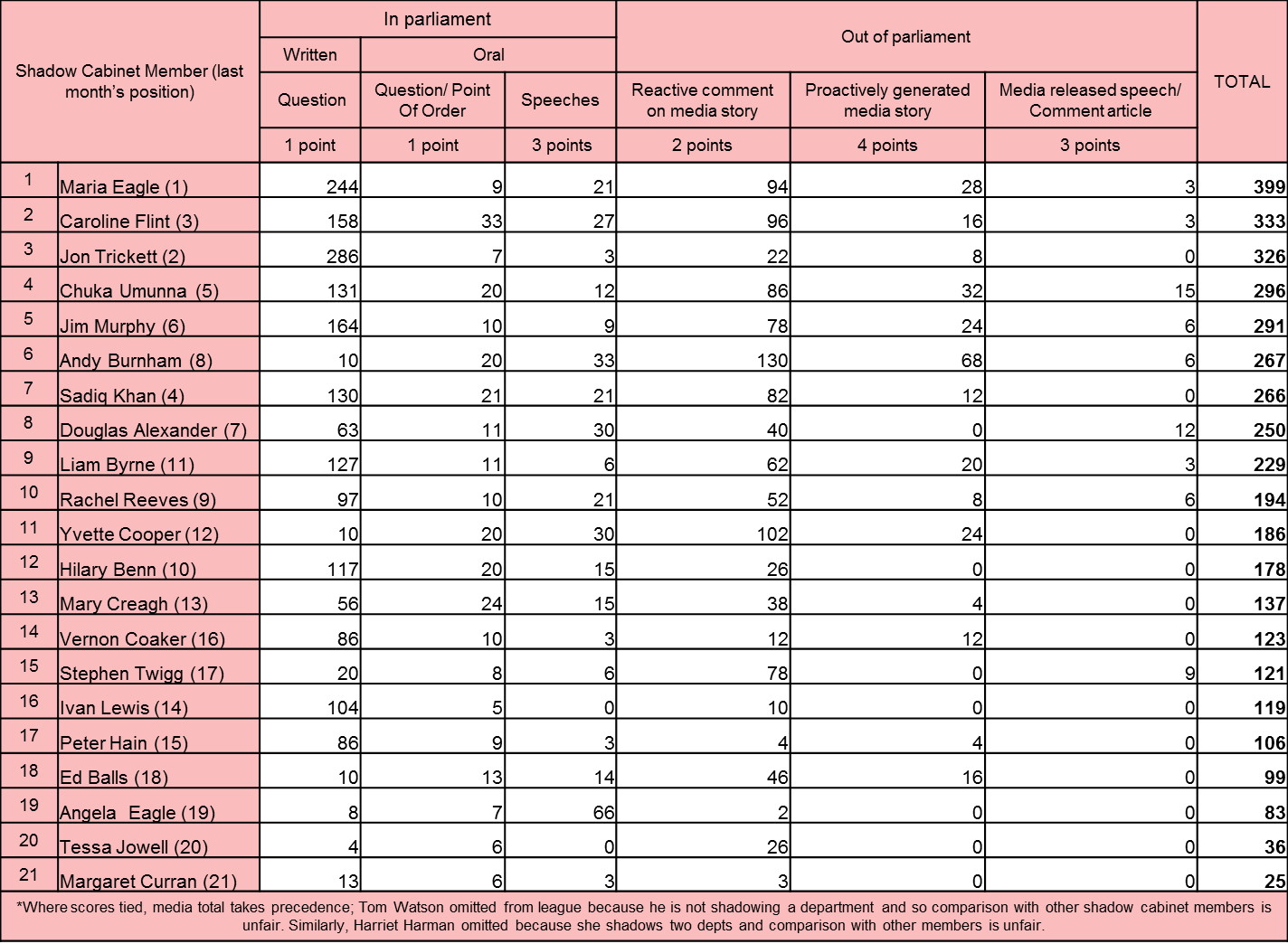
The first three months of this year have seen an unprecedented work rate: over 400 press releases, nearly 1000 written questions and almost 50 speeches from the despatch box.

Compared to last year, at this stage in the parliament, the shadow cabinet’s total score indicates a 54% hike in effort. In every category, the shadow cabinet has done more and worked harder.

While doubts will persist on the effectiveness of the party’s overall strategy, and Bradford West might be a prologue to greater disappointments in the May elections, it is hard to criticise the work ethic of many at Labour’s top table.

Since the last league in early February there has been a minor shuffling of the pack with three shadow cabinet members posting notable performances: Caroline Flint, Chuka Umunna and Andy Burnham.

(more…)

Facebook Twitter Digg Delicious StumbleUpon

Livingstone NIC-ed on tax avoidance

06/04/2012, 08:04:03 AM

by Atul Hatwal

The hand to hand combat of a mayoral campaign is hardly the ideal environment for sober reflection, but for the Labour party, it’s time to have a long hard think.

After yesterday’s partial release of the mayoral contenders’ tax and earnings details, there is now a threat that Ken Livingstone will not just lose the London election, but will seriously damage the national party in the process.

The full nature of this danger is not quite apparent yet. The media focus over the last 24hours has been on examining the total tax paid by each of the candidates, looking at who paid the most. This is understandable but misses the point.

The issue is not about the absolute amounts handed over to HMRC, but whether these figures demonstrate that the candidates have, or have not, lived up to their rhetoric.

It’s about trust, not finance and for one of Labour’s most high profile figures, who has volubly railed against tax avoidance, the figures are damning.

In 2010/11, setting aside pension contributions, Ken Livingstone received 92% of his income – £63,333 – through dividends and just 8% or £5,700 through a normal salary where tax was deducted on a pay as you earn (PAYE) basis.

This approach is a standard and perfectly legal way of drawing down money from a company and is used by hundreds of thousands of people for one simple reason: it avoids national insurance contributions (NICs).

Dividends are not liable for NICs, so being paid principally through dividends reduces or completely removes NICs payments.

In 2010/11 the threshold to start paying NICs was £5,720 per year and as if by magic, Ken Livingstone’s PAYE income for the year was £20 below the level where any NICs would have to be paid.

Fancy that.

The only reason £5,700 was paid as PAYE income at all is that that there needs to be a  level of PAYE earnings each year above a minimum threshold (£5,044 in 2010/11) to  build eligibility for certain benefits. For example, the state pension, for which Ken Livingstone qualified, during 2010/11.

Again, to be clear, this is not tax evasion, and it’s certainly not illegal, but avoiding NICs is tax avoidance for most voters.

(more…)

Facebook Twitter Digg Delicious StumbleUpon

Is this the beginning of the end for Ed Miliband?

30/03/2012, 07:55:37 AM

by Atul Hatwal

This morning it’s a cold new world. But as the shock passes and the harsh reality of George Galloway’s crushing victory begins to sink in, the questions will become louder and more insistent. Two in particular will dominate: How could this happen? And what does it mean for the leader?

The party briefers will try to box this result as a freak. They will cite the combined effect of the swing from Labour towards Respect among the British Pakistani community and the collapse in Tory vote as a localised one-off.

They will be wrong.

The vote demonstrates two critical points: first, hell will freeze over before large numbers of Tories switch to Labour. After the week the Tories have had, it’s not surprising their vote was down. But Labour picked up no Conservative switchers and remains toxic to swing voters.

The reality is, for too many people, Labour under Ed Miliband is not a viable alternative. The polls on leadership and economic competence have been unrelenting since he became leader.

Earlier this month the Guardian’s ICM poll placed David Cameron and George Osborne 17% ahead of Ed Miliband and Ed Balls on managing the economy 42% to 25%.  Meanwhile YouGov’s latest March figures on peoples’ preference to be prime minister had David Cameron 20% ahead of Ed Miliband 38% to 18% – that’s double the lead he held at the same point last year.

Second, the British Pakistani community has sent a clear signal to a party that has long taken their vote for granted: no more. Labour has spent two years since the general election agonising about Mrs.Duffy, Englishness and what are euphemistically called “white working class issues”. Well, congratulations, this is the result.

Simply cranking the handle on decaying community political machines and expecting the sheep to file through the pen will not work forever. When George Galloway condemned Labour’s use of “biraderi” or clan-based politics last night, he was right.

At some point Labour as a party will have to engage with its former ethnic minority supporters rather than just assume they will be there, regardless of whatever the party does.

But in one sense, there really is no excuse for such total and utter shock. This isn’t the first time that a feeling has taken hold in a formerly Labour supporting electorate that the party is no longer upto  leading or even interested in the local community.

What just happened in Bradford now happens in Scotland as a matter of course.  For Alex Salmond read George Galloway and the pattern begins to look a little more familiar.

(more…)

Facebook Twitter Digg Delicious StumbleUpon

The false debate over the public funding of politics

27/03/2012, 09:00:15 AM

by Atul Hatwal

Here’s a question: who is Labour’s biggest donor under Ed Miliband?

Is it Unite? Unison? Maybe the GMB?

Answer: none of the above.

An Uncut analysis of donations to the Labour party since Ed Miliband became leader reveals that the biggest single donor is the House of Commons, giving £9.6m. This so called “short money” is a stipend paid to the opposition to balance the advantage a government gains from the enormous resources of the civil service.

Roll in the funding the opposition receives from the House of Lords, the Scottish Parliament and grants from the Electoral Commission for policy development and Labour has banked almost £11.3m from public funding sources since October 2010. That’s more than the combined donations to the central party (as opposed to individual constituency parties) from the all of the unions.

This isn’t a recent a development either. A decade ago, when the Tories were at their nadir, what was their biggest source of funding? Was it Lord Ashcroft? Or a.n.other city gent, eager to run down his bank balance?

Of course not. In 2002 the total donations from individuals to the Tories came to £2.3m. In comparison the amount the Tories drew from public funds was nearly double at £4m.

These figures expose one of the myths in the political debate on funding – that the public will not accept state funding of politics.

Newsflash: they already have.

(more…)

Facebook Twitter Digg Delicious StumbleUpon

Ken Livingstone’s crumbling Labour flank

23/03/2012, 08:52:50 AM

by Atul Hatwal

Earlier this week YouGov released their latest London mayoral poll. While Boris Johnson’s 49%-41% lead on first preferences was widely reported, some of the most striking results were lost in the news vortex of the budget.

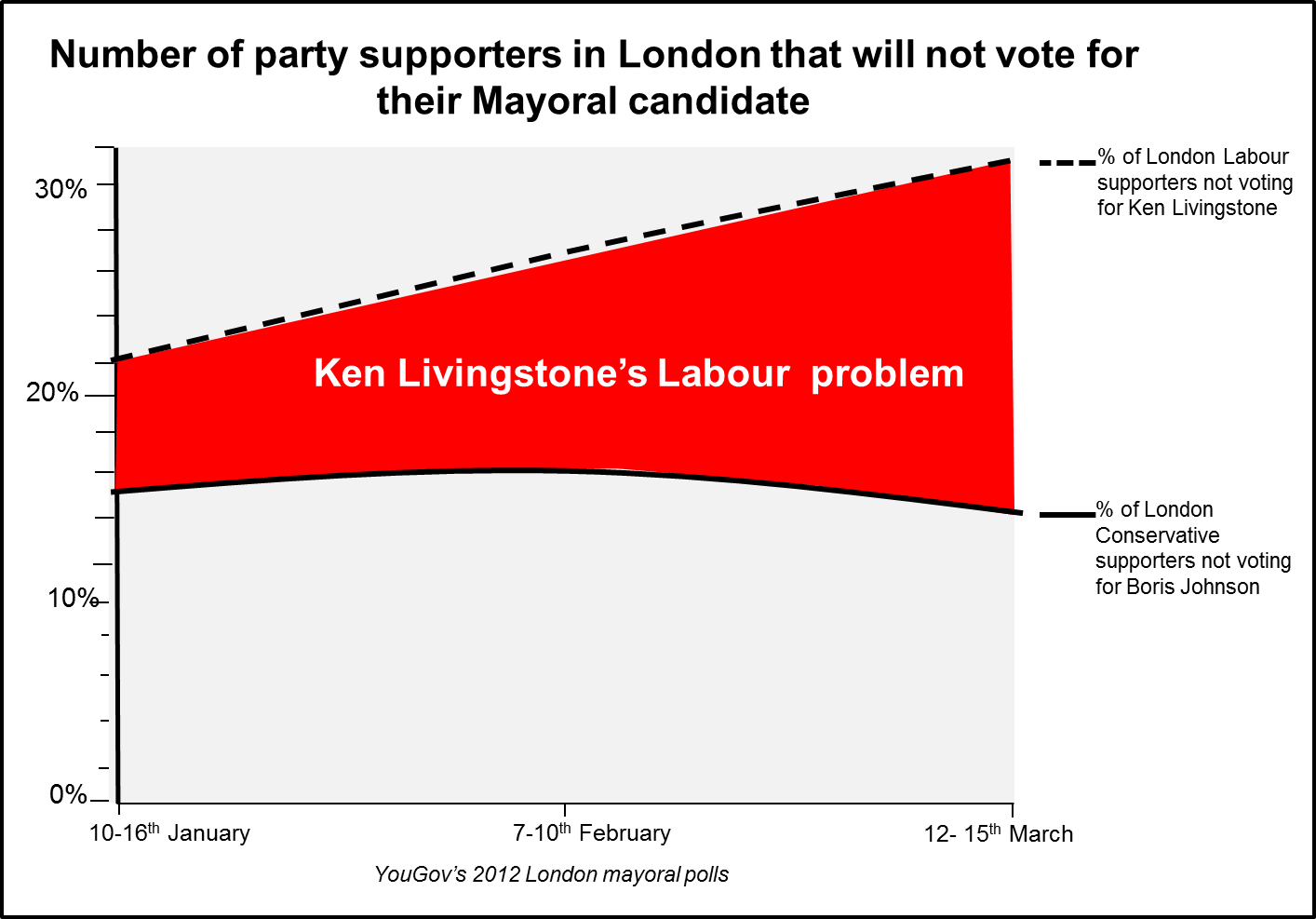
Chief among these is the scale of Ken Livingstone’s problem with Labour supporters: 31% say they will not vote for him in the mayoral election.

Just weeks before the election, almost 1 in 3 Labour supporters are refusing to back the party’s candidate for mayor.

In comparison, Boris Johnson’s core support is firmer. 86% of Conservative backers say they will vote for him with 14% either supporting other candidates or undecided.

The impact of this differential in party supporters’ commitment to their candidate is critical for the mayoral race: it translates into an 8% boost in Boris Johnson’s overall total.

And 8% is, coincidentally, the size of Johnson’s latest lead over Livingstone.

The bad news for Labour is that this problem has been building all year. The graph below shows how Ken Livingstone has progressively bled support from Labour backers while Johnson has consolidated his vote amongst Conservatives.

(more…)

Facebook Twitter Digg Delicious StumbleUpon

Budget preview: The polling that explains why George Osborne is cutting the 50p rate of tax

21/03/2012, 08:10:41 AM

by Atul Hatwal

When George Osborne steps up to the despatch box later he will publicly launch his campaign to be leader of the Conservative party.

David Cameron can breathe easy though. It will not be a throwback to the TB-GBs. Osborne’s real target will likely be shuffling about his city hall office, watching the TV coverage, thinking that he could do it all so much better.

Until now, Boris Johnson has been the darling of the Tory faithful. He shone at last year’s party conference, has repeatedly tweaked the prime minister’s nose on issues like cuts to policing and has been the king over the water to true blue believers who see too much yellow in the government.

In contrast, his rival to succeed David Cameron, has been conducting his campaign in stealth mode. But away from the bright lights of media scrutiny, in the corridors of Westminster, George Osborne has been very active.

If any evidence were needed, just speak to any first term Tory MP: Osborne has been almost indecent in courting the new intake into the parliamentary party.

The chancellor has deployed the full range blandishments: from hand written notes in the pigeon hole to invitations to select dinners, each and every member of the class of 2010 has had unbelievable amounts of personal attention lavished on them.

Team Osborne is confident that two years into government, they have the parliamentary vote locked up. For all of Boris’s grandstanding and media profile, few in the parliamentary party view him as a serious alternative to either David Cameron or George Osborne.

Recently, at a private dinner, one member of the 2010-ers went so far as to suggest that Osborne might even defeat Cameron in a vote amongst his contemporaries.

But that still leaves the blue rinse legions swooning for their blonde mop-topped heir apparent.

(more…)

Facebook Twitter Digg Delicious StumbleUpon

What the next few weeks have in store for Charles Allen

16/03/2012, 07:30:34 AM

by Atul Hatwal

Charles Allen, welcome to the spotlight. You might have thought you were already high profile, after all running ITV and EMI made you a fixture in the business pages. And your turn on Channel 4’s the Secret Millionaire was genuinely touching.

But all of that is as nothing compared to what you will experience as  chair of the Labour party’s executive board.

As you start your new role, you should be aware of the two pitfalls that perennially await ingénue businessmen keen to apply their acumen to the political world.

First, what works in business does not apply in politics. Second, the media are coming.

Politicians frequently muse about how good it would be to apply business practice to politics and improve efficiency. They do this because they have never worked in business, beyond perhaps a temporary sinecure in public affairs en route to a parliamentary seat.

Most politicians can barely run a bath, let alone any form of enterprise. Executive management as you understand it is almost non-existent. Just look at the how Labour party restructure has been managed so far.

But politicians are not an untalented breed and there’s a reason they have evolved in a particular way.

In business, all relationships are underpinned by money. Whether its shareholders and their dividends, employees and their wages or suppliers and their fees, power is held by the he or she who holds the purse strings.

In politics, most things that matter are based on goodwill.

(more…)

Facebook Twitter Digg Delicious StumbleUpon

How Labour has misread voters on the deficit

09/03/2012, 08:30:21 AM

by Atul Hatwal

On Tuesday, Ed Miliband did what should have been a good thing.

His speech on the need for a more active industrial policy was rooted in common sense. Ideas like a British bank tasked with expanding business lending are widely supported. And it was a neat idea to back an existing campaign by British manufacturers for a “made in Britain” label.

Although sceptics will always roll their eyes at a buy British campaign, the politics were right. Identifying the party with a business led initiative that had lots of businesses ready to talk positively about the proposal is a world away from “predators and producers”.

The government did their bit too, issuing a rebuttal comment that talked about the need for global trade and international business. The dividing line could not have been clearer – Labour backing British business while the government opened the next round of GATT negotiations with the public.

But despite receiving as warm a reception as he has enjoyed for an economic policy speech, what thanks did Ed Miliband get? Minutes after the applause he was fighting off a baying mob on Radio 5 live.

It was impossible not to feel sorry for him. The leader offered the usual platitudes about the scale of the task facing Labour, building up support slowly and getting a warm reception up and down the country. But it was just chaff.

What Ed Miliband reaped was in part the inevitable result of Labour’s economic strategy.

The last election was lost on the deficit. The electoral challenge for this parliament: which party is most trusted to reduce it.

In a way, Labour has understood this and developed a strategy that does indeed address the deficit.

Every press release issued by the economic team is rigorously consistent. The headline is almost always about poor growth with a clear causal link made in the story between growth, unemployment, reduced tax revenues and a worsening deficit.

Great. Job done, right?

(more…)

Facebook Twitter Digg Delicious StumbleUpon