


Posts Tagged ‘Atul Hatwal’

A closer look at Ed’s new chief of staff

23/12/2011, 12:30:46 PM

by Atul Hatwal

One of the longest running vacancies in politics was finally filled earlier this week. Over a year after he became leader, Ed Miliband has appointed a chief of staff: Tim Livesey.

The role of chief of staff is an essential part of the leader’s office. Part project manager, part adviser, wholly accountable for the smooth running of the leader’s world, whatever is going on, particularly if it’s going wrong, the buck stops with the chief of staff.

The billing for Tim Livesey is that he is a heavyweight appointment. He’s the man who will bring experience and assurance to the running of the team.

Following a difficult year with problems ranging from avoidable flurries such as the recent confusion around the departure of Ayesha Hazarika from PMQ preparation duties, to major misjudgements like that conference speech, a firmer hand on the tiller will clearly help.

Tim Livesey’s background seems to fit the bill. A high flying career in the foreign office, media experience as assistant press secretary to Tony Blair and the best part of a decade in the service of the Archbishop of Canterbury, principally running his PR operation, mean he has the type of broad experience required.

Using Livesey’s record to divine (so to speak) the type of advice he will give to the Labour leader, three incidents stand out.

First, his comments in a seminar about how politicians should present themselves in the media; second, the row over the church of England’s ham-fisted intervention on gay adoption; and third, his role in Rowan Williams’ controversial sharia law speech.

Just before Tony Blair left office, in one of his final speeches, he discussed the adverse impact of the media on public life. In a subsequent seminar, Tim Livesey was on the panel discussing this view.

(more…)

Facebook Twitter Digg Delicious StumbleUpon

The Feltham Fig Leaf

16/12/2011, 07:47:25 AM

by Atul Hatwal

It looks like 2011 is ending for Labour as it began, with a solid victory in a by-election. At the start of the year it was Oldham East and Saddleworth, and last night it was Feltham and Heston.

But although both Oldham and Feltham were strong performances for Labour, the similarities are superficial. The intervening months have fundamentally changed the context.

At the start of the year, the economic argument remained unresolved. Would the public back the Tories’ cuts when they saw them implemented? Or could Labour provide a more persuasive alternative.

Victory in Oldham in January bought the leadership some time to focus the party’s economic policy and make the case to the public.

Since then, Labour has set out its alternative, developing a distinct critique of the coalition and a very different economic prescription.

Eleven months on from Oldham, the choice has been made.

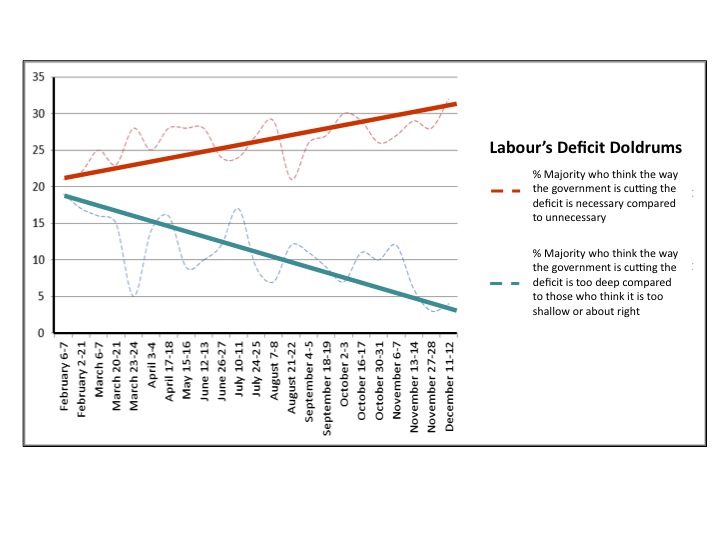
The graph above based on YouGov poll results shows just how badly Labour has lost the argument on the central economic issue – the deficit.

(more…)

Facebook Twitter Digg Delicious StumbleUpon

Labour needs to be an honest friend to the forces

09/12/2011, 11:38:44 AM

by Atul Hatwal

At the start of autumn, Uncut revealed that morale amongst the armed forces had plummeted, the first decline since the annual surveys began in 2007.

The obvious reason is the government’s bungled strategic security and defence review (SSDR). But as deep as the cuts to defence budgets are, and as badly as they have been managed by the MoD, the SSDR alone does not sufficiently explain the depth of the collapse in morale. There’s a missing element.

Context.

While in opposition the Tories turned a slogan, “backing our troops”, into the entirety of their party’s policy. General Dannat’s love-in with David Cameron was symptomatic of a military establishment that felt the Tories endorsed their world view and would act as a political arm of the defence chiefs of staff. (more…)

Facebook Twitter Digg Delicious StumbleUpon

November Shadow Cabinet League

02/12/2011, 09:06:45 AM

by Atul Hatwal

Have they put something in the tea at shadow cabinet meetings?

Because they seem to be a team transformed – in work ethic at least.

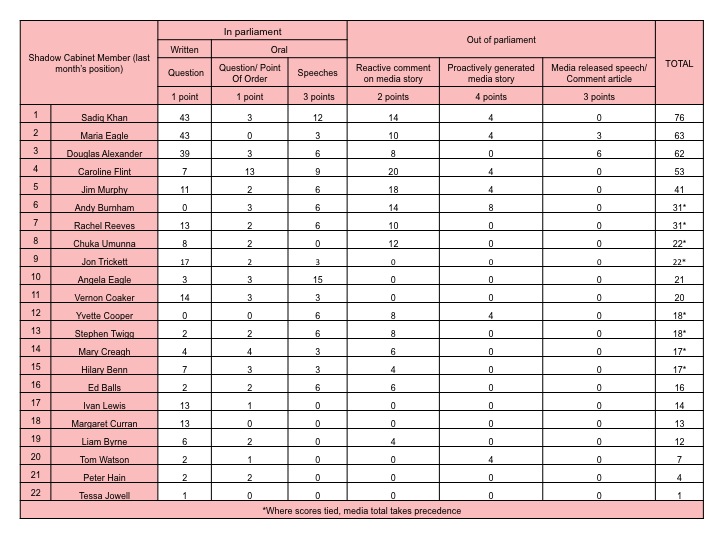
Despite doubts about Labour’s strategic positioning on the big issues, Ed Miliband’s new shadow secretaries of state have set about their task with a vigour not seen for months.

The days when Jim Murphy and Douglas Alexander gazed down on their colleagues from a distant summit appear to be past. Instead there is a genuine competition across the top ten with any and all capable of mounting a challenge for top spot.

(more…)

Facebook Twitter Digg Delicious StumbleUpon

Whatever happened to the Darling Plan?

25/11/2011, 09:55:28 AM

by Atul Hatwal

Ed Balls is walking into a trap. Unfortunately, it’s one he has set himself.

Next week George Osborne will deliver an autumn financial statement swathed in uncertainty and gloom for the government. So far, the questions from the media have focused on the chancellor’s forecasts and whether he will hit his deficit target, but at some point someone will ask Ed Balls those same questions about Labour’s plans.

Specifically, George Osborne, in the chamber, on Tuesday.

Ed Balls hasn’t mentioned the Darling plan in months, but based on what Labour’s frontbench have been saying and the party’s policy platform, we have a fair view of what Balls will set out.

Labour’s five point plan for growth defines our alternative approach. Out of five pledges, three are straight tax cuts – reversing January’s 2.5% rise in VAT, cutting VAT on home improvements and repairs to 5% and a one year national insurance tax break for small firms hiring new employees.

Given this, at the despatch box, Ed Balls will be promising growth from the tax cuts that will make-up the immediate revenue shortfall and increase economic activity so that unemployment falls, tax receipts go up and the deficit falls.

Quite a complex case with lots of links in the argument, but no numbers on either deficit totals or timelines.

(more…)

Facebook Twitter Digg Delicious StumbleUpon

The white collar crunch: unemployment rising fastest for senior execs

18/11/2011, 08:00:52 AM

by Atul Hatwal

The headlines this week were rightly dominated by the dismal news that youth unemployment crossed 1 million. But hidden amid the thousands of statistics released by the government, Uncut has uncovered figures that show a new and unexpected group beginning to feel the impact of the downturn.

Unemployment amongst senior executives has rocketed by 13% in the past year, significantly faster than the overall 7% rise in unemployment and even faster than the 12% rise in youth unemployment.

And while the increased unemployment rate for women has been in the news, in the top “managerial and senior official” category in the labour market figures its men who have been hit hardest.

Over the past year, unemployment amongst male senior executives went up by 14.3% while for women the rise was 10.7%.

At the other end of the job scale, levels of unemployment for unskilled workers rose, but by 4.6%, substantially below the headline average.  In the semi-skilled “process, plant and machine operative” category meanwhile, unemployment actually fell by 18.1% over the year.

Although the rise in absolute numbers of unemployed senior executives is comparatively small at 18,000 and their new unemployment rate of 3.3% is a world away from the 12.3% unemployment rate amongst unskilled workers, it will still potentially have disproportionately significant results.

(more…)

Facebook Twitter Digg Delicious StumbleUpon

Why the eurozone crisis is lethal to Labour

11/11/2011, 07:51:38 AM

by Atul Hatwal

The eurozone crisis is an unmitigated disaster.

I know, hardly breaking news. But I’m not talking about the impending threat to global capitalism. Worrying as it is, rivers of words have flowed on that topic. It’s Labour’s electoral prospects that are the concern here.

On the face of it, the crisis should have improved the party’s standing in relation to the Tories.

The government’s economic strategy is in shreds. Growth has been flatlining for months, domestic demand is anaemic and now the fate of the mythical export led recovery rests in the hands of reticent eurozone members who have demonstrated a singular inability to get ahead of the markets.

Many of Labour’s criticisms have been vindicated and now, of all times, the public should be taking a look at Labour as a realistic alternative.

But they’re not.

And the longer the crisis continues, the less likely that becomes.

For all the catastrophic implications of the crisis for the government and it’s economic approach, the underlying narrative of what is happening in the eurozone is kryptonite for Labour.

The common story running through all the tribulations on the continent is that the markets destroy countries with high public spending.

Regardless of the economic realities of the situation – we’re not Italy or Greece, never were, never would have been under Labour, and besides, we’re not in the euro – the crisis is confirming the visceral fear of runaway spending within the British voters’ psyche.

It’s why they voted the last Labour government out of office and is a fear that has since remained at the forefront of their considerations.

(more…)

Facebook Twitter Digg Delicious StumbleUpon

October shadow cabinet league table

04/11/2011, 09:09:24 AM

by Atul Hatwal

Back in June, based on a review of the first year’s performance in the shadow cabinet league, and the underlying politics of the party, I predicted four shadow cabinet exits – Meg Hillier, Anne Mckechin, Shaun Woodward and Tessa Jowell. Sure enough, the first three have departed, while Jowell has been moved down from Cabinet Office to shadow the Olympics and is expected to leave after the games next year.

The new shadow cabinet is four weeks old today. Contrary to Harold Wilson’s phrase, a week is not a long time in politics, and neither is a month. It takes years to build, or bring down, reputations.

Despite the anarchy at the top of the last Labour government over a period of years, Gordon Brown’s reputation for economic competence was remarkably resilient at the time. As is David Cameron’s despite his government’s economic record.

So the first month performance of the new shadow cabinet is unlikely to dramatically redefine the political landscape. But there are some hints at what the coming year might hold.

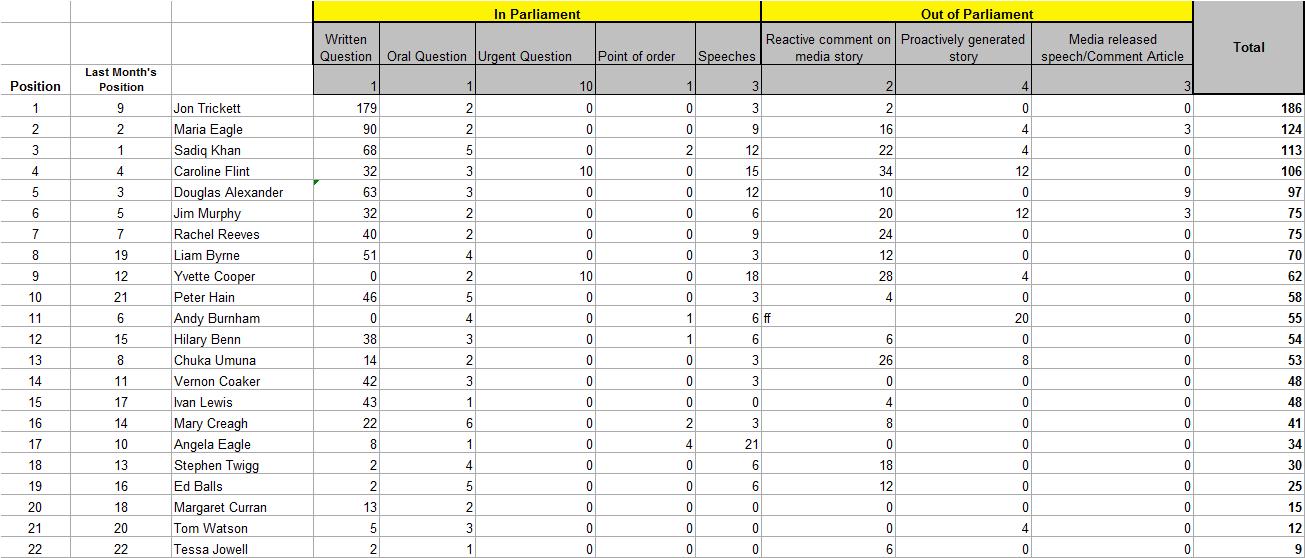
At the top, in amidst the familiar faces picking up from last term, Caroline Flint and Andy Burnham have pushed their way into the top six while three of the shadow cabinet newbies – Rachel Reeves, Chuka Umunna and Jon Trickett have staked out positions in the top ten.

(more…)

Facebook Twitter Digg Delicious StumbleUpon

Revealed: Migration cap to cost British universities £766 million per year in lost revenue and push up fees

14/10/2011, 09:39:41 AM

by Atul Hatwal

An analysis of the government’s latest higher education funding figures by Uncut reveals that British universities will lose £766m of revenue each year as a direct result of the government’s target to cut net migration below 100,000.

The cut will inevitably increase upwards pressure on fees for domestic students, according to academics.

David Cameron renewed his commitment to the target in his speech on immigration earlier this week and to achieve the government’s target of net migration in the tens of thousands, the government’s Migration Advisory Committee has identified the need for cuts of 60% in the numbers of foreign students.

Based on the current level of net migration, 239,000 per year, a reduction of 139,000 is needed to reduce net migration below 100,000, which would mean 83,400 fewer foreign students – 60% of 139,000.

Because of European law, the UK can only bar students from outside the EU which means non-EU students will bear the full brunt of the cuts.

New government figures reveal that last year non-EU students contributed £2.6bn in fees, over 30% of the total tuition fees budget. Based on these figures a cut of 83,400 would mean a revenue shortfall of £766 million per year.

If the government wanted to plug the shortfall through the tax system, this would involve tax increases equivalent to a hike in the higher rate of income tax by 1p.

Amongst the hardest hit by the revenue reduction will be some of the country’s leading universities which have the highest proportions of foreign students.

This includes the LSE, which has 65% foreign students, Imperial College with 40% foreign students and the University of Warwick with 28% foreign students.

The result of the cuts will be greater pressure to increase fees to the maximum.

Universities will typically charge foreign students fees that are several times the level that are charged to UK students, cross-subsidising costs for domestic students.

For example, a student wanting to study a physics degree at Imperial will be charged well over £20,000 per year. This is substantially more than the £9,000 tuition fees that British university students will pay at the top annual fee rate.

The cross-subsidy will have been factored into Universities’ calculations in setting fees. A senior academic at a top five university was blunt about the costs of their degrees,

“At £9,000, we don’t even cover our costs. The actual cost for a physics degree is £14,000. Without a cross-subsidy it isn’t going to work”

In contrast to the British stance, Australia recently changed its immigration policy to make it easier for its Universities to attract high-spending foreign students, particularly from India.

Similarly, the USA and Canada don’t include foreign students in their main immigration statistics that the political debate does not prevent their universities attracting valuable overseas students.

At a time when tuition fee budgets are already under pressure and several leading universities have already started pushing to lift the £9k cap, the cuts to foreign students will further destabilise higher education funding plans in Britain.

Atul Hatwal is associate editor of Labour Uncut.

Facebook Twitter Digg Delicious StumbleUpon

Apres le deluge – the political fall-out from the eurozone debacle

07/10/2011, 07:30:41 AM

by Atul Hatwal

It’s coming. Don’t say you weren’t warned. Peter Watt and Rob Marchant among others have been ringing the bell, but the gaze of Britain’s political class has been elsewhere.

Theresa May’s turn at Tory conference, as Mrs Slocombe, commanded more attention than the looming cataclysm. And now the shadow cabinet reshuffle is occupying Labour thoughts.

But as the eurozone ministers inch towards action, the shaking earth cannot be ignored for much longer.

In all of the furore around this rolling crisis, reams of newsprint have been written on the economics of the impending eurozone crash, but comparatively little on its political consequnces.

Yet it’s the political fall-out of this economic disaster which will utterly change Britain’s future.

Because after the eurozone finance ministers are finally driven to act, and the necessary billions are committed to securing eurozone, there will be a new European settlement.

The cost of Germany and France putting up the funds to save the euro will be pooled economic sovereignty in the eurozone, or more specifically a European bloc of 17 nations, where monetary and fiscal policy is run by the Franco-German alliance.

This will recast Europe and with it Britain’s economic prospects and security in three ways.

First, Britain will be vulnerable to increased eurozone protectionism, second the UK’s position as the preferred location for foreign direct investment in Europe will be threatened and third, Britain’s international defence commitments will likely need to be redrawn.

Protectionist voices have long been a central part of French economic policy.

Two years ago, the Sarkozy government received a formal slap on the wrist from the commission when one of its more hapless trade ministers admitted that Renault had shifted production of a model from Slovenia to France, in return for billions of euros of soft loans.

(more…)

Facebook Twitter Digg Delicious StumbleUpon