School’s out for summer and after a roller-coaster July its time to look back on performances over the past parliamentary year.
And as is traditional at the end of the season it’s time for some prizes.
Uncut is proud to be awarding prizes in four categories – 2010/11 league champion, top media performer, top House performer and most improved all round performer.
In keeping with Uncut’s Corinthian traditions, it’s not the monetary value of the prize that counts, but the popular recognition.
Handy, since this being a blog, these are virtual prizes and not worth a penny.
The wreckage of Rupert Murdoch’s empire floats in the political waters. MPs and journalists view a landscape transformed. But as the initial storm surge from hacking slows, Labour faces some tough new political choices.
Where next in the campaign?
By common consent Ed Miliband has had a good war. Should he now step back and let the Levenson Inquiry go about its business? Or should he keep on keeping on?
Around Miliband, two camps have rapidly emerged.
On one side are those advocating a Glee strategy – don’t stop believing.
If News International can be brought to its knees, what about the Daily Mail?
The Daily Mail is unique in eliciting the same reaction from Tony Blair and Alastair Campbell as the left of the Labour party. For this group, it is a once in a generation opportunity to fix one of Labour’s most implacable enemies and help create genuinely more open political debate.
The voices on this side of the divide include Ed Miliband’s base – his early and most enthusiastic supporters, new politics think-tankers and those yearning to move on from the technocratic managerialism of New Labour.
Belief is intoxicating. They want the moral crusade to keep rolling. This is the Ed they voted for.
On the other side are the old media hands. They have been out of their comfort zone for the past two weeks. Their world view involves dealing with the media to get Labour’s message across. War on News International was unthinkable ten days ago. War on the Daily Mail makes them feel ill.
Come what may, at some point, Labour is going to have to deal with the media.
The fall of News International might have taken them by surprise, but that doesn’t change the fundamentals of media management where some type of working relationship is essential, even with the enemy.
This group includes rafts of former advisers, members of the shadow cabinet and Labour-leaning journalists. It’s no coincidence that this nexus was also the source of Miliband’s recent leadership crisis.
But in the debate on resolving this dilemna, something’s been missing.
Neither camp has provided a cogent analysis as to why News International’s position collapsed so quickly. (more…)
For the moment, all eyes are on News International. Over the coming days, the focus will broaden as the political implications start to be fully felt.
At this stage, it’s difficult to tell definitively what the political fall-out will be, but one small political development has become apparent which will potentially have major consequences for Labour.
Note the position of the Lib Dems. They’ve staked out a distinctly more hawkish stance than Cameron, calling for tougher action, Rebekah Brooks’ resignation and a judge-led enquiry.
This follows on from a few weeks where Cameron and Clegg, last year’s political love birds, have been engaged in some seemingly sharper public exchanges.
The new mood was first evident on June 20th, when David Cameron subjected himself to the forensic questioning of Steve Wright in the afternoon on radio 2.
Out of the blue, he broke new political ground when he said that the Tories would have been tougher on immigration and welfare without the Lib Dems.
Apparently piqued, Clegg fired back two days later on his visit to Brazil saying that without the Tories the Lib Dems would have been tougher on the banks.
Looking at the change in tone, it’s easy to view this as a part of a linear process that starts with flowers in the Number 10 garden and ends in a bitter split. The New Statesman‘s Rafael Behr declared,
“With the prime minister now attacking his deputy openly on the radio, it’s clear that the early truce is over. How will the two parties convince voters that coalition is still a viable option for 2015“?
The Lib Dem position on hacking would seem to back this up. It has certainly been written up as such.
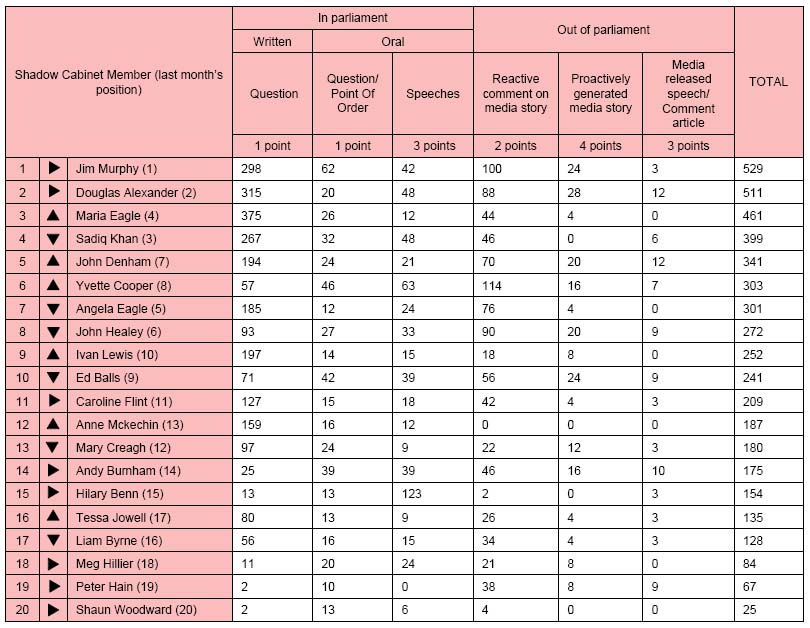
Murphy holds onto top spot but all eyes on the bottom as relegation comes closer
by Atul Hatwal
June saw Jim Murphy retain his position at the top of the league, albeit with a reduced lead as Douglas Alexander closed the gap between first and second. But the real interest lay in what was happening at the bottom following the news that the leadership intends to scrap shadow cabinet elections.
Assuming Ed Miliband’s writ runs, the prospect of relegation this year for shadow cabinet under-performers has suddenly become a real possibility.
It’s something that Uncut readers backed overwhelmingly last month with over 70% voting in favour of relegation before the next shadow cabinet elections. And it would certainly be peculiar for Miliband to fight for this change and then not use his new power.
In a resounding victory, Yvette Cooper’s Commons slap-down of Louise Mensch was Uncut readers’ choice for June’s shadow cabinet goal of the month. With 38% of the vote, Cooper was more than 17% ahead of Andy Burnham in second place who secured 21% of the vote.
Ed Balls was third with 18%, Tessa Jowell was fourth on 16% and Mary Creagh fifth on 8%.
Over the past year, Yvette Cooper has quietly established herself as one of the shadow cabinet’s true big beasts.
She has featured in two of the three goal of the month competitions so far, and has successfully defined the government as slashing frontline police services.
Readers pick from Balls, Burnham, Cooper, Creagh and Jowell for June’s title
After another month of shambolic Tory U-turns but without any perceptible Labour progress, both sides find themselves pretty much where they left off in May.
Although little has fundamentally changed in the electoral race, amidst the melee, there were some pointed moments from Labour. The five contenders for the goal of the month are, in alphabetical order, Ed Balls, Andy Burnham, Yvette Cooper, Mary Creagh and Tessa Jowell.
1. Balls doubles down on his plan for the deficit
The main Labour story in June was about Ed Miliband’s leadership. It sucked up so much media oxygen that a fundamental shift in Labour’s approach on the economy was largely over-shadowed.
On the 16th June, Ed Balls gave a speech at the LSE where he committed Labour to a multi-billion pound tax cut by temporarily reversing the VAT rise.
It’s a bold move. And the logic is clear. Poor economic figures and anaemic growth are pointing the way potentially to a Greek tragedy.
But it is a gamble.
The polls show persistent public mistrust of Labour on the finances. Many of Balls’ colleagues in the shadow cabinet are deeply uneasy or opposed. And the Tories now have a new £51bn spending black-hole attack-line on Labour.
If the cuts aren’t terminal and the UK economy does recover, even slowly, then the cost of the gamble in terms of public confidence in Labour’s economic competence will be high.
If the economy does sink into years of coma and the government is driven to take measures to jump-start growth, Balls will assume St.Vincent of Twickenham’s title as politics’ economic sage.
What is not in doubt is that this is defining moment for Labour.
2. Andy Burnham teaches the Dept forEducation to count
Each month brings another gaffe from the Department for Education. In June it was slipshod accounting with serial over-payments to Academies.
Burnham’s delivery combines his usual eloquence and authenticity. But it is the substance of his point that is most striking.
Without proper accounting, the whole cuts programme is purely an academic exercise. Plans will remain just that, completely disconnected from reality. It’s a systemic flaw in the way the department for Education operates which will generate several more urgent questions in the future.
Although Burnham is palpably frustrated with the department’s incompetence and Gove’s insouciance in not even bothering to attend proceedings, he is laying important groundwork.
Each time an urgent question lands, a little more credibility ebbs away from the Department. In the end, a tipping point will be reached and the state of constant political meltdown which engulfed the Home Office in the last Labour government will come to Education.
That faint squeal of tyres and slight waft of burning rubber – the hallmarks of a minister struggling to keep their policy on the road.
And now we wait for the noise to get louder, the smell more pungent, until the minister gives-in to the sliding chaos of another U-turn.
The latest threat to political pedestrians maybe a little while before it careens across the news pages, but it’s only a matter of time.
The Tory migration cap might get re-branded, re-engineered into a broad range of metrics and turned into an elasticated party hat, but the target of net migration in “the tens of thousands”, will ultimately go the same way as the NHS reforms, forest privatisation and weekly bin collections.
So far, Theresa May has been one of the quiet successes in the government, escaping relatively lightly in the gaffe stakes. She’s remained safe largely by moving slowly and not trying to reform every single piece of departmental policy within 10 minutes of arriving.
But with the migration cap, May has one of those too-good-to-be-true policies. A Jimmy Choo initiative that looked so alluring in the manifesto shop window that the Tories had to have it. But now, in government, somehow the shoe doesn’t fit, no matter what May does.
This week saw the first signs of the U-turn to come.
On Tuesday, the home secretary announced that the net numbers of foreign students in the UK would be reduced by 52,000 per year. On the face of it a major cut and a big step towards achieving the government’s target.
Except that in March, the reduction was going to be 100,000 per year.
On Sunday, Ed Balls re-launched his proposals for a £2bn tax on bankers’ bonuses to fund action on youth unemployment and a new house building programme.
Politically, the policy draws exactly the right dividing lines. Greedy bankers versus young unemployed and aspiring home-owners.
In economic terms, it focuses funds just where they are needed, helping reduce the costs of economic failure and getting the housing market moving again.
And by putting down amendments to the finance bill, Balls will ensure a parliamentary vote on the plan, giving the opportunity to pressure individual Tory and Lib Dem MPs and expose whose side they are really on.
The initiative has all the elements of a policy which could cut through the white noise of political debate to resonate with the public.
But it hasn’t.
Not that there was anything wrong with the proposals. Or the media coverage. The public just don’t seem to be listening, much as when the proposals were originally launched in March.
In his Q&A session at the GMB conference on Monday, rather than being on the front foot, Balls had to explain why Labour wasn’t doing better in the polls.
Can you hear it? That creaking, grinding metallic sound, emanating from the capital.
Even faintly in the background?
No? Well, it will get louder in the coming months till it’s deafening.
It is the sound of the clock being turned back twenty years to a time when London was a Tory town.
Labour might have lost the 2010 general election, but London remained a last redoubt in the south. Despite all the troubles, Labour was still the dominant party, winning 36.6% compared to the Tories on 34.5% and the Lib Dems on 22.1%.
In terms of seats, the result was even better with Labour taking 38 seats, the Tories 28 seats and the Lib Dems just 7 seats.
But that was then and a year is an eternity in politics.
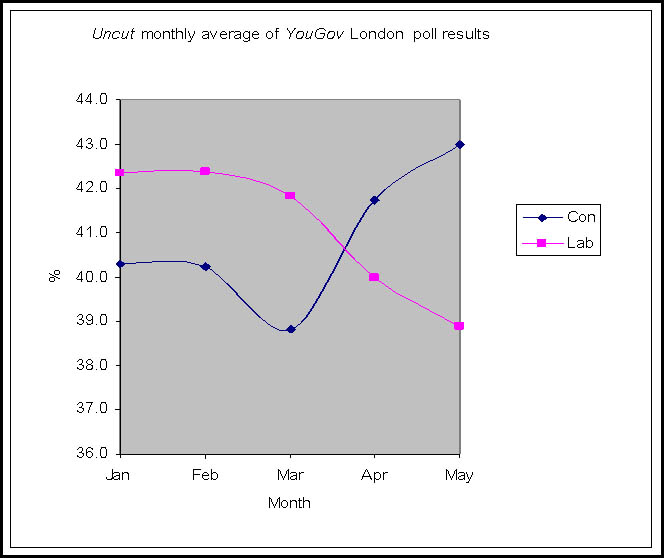
2011 could go down as the year in which the Tories turned back a generation of Labour ascendancy in London and pulled decisively ahead.
A new Uncut analysis of YouGov polling shows how a Labour lead of 2% in January had become a deficit of 4% by the start of June.
Polls can be deceptive and there is always a debate to be had about the extent to which they really reflect voting intentions, but two factors make these figures particularly worrying for Labour.
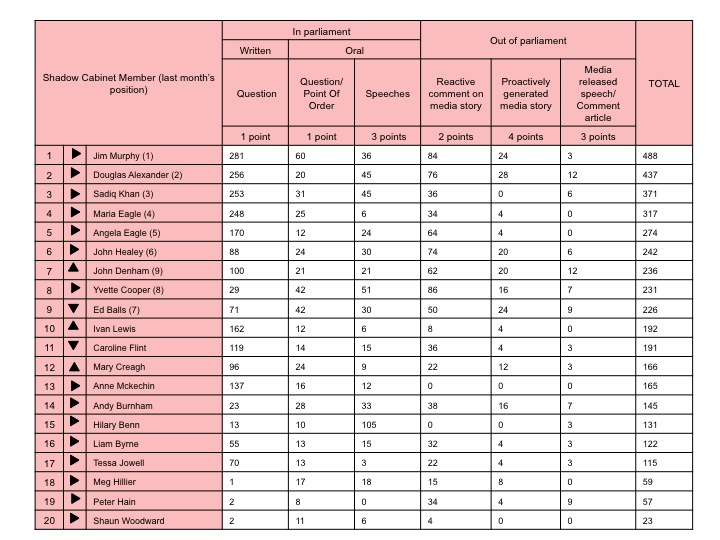
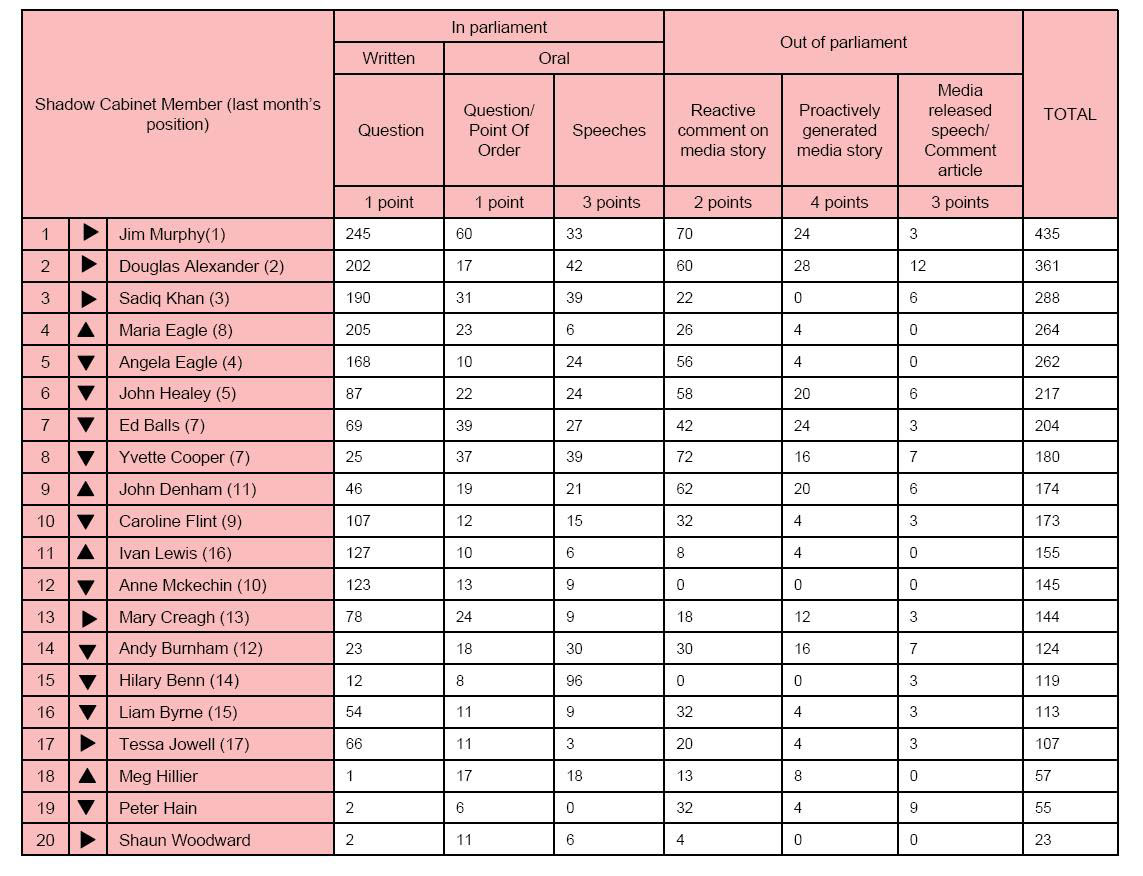
Bottom three adrift as Uncut readers vote on whether there should be relegation from the shadow cabinet
Jim Murphy has opened up a commanding lead over Douglas Alexander at the top of the league. Following a month in which he landed yet another urgent question and was a fixture in the media, there is now a gap of 74 points between first and second.
?
The gap is all the bigger because of an uncharacteristically quiet month for Alexander. For the first time since the shadow cabinet was formed, he didn’t put out a single press release in the month. Based on his performance in May, Alexander was the eighth hardest working member of the shadow cabinet.
He has never been this low in a monthly ranking.
It’s too early to tell whether this is the start of a decline in his work rate, but with the conflict in Libya, upheaval in the Middle East and the Taliban’s summer offensive underway, this is hardly time for a dip in activity.
In third, Sadiq Khan posted another solid month. He stepped up his media output, issuing four press releases, double the number of any previous month. In previous months, this media profile has been a weakness for Khan. Increased press work will help establish him as a major Labour figure in his own right, beyond having been Ed Miliband’s leadership campaign manager.
But, for Khan, there were areas for improvement that highlighted the difference between being third and what it takes to be number one. (more…)