Posts Tagged ‘Ed Miliband’

Uncut poll reveals public blame last Labour government, not Tories, for today’s benefits bill

12/09/2013, 09:55:29 PM

by Kevin Meagher

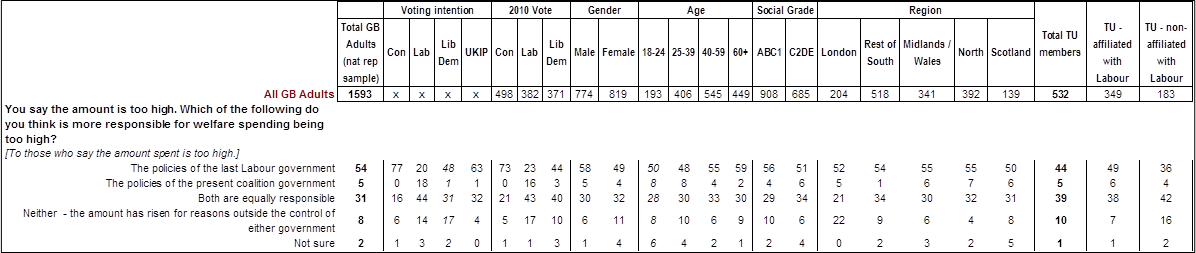
In raw political terms, the fact that voters hold Labour accountable by a margin of ten to one for the size of the benefits bill is about as about politically toxic as it gets.

The poll finding, in our forthcoming pamphlet “Labour’s manifesto uncut: How to win in 2015 and why”, shows the scale of Labour’s real challenge, underneath its broad opinion poll lead.

Over half of those who think welfare spending is too high (54 per cent) blame Labour, with only five per cent pointing the finger at the coalition.

Meanwhile 45 per cent trust Cameron to control welfare spending and prevent it rising out of control, compared to 14 per cent who back Ed Miliband.

This gap goes to the heart of Labour’s credibility as a party of government, so narrowing it must be a strategic priority.

(more…)

Facebook Twitter Digg Delicious StumbleUpon

Exclusive Uncut poll reveals trade union members overwhelmingly back Ed on reform

08/09/2013, 09:55:24 PM

by Rob Marchant

As delegates gather in Bournemouth for the Trades Union Congress, one subject will surely be a major topic of conversation for delegates from the larger unions: the future of their relationship with the Labour party.

While the relationship between the party leader and the leaders of the main unions has never been easy for either side, it is safe to say that relations are at a turning point in their 113 year-old marriage. As things stand, a smooth and trouble-free conference season seems an increasingly remote prospect.

To recap, the disastrous selection process for Labour’s parliamentary candidate for Falkirk West, where allegations of malpractice triggered the resignation of Tom Watson MP as its election campaign coordinator – and which even now is subject to wildly differing versions of events – has kicked off a wholesale reform programme of everything from party funding to MP candidate selection and conference voting.

Then, last Friday night on the eve of the TUC, the party suddenly accepted that no wrongdoing had taken place. Simultaneously, candidate Karie Murphy – Watson’s office manager and friend of Len McCluskey, general secretary of the Unite union – pulled out, in what seemed almost certain to be some kind of deal, after threats that Unite could boycott the party’s conference later this month.

Although McCluskey, perhaps somewhat unexpectedly, accepted the principle of reform of the union link from the outset, one wonders if this stance will continue. And other union leaders have been notably less enthusiastic.

The GMB responded last Monday by announcing a cut in affiliation fees of almost 90%, estimating that only around a tenth of current levy-paying members would sign up.

(more…)

Facebook Twitter Digg Delicious StumbleUpon

Syria: the hangover

04/09/2013, 12:48:08 PM

by Rob Marchant

If Westminster is often a bubble, on frenzied days like last Thursday it becomes even more so. Everyone is waiting for the latest news. What can easily happen, and what seems to have, is for Parliament to forget about the world outside entirely until it is over.

As the Telegraph reports, some Labour MPs, as they left the parliamentary lobby giddy with unexpected victory, were rudely jolted back to reality by pictures of Syrian victims of incendiary bombs, as a reminder of what had just collectively been achieved by voting down intervention, without necessarily meaning to. The hangover had begun.

It is particularly easy to miss the impact of such things in the wider party, the decent people who organise raffles and knock on doors. Over the weekend, I was in touch with two centre-left colleagues (and no, neither was Dan Hodges), one of whom was seriously considering leaving a party of which he had not only been a member for a generation, but had worked for during more than a decade.

The other would have resigned, but it was Saturday and she couldn’t get through to the membership department. Another typical story from one young member leaving is blogged here.

The consequence of Thursday, it seems, is now a leakage of the very centrist common sense the party so badly needs. Perhaps there would have been even more from the left, should Miliband have opted for intervention. We will never know.

When you make a tough decision on a touchstone issue, there is always the risk that you will lose people to the left or right. That’s politics. Miliband’s apparent instinct is firstly to stake out a position more or less in the political middle of his party and tack slightly from it this way and that, to try and keep the party together. We might argue that perhaps it would be better to stand still, but ok.

But it seems that – unless something happens which truly threatens the party and its leadership, like the battle with Unite – in that last moment when he is finally forced to jump one way or the other, one cannot help but feel the instinct is always to rabbit-run to the left.

And that in itself might be understandable to many, were it not for the way that the jump was made in this case. A last-minute change of mind, after Cameron’s meek acceptance of all Labour’s conditions, led to a breakdown of trust which seems to have torpedoed the idea of intervention altogether, quite probably permanently.

We might be on one side of this debate or the other, but what we cannot pretend is that something minor has just happened. That it is an inflection point in Miliband’s leadership, and in British politics, is undeniable (it is, after all, the first time a vote has been lost on a matter of national defence in over two centuries).

(more…)
Facebook Twitter Digg Delicious StumbleUpon

There’s more to helping Syria than air strikes

02/09/2013, 12:37:09 PM

by Lee Butcher

Parliament has spoken. Cameron’s rushed attempt to convince the nation of the need for intervention in Syria has failed. The reason and culprits will be debated for a long time to come yet. Whether intended or not a signal has been sent out to our international partners that if they want our support they are going to have to provide compelling reasons for doing so; in failing to do so Barack Obama and David Cameron have damaged their cause, for that they only have themselves to blame.

While I will not dwell on the possible reasons for the failure of that vote, the issue of chemical weapons is worth briefly addressing if for no other reason but to question the consensus that something must be done because of their use. The talk of the near century old norm to stop their use rests on rather dubious historical ground. A recent and notable example is Britain’s support for Saddam Hussein during his war with Iran between 1980 and 1988, a period which saw him deploy large scale chemical attacks against the Iranians and against civilians in Halabja.

As cynical as that policy was there is little evidence that it was followed by a sudden outburst of chemical weapons use by other powers because we failed to oppose him. On the moral grounds of action, it is worth questioning a morality which regards being killed by a bullet or a bomb (a cause of death responsible for over 100,000 people) as being better than being gassed. This is something which the supporters of this action will have to address themselves. As far as helping potential chemical victims, an alternative suggestion worth considering can be seen in this opinion piece from the New Scientist magazine.

The Labour party ought to now consider where next for engagement with the Syrian crisis and what Plan B from the government we can support. In seeking a limited response to the use of chemical weapons the government have opened up heartfelt moral concerns about the on-going suffering in Syria. Those who have voiced such concerns must realise last week’s vote, even if won, would not have addressed them. Their concerns inevitably widen our view on the crisis.

The government, Ed Miliband and Douglas Alexander should embrace this new found interest in Syria. Now that military options are limited we should see this as an opportunity to focus our minds on what else can be done for the Syrian people. If that occurs last week’s vote may well have a positive outcome for Syria.

(more…)

Facebook Twitter Digg Delicious StumbleUpon

Only Miliband can now lead Britain on Syria

30/08/2013, 12:00:35 PM

by Jonathan Todd

All changed, changed utterly. If politics is trench warfare, advancement by inch, especially now with our major parties seemingly so entrenched in their political and socio-economic citadels, with their safe seats and ideological comfort zones, then last night was a moment when the terrain dramatically shifted.

Ed Miliband led the Labour party out from behind the ghosts of Iraq. What emerges, however, is not a pacifist party. At the same time, the prime minister lost control of his most fundamental responsibility. “The people have spoken, the bastards,” he might lament.

The awful truth is that UKIP remain the party with a position closest to most of these people. Which is that we should stay completely out of a quarrel in a far-away country between people of whom we know nothing. There may be some who mistakenly think that this is Labour’s position.

The party’s position was, however, clearly set out in the 5 points that Miliband emailed to party members last night:

1.) We must let the UN weapons inspectors do their work and report to the UN Secretary Council;

2.) There must be compelling and internationally-recognised evidence that the Syrian regime was responsible for the chemical weapons attacks;

3.) The UN Security Council should debate and vote on the weapons inspectors’ findings and other evidence. This is the highest forum of the world’s most important multilateral body and we must take it seriously;

4.) There must be a clear legal basis in international law for taking military action to protect the Syrian people;

5.) Any military action must be time limited, it must have precise and achievable objectives and it must have regard for the consequences of the future impact on the region.

(more…)

Facebook Twitter Digg Delicious StumbleUpon

Ed gets it: the red line matters – but so does international legitimacy

29/08/2013, 08:34:51 AM

by Jonathan Todd

Daniel Finkelstein in the Times yesterday quoted Andrew Tabler, a Syrian expert, as saying: “What happens (in Syria) will not stay there.” Which makes it imperative that as large an international coalition as possible is built behind the evidence that the Assad regime used chemical weapons against its own people, constituting a violation of international law that must be punished.

This must not be Barack Obama “shooting an elephant” – the George Orwell analogy employed by Stephen Walt: the strong doing something only because it is expected. It must be the world coming together to protect the weak: those that have been gassed by Assad and those who may have WMD used against them by tyrants in future.

It is incontrovertible that an attack has occurred. It also seems highly likely that the Assad regime carried out this attack. Finkelstein is right that if this breach of the established red line passes without consequence, a green light is given to other evils. Iran and all world-be oppressors would note.

Enforcing that red line is vital. But so is enforcing it in the right way. Transparently drawing upon robust evidence, UN process and established precedent, to build both a watertight legal case against Assad and one that motivates wide support for the actions that follow. Failing to do this would degrade international law and weaken the capacity of the UK and our allies to positively influence the future of Syria and the wider region.

Under a scenario where the US and her supporters retaliate against Assad before UN processes have run their course, they would do so without the support of Russia, China and Middle Eastern states that might otherwise be brought on side. Whatever strikes are executed would be unlikely to remove Assad from power – and may do relatively little to undermine his capacities, while fortifying the resolve of his supporters and backers to resist The Great Satan. Hezbollah may well attack Israel. Western interests would crash under the force of the Electronic Syrian Army. Assad would launch further attacks against his own people – whether using WMD or not.

What would the US then do?

(more…)

Facebook Twitter Digg Delicious StumbleUpon

Ed is right to wait on policy, fixed term parliaments have changed the rhythm of politics

27/08/2013, 07:00:29 AM

by Ian Moss

In the summer of 2007 regional offices of the Labour party distributed leaflets to its constituencies and held briefing meetings with ward organisers to discuss the campaign plan for the forthcoming general election. Gordon Brown and his team kept open the possibility of going to the country whilst torturing themselves internally on whether to take the risk only two years into the third term Labour government.

As we all know this event is now commonly known as ‘the election that never was’. The point of regurgitating the painful memories of that story for everyone who watched it slowly reach its inevitable denouement is to emphasise one simple point: before the Fixed Term Parliaments Act of 2011 not even the government knew when the election was going to be and they were the ones that had the power to call it.

The Act has changed the rhythm of politics. At this time in the political cycle the government and opposition used to be playing a game of chicken over the election. Will they go the full term? Will they call early? How is the economic cycle looking? etc. etc. Instead, pretty much every major figure in politics went on a good long holiday.

This was sensible and calculated. They all know the election is in 2015, they all know next summer they will be in the middle of the long slog of a campaign that will last more than a year, starting in the autumn, and they all want to make sure they had a good break this summer so they can be prepared for it.

Why not?  The voters are switched off for the summer as well, and the political campaign over August is really an absurd prisoner’s dilemma. Every party thinks they have to do it because the other parties are. Every year the political parties spend their summers boxing shadows, or each other.  Every cabinet minister knows that this time next year they will be expected not to leave the country, to be on call, and to be attending campaign events across the UK.

(more…)

Facebook Twitter Digg Delicious StumbleUpon

What is the point of today’s Labour party?

21/08/2013, 10:01:17 AM

by Dan McCurry

Way back in 1992, at the TUC conference, John Prescott stunned the socialist movement, by making a forceful speech in favour of John Smith’s proposed trade union reform. He attacked the unions for even questioning the motives of the Labour leader. He shamed them into submission. He showed that his loyalty is to the party over the unions and as a result, was rewarded with the deputy leadership when Tony Blair later rose to power.

He is the closest thing there is to Labour party royalty, and he just accused the party leader of being ineffective. This is not unreasonable. Everywhere I look I see the government’s economic policy being attacked. The Economist magazine calls the right to buy policy “A daft new government-subsidy scheme”, but what did we hear from Labour? Nothing. Not a dickie bird.

Look at the way the non-aligned commentators judge Osborne’s policy. Here’s Frances Coppola, an economics blogger, and academic of the Cass business school,

As my regular readers know, I am determinedly politically non-aligned, so what I am going to say now will probably shock a lot of people. Osborne’s behaviour both angers and frightens me. He is playing brinkmanship with the UK economy to achieve political ends. Nothing he does makes much sense from an economic point of view – which is why the flagship Help to Buy scheme has been universally panned, even by his own department and by people from his own party. But if you view his actions as entirely determined by his desire to secure a Conservative victory in 2015, it all makes perfect sense. He is dangerous.

(more…)

Facebook Twitter Digg Delicious StumbleUpon

As the party looks forward to conference season, there’s unfinished business over Falkirk

07/08/2013, 08:20:23 PM

by Rob Marchant

There is a distant rumbling going on within the labour movement, with parliament in recess and the media in silly season, which will surely last until conference. It may, in fact, last until next Spring’s special conference. Or it may even last until the next general election.

Perhaps thanks to the timely intervention of the summer holidays, the media circus seems to have moved on from the Falkirk selection debacle.

But not so fast. This one will continue to rumble, and the reason is simple: we have ended the current chapter with two poles of the Labour party power structure effectively giving diametrically opposing versions of events, and both cannot be right.

This uneasy truce is neither sustainable in the long-term – truth will invariably out – nor making for anything like a trusting relationship in the near future.

To recap: Miliband has supported his party organisation, who seem to be telling him that Unite made moves to fix the selection. Len McCluskey, on the other hand, denies any wrongdoing whatsoever on the part of his union. He, along with various other party figures, is asking for the report of the party’s internal investigation to be published.

This is in spite of the fact that some clear facts are known: that people were signed up as party members without their knowledge and that the clear beneficiary was Karie Murphy, described by Channel 4 as a “close friend” of McCluskey and office manager to Tom Watson MP, his friend and former flatmate. The chair of Unite in Scotland, Stephen Deans, also happened to be, very handily, the chair of Falkirk West constituency Labour party.

We may never know the full contents of that report; if it has not been published or leaked by now, it seems pretty likely that it never will be. It is also completely understandable why: it would very likely cause a massive and unwanted row between the two sides.

Miliband is stuck. One cannot help speculating that McCluskey is perhaps only calling for it to be published out of pure brinkmanship, because he knows that Miliband will not do it. But whatever the answer, the report itself is now key.

In the midst of all of this, BBC Radio 4 made a rather intriguing recent programme called “Fight over Falkirk”. Intriguing because its “storm in a teacup” conclusion seemed to go directly against what insiders have been saying for weeks.

The three key BBC claims were: one, that at least some of irregularities were not down to recruitment through Unite’s Union Join scheme anyway; two, that the NEC didn’t see the full report, only a damning executive summary; and three, that the body of the report didn’t seem to support that summary.

(more…)

Facebook Twitter Digg Delicious StumbleUpon

C’mon Ed, fight

05/08/2013, 08:43:06 AM

by Dan McCurry

In case the reader needs reassurance that Osborne is a failed chancellor, you only have to look at what the financial services people are saying. A couple of weeks ago, Citywire ran with this headline, “Hooray for the (debt-fuelled) UK recovery!”

How about this funny analysis from the stockbroker Hargreaves Lansdowne:

“Former US president Abraham Lincoln has been credited with saying the problem with politics is you can never please all of the people all of the time. In a more contemporary setting and with the UK yet to regain ground lost during the 2008-09 recession chancellor of the exchequer George Osborne has struggled to please anyone at any time since stepping into 11 Downing street three years ago.”

However, the one thing that the Tories do massively better than Labour is this: When they are down, they come out fighting. Even when the world took note that Keynes had won and austerity lost, they carried on fighting.  The question is, what does Labour do? Has Ed Miliband and Ed balls given up? Do we only have an opposition on a Wednesday lunchtime?

While the Conservative party refuses to publish their membership numbers, due to their decline, our party is fizzing with excitement. This whole party wants to take the fight to the Tories. The only thing that’s stopping us is that we need the leadership to show the way.

“I see you stand like greyhounds in the slips,
Straining upon the start. The game’s afoot:
Follow your spirit, and upon this charge
Cry ‘God for Harry, England, and Saint George!”

Forget about trade union reform. That stuff is history. The unions have shown contrition over that Scottish selection thing, and it’s over. What looked like a Clause 4 moment, has become navel gazing. Concentrate on what’s happening with the Tories. It’s interesting and dangerous, for them and us. Look.

The Tories want to turn defenders into attackers. Unlike us, they don’t have a vision beyond making lots of cuts, and the cuts agenda will soon be over. That’s why they keep making tiny announcements about parking on the drive or stop and search. They are trying to create the illusion of being busy, and we should be ridiculing them.

(more…)

Facebook Twitter Digg Delicious StumbleUpon