




Posts Tagged ‘Ed Miliband’

3 years on: Labour is a happier place

30/05/2013, 09:25:51 PM

It’s 3 years since Uncut started so, in a series of pieces, we’re taking stock of what has changed for Labour since 2010. Kevin Meagher looks at party morale

“Let sunshine win the day” urged David Cameron speaking to his party’s conference a few years ago. Derided at the time, “Ibiza Dave” was on to something.

One of the noticeable changes to Labour over the past few years is that it’s a happier party. Not pleased to be in opposition (I don’t think), but a party, relatively speaking, at ease with itself.

After a decade and a half of the Blair/Brown psychodrama it is a welcome change of mood. Labour is more open these days. The era of top-down party management, vibrating pagers and lines-to-take are largely over. Not rejected per se, more absorbed into the party’s bloodstream. This is a sensible, social democratic party of incremental reform. We have made our peace with the pager.

What has been rejected though is overbearing centralisation. The days when frontbenchers actually shaved off their moustaches and beards at the behest of image consultants are thankfully long gone. The obsession with the media has eased, driven by the increasingly pluralistic ways of talking to voters and getting the party’s message heard.

Indeed, it is interesting to think how a Blair or Brown leadership would react to the rise of digital media, which has done so much to alter the terms of political discourse in the past few years. A gust of free speech has blown through the Labour party, allowing members far more say over its direction. The world has not ended.

In terms of the leader, there is no cabal of Millibandites (the Milliband perhaps?) running around stitching up their rivals. Spats between Unite, Labour’s main trade union backer on the left and Progress on the right are, in Labour party terms, fairly anaemic.

(more…)

Facebook Twitter Digg Delicious StumbleUpon

3 years on: Ed isn’t in the Hobbit and needs to bin the invisibility cloak

30/05/2013, 07:39:44 PM

It’s 3 years since Uncut started so, in a series of pieces, we’re taking stock of what has changed for Labour since 2010. David Talbot looks at Ed Miliband’s public profile

Ah, the Daily Express. What to say about this esteemed presence amongst our media? Last content sometime during the Boer war, today its coverage sticks to the traditional middle class issues of house prices, cancer survival rates and Princess Diana. A friend to the Labour party it almost certainly is not. Indeed, under the tutelage of its chief political commentator, one Patrick O’Flynn, the Daily Express can have a serious claim to be amongst the first members of the fourth estate to take the UKIP threat seriously.

O’Flynn seems an amicable, if slightly misguided, chap who nonetheless stumbled across pertinent analysis as we consider the three year anniversary of Labour’s demise, and Uncut’s rise from the ashes.

Three years on the Labour party is out of government, out of sight and out of mind. O’Flynn dubbed this Labour’s “invisibility cloak” in his leader last week, which was a charitable way of highlighting that three years on from a historic defeat, the party’s hierarchy has not constructed a coherent strategy for Labour’s return to power.

Ed Miliband continues to be Labour’s invisible man. Still virtually unknown to the British public this void in the British political realm can surely continue no more. Cameron was known to taunt the then novice Labour leader at the back end of 2010 noting that “he had been in the job for the past few months” before adding, woundingly, “people are wondering when he’s going to start?”

Too much of Labour’s strategy at present appears to be based on the coalition’s unpopularity, and frankly keeping low and not saying anything too stupid.

Indeed, as a political strategy it is well worn and often successful in the short-term. But three years on, Labour has rightly set itself an ambitious target of returning to power after just a single term out of office – a feat, historically, that has been near impossible to muster. Wearing an invisibility cloak for the next two years simply won’t achieve that high aim.

David Talbot is a political consultant

Facebook Twitter Digg Delicious StumbleUpon

3 years on: Ed Miliband has created Blue Nun Labour

30/05/2013, 06:20:09 PM

It’s 3 years since Uncut started so, in a series of pieces, we’re taking stock of what has changed for Labour since 2010. Mark Stockwell gives the other side’s view of Labour’s progress

You could see it on Ed Miliband’s face, that far-off day in September 2010 when he snatched the party leadership from under his big brother’s nose. David had led him in every round of the ballot, eclipsed him over every fence, but at the end, somehow, Ed had snuck through on the rails and won by a short head. And the new leader of the opposition was as surprised as anyone. In truth, he wasn’t ready for the responsibility that had been thrust upon him. Over the last three years, it’s shown.

Granted, he didn’t start from the most auspicious position. For all that the Conservatives had failed to win a majority, this only served to disguise the scale of the defeat Labour had suffered at the hands of the British electorate. When what Labour needed was to face up to the manifold reasons for that defeat, too many have sought comfort in the travails of the coalition and revelled in the difficulties of the despised Liberal Democrats.

It fell to Miliband to drag his party away from this comfort zone. He has failed. In truth, he hasn’t even tried. Yes, senior Labour figures have queued up to utter insincere pieties about how the leadership had been wrong in the past to dismiss the concerns of the party’s supporters about immigration. But the party as a whole continues to give the impression it doesn’t think it got much wrong in office – on the domestic front, at least.

It is no use Labour going into the 2015 election telling voters it was a mistake to kick them out last time. Asked to review their verdict (and you may be sure Conservative strategists will happily play along with such an approach), the good people of Britain will apply a swift coat of polish to their boots and find their own way to make sure Labour “reconnects with the voters.”

Miliband’s lack of preparedness has manifested itself in his desperate casting around for a distinctive, coherent agenda. It is rather as if, like the second year politics undergraduate he so closely resembles, finding himself unexpectedly home alone one evening, he has set himself the task of coming up with a tasty supper using only the ingredients he can find already in the kitchen.

Blue Labour? Hmmm, yes I remember picking that up on the way home after the leadership election. Maybe I’d had one or two glasses of wine. Anyway, it sounds interesting, in it goes.

But hang on, it’s missing something. I know, there’s that half-empty packet of incomes policy that’s been hanging around at the back of the cupboard since, ooh, about 1979. If I stick a big label on it saying “predistribution”, maybe I can kid myself it’s not past its sell-by date.

(more…)

Facebook Twitter Digg Delicious StumbleUpon

3 years on: Is being the “other guy” enough for Ed to win?

30/05/2013, 04:26:50 PM

It’s 3 years since Uncut started so, in a series of pieces, we’re taking stock of what has changed for Labour since 2010. Peter Goddard gives a member’s perspective

I am not immersed in politics. I am not obsessed, absorbed or professionally involved.

For people like me, or as I like to call us, ‘normal people’, politics only consists of the big events.

Three years ago, there were two big events: Labour lost the election and there was a new leader of the Labour Party.

I wasn’t a particular friend or foe of Ed Milliband’s, but what I did know was that he wasn’t the other guy – the disastrous Gordon Brown.

It was a chance, I thought, for a new start. Ed Milliband’s Labour party could be shaped, moulded and presented to the nation afresh.

Three years passed.

Cameron stopped hugging huskies and sharpened his economic scythe. Disability allowances were targeted, tuition fees introduced, a bedroom tax launched.

In response, Labour presented… the same stuff, but not as much of it. And maybe not as fast.

Two years ago, there was another big event: an election took place for Mayor of London. The Tories put forward their wild-haired wild card candidate.

In response Labour presented… that guy from last time.

Last year, a conference happened. Everyone got excited about how Ed Milliband was going to define and shape the party’s future.

Labour presented ‘One Nation’.

So three years on I’m still not sure what Ed Milliband’s Labour party is all about. If it has a story to tell that has just failed to cut through to people like me, or if he is simply keeping things vague in order to remain flexible up to the next election, I don’t know.

But what I do know is that, until someone like me can clearly describe what today’s Labour party is all about, Ed Milliband remains reliant on the same appeal he had on his initial rise to the leadership – simply not being the other guy.

Let’s hope that’s enough.

Peter Goddard is a sales and marketing consultant

Facebook Twitter Digg Delicious StumbleUpon

3 years on: We’re still at square one on the economy

30/05/2013, 12:23:58 PM

It’s 3 years since Uncut started so, in a series of pieces, we’re taking stock of  what has changed for Labour since 2010. Jonathan Todd looks at Labour’s progress, or lack thereof, on the economy.

As anticipated in my first Uncut piece, the deficit has defined the politics of this parliament. The political premium on being able to say where the money will come from has remained high, while the interest on government debt has stayed low.

George Osborne claims these low interest rates as City endorsement for his policies when really they implore him to borrow to invest. The market, it seems, is always right but only when it’s politically convenient.

While ministers struggle to offer the Treasury the cuts that the spending review demands, the political potency of the cuts narrative hardly seems diminished. This is in spite of the government failing to meet their stated objective: deficit reduction. As they reap a whirlwind of youth unemployment and stagnant growth.

Yet the economic debate stubbornly refuses to turn to Labour. The public seem trapped in a doom loop that is economically self-fulfilling and debilitates Labour, which must convince that a better economy could be achieved under prime minister Miliband.

As well as winning on bread-and-butter issues, Miliband has to address the deep structural problems that the nasty hangover from the NICE – non-inflationary continuous expansion – decade has revealed. Economic rebalancing requires rebalancing our top heavy state. The best chance for this in this parliament came and largely went with the mayoral referendums.

Having worked on Siôn Simon’s campaign, it was a big disappointment that Birmingham rejected this way forward. I’m working with Demos to try to think through new ways ahead for our cities.

These are times laden with immense challenges and without the resources that the delusions of the NICE decade conjured. Solutions urgently demand bold imagination. “One more heave” isn’t enough, as my first Uncut piece concluded.

Jonathan Todd is Labour Uncut’s economic columnist

Facebook Twitter Digg Delicious StumbleUpon

3 years on: Ed Miliband has one of the most experienced shadow cabinets’ since the war

30/05/2013, 07:00:10 AM

It’s 3 years since Uncut started so, in a series of pieces, we’re taking stock of what has changed for Labour since 2010. Kevin Meagher looks at a battle hardened shadow cabinet.

Like many of you, dear readers, I vividly remember watching the 2010 election count, taking heart from every morsel of comfort on a losing night (‘we’ve held Birmingham Edgbaston!’) and cheering on every small advance (‘Simon Danczuk took Rochdale – even after the Mrs. Duffy incident!’) It was bad – we were out; but it could have been worse.

The share of the vote was abysmal – the lowest since 1922 – but the Conservatives hadn’t won. This was undoubtedly a rejection of Labour, but not a sea change. It was becoming clear gazing at the goggle box in the wee small hours that there would have to be a coalition government and, at that stage – and against all expectations – Labour was still in the game.

The rest, of course, is history, but it seems this sense of relief that the result was not as bad as it could have been for Labour averted any exodus of talent from the top of the party.

After all, here you had a bunch of experienced ex-ministers, many in their early 40s, who could easily have transferred their talents to the worlds of business or academia. Why hang around with no guarantee you will ever sit round the cabinet table again – and even if you do is it worth slogging through five years of opposition only to do a job you’ve already done before?

After all, the immediate effect of losing ministerial office is a fifty per cent pay cut, closely followed by the realisation that your retinue of officials, drivers, security people, diary secretaries and assorted hangers-on are no longer trailing behind you. You are back to running a shadow operation from your pokey Westminster office.

It’s a big psychological readjustment and they could be forgiven for for facing an existential crisis about what they were doing with their lives.

(more…)

Facebook Twitter Digg Delicious StumbleUpon

Is Labour doing well enough?

29/05/2013, 03:52:42 PM

by Rob Marchant

Having had a couple of months which have not, frankly, been pretty for Labour, this is the question its leaders must surely be asking themselves in the wake of the local elections.

The question is, will they ask it of robust friends who might level with them? Or others who might well-meaningly equivocate, in the name of keeping them motivated?

First, it is easy to base our hopes of success on this or that transitory effect, but that seems rather like building one’s house on sand. There may be a UKIP effect come the election, but history has shown that such things are not usually that big. Yes, there may just have been a fundamental realignment, but things may just as easily go against Labour (Tory voters returning and narrowing the gap) as for Labour (remaining UKIP voters splitting the right-wing vote and letting Labour in). And, in any event, it is a fool who bases his strategy on the failure of others. Stop it. If there is a boost from UKIP, that’s a bonus.

Second, Labour’s poll lead is anyway soft and has been for some time, as Atul Hatwal has shown here at Uncut. Most exasperatingly, many seem to be still extrapolating that poll lead out to 2015 at the same level, when history has shown, time and again, that polls will narrow, as I wrote here, based on the fine time-series research of Leo Barasi. You cannot, and should not, judge polling on week-to-week changes, which are meaningless, but over long periods you can see trends and these are worth looking at.

Although many have compared its current situation with 1992 – when, of course, Labour lost – even that seems rather an optimistic reading; its current polling gap is also comparable with that of Labour’s in 1981, which is not exactly encouraging news, when you think how Labour was destroyed in 1983. By the way, Tory hegemony was by no means consolidated in 1981, many viewed Thatcher’s leadership as shaky and Labour maintained a respectable poll lead all through that year.

Third, the softness of the party’s positive polling in historical context becomes more deeply worrying when we look at our leadership polling in historical context. And no, before you start, this is not an agitation for a challenge to Miliband, which would be of no help whatsoever to Labour. But the worryingly low polling he is experiencing is not a help either and we should not pretend otherwise.

(more…)

Facebook Twitter Digg Delicious StumbleUpon

A return to growth may answer some of Labour’s tricky questions

25/05/2013, 03:17:52 PM

by Kevin Meagher

Confirmation from the Office of National Statistics that growth was indeed 0.3% in the first three months of this year – avoiding a triple dip recession – is good news for the economy – and potentially for Labour too.

Conventional wisdom has it that a return to growth is politically damaging for the opposition. At a stroke attacks on the government’s economic ineptitude lose their purchase. The gloom lifts. The Chancellor can puff out his chest and tell us the pain was worth it, the worst is past. Let, if not quite the good times, then certainly the better times roll.

But what if the opposite is true? What if rather than restoring the government’s fortunes the economy returning to growth is actually helpful for Labour?

After all we saw exactly this pattern through the mid-1990s when a reviving economy did little to refloat John Major’s political fortunes. In fact a return to growth may help Labour deal with its three big problems on the economy.

The first two are related to spending. Labour is committed to a temporary fiscal boost to kickstart the economy and knows it has little spare cash to meet its wider social democratic priorities. It remains elliptical about what it will do on either score and polls consistently shows the party simply isn’t trusted yet to run the economy, its third big problem.

Indeed, Ed Miliband’s reluctance to spell out how that stimulus would be paid for came glaringly unstuck during his interview with Martha Kearney on Radio Four’s World at One programme a few weeks ago.

Asked repeatedly if Labour’s approach would require an increase in short-term borrowing, he employed that classic Tony Benn tactic of answering a different question, maintaining debt would be lower in the long-term with Labour’s approach.

A spin of the news cycle later, Miliband was in safer environs on the Daybreak breakfast sofa conceding that, yes, short-term borrowing would increase as a necessary means of driving growth with in turn reduces longer term debt.

(more…)

Facebook Twitter Digg Delicious StumbleUpon

The folly of defeatism

24/05/2013, 12:06:56 PM

by Alex Shattock

Whenever we talk about Labour’s chances of winning the next election, there is always an elephant in the room that nobody wants to speak about. We thought it would go away, sort itself out. It hasn’t. Frankly, we can’t ignore it anymore, because it’s beginning to hurt our chances of success in a very visible way.

The elephant is the vocal minority in the Labour party who don’t believe we can win with Ed Miliband as our leader. It’s time to talk about the problems their defeatism is causing, and why it is misguided.

The MPs in our diverse shadow cabinet have done an admirable job in maintaining party unity. Their success is not, however, reflected by everyone in the party. The vocal minority who don’t believe in Ed Miliband are making their presence known, whether it is an unnecessary intervention by a former leader, or a (not so) subtle swipe at a pressure group conference. Their murmurings are becoming louder, and the media is starting to hear.

Their main criticism is that Ed has a “charisma” problem: but we all saw Ed’s fantastic One Nation speech. He can give a great performance when it counts. I suspect their discomfort runs a little deeper than that. The charisma problem is really an ideological problem: We’re not polling better because of the direction Ed is taking us.

It sounds to me like the defeatists don’t believe a centre-left platform can ever win a UK election. Perhaps they don’t believe it ever should. “Labour just isn’t connecting with business”, someone told me last week. “I mean, look at Ed’s speech about predators… He isn’t showing businessmen he wants to help them make money.”

Well, good.

The Labour party wasn’t created to help businessmen make money. There is a place for business in Labour’s vision, of course there is: but our primary concern should be building a better society.

Labour politics is about businesses as employers, the poor as deserving, inequality as a problem. We should not sacrifice our beliefs on the easy altar of populism. We should make the case for our beliefs in the public domain.

(more…)

Facebook Twitter Digg Delicious StumbleUpon

The polling that shows why Labour’s lead is soft

22/05/2013, 03:32:53 PM

by Atul Hatwal

The terms of the debate are shifting within the Labour party. Since the underwhelming local elections, the question is no longer whether the poll lead is soft but why. Just this morning, one of Ed Miliband’s more doughty supporters in the media, Mary Riddell, penned her most pessimistic piece to date on Labour’s position.

This change has been partially obscured by the recent writhing of the Tory right over Europe and gay marriage but as the spending review approaches, it will come into sharp focus.

As ever, the answer to the question is to be found in voters’ views on the economy and specifically spending.

Labour’s case against the government has been clear: excessive Tory cuts killed off the flickering recovery of 2010 with the deficit rising as growth flatlines.

It is hard to disagree with the economics. But there’s a political problem.

More and more of the public back the cuts.

YouGov have asked a detailed series of questions on deficit reduction over the past three years and the shift in responses shines a light on why Labour’s poll lead isn’t so much soft as aqueous.

The public’s support for action on the deficit has been constant: at the start of March 2011, 57% felt that “the way the government is cutting spending” was necessary versus 32% who thought it unnecessary. Last week the figures were 57% and 29%, virtually no change over the past two years.

This should have been a warning that something wasn’t quite right with the poll lead: how could the public support Labour while also agreeing with the government’s approach to cuts.

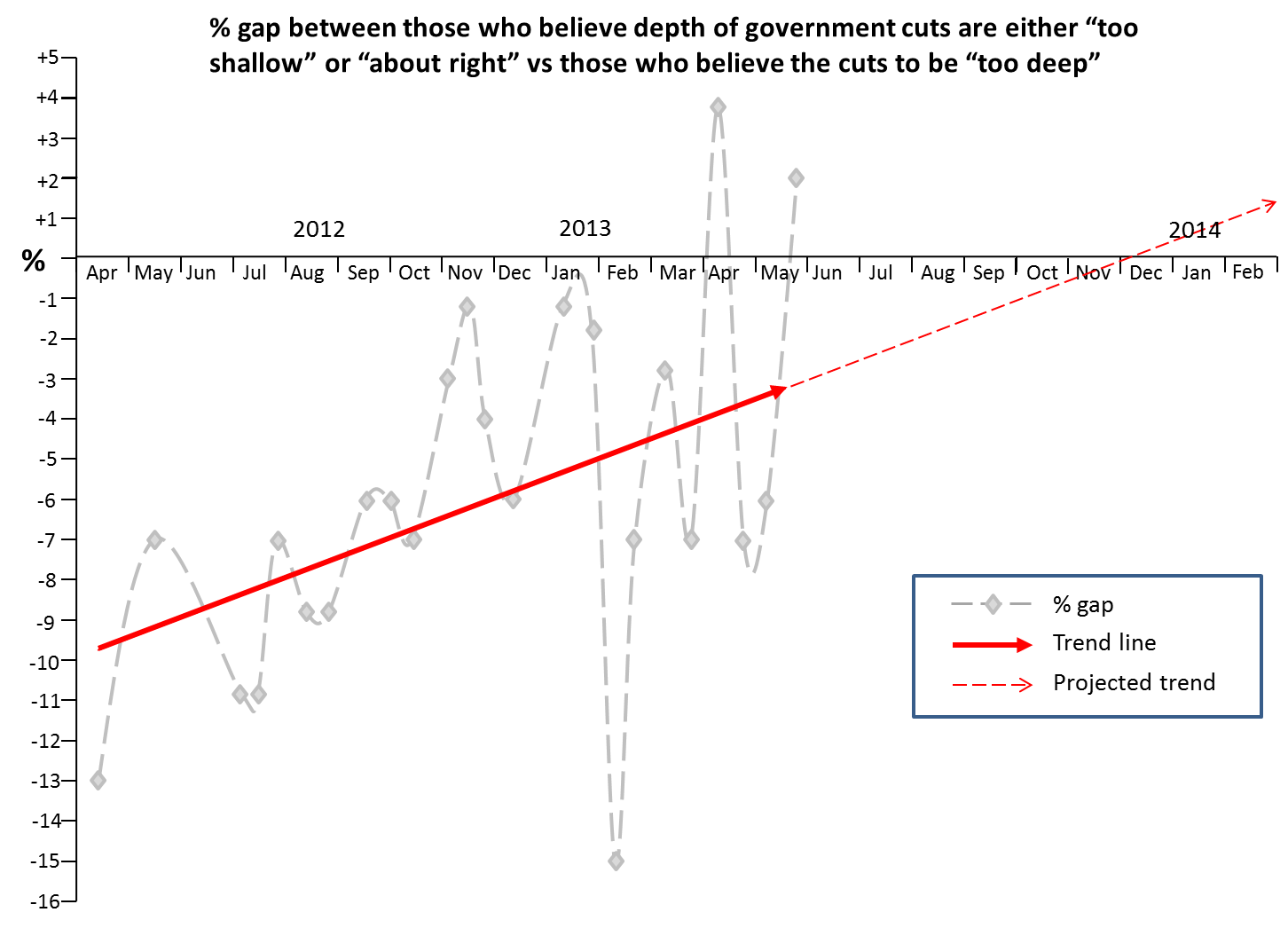
But the YouGov surveys also had seemingly contradictory responses. The key question is on whether the public believe the depth of the cuts to be “too shallow,” “about right,” or “too deep.” The answers to this question initially suggested a consensus that the cuts were too deep. But that is changing.

Source: YouGov

Since April 2012 when 13% more felt the cuts to be “too deep” than either “about right” or “too shallow”, the position has shifted radically. This week, the poll had the pro-cuts camp 2% ahead.

(more…)

Facebook Twitter Digg Delicious StumbleUpon