




Posts Tagged ‘Ed Miliband’

Sunday review on Monday: Ed Miliband’s speech to the Fabian Society conference

14/01/2013, 07:50:12 AM

by Jonathan Todd

The Fabian Society conference marks the new year in Labour politics as the third round of the FA Cup heralds another calendar year of football. No matter how many bore draws football fans shiver through, irrespective of the persistence of interminable political speeches, we summon reserves of hope and forbearance to return.

Ed Miliband, however, thinks activists can have justified hope. We know this because he told pre-Christmas Westminster receptions of the unprecedented position of strength Labour is in for a new opposition. We know this because the Labour Party has announced 106 seats that we are targeting to win, many of which are now a long way from being Labour. We also know this because Miliband chose the Fabian conference to launch a more intensive differentiation of his Labour Party from both old and new Labour.

Andrew Harrop, general secretary of the Fabians, thinks Miliband is right to be hopeful, as he introduced Miliband by anticipating him leading a government as transformative as Clement Attlee’s. Polly Toynbee further reinforced this hope by later saying that Labour would have to try hard to lose the next election.

It is necessary to revisit the launch of a Policy Network pamphlet by Ben Jackson and Greg McClymont to appreciate the significance that Uncut sees in Miliband’s speech.

Here a consensus hung in the air: parties returned to government after only one term in opposition tend to run against not only the incumbent government but against the government evicted at the previous election. Margaret Thatcher ran against Edward Heath in 1979, as well as James Callaghan.

(more…)

Facebook Twitter Digg Delicious StumbleUpon

Loyalty will only take us so far

01/01/2013, 03:50:55 PM

by David Talbot

The festive period is traditionally a season of good will; the nation’s increasingly extended sabbatical into family and faith. We now stretch what in most other countries is two days off into ten. The stresses and strains of the past year are forgotten, and the only talk of politics is that of the family variety.

For a glorious week or so we forget all about politics and politicians. Ed Miliband entered 2012 seemingly forgetting what profession he was actually in, and endured a torrid start to the year as a result, not because of anything he might have said or done – indeed the perception that he had not said or done anything loomed large amongst the charges – but because his personal polling and that of the Labour party’s were far below where they ought to have been.

Now that the new year has been ushered in, it is an apt time for reflection and pause before the year ahead. Twelve months ago, the great British public tended to believe that the spending cuts were indeed necessary, that Labour was more to blame for them than the Conservatives, and that George Osborne was a bad chancellor whose policies would yet further damage their our own financial prospects. However, they didn’t trust the Labour party with the nation’s finances and were reconciled, not resigned, to accepting the Coalition’s economic medicine. A year on, by and large, the British public still think that – with astonishingly little variance.

(more…)

Facebook Twitter Digg Delicious StumbleUpon

It’s still the economy, stupid, which is why the two Eds should be worried about 2013

31/12/2012, 08:00:15 AM

by Atul Hatwal

The Christmas break will have been a time for some self-congratulation in Labour leadership circles. A solid poll lead, a divided coalition and high hopes for the coming year.

Ed Miliband had a passage in his stump speech on the circuit of pre-Christmas Westminster receptions where he talked about the unprecedented position of strength Labour is in for a new opposition, with such a lead at this stage in the parliament. He is factually right, but then the competition for most effective new opposition is not terrific. In the past 33 years, there’s a choice of two: either William Hague’s Tories or Michael Foot’s Labour party.

And at this point in Mrs.Thatcher’s first term, two and a half years after the election, even Michael Foot managed an average lead over the Tories of 3% (averaging the four polls in November 1981 – h/t Mark Pack and his magnificent polling spreadsheet).

When considering unprecedented political phenomena, Ed Miliband, and indeed Ed Balls, might want think more carefully about where the party stands with voters on economic competence.

Decades of polling gives a very clear message: no opposition has won an election without a commanding lead on the economy.

In 1979, voters preferred Jim Callaghan to Margaret Thatcher as PM by 50% to 31%, but still elected the Tories who led on economic issues by an average margin of 10%. In 1997, Labour led by 10% on the economy at the election, while in 2010 the Tories led by 8%.

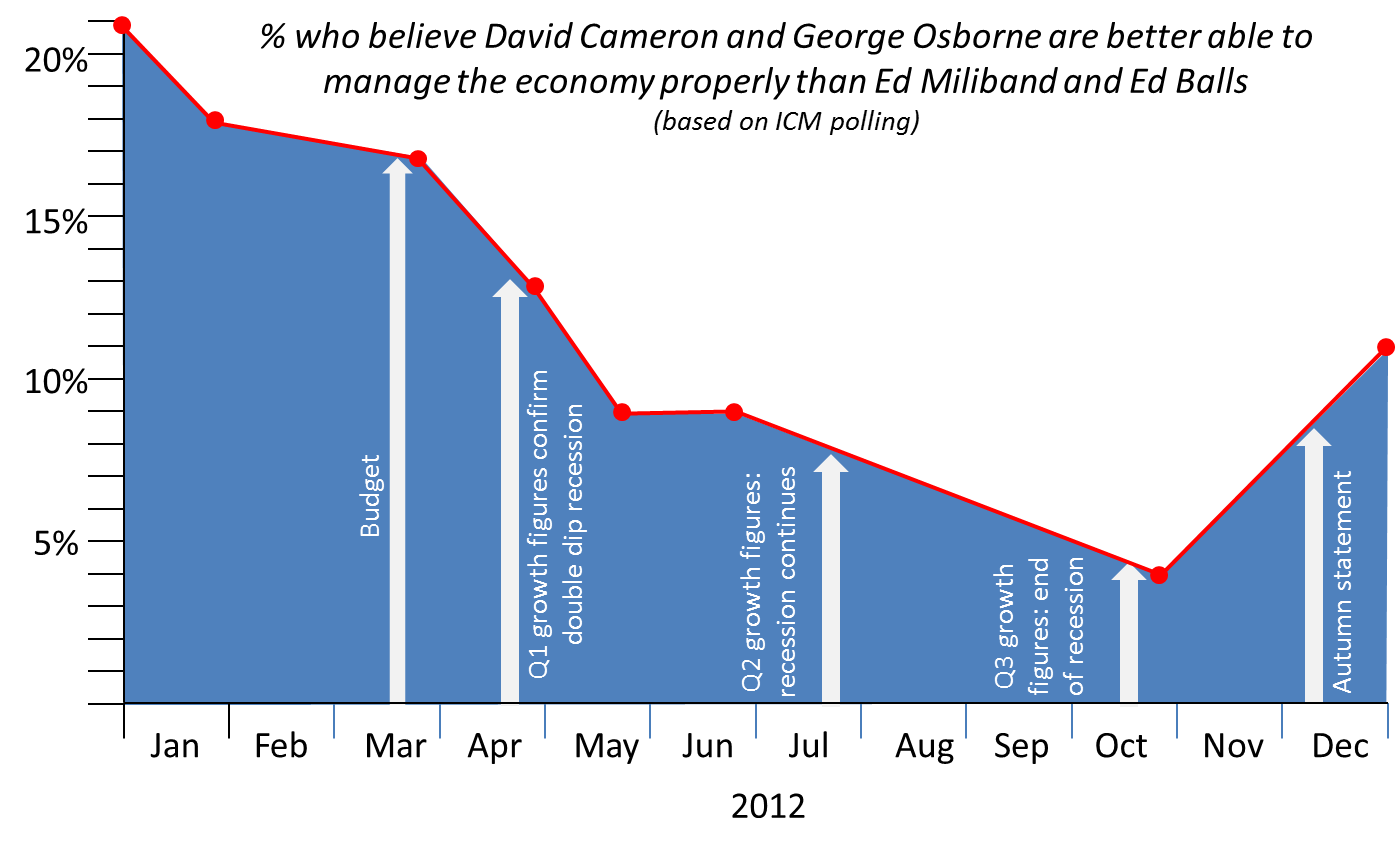
Currently. Labour is 11% behind on economic competence and no opposition has gone on to win the next election when trailing the government on the economy, after two and half years.

Typically, there just isn’t the time left in the parliament to overhaul the government lead and build a sufficient cushion prior to the inevitable narrowing of the polls as election day draws near. Based on the polling facts, a Labour victory in 2015, from this position, would truly be unprecedented.

(more…)

Facebook Twitter Digg Delicious StumbleUpon

Ed’s right on integration and the need to speak English, but we need practical policies to make this a reality

28/12/2012, 10:11:03 AM

by Dan McCurry

Today, Ed Miliband promised that in 2013 we will see some concrete policies that define what being a one nation party means. Good. We need them. There are many areas the detail is necessary, not least on integration.

Before Christmas, Ed made a good speech on the subject. He struck the right notes in a measured manner, acknowledging the benefits migrant communities have brought to Britain while stressing the importance of the basics such as everyone speaking English. So far, so good.

Now we need to explain what this means in practice. For those that can’t speak English, what will we do?

A practical example. In my experience, if I can’t understand my Bangladeshi client, when I’m filling out the legal aid form, then I just pass them the pen and ask them to fill in their own details. In the box marked “place of birth”, quite often, they will write, “London hospital, Whitechapel”.

Born in this country, but with language skills so bad that they cannot be understood when speaking their own name and address, the issue is lack of exposure to the English language, during the early years, before the age of three. Without good English, their life outcome will suffer considerably, yet this someone who was born in this country.

Thankfully, these days it is less and less frequent for younger Bangladeshis to suffer from this problem. They are so surrounded by English speaking aunts and uncles that the issue no longer arises.

However, it is tragic for the Bangladeshi community that it wasn’t until the third generation, that the majority of the community could speak the language of the nation of their birth fluently. And it remains a major issue for many in the first and second generations of the community.

Ed Miliband says that Labour made mistakes by believing that these things will sort themselves out. People used to say that integration will happen naturally with the generation born here. But that was wishful thinking. Many who were born here, were held back before the age of three, by the problem that they were expected to solve by virtue of being born here.

(more…)

Facebook Twitter Digg Delicious StumbleUpon

Ed Milband is out of step with most voters on welfare reform

20/12/2012, 07:00:11 AM

by Peter Watt

If the economy is the central battleground of the next election then welfare reform looks like being one of the other key areas for the political combatants.  The chancellor’s Autumn statement made it pretty clear that he intends to make it a key wedge issue over the coming years.  And to make sure that we all got this, the Tories have released an online attack ad on the websites of local newspapers in marginal seats.

Click on the ad and you are asked your views on welfare reform by the Conservative party. Labour reacted with its own marginal seats campaign complete with outrage at the demonization of the poor and attempts to divide and rule between artificial notions of “strivers” and “scroungers”.

So both parties see the next election being about the cost of living; both see strategic weaknesses in the others approaches to those working on low to modest incomes and both now have drawn a line in the sand – the proposed below inflation 1% rise in most working age welfare benefits.

For the Tories this will help create a “welfare system based on fairness’” as the campaign leaflet to accompany their online ad makes clear:

(more…)

Facebook Twitter Digg Delicious StumbleUpon

Why isn’t Labour shouting about the success of the future jobs fund?

19/12/2012, 07:00:19 AM

by Dan McCurry

There was an interesting piece in The New Statesman by Rowenna Davis last week that examined the DWP report on Gordon Brown’s future jobs fund. Under this programme young unemployed people were given a guaranteed 6 months work at minimum wage and the DWP evaluation has found this policy had a net benefit to society, for each young person enrolled, of £7,750.

The writer contacted Ed Miliband’s office to ask for a view from the leader’s staff, only to be told that, “it still does nothing for those people who are in work on benefits.”

I see Ed Miliband as a man who has a great conviction that there is something deeply wrong and unjust about the system. He desperately wants to find the answer, but can’t quite put his finger on it. It’s as if it’s there, but just out of reach. It’s good to have a leader who wants to make a real difference, rather than aspiring to coast through a term in office. However, he does sometimes look like he is chasing rainbows at the expense of doing the job.

Rowenna’s experience tends to chime with a suspicion I’ve had in the past. I have an image in my mind of all the people around Ed Miliband desperately biting their knuckles, with the intense hope that they can find the answer, if only they can think deeply enough.

(more…)

Facebook Twitter Digg Delicious StumbleUpon

Doing your homework in opposition is essential to being a competent government

24/10/2012, 03:58:55 PM

by Jonathan Todd

Whether at Eton or Haverstock a lack of homework catches up with pupils. This homework might involve putting flesh on the bones of One Nation Labour’s audacious land grab for the political space created by the withering of the Tory left. Or it might be more hands on: ensuring the cogs of government turn quickly enough for welfare and education reform to deliver the substance of national competitiveness.

David Cameron has often seemed curiously devoid of purpose as Prime Minister. His conference speech crafted one. His argument is that to compete in a world of rapidly rising powers all Britons who can work should work – hence, the need for welfare reform – and no Britons should have substandard skills – thus, the justification for schools reform.

His economic argument is no longer simply about the immediate need to reduce the deficit but one that binds in his key domestic reforms into a longer-term platform for economic renaissance. It would be short-sighted to deny the coherence of this argument.

But soon what Cameron says will matter less than what he has been able to do.

Will universal credit get Britain working or will it be a complete catastrophe? Will free schools make as big a difference to education standards as Michael Gove thinks they will?

(more…)

Facebook Twitter Digg Delicious StumbleUpon

Why Labour has to win in 2015

19/10/2012, 02:50:29 PM

by Ian Stewart

Politics is a game. It is irrelevant to the real needs. The authorised version of the game and its rules have been pickled, or maybe set in aspic, or possibly worse. The ingredients that make up our HP Sauce have curdled. That is the view from the bottom of the pile, it is the reason why so many of us cannot be bothered. It is also the view peddled by the seemingly endless parade of hip young things in our media today. That is unless they can find a cause that ticks the right boxes of their sales demographic.

If you want to practice politics go to a good university then get that job as a researcher or SpAd. Get yourself into a union machine, work in local government or law or work for a pressure group or the media. In other words get inside the established channels as quickly as you can, starting with student politics.

Whatever you do, do not get a job outside of the process. The process is king – never forget that. Once inside you can play the game to your heart’s content. In your chosen career – showbusiness for ugly people – you will be talking to others similar to yourself and most of those interested in what you do will also be like you. The rest of us neither matter nor care, except during elections.

You can read a lot of leftish blogs and sites these days and most of them seem to accept the rules of this game. It’s a game that few can ever win. Left wing commentators occasionally wring their hands over the fate of beings called “the low paid.”

I have a suspicion that most of them have only sensed these beings from a slight distance. Let me help you, my fellow blogging comrades, in your search for these mythical beings. They were serving your coffee, washing your dirty plates and getting you that glass of wine in the bar at that conference you attended… (did you tip, or did you think a few extra quid would be demeaning? Tightwad.)

I know this because I am one of them. I’ve spent most of my working life in catering, hotels, restaurants and bars. I admit that I’m atypical (particularly in London) as I am English and fairly educated. Oh, and I am interested in politics. Forgive me, I spent all of my working day on my feet, including my break, and am a little cranky. Sadly, in many respects George Orwell’s Down and Out in Paris and London is all too familiar today. To those who see politics as simply a tribal game or as irrelevant to the lives we all lead, let me explain what a large bulk of “the low paid” go through on a daily basis.

(more…)

Facebook Twitter Digg Delicious StumbleUpon

When Ed Miliband marches against austerity tomorrow, will he answer the £10bn question?

19/10/2012, 10:22:26 AM

by Atul Hatwal

Tomorrow, when Ed Miliband attends the TUC’s march against austerity, he will be asked a simple question.

The answer will help determine whether One Nation Labour is an idea that will resonate with the public or just an ephemeral phrase du jour:

Ed, do you back Unite, Unison and the GMB who have just submitted a claim for a 13% rise in wages on behalf of 1.6 million local government workers?

Yes or no?

No, don’t use a parsed formulation of words involving the phrase “tough choices” while avoiding a clear position.

Do not obfuscate, this isn’t a demand to write the next manifesto several years before the next election, it’s just a question that cannot wait three years for an answer.

Neither is it good enough to say that this is a matter for local government as if the leader of the Labour party is somehow legally proscribed from having an opinion.

For the unions, in a very practical sense, this wage claim is part of the alternative to austerity and it is a question they will ask of Labour’s leader, face to face, on Saturday.

Their local government members have faced real terms pay cuts, year on year since 2009. 13% sounds a lot for a wage claim but it would only recoup the real terms losses (e.g. the difference between inflation and the nominal pay rises awarded) suffered since 2009.

What is the point of the union movement if it cannot protect its members from never-ending pay cuts?

(more…)

Facebook Twitter Digg Delicious StumbleUpon

So, if Labour win the next election, where will we be in October 2015?

18/10/2012, 07:00:56 AM

by Peter Watt

On Saturday hundreds of thousands of people will be demonstrating against the cuts to the public sector being imposed by the government.

The TUC’s “we were told there was an alternative” march and rally in central London is the latest in a series of events organised against the cuts since Ed Balls unveiled his emergency budget in June.  PM Miliband faced heckling and walkouts at the TUC in early September and at the Labour party conference 100,000 protesters ringed the conference over-shadowing his Tuesday speech.

Government ministers have faced UK Uncut activists chaining themselves to their cars, bikes, houses and constituency offices as disruption and protest is maximised.  But it is the anger towards prime minster Miliband that is most palpable.  The elation of the election victory a mere four months ago must now seem a very distant memory to our beleaguered PM.

The problem seems to boil down to a sense of voters feeling let down as Labour impose their austerity package.  Of course Miliband and Balls can point to a series of speeches and announcements that they made in opposition that they say made it clear that they would need to make cuts.  As Balls said in his interview with Andrew Marr last week:

“We said it would be tough and it is, five years of failed coalition policy that delivered negligible growth means that the government books were even worse than we thought.  Of course we were always clear with people that we would need to make some cuts but unfortunately in reality this means that we have a much tougher job on our hands than even we realised.”

But it appears that voters were not as clear about the Labour party’s intentions as Miliband and Balls now claim that they were.

(more…)

Facebook Twitter Digg Delicious StumbleUpon