


Posts Tagged ‘Rob Marchant’

Naiveté is a weakness in all walks of life but in politics, it’s deadly

17/04/2013, 02:08:49 PM

by Rob Marchant

Major political events which blow all other news out of the water, such as the death of Margaret Thatcher, tend to do two things. First, they make us take a step back and take stock, to ponder the grand historical sweep of things; and second, they give us a little time to do so, as the normal scheme of things is largely suspended.

So far, Miliband is having a “good war”: his Thatcher tribute speech was widely thought to be very good and, in any event, the fact that his opponents cut taxes for the well-off a fortnight ago is surely helping his approval ratings. His party is still solidly ahead of the government, although arguably still more down to the latter’s failure than Labour’s conspicuous success.

But politics is about people. About personalities. As we do the stocktaking, we now know much more about Miliband and his leadership style than we did back in 2010. As critical friends, do we not have the right – or rather, the obligation – to comment, if we think that there are weaknesses in the approach? We do.

Last week, various leftists were justifying their rapacious criticisms of Thatcher by the “two wrongs make a right” technique: recalling equally harsh words spoken by Tories on the death of Michael Foot, that same year as Miliband’s accession.

(more…)

Facebook Twitter Digg Delicious StumbleUpon

David Miliband and the big beast famine

03/04/2013, 10:08:04 AM

by Rob Marchant

The most important news about David Miliband’s departure is, of course, that it is by no means news.

Journalists were last week making all kinds of wild claims, that this would somehow upset the delicate balance between Miliband’s core team and the remaining Blairites in the cabinet, as if the latter’s secret leader had suddenly been whisked away in the midst of plotting revolution.

The truth is more mundane, of course: Miliband senior was hardly, at this point, at least, the ringleader of some turbulent band of plotting Blairites. He was merely decently trying to stay out of everyone’s way and put together an alternative political life, in which he was not constantly examined for signs of fraternal betrayal. In his decision to emigrate, he has merely been a grown-up and recognised his own failure in that most impossible of tasks. What would have been extraordinary news would have been for him to accept a place in his brother’s cabinet. The die was cast in October 2010; this is just the inevitable endgame.

Where it leaves us, let’s be honest, is exactly where we were before: in a world where the big beasts who bestrode earlier generations are all but extinct.

This is ever more tricky in a world where politicians do not have what Denis Healey’s wife, Edna called “hinterland”. As the great man told Rafael Behr in a recent interview:

“None of them have that in either party. In my time, people didn’t start earning money until well into their life in politics. Now people can get a career out of politics as soon as they leave university. They don’t have experience of the real world.”

Indeed, this phenomenon is not just confined to Labour – after all, aside from Ken Clarke, who has Cameron got in the “silverback” category? – but if we want to win and win properly, we need to act with a little more mature wisdom than the prime minister has over the last twelve months.

(more…)

Facebook Twitter Digg Delicious StumbleUpon

Wanted: a 21st century internationalism for Labour

20/03/2013, 02:16:22 PM

by Rob Marchant

Society, and not just in Britain, is increasingly dividing up into two parts: the first, those who work in a national context: public sector workers, most lawyers, a lot of media and small businesses. Those for whom “abroad” mostly means a holiday. Their day-to-day is dealing with other Brits, who in turn deal with other Brits. That’s one part.

And the second comprises those who work in an international context. This need not mean people constantly jetting around the world or spending their lives in videoconferences. It also means people in ordinary jobs working for global businesses (an awful lot of us) whose livelihoods depend on international sales; on dealing with other countries; on understanding how things work there.

If you are a UK manufacturing worker, you may be aware that raw materials are arriving in your workplace from Russia, part-made goods from the Far East and that the finished product is destined for, say, Dubai, and you don’t so much as blink.

The risk is for Labour, that some of those opinion-formers it needs to win back, like some of the Tory switchers from 2010, are in the second bracket: people who are more aware, if sometimes only by osmosis, of the world outside. Myopia can scare off these people.

One Nation, as I have commented before, is a great strategy for Labour. It is a unifying banner, around which its core supporters, along with those Labour needs to win back, can rally.

The Tories, by contrast, as evidenced by Cameron’s weekend speech (and previous conference speech), are staking their claim in two ways: one is through “aspiration”; the other through the “global race”. These are the battle lines, already starting to be drawn for 2015.

(more…)

Facebook Twitter Digg Delicious StumbleUpon

The Chávez tragedy turns to farce

05/03/2013, 12:20:19 PM

by Rob Marchant

While the elusive state of health of Venezuelan leader Hugo Chávez seems to have been delicate since at least 2011, it is finally starting to be recognised that he really is not very likely to return as leader, any more than Fidel Castro is ever likely to retake the reins in Cuba. But there is a great deal more to this tortuous tale.

The trouble is, accurate information is so difficult to come by, local media being highly polarised either for or against the man, that no-one can really quite work out the truth; even as to such a simple fact as whether or not the president is still alive.

The evidence that he might not be is circumstantial, yet substantial: he has not been seen in public since his cancer surgery on 11 December, and failed to turn up for his inauguration one month later, leading to severe constitutional speculation as to whether he could legally continue as president in such circumstances.

Things came to a head last week, when a former Panamanian ambassador, Guillermo Cochéz, gave a surprisingly detailed report. It claimed that Chávez had been in a vegetative state since 30 December and had finally had his life-support switched off two weeks ago, at the request of his family. While Cochéz certainly has an axe to grind against Chávez, as a public figure he has also staked his reputation on the claim, one that one simple public appearance by the Venezuelan president would obviously destroy. And, there has been no hard evidence from the administration to the contrary.

Something very odd is going on. The report also tallies with one from 2 January by Spanish newspaper ABC, quoting Cuban sources, that he was in a coma, on life support and a switch-off could happen “at any moment”. Demonstrators outside the presidential palace are now chaining themselves together, rightly demanding to know who is running their country, and under what authority.

(more…)

Facebook Twitter Digg Delicious StumbleUpon

Isn’t it time Labour stopped facing both ways on Islamist extremism?

20/02/2013, 11:33:32 AM

by Rob Marchant

In the Labour party, we have, last week, been shocked at how one of our members of Parliament, Sadiq Khan, can receive death threats from freaks who believe they are licensed to make him vote against gay marriage by force including, apparently, murder. And Khan is apparently not the only one: Labour List reports that “Rushanara Ali, Shabana Mahmood, Anas Sarwar…are all believed to have been similarly targeted”. Bravely, none of them wavered in their commitment to their own values, of equality for all under the law.

Yet, at the same time, we have other MPs, who invite a preacher who laughs about taunting his Jewish high school teacher with a swastika, who thinks being gay is a “great crime” that signals “the start of the collapse of every society, and who is convicted of funding a terrorist organisation, to speak at the mother of all parliaments.

In the Labour party, we are shocked to read in the Observer at how supporters of extremist group Jamaat-e-Islami throw stones at a crowd of people in London’s East End, demonstrating against the theocracy which is killing their homeland, Bangladesh. They stone a crowd containing old people and children. Many of those demonstrating are Muslim women, who rightly reject this misogynistic cabal who would happily bring Sharia to the East End.

Yet, at the same time, we last year campaigned to re-elect a candidate who, as former Mayor, in 2004 welcomed to London a particularly vile preacher. A preacher who, apart from his views on rape and wife-beating, feels entirely comfortable with the abhorrent practice of female genital mutilation.

(more…)

Facebook Twitter Digg Delicious StumbleUpon

The far left has gained entry at the top of the Labour party

06/02/2013, 01:24:28 PM

by Rob Marchant

While the latest controversy surrounding the Socialist Workers Party shows that we all still have an odd, vicarious interest in the goings-on of a fringe, far-left party – or as blogger Laurie Penny put it in an unintentional comedy moment, a party which contains “many of the UK’s most important thinkers and writers” –  we might just miss something less obviously scandalous but closer to home.

Three weeks ago, Ken Livingstone’s former chief of staff, Simon Fletcher, was appointed as trade union liaison manager to the leader’s office. A backroom role, it is there to manage the relationship between trade unions and the party and has the ear of the party’s leader and deputy.

While the Mail and the Standard, not really newspapers which understand the running of the Labour party, ran their predictable “Red Ed” headlines and tried to use the appointment, laughably, to attack Miliband for being a Trot in disguise, in the process they made one legitimate point which should concern us on the mainstream left. It relates to the so-called Socialist Action group.

Although most Labourites believe they know Livingstone, it is surprising how many of his supporters are still unaware of Socialist Action. For those requiring a brief refresher, the Trotskyite clique that spawned most of Livingstone’s advisers during his mayoral tenure is documented in an extract from his biography:

“[it is] so discreet and secretive that it does not even admit its own existence and its members will not confirm they have ever belonged to the group.”

The only member of Ken’s coterie listed on the group’s website appears to be Redmond O’Neill – who died in 2009 – although Fletcher’s and others’ associations with it have been documented by other sources, including said biography and former members. With Socialist Action, the emphasis, as the above quote indicates, is on plausible deniability, an old tactic of the far left frequently wielded by the former mayor himself (although, in his case, the word “plausible” may have often been stretched to breaking point).

(more…)

Facebook Twitter Digg Delicious StumbleUpon

The polling facts about Labour’s mid-term lead

09/01/2013, 12:02:49 PM

by Rob Marchant

Much has been made during 2012 of Labour’s solid poll lead, which has been of the order of 10% ever since the government’s disastrous Budget. For some it seems difficult to refrain from mentally converting this into a line on Peter Snow’s election night model of the House of Commons, showing a majority for Labour.

What this fails to account for, quite apart from the changed circumstances which may prevail in two years’ time (and which may be much more attractive for the Tories, as Peter Kellner cheekily points out here), is that incumbents tend to have a dip at mid-term anyway. Quantifying this effect would obviously help us to make more accurate forecasts, to the extent that this is possible.

Last week at Uncut, Atul Hatwal showed the numerical arguments against a win for any party which failed to establish a poll lead on the economy. In a complementary way, we can try and allow for this mid-term effect, to try and get a better idea of where things might end up, all other things being equal.

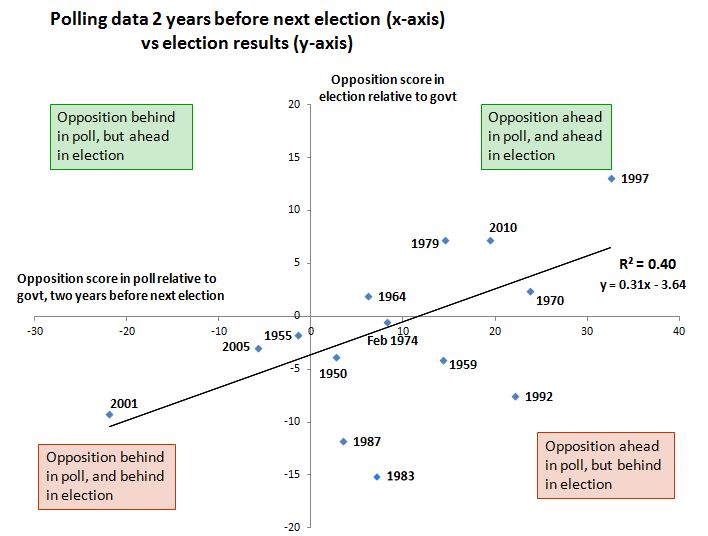
There are various ways of trying to gauge it*. A year ago, an excellent piece of analysis was carried out by Leo Barasi (and for which I am indebted to John Rentoul for pointing out) on post-war polls both eighteen months into a parliament and two years out from the next, which concluded, rightly, that Labour’s prospects were numerically better than many seemed to think.

Interestingly, this conclusion now looks a little less secure, not because Barasi’s model has changed or become less applicable, but because the polls have actually improved for Labour in the last year and therefore many commentators, who were very negative at the end of last year, have gravitated towards a much warmer view of Labour’s prospects.

To revisit the second part of that analysis – that of two years out from the next election – is now both timely and illustrative, which we do now in this graph:

It is interesting to look at the regression line but the data points, too, tell a story. It is also useful to apply a little political history to the figures.

First, the most striking thing to note is that over four-fifths of postwar oppositions have had a lead in the polls at this point, two years out from an election. Irrespective of whether they go on to win or lose. So having a lead in itself is hardly remarkable: in fact, allowing for outliers**, they almost all do. It is the size of the lead that counts. Conclusion: don’t get excited about being ahead in the polls at this point. It seems to be a necessary, not a sufficient condition. Not being ahead, now that would be something.

(more…)

Facebook Twitter Digg Delicious StumbleUpon

A Labour Christmas carol

26/12/2012, 08:00:44 AM

by Rob Marchant

It was Christmas eve, 2012, and Ebenezer Miliband lay in his bed, thinking of how his little hardware shop was faring in the middle of this perniciously cold winter. Business had been difficult, and here was a man generous to a fault. Perhaps too generous, some said. Debt was high everywhere in London that year, and no-one wanted to make promises to anyone, about anything. But Miliband, a decent and honourable man, was always good to his creditors.

He lay and fretted about his little business, and the harsh economic climate, unable to sleep. And, as he lay there, suddenly something very strange happened: it seemed like the bells on all the clocks in the house were sounding, madly, at the same time. Miliband looked around him, startled. What on earth was happening?

And then suddenly, after a few long seconds, they stopped ringing, as abruptly as they had begun, and silence reigned again. As he turned back towards his bed, who should have quietly appeared meanwhile, but the ghost of his mentor and former business partner: Jacob Brown, esq.

Brown had been a faithful friend and backer, but had had mixed success in charge as the shop’s senior partner, before his untimely demise. In his early days, he’d been affectionately known as “Prudence”, a name which people had later stopped using, for reasons which no-one could now quite remember.

Never a man for idle chit-chat, he had obviously come with a purpose and got straight to the point.

“Ebenezer,” he said, glowering a little, “d’you think it’s been a good year?”

The shock of seeing the ghost had not quite hit Miliband yet, and his words came out easily at first. He was also not quite sure what Brown was getting at. “Well, actually, not bad at all, Jacob. Sales are up, and the competition’s had a terrible year. No-one’s buying from them.”

Brown snorted derisively. “I had a honeymoon, too, you know. Much good did it do me. But I mean, do you really think you know where you’re going?”

(more…)

Facebook Twitter Digg Delicious StumbleUpon

The short Gaza conflict has shone a light in Labour’s dark corners

28/11/2012, 03:25:25 PM

by Rob Marchant

The attacks on both sides have ceased in Gaza and southern Israel and the death tolls have ceased to mount – a sure-fire way to get the issue off the news bulletins again – and an uneasy truce holds. For now.

But, during those eight days, the focus of popular attention briefly fell on what is probably, for the vast majority of its citizens, an issue at the very margins of their daily thinking. Even many of those interested in international affairs have simply given up trying to understand the complex debate on the territorial and governmental rights of Israel and Palestine, or simply feel “a plague on all your houses”. And that is for those who think about it at all.

Except one group of citizens, of course. The political class: not necessarily politicians, but that odd and strangely passionate group, those actively involved in politics. If you are reading this, you are very likely one of them. Everyone has an opinion.

What has happened on the British left during this short period, therefore, is that the somewhat strange, yet long-held, views of some of its members have suddenly had a public airing, where no-one would normally even listen. Often all the complexity of the Israel-Palestine situation, with respectable arguments on both sides for ends if not means, has been reduced to the infantile football-terrace chanting of “my side’s right, your side’s wrong”; and oh, what a revealing set of quotes it has provided.

“We do not hate Jews. We hate Zionism,” shouts George Galloway, seemingly feeling that he really needs to make it clear, speaking to a somewhat disturbing (watch it here) Bradford rally, flanked by two large Palestinian flags. So that’s alright then. Not Jews. Just Zionists.
(more…)

Facebook Twitter Digg Delicious StumbleUpon

Rotherham is the most important election of all

14/11/2012, 07:00:06 AM

by Rob Marchant

It seems that, over the next two weeks, we are about to suffer a plague of elections: six by-elections, plus the rather-important PCC elections.

But the one which has the most compressed timescales of all – where candidate Sarah Champion was selected yesterday, with a mere two weeks until polling day and after a walkout at the selection meeting – is going to be the toughest, nastiest and arguably the most important of all.

Why?

Denis MacShane’s resignation a fortnight ago, over the falsification of invoices, was a tragic, shabby end to what was an otherwise rather admirable and productive career, including three years as minister for Europe and some brave work fighting anti-semitism. And whilst there was never any question of personal gain resulting from his actions, it was also clear that his behaviour was inexcusable and that he had to go, to avoid dragging out the pain for him, Labour and his constituents over a further half-parliament.

What has not yet been focused on, however, is the considerable headache that his departure gives Labour.

First, we are in a political climate where the conventional wisdom is that trust in established parties is at a historic low – and therefore the likelihood of major parties being punished is high. Although neither Respect nor the BNP are currently in particularly good shape, this is good news for both of them in all these elections.

(more…)

Facebook Twitter Digg Delicious StumbleUpon