




UNCUT: Labour’s 2013 report card: relying on the kindness of strangers is not enough

08/01/2014, 07:00:18 AM

by Rob Marchant

Recently there seems to have been an odd acceptance by some right-wing commentators that Britain is to “sleepwalk to a Labour win”, as the Telegraph’s Matthew D’Ancona put it. It may be a genuine belief, rather than a way of giving Cameron a sly wake-up call. But if only that outcome were so sure from Labour’s current position.

On the contrary, when we look back on the third year of the Miliband project, we might struggle to see it as the success-filled year of the winning team.

For a start, any midterm year which an opposition ends with both a party and a leader less popular than at its start – as pollster Anthony Wells has observed – can hardly be declared an unqualified success.

This was a year in which a party going on to win a general election needed to be increasing its lead in both those categories, or at least holding them firm. If the near-halving of Labour’s poll lead had been down to some kind of surge for the Tories, it could have been acceptable. But the fact that both Labour and their leader are polling worse is discouraging news.

Pollster Deborah Mattinson’s noting that no party has ever gone on to win a majority from here is important, if not conclusive. And the answer is not, self-evidently, to simply lower our expectations and carry on as before, hoping to grasp at a deal with the Lib Dems, should such a thing one day be on the table.

When you are in a hole, stop digging, seems more appropriate. Or, put more simply, you do not tend to go down in the polls because the public thinks you are doing the right thing.

A second point would be the Syria vote: although Miliband managed to klutz it up fairly comprehensively, it is also fair to say that Cameron foolishly underestimated the lack of support in his own party. As a result, neither is cutting much of a figure of world statesman, as the bodies pile up in Syria at a higher rate than ever. “We stopped the rush to war” has a rather hollow ring to it, now it looks like the flimsiness of Western resolve means the murderer of thousands of children will stay in power after all.

Read the rest of this entry »

Facebook Twitter Digg Delicious StumbleUpon

INSIDE: Toil and trouble bubbling in the shadow cabinet pot

07/01/2014, 02:11:07 PM

In the past week, lefty pointy-heads have been all a-twitter about a piece on the Economist’s blog, mapping out how Ed Miliband might want to clip the Treasury’s wings and expand BIS, so that BIS becomes an engine for “economic reform”.

This new “department for Milibandism” would take on responsibility for jobcentres from DWP, training from Education, cities and regional growth from CLG and financial services from the Treasury. The poor old Treasury would be left as a much diminished office of the budget.

Cue supportive interventions from noted Ed-ites and much sage discussion about the policy and institutional impact. But as the wonkathon subsides, thoughts turn to the politics of such a change and the eternal question, cui bono?

The stony silence from the shadow chancellor’s camp speaks volumes. Ed Balls would effectively be demoted to the role of chief secretary to the Treasury. Suffice to say, he’s unlikely to be a fan. No, the lucky beneficiary from this radical Whitehall surgery would appear be Chuka, the current shadow at BIS.

So who lobbed this political incendiary into the debate? Step forward the uncredited author of the piece, Jeremy Cliffe.

Would that be the same Jeremy Cliffe who is good mates with one, er, Chuka Umunna? The same Jeremy whose Linked-In CV lists a past role as “Campaign Intern, Streatham Labour, December 2009-January 2010.” The same Jeremy whose CV goes on to list one of his jobs as “Researcher, Office of Chuka Umunna, June 2010-August 2010”?

Hmm. Stop it. You’re too suspicious, Uncut is sure this is all just a big coincidence.

In other coincidental news, la Umunna penned a piece for last week’s Observer on democratic renewal; nothing to do with industrial strategy and completely out of the blue, but nevertheless a worthy subject for a political intervention. It brought to mind a comment from a grizzled whip a few years ago, speaking about loyalty from the then cabinet, “When the children start talking off-topic, discipline is breaking down and trouble’s not far behind.”

In fairness to Chuka, at least he was scrupulously on message in his Observer piece. Rumours from the PLP abound that the really big fight of the coming term is about to kick-off: Balls versus Burnham with loyalty to the collective shadow cabinet line likely to be the first casualty.

Read the rest of this entry »

Facebook Twitter Digg Delicious StumbleUpon

UNCUT: It’s all about Obamacare in America

07/01/2014, 07:00:34 AM

by Jonathan Todd

Beyond being the first African-American president, an achievement, obviously, secured on day one, the Affordable Care Act (ACA) or Obamacare is Barack Obama’s best, perhaps only, hope for a positive, domestic legacy. Opposition to it binds Republicans. While it’s almost 4 years since Obama signed it into law and as a result, as of 1 January 2014, 6 million Americans are receiving insurance that they otherwise wouldn’t, it remains the dominant issue in US politics.

Obama has improved the economy, repealed “don’t ask, don’t tell” and exited the US from unpopular wars, while avoiding others and killing Osama Bin Laden. Largely creditable but not governing prose to match 2008’s poetry, which perhaps was pregnant with disappointment.

Equally, it shouldn’t seem too much to expect more concrete steps to eradicate the causes of the 2008/09 crash, a less dysfunctional DC, and a Middle East strategy that doesn’t cede so much to the regimes of Iran and Syria – especially when coinciding with an intended pivot to the Pacific that is not preventing China and Japan edging toward World War III.

This underwhelming record and the impending inevitability of lame-duck status makes ACA, the most significant US healthcare reform since the 1960s, vital to Obama’s submission to history’s judgment. The pendulum is swinging against his party, however.

In 2014, the Republicans are likely to hold the House and with victory in either North Carolina or Louisiana will probably take the Senate. There is a growing audience for what they have to say. It’s not clear, though, that they have much to say. Except how awful ACA is.

Re-election as governor in a traditionally Democratic state makes Chris Christie the Republican’s presidential frontrunner. To be this candidate, he’ll need to win the support of a party that brings together social conservatives and economic liberals, as well as Wall Street and rural America.

A positive platform to galvanise this eclectic bunch is a tough ask. ACA will loom large in its negative campaigning. That Republicans find it easier to agree on what they oppose, rather than what they support, means their legislative tactics will continue to raise the stakes on ACA.

Read the rest of this entry »

Facebook Twitter Digg Delicious StumbleUpon

UNCUT: The Milibelievers are destroying Labour’s chances for victory in 2015

06/01/2014, 10:47:37 AM

by Atul Hatwal

The polls are fine. Labour’s rating is holding firm in the high thirties, it will stay there because Lib Dem defectors will boost Labour’s core vote from 2010 and UKIP will squeeze the Tories’ vote.

This is the litany of the Milibelievers.  A group that is distinctly under-represented in the PLP but more vocal in the media community and believes Ed Miliband’s gameplan is working.

It was neatly summarised by George Eaton before Christmas and represents one the greatest threats to Labour success in 2015. Because unless Labour radically changes course and accepts the current gameplan is failing, defeat is increasingly likely.

There are two flaws to the Milibeliever prospectus.

First, Labour’s base is not the 29% achieved 2010.

Given how appalling Labour’s performance was in 2010, it’s tempting to believe that it represents rock bottom. 29% was derisory, but Labour can fall further. In polling for Uncut by YouGov in early September, just over 1 in 4 (26%) of Labour’s 2010 voters said they did not intend to vote for the party at the next election.

There may have been some minor movement in the attrition rate since Autumn, but given the broad similarity in the polls between then and now, it is unlikely to have changed significantly.

This means Labour’s current base is actually nearer 22% rather than 29% and unless something major changes, Labour will not even be the largest party, let alone a majority government, no matter how solid the block of Lib Dem defectors.

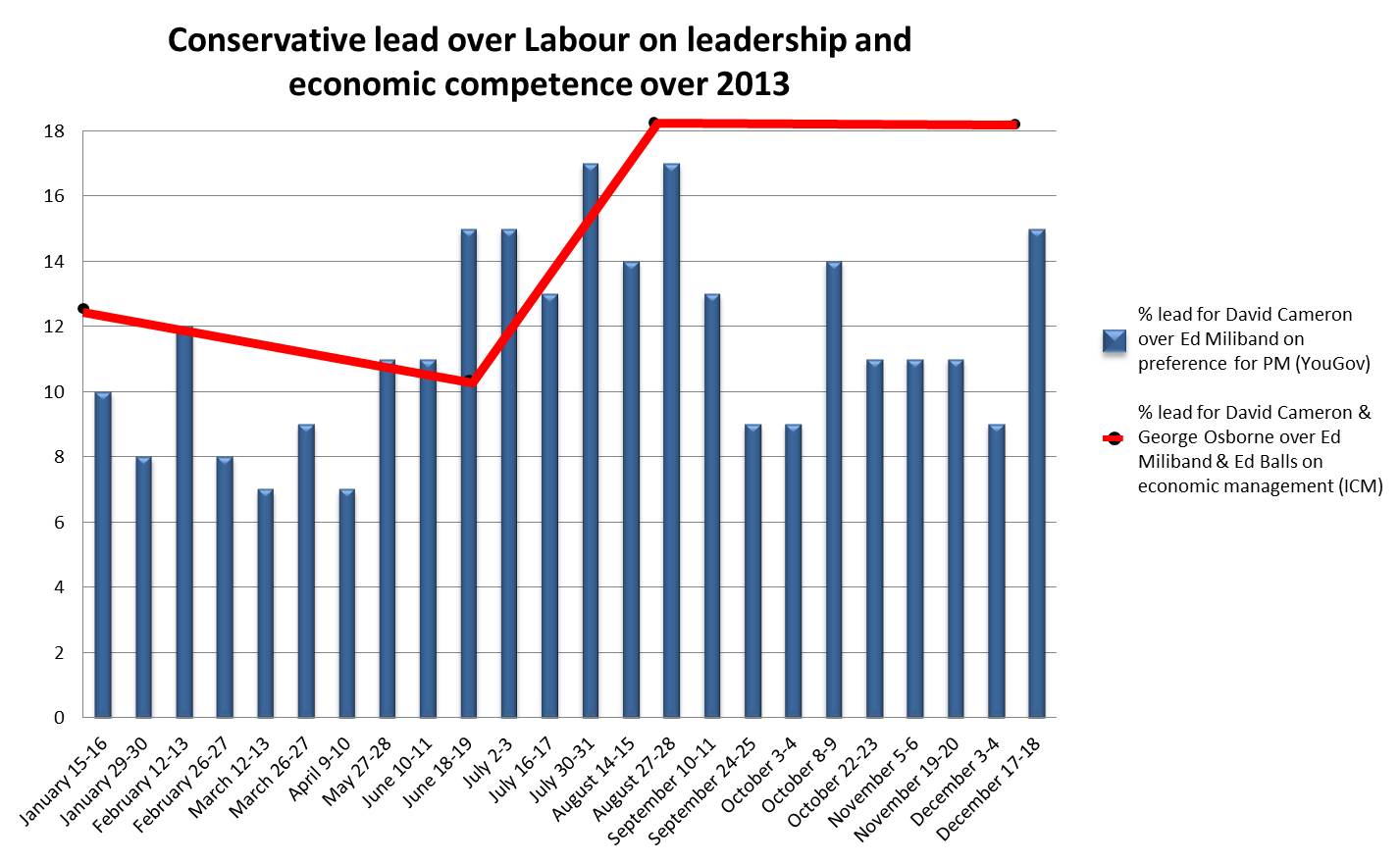
Second, Labour is losing the argument in terms of leadership and economic competence. This is the underlying reason why the party’s base vote has eroded since 2010, why it is overly optimistic to believe Labour can rely on legions of 2010 Lib Dem voters backing the party into the high thirties and why many UKIP converts are likely to lapse back into the Tory fold.

The chart below sets out the scale of Labour’s problem. No opposition has ever won while being behind on both leadership and the economy, and Labour now trails by double digits on both.

Con lead over Lab on PM and econ Read the rest of this entry »

Facebook Twitter Digg Delicious StumbleUpon

UNCUT: Ed Miliband’s simply trying to end “brutish jobs for British workers”

06/01/2014, 07:00:48 AM

by Kevin Meagher

Every mention of immigration is pored over for what the person raising it really means.

Ed Miliband’s piece in yesterday’s Independent on Sunday is pretty clear. A Labour government will close the loophole in the EU’s Agency Workers Directive that allows some companies to undercut British workers by employing agency staff on less favourable terms. This is particularly an issue in sectors like food production and hospitality which use a lot of foreign workers, resulting in 300,000 people being paid less than the minimum wage.

Miliband’s is firmly a critique of neo-liberalism, not immigration per se. His ire is reserved for the excessive effects of labour market deregulation on people in the foothills of the economy. He isn’t saying British jobs for British workers in a chauvinistic way, he’s saying that for too many it’s a case of “brutish jobs for British workers” as a race to the bottom in terms of pay and conditions for the least protected undermines everything Labour should stand for.

As he put it yesterday:

“What chance of rising living standards for all when unscrupulous firms can exploit workers from abroad to get around the minimum wage?

What chance of giving everyone a fair shot when recruitment agencies are allowed to recruit only from overseas, excluding locals from even hearing about jobs?

What chance of skills for the next generation when too many employers can just import them without having to train people here? Who would have predicted that just 14 years into the 21st century IT apprenticeships would be falling? Not because we don’t need IT skills but because they are too often just brought in from overseas.”

Read the rest of this entry »

Facebook Twitter Digg Delicious StumbleUpon

UNCUT: Rather than shedding tears for Mrs.Thatcher, Tory Ministers should apologise for their coalfields’ legacy

04/01/2014, 11:01:45 AM

by Michael Dugher

With the release of the cabinet papers on the 1984 miners’ strike, one of the more shameful chapters of our history has once again been exposed – and it’s time today’s Tory ministers apologised for the sins of their fathers.

Yesterday cabinet papers from 1984 revealed that Margaret Thatcher’s Conservative government did have a secret hit list of pits earmarked for closure.  Despite denials by the then government and by the National Coal Board, we now know that Tories planned to close 75 mines at the cost of some 65,000 jobs.

The papers also revealed that the previous Conservative government did seek to influence police tactics and put pressure on them to escalate the dispute.  Government ministers at the time pressured the Home Secretary, Leon Britton, to ensure chief constables adopt a “more vigorous interpretation of their duties”.

Shockingly, the cabinet papers also show that the Tories were willing to go as far as declaring a state of emergency and deploying the Army in order to gain victory over the striking miners and the unions – confirmation that it was a central tenet of government policy to regard tax-paying, law-abiding colliery workers, locked in struggle to defend their jobs and their way of life, as (to use that awful phrase of Margaret Thatcher’s) “the enemy within”.

Far from viewing people from these coalfield areas, such as in Barnsley where I represent, as ordinary, decent, hard-working people employed in a valuable and vital part of our economy, they presented the striking miners as dangerous ‘revolutionaries’ to be defeated. It is extraordinary to think that a British Prime Minister would seriously consider deployment of the British Armed Forces against ordinary British communities to further her domestic political ends, but this is the ugly truth of the Thatcher administration.

Read the rest of this entry »

Facebook Twitter Digg Delicious StumbleUpon

UNCUT: Letter from Wales: “Wales will cease to exist!”

03/01/2014, 09:00:40 AM

by Julian Ruck

This is the view of one of the Welsh government’s own education adviser’s, Professor David Reynolds, following last month’s PISA report (Programme for International Student Assessment, published by the OECD on 3.12.13). In the past he has also commented that “Wales is in the last chance saloon” and will be “economically dead”, if it doesn’t start taking seriously the abysmal state of education standards in Wales.

The PISA report referred to confirms unequivocally every word I have been saying both here and elsewhere, about the crisis of opportunity that is facing Welsh children in a modern, global world. Wales really is the supreme dunce of dunces in the UK when it comes to the Three R’s, let alone anything remotely resembling academic excellence. One might not agree with Michael Gove and his free for all policies but his comment in respect of Wales and its primitive state of academic learning, “You only have to look across the Severn bridge to see a country going backwards,” undoubtedly has enough decibels to drown out a punk rock band blasting away at Glastonbury!

Every year Welsh education gets worse and what does Carwyn and his Team Druid have to say about this disgraceful state of affairs ? The usual plaintive and nauseating wails of “It’s all everyone else’s fault and give us time!” The only thing our Carwyn ever gets passionate about sources tell me, are the dreams of an infatuated love affair with an obliging rugby ball.

Give them time?!! They’ve had 14 years to put things right and to stop giving Welsh school children a fourth class education.

Complacency! Complacency! Complacency!

Read the rest of this entry »

Facebook Twitter Digg Delicious StumbleUpon

UNCUT: Labour history uncut: Ernie Bevin “hammers George Lansbury to death” and changes the course of party history

02/01/2014, 02:18:31 PM

by Pete Goddard and Atul Hatwal

Labour might have spent most of 1934 duelling between the leadership and the Socialist League but it didn’t seem to cause too much harm at the ballot box. The party picked up two seats from the Conservatives in by-elections, they nicked one from the Liberals and they also beat the splitters of the ILP to win back Merthyr – a great boost to the party’s Scrabble score.

In a world without opinion polls, these by-election successes seemed to point the way to a Labour resurgence at the next election, expected sometime in late 1935.

The case for optimism was boosted in June 1935 when the ailing Prime Minister, Ramsay Macdonald retired, to be replaced by Tory Stanley Baldwin.

Although the Labour movement was agreed that Macdonald was Satan incarnate, the rest of the country couldn’t see the horns and pitchfork and he had remained popular as the head of the national government. With his resignation, the government’s fake moustache and glasses were removed and it suddenly looked like the Tory outfit it had been all along.

Everything was falling into place. The election would now be a clear choice between the Tories and Labour.  Yes the Liberals were lurking around too, but everyone just assumed they’d support whoever won to form a majority government because, well, Liberals right?

But beneath the surface trouble was being stirred up for the party by, oddly enough, Benito Mussolini.

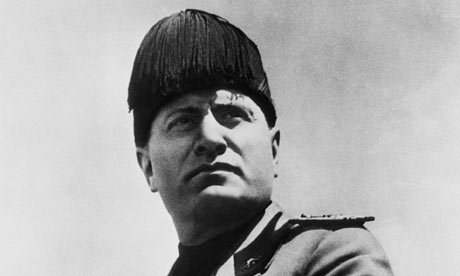
Benito Mussolini gazes into the future, fails to spot the meat-hooks

Benito Mussolini gazes into the future, fails to spot the meat-hooks

Over the past two years, fascism had spread across Europe. The prospect of international conflict topped the political agenda and Mussolini’s threats to forcibly plant spaghetti trees throughout Abyssinia brought matters to a head.

This was the defining issue of the day. And on it, Labour was conflicted.

Read the rest of this entry »

Facebook Twitter Digg Delicious StumbleUpon

UNCUT: The big ideas of 2014 and what they mean for Labour: summing up

01/01/2014, 07:16:21 PM

by Jonathan Todd

I might be perverse and deficient to have enjoyed finding time during Christmas week to assess what Prospect’s big ideas of 2014 mean for Labour. I worry, though, that this is all the time that anyone in Labour has spent on some of these ideas. Larry Summers may, for example, be asking big questions about monetary policy but Labour still has precious little to say on this economically central topic.

Labour not only needs to get our thinking caps on in 2014 but convince the electorate that we have solutions to the big challenges that will face the UK of May 2015. This is a divided electorate. Between the 99% and the 1%, global London and the provincial shires, and those that see government as the problem and those that see it as their safety net.

Another division emerges beyond some of Prospect’s ideas. Between the doers and the downers. The doers are collaboratively consuming, popping up everywhere and making new news. In other words, seizing for themselves the opportunities of our times. Public policy appears barely relevant to much of this, except perhaps to the extent that it has facilitated the digital revolution. Certainly, politics feels marginal to the doers, who are too busy doing to have much care for it.

In contrast, the downers – those fuelling the politics of rejection – are angry with politics. As they are angry with much else. As the doers grasp fresh possibilities, the downers feel all their possibilities have closed down.

Successful politicians must make themselves relevant to the doers, while pacifying the downers. These are very different people, best suited to very different messages. The doers are only interested in politicians if they can enable them to do more. Maybe extending access to devices of more measured lives, while tackling the new risks identified by cloud sceptics, are some means by which this might be done.

Read the rest of this entry »

Facebook Twitter Digg Delicious StumbleUpon

UNCUT: A party preparing for government forgets gesture politics and focuses on what really matters

01/01/2014, 02:13:01 PM

by Kevin Meagher

The relative lack of female train drivers may well be an issue that could do with rectifying, but is it really a “national scandal?”

Mary Creagh thinks it is. The Shadow Transport Secretary gave a quixotic interview with the Daily Telegraph over the Christmas break where she blamed children’s television programme Thomas the Tank Engine for “negative stereotypes,” arising from the lack of women choo-choos.

“The only female characters are an annoyance, a nuisance and in some cases a danger to the functioning of the railway” she said, as the internet rocked with mirth.

When passengers are ruing New Year fare increases while enduring the misery of another year of overcrowded trains it seems indulgent – and unfocused – to alight on gender stereotyping – if indeed it is such a thing –  in a single kids television show (a period one at that) as the top issue for Labour’s frontbench transport team to bother about.

And, it would seem, pointless too. Has the decision of haulage giant Eddie Stobart to name its entire fleet of wagons after women had any appreciable effect on female recruitment into long-distance lorry driving? (Answer: only 0.5% of the UK’s 300,000 truck drivers are women, so, no).

In fairness, Creagh was simply backing a campaign led by train drivers’ union, Aslef. It’s not that the general point about the lack of women in the rail industry is not a worthy one, but it is an undeniably marginal one when Labour is so flaky on the big transport issues like HS2.

Read the rest of this entry »

Facebook Twitter Digg Delicious StumbleUpon