




UNCUT: Letter from Wales: Understanding the Tory threat in Wales

04/12/2013, 07:08:49 PM

by Julian Ruck

Some might argue that without the Falklands War and internal Labour warfare Margaret Thatcher might never have imposed her ‘revolutions’ upon British society. Politics is always about luck (and of course Machiavellian expediency) and let’s face it, she had plenty of it. The grand irony perhaps being, that she dared to increase state control way beyond the temerity of any of her Labour predecessors, a fact often forgotten or ignored by the 21st Century politeness of please all and even their poodles, political endeavour.

No-one would argue that Thatcher’s sons ie Major, Blair and Brown carried her No 10 torch around the globe in one way or another.

So, how has Welsh Labour, and more particularly the Welsh Labour government, evolved over the years of  modern, innovative and more realistic Labour social democracy vs Tory Mammon worship?

It hasn’t, must be the only sensible answer. Years of complacent take for granted mandate has demolished new thinking and allowed the Welsh Labour political elites to wallow in unchallenged bowers of old Labour bucolic detachment and arrogant disregard for the norms of democratic oversight and scrutiny. Welsh Labour has undoubtedly added a new dimension to de Tocqueville’s ‘… socialism seeks equality in restraint and servitude.’

Carwyn Jones, his cabal of Ministers (although to be fair as far I know, there isn’t one Nell Gwyn amongst them), his pliant media apparat have managed to build up a reputation of non-engagement with the Welsh media, such as it is, that would shame even Paul Flowers into going straight!

Read the rest of this entry »

Facebook Twitter Digg Delicious StumbleUpon

UNCUT: The shadow cabinet league: Sadiq takes an early lead

04/12/2013, 12:53:58 PM

by Alan Smithee

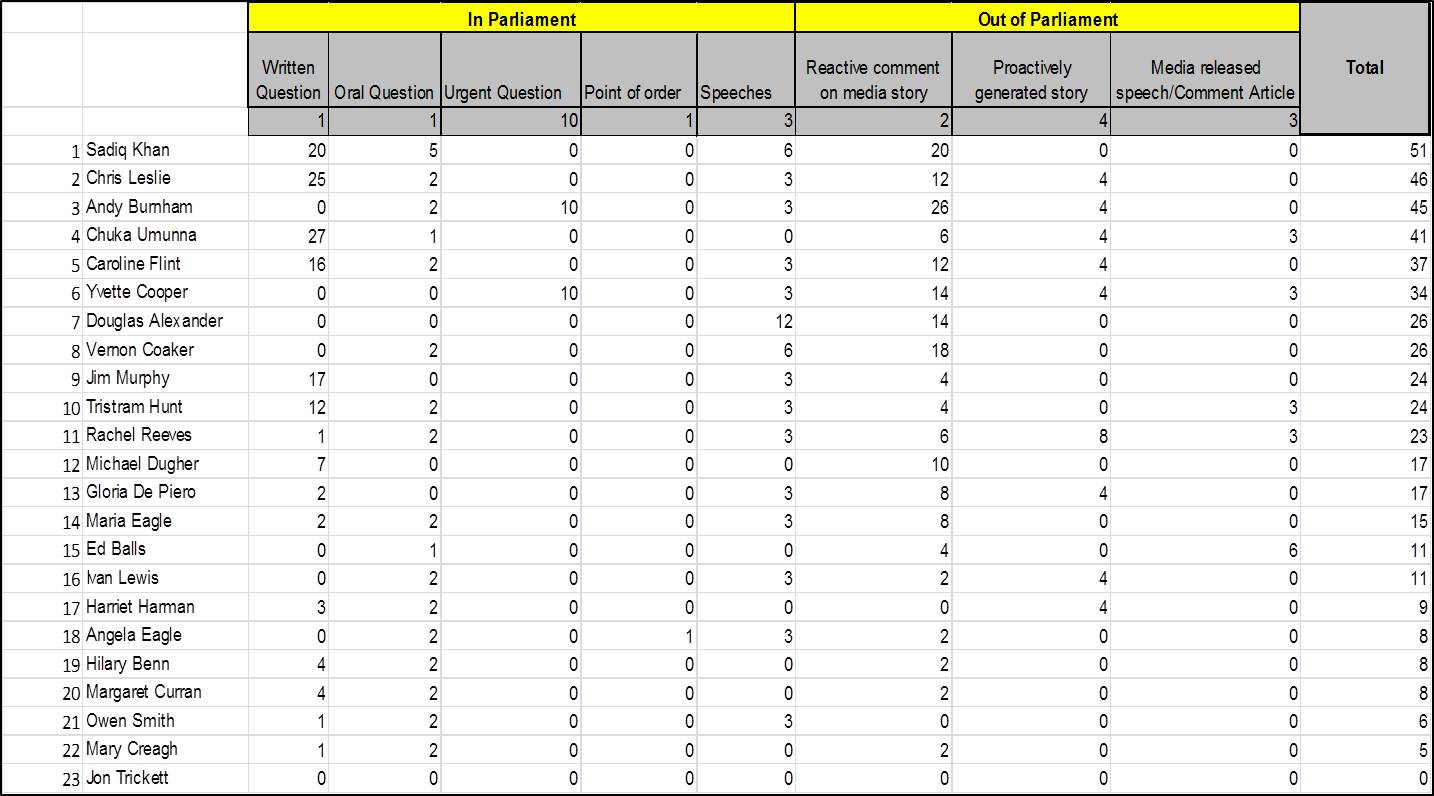
Rebooting a franchise is always a tricky task; for every Batman Begins, there is a Phantom Menace or Superman Returns. This reboot is rather cheaper and less sexy than your average Hollywood blockbuster, having been calculated on open-source software. As it is the first month back, it is hard to draw major conclusions from such a small data of pool. However, there are data points that bear discussing.

Shadow cabinet work rate table - November 2013

Shadow cabinet work rate table – November 2013

Storming into a surprise lead is Sadiq Khan, shadow justice secretary. Much of his media comment and written answers that underpinned his high score have been under-the-radar. He has constantly hammered away at the DoJ on prisons, focussing on rising costs and issues with places. His mayoral ambition seems to be drifting, but he has mastered the skills of opposition and could well turn up a political gem with his relentless digging.

Read the rest of this entry »

Facebook Twitter Digg Delicious StumbleUpon

GRASSROOTS: Labour must hope that Cameron and Osborne do not have Merkel’s political nous

03/12/2013, 07:00:45 AM

by Callum Anderson

On Thursday, George Osborne will give his penultimate Autumn Statement before the 2015 general election. It is likely to be a highly political Autumn Statement. But whilst most of its content has yet to be leaked (at least at the time of writing), save for the likely rolling back of green levies – an attempt by the coalition to tackle the “cost of living” crisis – there is still scope for the prime minister and the chancellor to create huge problems for Ed Miliband and Ed Balls, if they can demonstrate that they are beginning to understand the economic concerns of voters, and shift to the centre ground.

Hopi Sen has already entertainingly set out how Osborne and the Conservatives could steal a march on the two Eds on the ‘cost of living crisis’. Increasing the minimum wage above inflation each year for the next five years, subject to the advice of the Low Pay Commission; raising the tax free personal allowance by £500 each year, and thus lifting millions of people from the burden of tax; reintroducing the 10p tax rate temporarily, benefitting all full-time workers on the minimum wage; and announcing an immediate cut in domestic energy bills, funded by a tax on overseas buyers of expensive property, are just a few measures that would leave the Labour hierarchy scratching their heads as to how to respond.

Indeed, such a strategy has been expertly executed by Angela Merkel, the German Chancellor, since she was elected in 2005. Her Christian Union party (CDU) – Germany’s conservative party – has been the lead partner in the previous two coalition governments: first with the Social Democrats (SPD) between 2005 and 2009, and second with the Liberals (FPD) between 2009 and 2013, and is set to enter another Coalition with the SPD within the next month.

Ms Merkel has been particularly adept in not only keeping the CDU resolutely on the centre ground of German politics, but also shifting the balance of responsibility disproportionately to her junior coalition partners. For instance, during her first term, Ms Merkel astutely took advantage of the unwillingness of SPD members to enter a coalition government with her own CDU to, in the first instance, solidify the “Hartz” labour market and welfare reforms of her SPD predecessor, Gerhard Schroeder, as well as ensure that both parties shouldered the responsibility for the substantial austerity measures taken in response to the 2007-08 financial crisis.

Likewise in her second term, Ms Merkel has been, perhaps too successful, in allowing the FDP to shoulder much of the blame in the slow response to the Euro crisis of the last few years. I say too successful because the FDP, who have traditionally had more in common with the CDU than any other party in the German parliament, crashed at the federal elections in September to such an extent that they have no seats for the first time since 1945.

Read the rest of this entry »

Facebook Twitter Digg Delicious StumbleUpon

UNCUT: Labour history uncut: the Socialist League is sent packing

02/12/2013, 05:55:31 PM

by Pete Goddard and Atul Hatwal

When Stafford Cripps got up to speak to Labour students in Nottingham on the 6th January 1934, the reporters in attendance did not expect too much excitement. A brisk refresher on the Socialist League’s plan for an imminently Socialist Britain, then tea and biscuits if they were lucky.

Addressing the audience, Cripps declared,

“I do not believe in private armies, but if the Fascists started a private army it might be for the Socialist and Communist parties to do the same. When the Labour party comes to power, we must act rapidly and it will be necessary to deal with the House of Lords and the influence of the City of London. There is no doubt we shall have to overcome resistance from Buckingham palace and other places as well.”

The press sat up and took notice.

Because Cripps was airing the possibility of a Labour party private army? No. Because he was suggesting Labour join forces with Communists? No.

The Rubicon that Cripps had crossed was in voicing the great unmentionable, “Buckingham Palace.”

Outrage abounded. Within a day, Cripps had had to issue one of the finest political clarifications ever,

“There seems to have been some misconception of what I intended to convey by the term ‘Buckingham Palace’. I most certainly was not referring to the Crown…I cannot understand why anyone should have thought I was referring to the Crown.”

Indeed, the fools. Its obvious Cripps was talking about resistance to socialism from all those other people in Buckingham Palace. The servants maybe. Or the corgis.

Among the NEC there was a collective rolling of eyes at the gaffe. Dalton was apoplectic while Bevin was disgusted. Fortunately for Cripps though, one senior member of the party continued to back him – a member who also happened to be the acting leader – Clement Attlee. Thus Cripps swapped his red flag for a red face but remained free from formal censure.

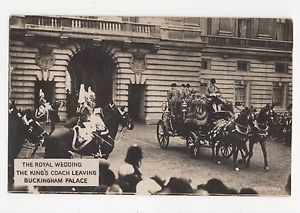
1934 – Riding out to battle the impending socialist army, Buckingham Palace wondered if it should maybe have modernised its forces

1934 – Riding out to battle the impending socialist army, Buckingham Palace wondered if it should maybe have modernised its forces

Read the rest of this entry »

Facebook Twitter Digg Delicious StumbleUpon

UNCUT: The questions facing George Osborne in the Autumn statement

02/12/2013, 07:00:20 AM

by Jonathan Todd

We all live in a George Osborne submarine. Or so he wishes. Doing his work beneath the surface, emerging periodically to bestride events, such as this week’s distinctly wintry Autumn statement.

Osborne saw Gordon Brown use these set piece occasions to determine the terms of political trade. He’s equally keen to exploit his bully pulpit. He faces, though, a number of challenges to doing so:

1.) Has the relationship between economic and Tory recovery broken?

The Autumn Statement is wintry in the sense that it’s being delivered in December. The economy, however, is more mid-March. The darkest days feel behind us and something better nearly upon us.

Given this, Benedict Brogan asked a pertinent question recently: Why are the Tories not doing better in the polls?

The Todd thesis – as Lewis Baston called it – appeared to break down as soon as it was expounded. This thesis was based on a regression analysis of economic sentiment and Labour’s lead over the Tories. It was expounded at the end of October and held that for every 1% increase in the proportion of the electorate reporting the economy as doing well, the Tories would close on Labour by 0.6%. Since then, there has been a 3% increase in the proportion of the electorate reporting the economy as doing well. But, while there is some fluctuation, Labour’s lead has held firm enough to prompt Brogan’s question.

It may be that the Todd thesis will reassert itself over a longer time horizon. If economic sentiment keeps improving, growth in Tory support will eventually catch up. Less positively for Osborne, it may be that the Todd thesis has collapsed because something has happened to disrupt the causality between improving economic sentiment and growing Tory support.

Ed Miliband’s focus on the cost of living may mean that even though people increasingly feel the economy is doing well, they don’t believe this improvement will benefit them, so it doesn’t translate into Tory support. Alternatively, the better people feel about the economy, the less Labour’s reputation for profligacy may trouble them. In better times, Labour becomes a risk worth taking.

Read the rest of this entry »

Facebook Twitter Digg Delicious StumbleUpon

GRASSROOTS: Sunday review on Thursday: The not-the-London-Labour-mayor hustings

28/11/2013, 01:14:49 PM

by David Butler

When is a husting not a husting? When it is a Progress Campaign for a Labour Majority event on winning in London. That all the invited panellists, including the curiously absent Sadiq Khan, are considered potential nominees for Mayor of London was just pure coincidence.

The event was less a tale of two Londons (or One London Labour or whatever today’s vogue is) but of two de Blasios. David Lammy and Diane Abbott sought this mantle both through reference to New York’s Mayor-elect and through the language and policies on offer. Lammy provide a toned down version of de Blasio’s message, whilst Abbott raised the rhetorical and policy stakes, offering a clear left-populist platform. This, and her potential support from the remnants of Ken’s old machine, makes her a serious contender within a party and electorate to the left of the national norm. Even Andrew Adonis and Tessa Jowell, neither of whom particularly fit the de Blasio mould, referenced “two cities” and “One London” respectively.

However, in many ways, it felt like a London housing policy seminar that happened to have a different title. Both Abbott and Lammy announced support rent regulation, albeit with Lammy obfuscating by calling for “fair rents”. Lammy subsequently redeemed himself with an eminently sensible proposal to build housing on the Green Belt. Jowell warned about the impact of the mansion tax on “asset rich but cash poor” families, a rather surprising move in the circumstances; worrying about those who do well out Britain’s over-inflated housing market should not be high up her priority list. As expected, Adonis had the more innovative ideas proposing to explore shared equity schemes and a “housing bank” to take a stake in future developments in order to prevent land banking.

Read the rest of this entry »

Facebook Twitter Digg Delicious StumbleUpon

UNCUT: Two impressions of Policy Exchange

28/11/2013, 07:50:03 AM

by Jonathan Todd

My two visits to Policy Exchange bookend the Tory modernisation project. Early in David Cameron’s leadership, I heard Daniel Finkelstein and Siôn Simon debate what this endeavour might learn from Labour’s own modernisation. Nick Boles, then director of the think-tank, dressed in suit jacket and vest, gave Simon some cheese as thanks for passing into centre-right territory.

Simon came not to praise Cameron’s efforts and Boles recently buried them. So hopeless is the Tory modernisers task that Boles, Cameron’s planning minister, now claims it cannot be accomplished within their own party. A more hospitable adjunct is required.

Perhaps things would have turned out differently had Tory modernisers heeded the insight that Simon gave them. He argued, essentially, that Tory modernisers were taking the wrong lessons from Labour modernisers. The Tories saw Alastair Campbell and thought that modernisation meant slick communication. Actually, it requires much more. What Campbell himself has called “heavy lifting”. Thinking through how traditional values can be applied in a contemporary context.

The values are the end, their policy application is the means, the heavy lifting builds new means to achieve timeless ends. This approach updated the revisionisms of earlier Labour pioneers, like Tony Crosland and Hugh Gaitskell. Cameron’s only fixed end, however, was to become prime minister. His lack of an animating purpose has left him seeming inauthentic and his administration bereft of ballast, easily knocked off its stride.

Read the rest of this entry »

Facebook Twitter Digg Delicious StumbleUpon

UNCUT: The real reason why the Co-op saga is bad news for Labour

27/11/2013, 07:01:39 AM

by Rob Marchant

First, let’s get a few things straight. The Co-op Bank is not the Co-op Group, and is not the Co-op Party, a separate political party which sponsors MPs, among other things. Problems for one does not necessarily mean disaster for all three.

And there are two further stories currently being bandied around, both fallacies. And a third story, which no-one seems to be telling, which is the truth.

Fallacy one: the Labour Party is tainted with the scandal of Paul Flowers. Tosh.

It is no more Ed Miliband’s fault that his banker was found to have dodgy personal habits and was not apparently a very competent chairman, than it is any of the thousands of business or charitable customers of the bank who were similarly disappointed. No, the attempt to link Flowers to Labour is a rather desperate attempt by the Tories and right-leaning newspapers to succeed where they have largely failed in getting the public’s attention over Falkirk; a matter over which, in stark contrast to the Co-op, the party’s behaviour is open to serious question.

Fallacy two: the Labour Party will be broke because of the loss of donations from the Co-op. Wrong. There are currently 32 MPs sponsored by the Co-op Party who have been told, according to the Guardian, that they might face a 30% cut in funding. What is the worst that can happen to them? Well, it’s that they might have to do what other MPs do: raise funds themselves to fund their constituency offices. So what?

A bit of a back-of-the-envelope calculation: funding of the Labour Party during the first ten months of 2013, above the minimum donation threshold, from organisations containing the word “Co-operative”, amounted to the princely sum of £17,478.25 (by all means check my calculation at the Electoral Commission here). Even allowing for a margin for error, compare that to the millions the party receives annually from trade unions and you can see how ludicrous it is to think the party’s funding will be seriously hit.

The third point is not a fallacy, sadly, but it is the one no-one seems to be focusing on.

Read the rest of this entry »

Facebook Twitter Digg Delicious StumbleUpon

UNCUT: The real reason Labour will never publish the Falkirk report

25/11/2013, 09:40:30 AM

by Atul Hatwal

Yesterday Labour members in Falkirk gathered for their annual general meeting. They elected a new party chairman, Gray Allan, and once again the party attempted to move on from the disastrous parliamentary selection process. The new chair’s first statement clearly frames the date for the new selection vote as the point where the party will try to claim closure,

“On 8 December, in Falkirk, we will select a candidate to fight this seat for the next general election. The priority for us is to work to regain the trust of the people of Falkirk so that we can be confident of a victory in this constituency.”

But no matter how much the party wants the Falkirk farrago to go away, there is a problem.

The constituency remains in special measures, Labour HQ is running the selection process and no CLP member who joined later than March 12th 2012 can participate in the vote. All of this despite the official party line being that no group or individual has been found to have broken any rules.

This contradiction is the reason the questions keep coming. The missing link is the unpublished report into the selection process conducted by Labour officials.

The report was the basis for the action taken in Falkrik and sets out the detail of what went wrong. The allegations contained in it ignited civil war within the Labour movement between the party leadership and Unite and have driven media coverage so catastrophic that Gray Allan was moved to talk about regaining “the trust of the people of Falkirk” if Labour is to win again in what should be a rock solid Labour seat.

Until the report is published, it will be impossible for Labour to successfully move on.

Read the rest of this entry »

Facebook Twitter Digg Delicious StumbleUpon

UNCUT: Letter from Wales: Welsh Labour is damaging Ed

22/11/2013, 10:12:21 AM

by Julian Ruck

The search lights of accountability and scrutiny will always make Welsh Labour dive for the blacked out sanctuary of its pleasure cruisers bobbing up and down in Cardiff Bay. For 98 years Welsh Labour has been able to wallow in a take for granted mandate that enjoys the unchallenged absolutism of a House of Saud princeling.

Almost every day in Wales, some political scandal or other hits the Welsh headlines, be it financial, be it authoritarian or be it just plain blazing incompetence. Wales has one of the lowest performing economies in Europe, it’s education system is cheating its young folk on a grand scale and awarding them qualifications that would shame a Zimbabwean Sunday school class and not to mention that only this week the Wales Audit Office has announced that the Welsh government has blundered (yet again!) over its financial projections on reduced student fees resulting in its populist flagship now being nothing better than a clapped out rowing boat.

And of course, its health service is worse than England’s on a good day – which really is saying something!

And what does First Minister Carwyn Jones say at the September Labour conference? That he leads a government that is ‘a living, breathing example” of what the party can achieve in in power!! How on earth Ed kept a straight face on hearing this startlingly complacent, Chamberlain letter waving delusion and swansong of profound idiocy is utterly beyond the keyboard of this humble Uncut scribbler.

The question then is this: Can Ed rely on the historical Welsh Labour mandates of the past? Hegel remarked that ‘governments never learn from history, or act on principles derived from it.’ The lessons of Welsh political history would instruct Ed to take the Labour vote for granted in Wales thus proving Hegel wrong but since when, like economic forecasts, do philosophical meanderings always get things right?

There is a view that our young are politically indifferent. This may well be true up to a point, but they are still a force to be reckoned with – technological whizz and bangs notwithstanding –  and cannot be ignored. Welsh Labour can no longer rely on the generational ‘My dad voted Labour so I’m going to do the same,’ or indeed the oft quoted ‘Stick a Labour donkey up in Swansea and it will still get the vote.’

Read the rest of this entry »

Facebook Twitter Digg Delicious StumbleUpon