GRASSROOTS: Could we, or should we win again? Paul Bower on his difficult relationship with Labour

20/08/2010, 03:00:32 PM

I left the Labour party in March 2003 when the bombs began to fall on Baghdad.  This ended a formal relationship that began on 4 May 1979, when I joined the day after Thatcher was elected.  My Labour leanings had roots in my childhood in a small Sheffield terrace with no bathroom.  One of my earliest memories is of my dad explaining to me why Harold Wilson and not Alex Douglas Home should lead the country. My dad died in 1968.  He was a toolmaker in a family firm where conditions were Dickensian. Health and safety was non-existent and there was no sick pay or pension.  He didn’t trust politicians, but he told me that Labour were our best hope. He suffered from a series of lung diseases and his life was saved by the NHS on at least three occasions starting in 1949.  If Nye Bevan and Clem Atlee had not created the NHS I would not have been born.              

In between working with bands like ABC, The Human League and Heaven 17 I campaigned vigorously for Labour. In the 1983 election I argued with voters who looked at you incredulously when you explained that Michael Foot should be Prime Minister. In 1985 I played a small in part setting up Red Wedge, the collective of radical musicians, comedians, writers and film makers who attempted to engage young people with politics and encourage them to listen to what Labour had to say. We supported Neil Kinnock’s efforts to bring the party into the modern world without losing its passion and principles.  We liked Neil.  

Read the rest of this entry »

Facebook Twitter Digg Delicious StumbleUpon

GRASSROOTS: Our new leader will need to ‘fess up, stop spinning and start inspiring, says Sally Bercow

20/08/2010, 11:30:10 AM

At a drinks party recently, I got chatting to someone who said that if Labour is to win the next election, it needs ‘rebranding’. This chap did something in marketing, so he would say that wouldn’t he. Nevertheless, it was rather depressing to hear, and in my view it is wrong to boot. Our party is not a packet of sweets or a jar of coffee awaiting new packaging; in fact that is precisely where the last Labour government went wrong – by substituting idealism and vision with spin. Our new leader must break decisively from the past; he (for it will be a he) cannot simply change the advertising agency (although he should definitely look at that), rehash what’s gone before and embark on a rebranding exercise.

Encouragingly, all five Labour leader candidates seem to appreciate this – at the moment. However, the persuasiveness of the spin doctors, advisers and pollsters that will flock around our newly elected leader should not be underestimated. They will bandy about empty phrases like ‘progressive centre left’ whilst arguing that Britain is fundamentally a deeply conservative country and so Labour dare not move more than a milimetre to the left of the Coalition. As a result, the temptation will be to tinker at the edges and carry on much as before, banking largely on the Con-Libs becoming increasingly unpopular. This will not wash. It does not, however, mean lurching drastically to the left on every issue. What it does mean is fashioning a new approach based on three concepts.

First, if Labour is to start to regain the public’s trust we have to be brutally honest about where we got it wrong and (dare I say it) where the coalition might be right. ‘Fessing up to a few oversights; even ones as significant as being too soft on the bankers and allowing the state to become too controlling, will not cut it. Our new leader should own up lock, stock and barrel – even though they might find it a bit awkward because they sat in cabinet at the time. With a bit of luck, the new leader will admit to Labour’s mistakes in areas including civil liberties, ID cards, prisons, housing (or more accurately the desperate lack of it) and the digital economy, then duly consign those policies to the scrapheap.

Simultaneously, and this does not come naturally to the more tribal amongst us, we will earn the public’s respect if we stop trying to score points for the sake of it and actually admit it if the Coalition has a case. It is simply not credible for the new leader to roundly condemn every single one of the coalition’s policies and planned cuts.

Second, on the back of such unflinching honesty, our new leader can go into battle. He must defend the last Labour government, who left a better, fairer, more tolerant country with transformed public services and an economy saved from depression. He must expose the chronic iniquity and manic ideology of the coalition’s policies and seek to thwart or temper them. And, most importantly of all, he must set out a clear, attractive and viable alternative.

Third, beyond adopting this new honest approach, Labour needs to develop a new programme. This should be done not by pandering to media prejudice, by shifting according to fluctuating opinion polls or by becoming overly cautious. Instead, we must craft an inspiring credo, driven by progressive Labour values, which has the potential to improve the lives of the mainstream majority in a way and on a scale that this right-wing government cannot imagine, let alone deliver.

It is time to rediscover our principles, our values and our idealism. An unerring focus on social justice – fighting for a fairer, more equal Britain – coupled with economic dynamism should be at the heart of our new programme. This focus on social justice will mean taxing the rich more, reducing the gap between the haves and the have-nots, creating more affordable housing, reducing the ugly disparities in educational achievement and thereby paving the way for a more socially mobile Britain.

Economic dynamism will mean an explanation of how we would reduce the deficit (by credible spending cuts and bold, but fair, tax rises) and over what timescale. In addition, we must develop a clear plan for growth and an active industrial policy (investing in manufacturing, green industries and apprenticeships), so that we can create a broader, more balanced economy, rather than the skewed, misshapen and city-driven creature of neo-liberal economic theory.

Labour’s new programme must not be imposed from the top but fed and informed by people in communities across the country who have something to tell us and hold our fate in their hands. Never again must we allow ourselves to become so aloof and out of touch. This means listening to and engaging with our councillors, activists, trade unionists, rank and file members and, above all, those who either deserted us in the polling booths or didn’t bother to turn out at all.

Every government runs into trouble and the coalition will be no exception. The biggest mistake would be simply to wait for them to lose the next election. Instead, Labour needs to ‘fess up, stop spinning and start inspiring millions of voters by fighting for a fairer, less divisive and more equal Britain.

Sally Bercow
Facebook Twitter Digg Delicious StumbleUpon

UNCUT: Changing the record on politics: Peter Jenner talks sex and drugs and rock and roll

20/08/2010, 09:00:47 AM

 Labour was not too bad on sex. Gay rights, single parents, sex education, civil unions, AIDS treatments, STD education, general openness of discussion of sex issues, problems and possibilities. These all added up to a pretty positive development in the social environment. Chronic British uptight-ness, prejudice and repression were dealt with in social life and interaction, the arts and education. It made a Britain a better place to live in. 

In contrast, the treatment of drugs was a classic opportunity lost; fear of every hysterical headline demanded a conservative response. Drug czars, the war on drugs and experts on the misuse of drugs sacked or resigned all played to the worst of Labour’s populism and PR directed policy responses. Alastair Campbell and Peter Mandelson orchestrated a mindless response to the drug problem, despite all the evidence that repression and prohibition was having little if any positive effect, and that the most dangerous thing about drugs were that they were illegal.  

Read the rest of this entry »

Facebook Twitter Digg Delicious StumbleUpon

UNBOUND: Friday News Review

20/08/2010, 08:07:26 AM

The campaign crosses the border

“The Shadow Energy Secretary, who today begins a three-day tour of Scotland with a visit to Govan shipyard, is said by his camp to have secured most first-preference votes among Labour MSPs and is doing “particularly well” on second preferences among Scottish Labour MPs.  A source close to Ed Miliband told The Herald: “We are not taking anything for granted but are encouraged by the response among Scottish parliamentarians. We’re confident that, by the time people vote, Ed will have majority support in Scotland.” – The Herald Scotland

“Ed Balls explaining why he thought he was not doing as well as his opponents north of the Border: “It’s partly having had an English portfolio. It’s partly through people thinking to themselves we need to move beyond Gordon Brown and I started off as being the person three months ago who was closest to him.” – The Herald Scotland

The Philip Green agenda

“Sir Philip has been hired to advise on Whitehall efficiency. His wife Tina is a Monaco resident and as owner of Arcadia received a £1.2bn dividend in 2005 on which UK tax did not have to be paid.  Alastair Campbell, the former Downing Street spin doctor, said the deficit would already be smaller if billionaires paid the same amount of tax as everyone else.” – The FT

Read the rest of this entry »

Facebook Twitter Digg Delicious StumbleUpon

GRASSROOTS: Battle of the stats: Oona King’s campaign manager rebutts Steve Hart

19/08/2010, 08:00:29 PM

This article is a response to an article from Steve Hart based on his pamphlet ‘Who can beat Boris?’

Beware those bearing false statistical comparisons and wishful thinking. Steve Hart’s argument that Ken Livingstone is more popular than Labour is based on a flawed set of assumptions that, don’t stand up to scrutiny.

Steve claims that in 2008 Ken Livingstone out performed London’s MPs in the 2010 general election; and in so doing, he makes a totally false comparison. The mayoral election in 2008 was a London-wide election that was effectively a two-horse race – and voters understood it this way. The Liberal Democrats (and smaller parties) weren’t competitive and many voters simply voted with a major party without going through the charade of transferring their vote.

The general election in London was, in contrast, effectively more than 70 local races. Many of which the Liberal Democrats were competitive in – either where they already held MPs, in say Steve and my own constituency of Hornsey & Wood Green or Richmond or where they were hopeful of taking MPs: Islington South or Hampstead & Kilburn. This meant their vote was motivated to stick with them, rather than to stop their least favorite as was the case in the 2008 mayoral election.

Read the rest of this entry »

Facebook Twitter Digg Delicious StumbleUpon

UNCUT: We should all be in the dock on immigration, says Dan Hodges

19/08/2010, 05:12:35 PM

Next month, a special election court will rule on whether Phil Woolas’ 103 vote general election victory in Oldham East and Saddleworth will stand. The verdict will hinge primarily on a number of leaflets distributed during the campaign, which were the subject of a complaint by Lib Dem candidate Elwyn Watkins. The leaflets themselves, which were doing the rounds on the internet and Twitter over the weekend, relate to the ongoing debate over race  migration and religious fundamentalism, and given the sensitive nature of the allegations. It would be inappropriate to go into details here.

However, the Oldham case has thrown into sharp focus one of the most difficult, controversial – and in my view defining – issues we face as a Party. Our stance on immigration.

Some cards on the table. I’ve known Phil Woolas for twenty years. He was in the front line campaigning against racism and prejudice long before he sets his sights on a Westminster seat. I saw  first hand how, behind the headlines, as a home office minister he tried to push the case for a fairer, more progressive immigration and asylum system. Those people trying to pin Phil to the wall are missing the bigger picture.

Read the rest of this entry »

Facebook Twitter Digg Delicious StumbleUpon

UNCUT: Government transparency in the age of austerity? I won’t hold my breath, says Vincent Moss

19/08/2010, 03:00:44 PM

Something strange is going on in Downing Street. Workers are removing “Tony Blair’s mirrored gym”, ripping down a wall and installing a lavish new kitchen, we are told, in the flat above Number 11 – the London home of David Cameron and his family. Meanwhile, the Camerons are enjoying the first week of their holiday at the PM’s country retreat Chequers, with its tennis court, heated pool, and staff to attend to their every need on the 1,000-acre estate.

 That’s a bit odd too, given Downing Street initially led the media to believe they’d be in Cornwall this week. But does any of this really matter when up to 500,000 public sector workers are facing the sack in the tightest spending squeeze in living memory with every pound of the public finances under scrutiny? Yes, it does.  As chancellor George Osborne (who has the run of the croquet set at his country residence of Dorneywood) keeps telling us: “We are all in this together”. 

Both men are making far greater use of these pads, more suited to rock stars than to servants of the people, than their Labour predecessors.   And, while the residences are funded via charitable trusts and not taxpayers’ cash, Cameron’s and Osborne’s growing fondness for their new homes sits uncomfortably with their rhetoric about austerity Britain.

When it comes to the Camerons’ flat above No11, the media were initially told that the family would be shelling out for all the work in the building.   According to the Sunday Telegraph, it now looks like they may only pay any costs above £28,000. We’re also told the main Downing Street kitchen is also getting a major makeover.  Is that a top priority in these difficult times?  How much is that costing? Only days ago, communities secretary Eric Pickles courageously revealed details of all the spending Labour made over £500 in his new department during Gordon Brown’s last year in power.  Pickles insisted this was all in the need of greater openness and transparency and challenged other Whitehall departments to do the same.  “This department, like the rest of Whitehall, needs to look at where every penny is going and getting this data out in the open will help that process,” maintained Pickles.  Although I’m not sure the edict has yet extended to the chauffeur-driven Jaguar that Pickles reportedly enjoys courtesy of the taxpayer.  

It’s a similar story when it comes to the cash being poured into the revamp in Downing Street.   Digging around for a bit of Pickles-style “transparency”, I find Labour Uncut’s guest editor Tom Watson has already fired in questions in the hope of some clarity.  So far, nothing has emerged.  Why?  Haven’t they got the Pickles memo yet? If we really are all in this together, Cameron and his ministers should be leading by example.  He should start by publishing all the spending on the renovations on his taxpayer-funded Downing Street flat.  And then, he should insist that all Whitehall departments publish all their costs over £500 on a quarterly basis. I won’t hold my breath.

Vincent Moss is political editor of the Sunday Mirror Group

Facebook Twitter Digg Delicious StumbleUpon

UNCUT: Politicians must show greater personal humility and political courage, says John Kampfner

19/08/2010, 12:05:36 PM

In a recent comment article I wrote about my hopes and fears about the new coalition. To put it another way, to what extent did I regret my decision, which I explained in a pamphlet I launched with Nick Clegg and a shorter accompanying piece in the Guardian back in March, to endorse the Liberal Democrats?

As a self-professed left-liberal, surely I must have been feeling sore when my newly-adopted party jumped into bed with the Conservatives? No, I wrote, I felt neither betrayed nor chastened. Awkward sometimes, nervous pretty much every day, complacent, never. It has not been an easy decision, particularly when the odd blogger embarks on a customary “Judas is a term too good for you” green ink rant.

But when Tom Watson asked me to pen a few thoughts on what might entice me back into the Labour fold, the offer was too sensible to resist.

I don’t see the issue of allegiance as a simple trade-off. One of my strongest criticisms of Labour, whether “new” or “old”, was its tribalism. I have not swapped one tribe for another. My appeal is for a broader based pluralist politics, embracing the best from all parties, and none. Some of the strongest politics is taking place far away from the musty building in SW1 where MPs reside, and in which the public has so little faith. Much of it revolves creating a more liberal Britain.

But back to Tom’s question. I’ll break it down into three main areas: policy, vision and behaviour.

Policy: Labour achieved some notable successes, from the minimum wage to civil partnerships, but its actions were determined essentially by cowardice and fear. Whether Iraq (Blair’s ingratiation with Bush) or the banks (bail-out plus supine non-regulation), Labour was fearful of the Right. It played to the lowest common denominator. It was authoritarian on criminal justice and weak on political reform. Contrast its criminal-justice agenda with the last three months which have seen ID cards abandoned, stop and search abandoned, child asylum-seeker detention abandoned.

Vision: In all the 13 years of the Labour government, I could not fathom what the vision was. What was the abiding principle? I concluded, with reluctance, that the most important priority was to win, and to keep the other lot out. A tribe is a group based around social affinity and common interests; it is not a vehicle for change or inspiration.

Behaviour: It was this ideological emptiness that led the Labour machine to behave in the way it did. By ‘machine’, I mean the inner core around Blair and Brown. I exclude a number of ex-ministers and MPs who acted with greater self-knowledge, people like Robin Cook, Mo Mowlam (both sadly long departed) and Jon Cruddas. Peter Mandelson’s book provides the definitive word on the narcissism and bullying that we all wrote about – and were denounced for writing.

So where does Labour go from here? The leadership contest has been unedifying. This is due to its length, to its narrow audience, but also to a more fundamental lack of ideas. In the absence of Cruddas, I hope that Ed Miliband wins. But the victor will achieve little if he does not ensure that Labour searches its soul.

The party needs to ask why, at the height of public anger over the banks, it was the Left and not the Right that received a kicking across Europe? The critique needs to go beyond media ownership (valid though that point is) and incorporate imaginative and self-critical thinking about the role of the state and individual in a world that long ago moved on from Bevan and bed pans.

The coalition faces a rocky road ahead. Many people will suffer as the cuts bite. I will be as critical as the next person. I don’t see politics as a zero-sum game; you’re with us or against us. Britain needs a credible Labour opposition and when the times comes a Labour government of some sort again. It won’t happen until its politicians show greater personal humility and greater political courage.

John Kampfner

Facebook Twitter Digg Delicious StumbleUpon

UNCUT: Billy Bragg: what the next leader must do to win my vote for Labour again

19/08/2010, 09:00:13 AM

I live in one of an estimated 80% of constituencies where the result is a foregone conclusion. West Dorset is a ‘safe’ Conservative seat. With Labour stuck at around 10%, a vote for the local candidate would be a somewhat futile gesture. Instead, I have voted tactically for the Lib Dems in the past three elections in the hope of unseating the Tories. Although they always win, the majority of us vote against the Tories. This tactic has brought us some success; in the neighbouring constituency of South Dorset, a Labour MP – the first for 40 years – was twice elected with the support of Lib Dem tactical voters.
 
Our local anti-Tory coalition has been shattered by the national Tory/Lib Dem government, making my choices at the next election very limited. No longer willing to vote tactically for the Lib Dems, I am left with the prospect of walking down to polling station in the sure knowledge that voting Labour will make no difference to the outcome. It’s a dilemma that millions of other potential Labour voters around the country will face if the next election is fought under first past the post; would you bother going to a football match if you knew that your team all had their legs broken before the game? 
 
It is even more frustrating when you look at the size of anti-Tory vote. Under a fairer voting system, the Tories could be defeated. Although AV is not the proportional change that I had hoped for, it does have the potential to re-engage Labour voters disenfranchised by FPTP. To get me to vote Labour again, a new leader of the party would first have to make my vote count. A strong campaign in favour of AV by the new leader of the Labour party would have my active support.
 
Having made my vote count, the new leader would then have to give me something to vote for. The party desperately needs to remember why it was formed; to defend ordinary people from exploitation by a financial system that refuses to accept any responsibility for the inequality that it creates.
 
As the coalition government go beyond the requirements of deficit reduction to make ideologically motivated cuts to public services, the new leader of the Labour party needs to make the case for the collective provision of health care, education, housing and pensions as the best way to protect the majority of citizens from the insecurity that has accompanied globalisation.
 
Five million Labour supporters went AWOL between 1997 and 2010. They didn’t switch to the Tories, most of them simply stopped voting for a party that they felt no longer stood up for their interests. To win them back, the party needs to make an ideological commitment to significantly narrowing the gap between rich and poor. And you can’t create a fairer society without a fairer voting system. 
 
The fact that neither Labour nor the Conservatives were able to win a majority at the last election suggests that our democratic discourse has become stale, the electorate jaded. A Labour party that sided with the Tories to defend the status quo in the AV referendum would only serve to undermine enthusiasm for a new leader.
 
Instead, the party needs to use the referendum as a shop window for radical policies that engage a new generation of activists and supporters who want to live in a society where the interests of the people come before those of the markets.

Billy Bragg

Facebook Twitter Digg Delicious StumbleUpon

INSIDE: It’s a hard life: The rapidly ageing MP for Barnsley East

19/08/2010, 08:30:23 AM

The strains of public office have taken their toll on many a man.

Remember how Blair greyed; his once youthful, grinning face wrinkling  in the heat of coal-face politics. Holding the jenga coalition together, shiny Dave Cameron has followed suit and sagged. Even the political Peter Pan Barack Obama suffered ‘silvering’; ageing prematurely under stress.

But now, news reaches Uncut of an extreme case. The first of the class of 2010 has been hit by the phenomenon.

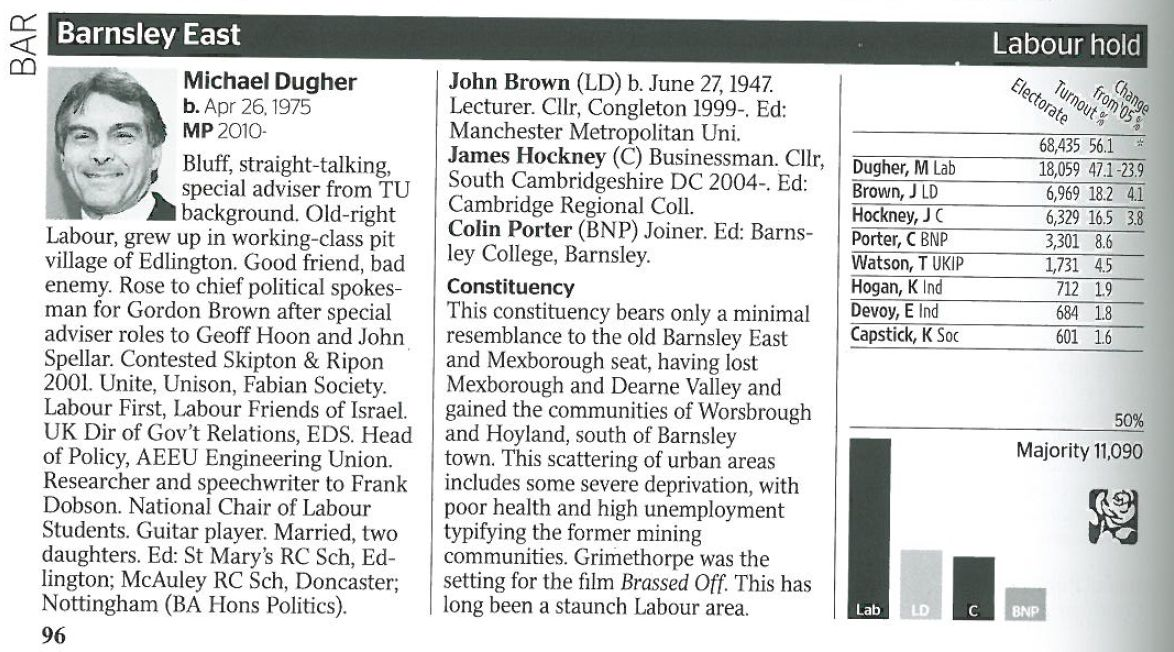
New MP for Barnsley East, Michael Dugher, was previously known for his boyish good looks. Even after his pit-town upbringing, there wasn’t a crow’s foot in sight. Here is a snap of fresh-faced, dewey-eyed Dugher in all his pre-election glory:

And here he is, sporting a glamorous centre-parting in the reasonably priced £55 Times Guide to the House of Commons 2010:

Poor boy.

(Note to Times guide researchers, if you got confused by the 9th April post; Michael is the one on the left. The one whose picture is plastered all over the rest of the site.)

Facebook Twitter Digg Delicious StumbleUpon