




UNCUT: Six reasons why Labour should rule out an SNP deal

11/03/2015, 02:26:41 PM

by Rob Marchant

There is a rule in electoral pact-making, and pretty much any card game, which is fairly universal: don’t show your hand to the other players.

That is, don’t rule anything in and don’t rule it out. You have nothing to gain (you can fritter away your negotiation leverage when agreeing the pact) and everything to lose, in the event that you find yourself in a different situation from that expected and have to eat your words. Obvious, really. Wait until the moment comes and deal with things when you have all the information.

But it could also be argued that there one sensible exception to that rule: if the mere hint of a pact with another party could be damaging to yours even before the election. Especially when things are balanced on a knife-edge and almost anything could affect the result.

That has never really been the case with the Lib Dems: until 2010 they were a slightly dull, modestly successful and broadly respectable opposition party, whether we liked it or not. Now they are bloodied with the hard work of actual government and potentially facing a big hit at the polls, they are possibly less attractive partners. But neither are they toxic.

The same cannot necessarily be said for some other parties. Cameron would have to tread very carefully indeed in the unhappy event of ending in a coalition with UKIP, unlikely though that might seem – the toxicity of some of its members could sit ill with his (mostly) respectable party.

But worse still is the idea of a partnership between Labour and the SNP. Here’s why.

Read the rest of this entry »

Facebook Twitter Digg Delicious StumbleUpon

UNCUT: Enjoy your daily paper during the campaign. It might not be there next time round

10/03/2015, 01:17:46 PM

by Atul Hatwal

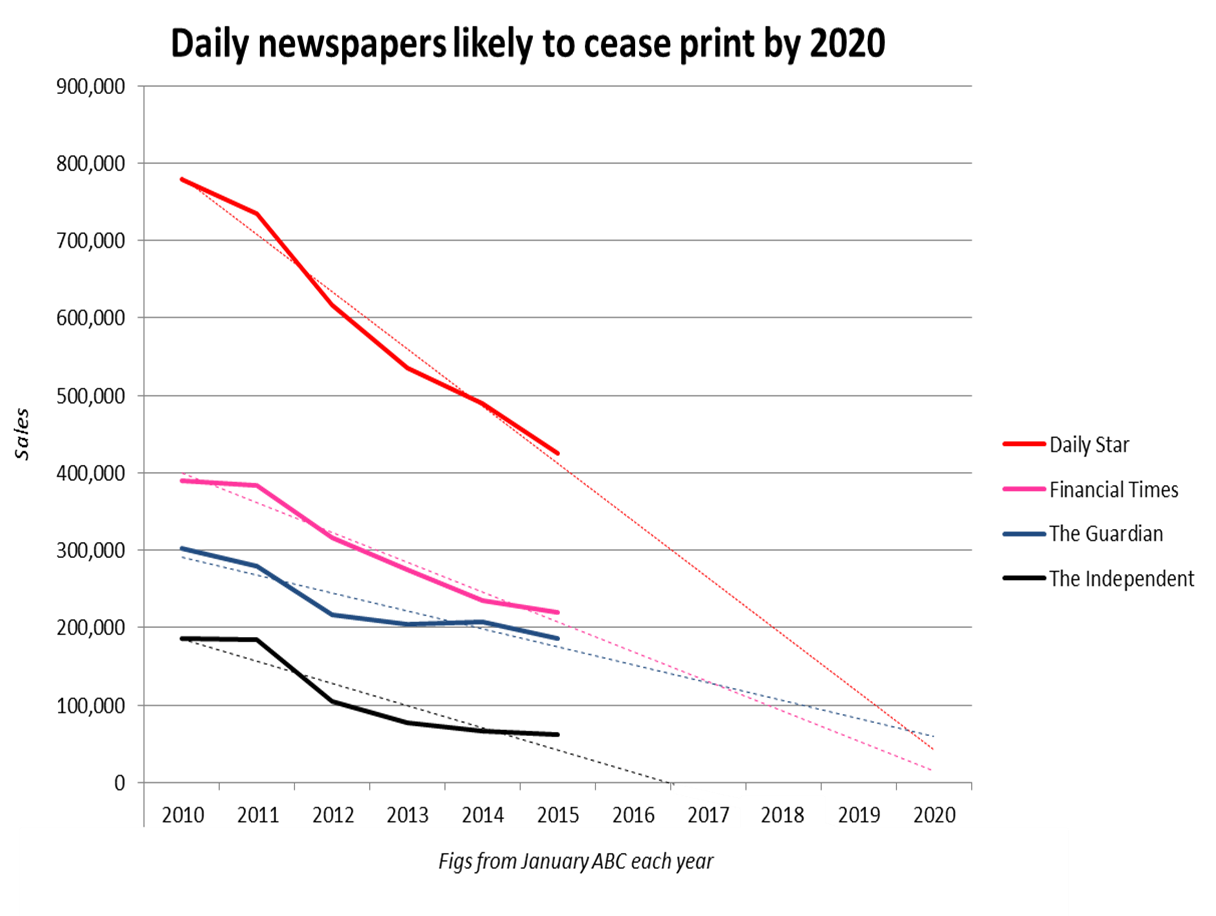
This election will be the swansong of an institution which has dominated the media landscape for well over a century: the daily newspaper.

By 2020, if the trends established over the past five years continue, four out of 11 daily newspapers will likely have ceased print production.

Old certainties will crumble: the Sun will set – it will no longer have the biggest daily print circulation – and the Telegraph’s commanding lead as the most popular of the old broadsheets will almost entirely evaporate.

The papers likely to cease publication by 2020 are the Independent, the Guardian, the Financial Times and the Daily Star.

Dailies cease print 2020 v2

The Independent will probably be the first to end its print run. If the trend in print sales over the past five years continues, then it will literally run out of readers at the start of 2017.

This does not of course mean the Independent will cease to exist. It can continue online but unless the Lebedev family, or a new owner, is prepared to fund the print run of a paper that absolutely no-one buys, there will be no Independent newspaper in a couple of years.

Compared to the Independent, the Guardian seems relatively healthy. With 185,000 daily sales it still has a significant audience. However, by 2020 a combination of the high operating costs of print and declining sales will tip the balance towards the end of the physical newspaper.

Read the rest of this entry »

Facebook Twitter Digg Delicious StumbleUpon

UNCUT: The northern road to prime minister Miliband

09/03/2015, 01:09:09 PM

by Jonathan Todd

You wait an eternity for a female Cumbrian MP and then two seem set to come along at once. Lee Sherriff, Labour’s candidate in Carlisle, is regularly applauded in speeches by shadow ministers. Sue Hayman has more recently been selected by Labour to fight Workington, a seat the party has invariably held throughout its history.

Polling by Lord Ashcroft suggests that Sherriff is set to turn around the 853 majority of Conservative MP John Stevenson. Iain Dale also calls the seat narrowly for Labour. Assuming Labour suffer no Cumbrian losses, this would give Labour at least four of the six Cumbrian seats.

Labour faces tougher fights in Westmorland and Lonsdale, where Tim Farron defends a majority of over 12,000 for the Liberal Democrats, and Penrith and the Border, a Conservative citadel, granting Rory Stewart a majority of over 11,000. These seats have never been red and cover much of the Lake District National Park, which draws visitors from across the globe. The more Labour inclined seats have their charms but are less well travelled.

Stevenson is Carlisle’s first Conservative MP since Ronald Lewis won the seat back for Labour in 1964, the year Harold Wilson first became Prime Minister. In 1983, an unhappier general election year for Labour, the party’s commitment to unilateral nuclear disarmament allowed Cecil Franks, the Conservative candidate in Barrow and Furness, where the building of nuclear submarines has long been a major source of employment, to ask at every opportunity: “If Labour gets elected, what will the lads do on Monday?”

John Hutton defeated Franks for Labour in 1992, meaning that four of the six Cumbrian MPs again were Labour, but it took another five years for the government to become so too. If Sherriff were to win Carlisle, it might herald another period in which four of the six Cumbrian MPs are Labour but the government is not. Equally, Carlisle is the kind of seat to give Ed Miliband hope.

As average weekly earnings in Carlisle lag the average for Great Britain by around £120, it is a place where Labour’s cost of living focus is likely to have had resonance and decisions taken by the Tory-led government are unlikely to always have been well received. With diligent local campaigning, it should be possible to transfer this grievance with the government into support for Labour. A recent profile in the New Statesman indicates that Sherriff is providing such campaigning with aplomb.

Read the rest of this entry »

Facebook Twitter Digg Delicious StumbleUpon

GRASSROOTS: Just not good enough – a story of Labour selection

06/03/2015, 03:49:55 PM

by Paul Wheeler

I had an interesting conversation with a well connected Labour councillor recently. We both had an interest in a recent Parliamentary selection contest.

His preferred candidate won and it was clear why. He had the better website, he had been full time contacting members for months, he was bright, articulate and union sponsored. In fact he was so well organised he even got his supporting union to provide a breakfast to ensure his supporters turned up for the early morning selection meeting. As my new friend put it cruelly but accurately my preferred candidate ‘just wasn’t good enough’

And he was right. He ran a slip shod campaign with a pretty poor website and relied on old contacts and promises. All he had going for him was that he was born and bred in the constituency and as a leading councillor had helped turned the town around when everyone else had written it off.  Critically for a lot of new members to the area he hadn’t been to university and was therefore not ‘quite up to the job’ of being an MP.

Read the rest of this entry »

Facebook Twitter Digg Delicious StumbleUpon

INSIDE: Don’t blame Cameron. A sitting PM would be mad to agree to TV debates

06/03/2015, 07:00:28 AM

The gap between being in opposition and government is thrown into sharp relief by the debate (squabble?) around televised election debates.

Don’t blame David Cameron for not wanting to have them. No sitting prime minister in his or her right mind would willingly choose to participate. The stakes are stacked against you from the start.

Most obviously, you are defending a record while the other participants are free to attack it.

What’s more, the prep time needed to brief a prime minister is massively greater than that needed to pick at their record.

For a leader more popular than his party, having Cameron grounded in London rehearsing how he defends his record across the board is wasted time for the Tories.

Prime ministers, even those as callow as David Cameron, appreciate that being in government is a complex business.

It’s made harder by the fact that a prime ministerial brain will be stacked full of the nuance of policy issues, making instant snappy rebuttals hard to craft on the hoof.

Read the rest of this entry »

Facebook Twitter Digg Delicious StumbleUpon

UNCUT: Nigel Farage doesn’t understand his own policy. Net migration would be 200k not 50k under Ukip

04/03/2015, 10:34:41 AM

by Ranjit Sidhu

On the Today programme this morning, Nigel Farage demonstrated that he did not understand his own immigration policy. He talked about targeting annual net migration in the range 20-50,000 while describing measures that would mean net migration under Ukip would actually be over 200,000.

Here’s why Nigel Farage got it so badly wrong.

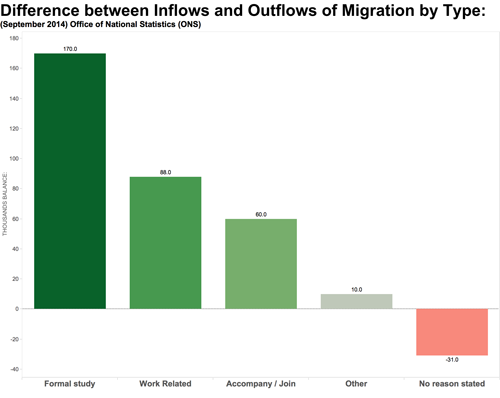
Last Thursday the latest immigration statistics from the Office of National Statistics (ONS) broke down the figures into the general categories of the reason for coming into: a. work b. formal study c. to join a relative.

When we look at these figures, we see the overwhelming reason for net migration of 298,000 is not those searching for work, but rather those coming to this country to study at our universities (57%). As Nigel Farage has said, Ukip would not stop genuine international students from coming to the UK to study.

Inflow outflow by migration type

Further, this is the group with the most significant difference between inflow and outflow, with 192,000 in the year ending September 2014 coming to the UK to study, with only 22,000 of our own leaving the UK to be educated abroad. This is a long term trend with those coming to the UK for formal study accounting for an average 66% of net migration.  In fact, in 2011 the balance of those coming to the UK for formal study was actually larger at 213,000 than the total net migration of 205,000.

Study vs net migration

How can that be?

Read the rest of this entry »

Facebook Twitter Digg Delicious StumbleUpon

UNCUT: Uncut Review: Blue Labour, Forging a New Politics, edited by Ian Geary and Adrian Pabst

02/03/2015, 10:43:34 AM

by Jonathan Todd

This book is reviewed in advance of the launch event at 7pm tonight in Portcullis House

Blue Labour was a useful vehicle for Ed Miliband. He wanted to move on from New Labour. Blue Labour helped him to do so without backing into too many left-wing cul-de-sacs. But Maurice Glasman, the original Blue Labour guru, grew frustrated with Miliband, having probably already alienated the party leader with his predilection for colourful comment.

Reflecting on this in Blue Labour, Forging a New Politics, a new book edited by Ian Geary and Adrian Pabst, Glasman laments that “in a rationalist, tin-eared and ungenerous Westminster village” he has fallen “into trouble” as a result of a fondness for “paradox, something that sounds wrong but is right”. While the book contains chapters from Labour’s Policy Review Co-ordinator (Jon Cruddas), as well as potentially the next Labour London mayor (David Lammy) and next deputy leader (Tom Watson), it is uncertain whether Blue Labour can again be the Westminster village force that it appeared when Miliband was elected leader.

Appropriately for a public philosophy propagated by Miliband, it is ceded within academia. Four book contributors are current holders of academic positions, while the University of Kent’s website indicates that Pabst’s “research focuses on contemporary post-liberal politics”. It’s not so long ago that I was commenting on drafts of a Demos Quarterly essay by David Goodhart, who also appears in this Blue Labour collection, on post-liberalism, never having previously encountered post-liberalism as a term. Now post-liberalism is subject to academic research, while Blue Labour, Pabst claims, “emerged as part of a wider ‘post-liberal’ turn in British politics in the wake of the 2008 economic crash and the 2011 London riots”.

The financial crisis, of course, wrought deleterious consequences. Through its analysis of the interactions between globalisation and financial liberalisation, Martin Wolf’s latest book provides a powerful account of how this happened. Wolf was caustic at an IPPR seminar last autumn on what he perceives as Labour’s failure to provide policy solutions big enough to meet the challenges that he poses.

Read the rest of this entry »

Facebook Twitter Digg Delicious StumbleUpon

UNCUT: Labour’s campaign is a mess. So much wrong, so little right

27/02/2015, 09:39:29 AM

by Atul Hatwal

Labour has achieved something remarkable this year. In the space of eight weeks the party has managed to focus the national debate on some of its strongest issues – the NHS, equalities and tax avoidance – and yet still failed to land a blow. The average of this week’s YouGov polls is a very small Conservative lead.

The NHS should be a campaign winner, every time for Labour. But when Andy Burnham decided to use the rise in NHS spending outsourced to the private sector, as his key evidence to prove the Tories’ privatising intent, he turned political gold to base metal.

Given two-thirds of the rise in outsourcing happened under Labour, with the rate of increase actually slowing under the Tories, it doesn’t take David Axelrod to work out why Labour was on the back foot almost immediately.

Then there was Harriet Harman’s pink battlebus. There’s nothing wrong with the bus being pink and the issues raised by the women’s tour are important, but when Labour frontbenchers have been campaigning vociferously that equating the colour pink with girls is sexist then, once again, who couldn’t have predicted disastrous headlines?

Most recently there has been Ed Miliband’s offensive on tax avoidance. It’s difficult to think of territory more uncomfortable for David Cameron. Yet by broadening the Labour attack onto the principle of tax avoidance, rather than the narrow specifics of the jaw-dropping appointment of HSBC’s Stephen Green as a Minister, even when government officials knew all about HSBC’s illicit activities, Ed Miliband blew it.

Cue embarrassing questions about whether shadow ministers collected receipts for every odd job or window cleaned and the circumstances in which Ed Miliband’s mother seems to have avoided tax on the house in which he now lives.

Individually, these incidents seem like discrete gaffes but a common thread runs through each failure.

Andy Burnham, Harriet Harman and Ed Miliband all walked into such eminently predictable elephant traps because their moral certitude blinded them to the politically obvious.
Read the rest of this entry »

Facebook Twitter Digg Delicious StumbleUpon

INSIDE: Balls for chop in future Labour/SNP coalition deal

26/02/2015, 09:52:58 PM

Ed Ball’s will be the sacrifice that seals a coalition deal between Labour and the SNP, if senior members of Ed Miliband’s inner circle have their way.

As private debate within Labour circles intensifies on the terms of a potential deal with the SNP, Uncut has learned that some of Ed Miliband’s closest advisers are plotting to sack Ed Balls in a bid to secure Ed Miliband’s tenure in Number 10, in the event of a hung parliament where Labour is not the largest party.

Insiders familiar with these discussions over the past few weeks describe a scenario where Labour would have to “reset its economic standing with the public” and demonstrate to the SNP that it would not be “wedded to austerity-lite.”

For some of Ed Miliband’s closest and oldest advisers, removing Ed Balls would achieve both objectives as well as ridding them of a potentially truculent and obstructive Chancellor.

The animosity between Ed Miliband’s inner circle and Ed Balls is well known. Last year Uncut revealed how team Miliband had plotted to sack Ed Balls in the Autumn reshuffle only to be thwarted by the Labour leader’s weakness coming out of conference season. And just last week the Sunday Times reported on the depth of the recurring tensions between Miliband and Balls.

The recent bitter negotiations between the shadow Chancellor and Labour leader on how to fund Ed Miliband’s cherished cut in tuition fees, are said to have hardened views within Miliband’s circle.

Now this enmity is centre-stage in Labour’s developing psycho-drama over whether to strike a coalition deal with the SNP.

A sizeable section of the parliamentary party, not to mention Labour’s newly elected leader in Scotland, Jim Murphy, would be bitterly opposed to treating with the Scottish nationalists.

However, Murphy’s rage at any potential deal with the SNP only sweetens the prospect of a coalition agreement with the SNP for some of Ed Miliband’s advisers, as well as a section of MPs close to the unions, who would be pivotal to bolstering PM Miliband’s position within the parliamentary party.

As one disillusioned shadow cabinet adviser put it to Uncut, when describing the way the disparate coterie around Ed Miliband viewed a deal with the SNP,

“Half of them want to shaft Balls, half of them want to get Murphy and most of all, they all want to keep their jobs and not be out on their ears as failures. Most will say yes to a deal enthusiastically, no-one is going to say no.”

Facebook Twitter Digg Delicious StumbleUpon

UNCUT: A Labour/SNP deal would be a disaster for Britain and Miliband

26/02/2015, 01:30:18 PM

by Samuel Dale

It’s May 13th 2015 and Ed Miliband is walking down Downing Street after being asked to form a government by the Queen.

It’s been an unpredictable and gruelling week of horse trading and backroom deals.

Labour and the Tories tied on 285 seats each and Miliband has done a deal with Alex Salmond to seize power.

His pact with the SNP – which won an incredible 45 seats – has put him into Number 10 but he is the weakest prime minister in decades, maybe ever.

As he makes his first speech outside that famous door, Sterling starts to plummet.

The FTSE 100 has already fallen almost 10% in the first part of the week as the likelihood of Miliband in power became clear. It tanks further as he talks.

The creme of Britain’s financial services industry are implementing their plans to leave London.

Hedge funds quickly plan moves to Jersey, big asset managers to the US while big banks look to Asia and New York.

Energy firms instantly scrap investment plans as the price freeze becomes reality while pension funds put their UK infrastructure investments on hold.

The SNP-Labour deal has promised to “end austerity” and increase spending in cash terms every year this parliament. Investors are spooked.

The International Monetary Fund has already warned that the UK must stick to its deficit programme and Angela Merkel has subtley warned London not to turn itself into Paris, or even Athens.

Read the rest of this entry »

Facebook Twitter Digg Delicious StumbleUpon