Posts Tagged ‘Andy Burnham’

Labour needs to be straight about its plans for the NHS

24/10/2014, 01:38:13 PM

by David Talbot

“The NHS is on the ballot paper in May” declared the Labour leader at Prime Minister’s Questions as he sought to solidify his party’s clear advantage on this most important, and emotive, of issues. That the NHS is set to be centre stage at the forthcoming general election is partly due to naked politicking, and partly due to the dire forecasts for our health service. Both main combatants are well aware of the financial and demographic peril the NHS is in, but both continue to besmirch the debate with clichéd attacks on how the Tories can’t be trusted on the NHS or, a new variant of the same line, Labour are ruining the NHS in Wales.

It is essential that politicians are honest with the public about the scale of the challenges facing the NHS. This is particularly true of the Labour party who are prone to nostalgia and playing on sentiment, invoking the spirit of Nye Bevan and having a nonagenarian address party conference, for instance, but specifically because the party is making pledges which, deep down, it must know will be difficult or nigh on impossible to deliver. The NHS matters too much for short term electoral considerations; it is better that the party is frank, and dare say unpopular, with the public now rather than risk alienation, anger and a disintegrating NHS later.

Ed Miliband’s flagship announcement at the party conference last month was an eye-catching commitment to establish a new £2.5 billion ‘Time to Care Fund’. This unravelled not long after some fairly rudimentary scrutiny; it will be not be implemented in full until 2017/18 and Labour would need to first pass a Budget and then enact legislation before the mansion tax, levy on tobacco firms and tax avoidance levies would yield any income. And even then there are serious doubts the revenue raised would come anywhere near the £2.5 billion quoted.

It is not to say that the party is not coming up with a better vision for the NHS. Labour’s plan for a combined health and care service is unquestionably the right direction of travel, but it is not a cost or pain-free option. Andy Burnham may deny that there will be large-scale reorganisation, but unavoidably, and undoubtedly, there would be heavy financial and structural costs. A messy structural reorganisation of the administration of healthcare would clearly get in the way of healthcare delivery. What is important, what the public should not be fed, is the idea that it is not a reorganisation. It is exactly that.

The King’s Fund Barker report estimated that even after introducing a combined health and care service, spending would need to rise to around 11% of GDP to meet demand. This would still leave our health spending trailing the highest European spenders – but it would require double the spending increase that Labour is currently proposing.

(more…)

Facebook Twitter Digg Delicious StumbleUpon

We need to get real about the cost of ageing

20/02/2014, 10:42:48 AM

by James Beckles

In Britain we face a challenging future with an increasing population and one that is ageing rapidly. Statistics show that one in six of the UK’s population are over 65. Britain’s older people have made momentous strides to make Britain the place it is today with its diversity, modernity and liberal sensibilities. But our public services in health and social care, two areas many older people are dependent on, face a catastrophe of over burden and under-funding if this Tory-led government continue to strangle public spending and investment in health and social care.

We have heard this government’s hollow promises about protecting the NHS, yet their Health and Social Care Act 2012 has begun the process of privatisation and gutting the National Health Service by private firms; who are cherry picking the best parts and providing very little in patient satisfaction and care. Cameron, his Lib-Dem allies included, have shown a blatant disregard for the health and well being of the general public and it’s most vulnerable people.

As a former Care Quality Commission (CQC) compliance inspector I saw first hand how the failures of health and social care can lead to poorer health outcomes for older people, whether it was a late diagnosis for a treatable condition or the lack of regular contact with health professionals. All this was because the professionals in health did not speak to the ones in social care. There were no formal links and this affected older people significantly. There were examples of good care of course but this was few and far between.

(more…)

Facebook Twitter Digg Delicious StumbleUpon

Toil and trouble bubbling in the shadow cabinet pot

07/01/2014, 02:11:07 PM

In the past week, lefty pointy-heads have been all a-twitter about a piece on the Economist’s blog, mapping out how Ed Miliband might want to clip the Treasury’s wings and expand BIS, so that BIS becomes an engine for “economic reform”.

This new “department for Milibandism” would take on responsibility for jobcentres from DWP, training from Education, cities and regional growth from CLG and financial services from the Treasury. The poor old Treasury would be left as a much diminished office of the budget.

Cue supportive interventions from noted Ed-ites and much sage discussion about the policy and institutional impact. But as the wonkathon subsides, thoughts turn to the politics of such a change and the eternal question, cui bono?

The stony silence from the shadow chancellor’s camp speaks volumes. Ed Balls would effectively be demoted to the role of chief secretary to the Treasury. Suffice to say, he’s unlikely to be a fan. No, the lucky beneficiary from this radical Whitehall surgery would appear be Chuka, the current shadow at BIS.

So who lobbed this political incendiary into the debate? Step forward the uncredited author of the piece, Jeremy Cliffe.

Would that be the same Jeremy Cliffe who is good mates with one, er, Chuka Umunna? The same Jeremy whose Linked-In CV lists a past role as “Campaign Intern, Streatham Labour, December 2009-January 2010.” The same Jeremy whose CV goes on to list one of his jobs as “Researcher, Office of Chuka Umunna, June 2010-August 2010”?

Hmm. Stop it. You’re too suspicious, Uncut is sure this is all just a big coincidence.

In other coincidental news, la Umunna penned a piece for last week’s Observer on democratic renewal; nothing to do with industrial strategy and completely out of the blue, but nevertheless a worthy subject for a political intervention. It brought to mind a comment from a grizzled whip a few years ago, speaking about loyalty from the then cabinet, “When the children start talking off-topic, discipline is breaking down and trouble’s not far behind.”

In fairness to Chuka, at least he was scrupulously on message in his Observer piece. Rumours from the PLP abound that the really big fight of the coming term is about to kick-off: Balls versus Burnham with loyalty to the collective shadow cabinet line likely to be the first casualty.

(more…)

Facebook Twitter Digg Delicious StumbleUpon

A tale of two very different Guardian interviews: Darling and Burnham

13/08/2013, 10:54:24 AM

by Jonathan Todd

Decca Aitkenhead reported this weekend on Andy Burnham telling her that Labour must shout louder or risk election defeat. Some twitter reaction suggests that this would help Labour on the doorstep. As with Chris Bryant’s Monday morning Today appearance, we might wonder, however, whether it is content more than volume that is causing Labour to fail the Daz doorstep challenge.

Almost exactly five years ago, Aitkenhead interviewed Alistair Darling. Maybe there is something about the summer heat that causes Labour politicians to unbutton themselves around her. “Now Alistair,” Aitkenhead records his political advisor imploring when they sat down for the interview, “tell her everything. Make sure you tell her everything.”

This instruction implies, unsurprisingly, prior calculation. And for all the conviction that Burnham was eager to display to Aitkenhead – for the NHS and for comprehensive schools, in particular – we should probably also assume, as is the way of serious politics, calculation on the part of Burnham. We might, therefore, wonder what the calculations of Burnham and Darling were intended to accomplish.

“No one had any idea,” Darling replied when asked whether anyone had anticipated the scale of the financial crisis that was still unfolding at the time of his interview. He warned that the economic climate of 2008 was “arguably the worst … in 60 years. And I think it’s going to be more profound and long-lasting than people thought.”

This remains the weakest economy on record and, as Mark Carney noted last week in his first press conference in charge of the Bank of England, those records go back more than one hundred years.

This speaks amply of Darling’s prescience. We might wonder whether so many would now blame Labour for the state of the economy if we’d done a better job in 2008 of getting across what Darling’s interview sought to communicate: we’re being hit by a unprecedented, global shock, which we must travel a long, hard road to recover from.

Darling was doing what Labour does at our best: being honest with the country about the scale of the challenges that confront us and providing leadership to meet them. He was, however, rewarded with “the forces of hell” from Gordon Brown’s operation next door. Presumably, they either didn’t accept that things were as bleak as Darling contended (but Carney’s assessment bears out Darling’s judgment) or reasoned that to acknowledge as much would reflect badly on Labour (but while reality can’t be denied, as Bryant discovered, it can be explained, and better in terms of the inefficiencies of global capitalism than the Labour government).

(more…)

Facebook Twitter Digg Delicious StumbleUpon

Labour needs to be honest about tough spending choices in the NHS

19/07/2012, 07:00:28 AM

by Peter Watt

It has been a particularly tough few months in the NHS.  Setting aside the impact of the NHS and Social Care Act (2012), the impact of the freezing of budgets is being well and truly felt.  Every week sees another story of a hospital or a patient group in crisis or expressing concern.

July seems to have been particularly difficult.  Early in the month we saw the South London Healthcare NHS Trust being put into administration.  The Trust consists of three hospitals – Princess Royal in Orpington, Queen Mary’s in Sidcup and the Queen Elizabeth in Woolwich and serves more than one million people.

And then this week the South West Pay, Terms and Conditions Consortium, a group of 19 hospitals in the south west, were shown to be planning to cut the pay and conditions of up to 60,000 staff in order to balance tight budgets.  The headlines all warned of doctors and nurses being sacked and of pay and conditions being cut.  I had a special interest as one of the hospitals in the consortium, Poole, was where I nursed and I still have friends there.

According to their project initiation document, the consortium has come together in order to:

“…assist Trusts across the South West in modernising  pay, terms and conditions to ensure that they  are ‘fit for purpose’ going forward.”

In other words they are hoping to challenge national pay and conditions for their staff as a way of bearing down on their staffing costs.  Specifically they are exploring a number of options such as reducing anti-social hour’s payments, some degree of reward for performance for incremental progression, reducing holiday entitlement, increasing hours and reductions in pay for staff on over £21,000.

(more…)

Facebook Twitter Digg Delicious StumbleUpon

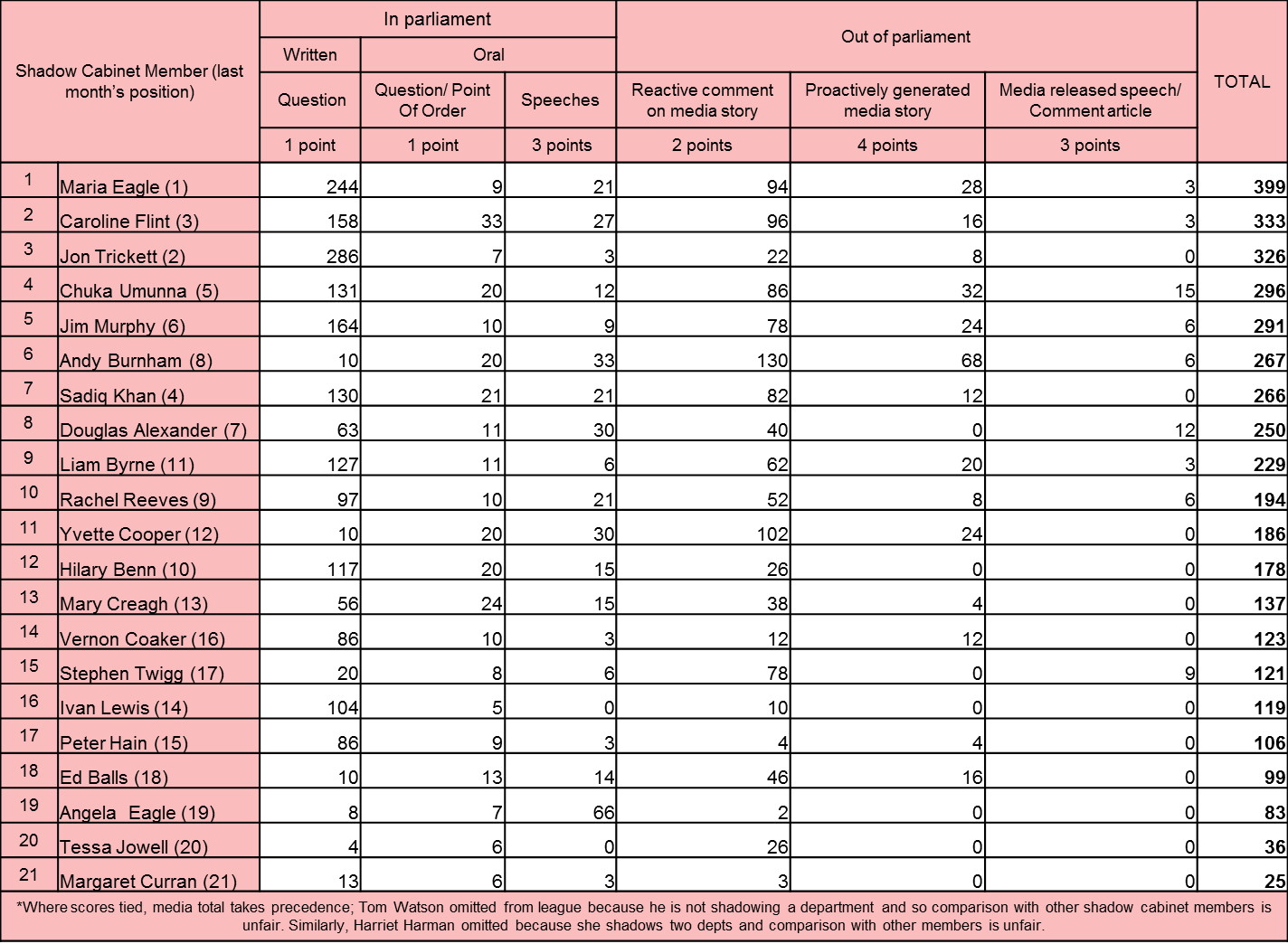
The April shadow cabinet league

12/04/2012, 08:30:36 AM

by Atul Hatwal

It’s become a tedious holiday tradition: MPs tweeting about their various constituency appointments and local campaign meetings, furiously reassuring voters and party members that they are busy at work, despite the long parliamentary recess.

The world really doesn’t need another tweet telling us yet again about a “good reaction on the #Labour doorstep” and for Labour’s shadow cabinet, many (though not all) should just take their break with good grace – they have earned it.

The first three months of this year have seen an unprecedented work rate: over 400 press releases, nearly 1000 written questions and almost 50 speeches from the despatch box.

Compared to last year, at this stage in the parliament, the shadow cabinet’s total score indicates a 54% hike in effort. In every category, the shadow cabinet has done more and worked harder.

While doubts will persist on the effectiveness of the party’s overall strategy, and Bradford West might be a prologue to greater disappointments in the May elections, it is hard to criticise the work ethic of many at Labour’s top table.

Since the last league in early February there has been a minor shuffling of the pack with three shadow cabinet members posting notable performances: Caroline Flint, Chuka Umunna and Andy Burnham.

(more…)

Facebook Twitter Digg Delicious StumbleUpon

January Shadow Cabinet League

13/01/2012, 11:17:00 AM

by Atul Hatwal

It’s Friday the 13th. And the Tories are level pegging with Labour in the polls and discontent with Ed Miliband’s leadership continues to swirl. The sense of gloom is palpable.

But on one measure at least, hope continues to flicker.

The revival of the shadow cabinet’s appetite to hold the government to account continues apace. This month’s shadow cabinet work rate league table reveals a new benchmark – the highest number of weekly stories proactively generated by the Ed Miliband’s team since he became leader.

This isn’t just a matter of issuing a media release commenting on someone else’s news, it’s making the news.

Chuka Umuna and Andy Burnham have led the charge with each generating four stories since the last league table.

(more…)

Facebook Twitter Digg Delicious StumbleUpon

Conference diary

27/09/2011, 10:00:38 AM

A well-attended Labour party Irish society reception saw a run on the free Guinness within 45 minutes of opening. As stocks became dangerously depleted, quick-thinking chairman, Conor McGinn, did the decent thing and sacrificed his credit card – and possibly his credit worthiness – to supply liquid reinforcements.

Andy Burnham joined the outgoing leader of the SDLP, Margaret Ritchie, and Irish education minister, Ruairi Quinn, as he reminisced about his Irish immigrant grandfather’s days working in Liverpool’s Albert dock.

Praising the BT conference centre, Burnham rued the site not being home to his beloved Everton football club. At which point a reveller in Everton kit ran up to the stage to shake Burnham’s hand, rolling up a sleeve to reveal an Everton tattoo on his arm exclaiming: “It’s not a tattoo, it’s a birthmark”.

Apparently they’re rather fond of football in Liverpool.

……….

A fringe meeting on the olympic games saw plain old “Seb” Coe line up alongside triple jumper, Jonathan Edwards, Labour’s former Olympics minister Tessa Jowell and Simon Henig from the local government association to fly the flag for the all-round wonderfullness of next year’s games. Complete, of course,  with its £9.3 billion price tag.

Spouting impeccable New Labour lingo, “Seb” said there was still “a massive amount done, a massive amount to do”.

But on a day when Ed Balls reaffirmed Labour’s commitment to budgetary rectitude, not all of his colleagues were quite so on-message.

Asked to give advice to future cities hosting the games, Tessa had this to say: “Get your budget with a great stonking contingency”.

…..

How is Labour faring with its erstwhile corporate friends?

Many of the regional receptions are without deep-pocketed corporate sponsors to top-up delegates’ glasses with pinot grigio, except, that is, for the Yorkshire region.

They were treated to an embarrassment of riches with both Asda (headquarters in Leeds) and Yorkshire Water throwing contributions into the flat cap.

What is Yorkshire’s secret? Oh yes, Ed Miliband, Ed Balls, Caroline Flint, Rosie Winterton, Yvette Cooper, Hilary Benn and Mary Creagh are local MPs.

That’s what.

…..

Party members visiting conference receive an “invitation” to see the leader’s speech. Excellent.

But you have to read the small print. Its to a “live screening” in one of the conference centre’s halls.

Not quite as impressive, but unfortunately there’s more.

“This invitation does not guarantee entry. Admittance to the auditorium is on a first-come, first-served basis”.

So let’s get this clear: its not an invitation to sit in the hall. Its not even an guarantee to see Ed in all his HD glory on the big screen.

So its not really an invitation at all, is it?

Facebook Twitter Digg Delicious StumbleUpon

Shadow cabinet goal of the month

11/02/2011, 08:00:56 AM

by Atul Hatwal

Three moments of magic from the shadow cabinet

A few years ago, the newsreader Martyn Lewis made a plea for more positivity in the news. His Jerry Maguire moment was greeted as, well, Jerry Maguire’s was.

For Lewis, there wasn’t a redemptive ending; he wasn’t vindicated and every time he read the news subsequently, you couldn’t help but think he was a bit odd.

But somewhere in what he was saying, was a grain of something. Not quite common sense, because clearly no one is going to be interested in news that reports everything is just fine. But in his own slightly pompous and mistaken way, he was articulating a desire that most of us have for some light to provide a bit of contrast to the constant shade.

Politics is a dark place at the moment. The coverage reflects this. The sun isn’t shining for Labour and things are far from how they should be. But there are flashes of light. And it’s as important to recognise these as the mistakes which deepen the gloom. Otherwise there’s no basis for hope and no route back from opposition to power. (more…)

Facebook Twitter Digg Delicious StumbleUpon

Saturday News Review

23/10/2010, 07:48:41 AM

It’s all gone Nick Clegg

One question swirling through the sea of British politics is this: how will Ed Miliband act towards the Lib Dems? The Labour leader certainly didn’t flinch from attacking the yellow brigade during the leadership contest, at one point calling them a “disgrace to the traditions of liberalism.” But surely he’ll have to soften that rhetoric in case the next election delivers another bout of frenzied coalition negotiations.

Which is why Andy Burnham’s article in the Guardian today is worth noting down. In making his point – that the Lib Dems haven’t won the pupil premium they sought – he does all he can to force a wedge between Nick Clegg and his party. In other words, it looks as though Ed Miliband’s campaign promise that he could only work with a Clegg-less Lib Dem party is now official Labour policy. – The Spectator

The political significance of Clegg’s failure to fund the pupil premium is huge. It goes to the heart of the politics of the coalition, and raises real questions about Clegg’s influence within it. The issue is politically charged because it was one of the points on which the Lib-Lab post-election talks foundered.

Taken all together, I don’t think this is an education policy that most Lib Dems can sign up to. We now have not one but two major Lib Dem broken promises on education. Ruthless Tory ministers have chewed up and spat out Mr Clegg. For a party proud of its principled approach to education policy down the years – and which famously promised a penny on income tax to fund it – these are bleak times indeed. – Andy Burnham, The Guardian

Nick Clegg faces criticism after attacking the Institute for Fiscal Studies’ (IFS) assessment of the spending review as “complete nonsense”.  The deputy prime minister’s comments came after the economics thinktank said the spending review’s approach to welfare and public services would have a regressive impact. The IFS’ acting director, Carl Emmerson, had said the Treasury’s own analysis showed the poorest would be hit hardest by cuts to both public services and welfare payments. – politics.co.uk

Where the Axe Falls

Urban areas will bear the brunt of the spending cuts announced this week with every major English city facing a triple whammy of the biggest job losses, council cuts and benefit withdrawals, a Guardian analysis of the impact of the key decisions reveals.

Local authorities with dense populations face the deepest cuts, according to a breakdown of the measures by George Osborne to slash council spending, reduce child benefit and cut the educational maintenance allowance. The predicted 490,000 job losses in the public sector will fall most heavily on cities.

In public sector job losses, the biggest losers are Birmingham, Leeds, Manchester and Liverpool – all largely Labour strongholds, plus the Conservative Westminster and Sheffield Hallam, which is Nick Clegg’s constituency. – The Guardian

Wayne’s World

The opulence of Wayne’s world and his record-breaking deal stands in stark contrast to the other news which rocked the city this week. It is now estimated that 40,000 people in the Greater Manchester area will lose their jobs as a result of Chancellor George Osborne’s plans to cut £83bn from public spending to fight the deficit. Those cuts will translate into the loss of 30,000 public-sector posts and a further 10,000 job losses from private businesses. The majority of jobs will be lost either in the NHS or from the region’s 10 town halls, where 6,750 workers are expected to be added to the dole queue. – The Independent

Super Councils to the Rescue

A new generation of super-councils across the country is being backed by Conservative ministers as a means to slash costs and drive up efficiency standards. A cull of smaller councils would inevitably lead to sweeping job losses.

Three Conservative-controlled councils in the capital – Westminster, Kensington & Chelsea and Hammersmith & Fulham – yesterday announced moves to share services, although they would retain their separate identities. – The Independent

Council Cuts to Cause NHS Chaos

Hospital beds will be filled by the elderly and the vulnerable because of cuts to local government care, a senior health service figure has warned. Nigel Edwards, the head of the NHS Confederation, said the pressure on beds could mean that hospitals would be unable to admit patients “who badly need care”.

In a letter to The Daily Telegraph, Mr Edwards said the result could be that elderly patients would have to stay on in hospital for longer as there will be no after-care available in the community. “Less support from council services will quickly lead to increased pressure on emergency services and hospitals. Hospital beds will be blocked for those who badly need care because the support services the elderly require after discharge will not be available.” – Press Association

Patients will be left untreated as the NHS struggles to mop up the consequences of severe cuts in local authority funding, said Nigel Edwards, the head of the NHS Confederation. In a letter to The Daily Telegraph, Mr Edwards — whose organisation represents NHS trusts running hospitals and ambulance services — says the cuts in local authority budgets will force them to reduce care services for the elderly and vulnerable. – The Telegraph

Mandelson’s U-Turn

During the leadership campaign, Mandelson criticized Miliband at various points, blaming him for the platform Labour ran on in May’s election and warning Miliband could lead the party down “an electoral cul-de-sac.”

However, in a telephone interview with Dow Jones Newswires Friday, Mandelson said the new Labour leader had positioned himself well on the key political debate over how to handle the country’s fiscal challenges.

“Ed has done what the leader of the opposition needs to do, make a serious argument that has credibility and speaks for the views of many in the country,” Mandelson said. “He has done that successfully.” – The Wall Street Journal

The Rocky Road to NPF Reform

Labour‘s method of making policy has not achieved its objectives, has been far too distant from ordinary party members and has created a great deal of cynicism, Peter Hain says today.

Hain, the man chosen by Ed Miliband to lead Labour’s policy forum, says in a Guardian interview: “I defend the policy forum principle, but there is a great deal of cynicism amongst party members that we need to address. If you disempower your membership, you start down the road to losing, and that is what happened during our 13 years of power.

“I feel rejuvenating our national policy forum is a precondition to winning the next election, and that is very much Ed Miliband’s view.” – The Guardian

Facebook Twitter Digg Delicious StumbleUpon