




Posts Tagged ‘Ed Miliband’

Ed could be PM even if Labour finishes second and his coalition partners, the Lib Dems, finish fourth

23/04/2015, 01:59:15 PM

by Michael Collins

In the last week or so the polling website May2015 has convincingly put forward the thesis that even if the Tories win the most seats and votes on May 7, Ed Miliband is the likelier Prime Minister. This has significant implications for the stability of Britain’s democracy over the coming weeks.

In fact, the situation may be even more precarious than it seems, with neither Labour nor the Conservatives able to establish a majority, even via coalition. To see why this will be so difficult, we must look not only at the numbers but also the differing ideological leanings of the parties. Europe is the key issue.

Those, such as Dan Hodges at the Telegraph, who are still betting on a Tory-led government, believe that the Tories’ aggressively insisting the SNP will pull the strings if Labour come to power will have a significant pro-Tory impact on English marginals as polling day approaches. This may well happen, though it is still to show up in the polls.

With the Tories coming out as the biggest party in terms of votes and seats, the assumption from those backing Mr Cameron to stay in Number 10 is that “if the seats are there,” the Liberal Democrats will do another deal with Cameron and we’ll have coalition 2.0.

Taking out the anticipated 5 Sinn Fein seats (their elected MPs do not sit in the House of Commons), plus the Speaker, the magic figure for the slimmest of working majorities is 325 seats.

Let’s imagine for sake of argument the Tories reached 302 seats, which is well beyond the highest predictions of any of the main polling indicators, with the Liberal Democrats on a more realistic 23. This would give the two coalition parties 325 seats.

On that basis, can the Liberal Democrats really carry on propping up the Conservative Party? The coalition vote share would have fallen, with both parties losing seats. Looking ahead, the Tories promise much deeper (albeit unspecified) cuts. And most importantly, they have proposed a referendum on Europe. This situation will be very unappealing to the Liberal Democrat membership.

We should also think not only about divisions between but also within parties. A sizable rump of Tory rebels has consistently voted against the coalition throughout this parliament. They mostly detest the Liberal Democrats, and they have turned themselves into a single issue cabal with their fundamentalism over the EU.

(more…)

Facebook Twitter Digg Delicious StumbleUpon

Reaching out to centrist voters now is good tactics. Strategy it ain’t

23/04/2015, 11:45:50 AM

by Rob Marchant

Happily, Labour has had a very good fortnight. Since my last column, Miliband’s personal ratings have jumped up and the Tory campaign has blundered from unforced error to unforced error. Bookies and polls now put him as neck and neck with Cameron as next PM, not lagging way behind as before.

The final piece of this recovery in both results and performance, last weekend, was a quite unexpected outreach programme from Labour to the centre ground, of which more later.

After the last election, the new prime minister, formerly known for his husky-cuddling and his “greenest government ever” shtick suddenly remembered his back benchers and became, for the most part, a much more traditional kind of Tory.

Nowhere has this been more evident than in his Europe policy, where he essentially caved in to the more rabid Eurosceptic elements in his own party, in the hope of stemming the flow of voters and defecting MPs to UKIP. If, as some are predicting, UKIP ends up the election having lost Thanet South and with merely a couple of MPs, he will surely look back on this decision to pander to their agenda as one of the utmost folly.

That game is not only dangerous for Britain, it is poor internal politics for Cameron: after all, his (almost universally pro-EU) big business backers can hardly be delighted at the prospect of an EU referendum. But in any event, it is not hard to paint the Tories as having lurched into a right-wing caricature of themselves.

On the other hand Miliband, for the majority of his tenure as leader, has often given the impression of being more mindful of his party at large than of the electorate outside, with the result that Labour’s policy agenda has mostly languished in its comfort zone on the soft left. There was one brief flicker of hope that Labour would once again embrace a broad church, around the time of Miliband’s 2013 “One Nation” conference speech: but in policy terms One Nation turned out, for the most part, to be a slogan, and little more.

Politics is a lot like the game of squash: those who dominate the centre of the court tend to dominate the game.

(more…)

Facebook Twitter Digg Delicious StumbleUpon

Cameron beware: Benefit claimants lose money when they don’t turn up to an interview

16/04/2015, 05:42:54 PM

As the only national political leader taking part in tonight’s “challengers’ debate,” is it a mistake for Ed Miliband to put himself on a par with the nationalists and minnows of British politics?

We’ll soon find out, but assuming he does well enough (in a format that usually favours his softer public style) it will bolster an already confident Labour campaign and throw the spotlight on the absent Prime Minister’s reluctance to defend his own record.

Indeed, Miliband has a neat line on David Cameron’s failure to turn up: “I think if you are applying for the job of Prime Minister, the very least the British people expect is for you to turn up to the interview.”

Such bad form, especially when Employment Minister Esther McVeigh has been very clear on this point: “…jobseekers have a responsibility to do everything they can to get back into work. We are ending the something for nothing culture,” she has previously opined.

For the first offence of failing to turn up to an interview, an unemployed benefit claimant faces losing four week’s Job Seekers’ Allowance.

Cameron should beware, the penalties increase with every no-show.

Facebook Twitter Digg Delicious StumbleUpon

The smaller parties should be careful what they wish for. It always ends badly for the kingmaker

16/04/2015, 09:57:12 AM

by Atul Hatwal

We are approaching peak minnow for the campaign. Yesterday the Lib Dems and Ukip launched their manifestos and this evening there is the five-way debate featuring the smaller parties minus Nick Clegg but inexplicably with Ed Miliband guest starring at the front of the coconut shy as the designated representative of Westminster’s failed big party duopoly.

But as much fun as the SNP, the Greens, Plaid and Ukip will have beating up on Ed Miliband the smaller parties should be careful what they wish for.

They might be eyeing eventual roles as kingmakers or junior partners in government, but history has a harsh lesson: it always ends badly.

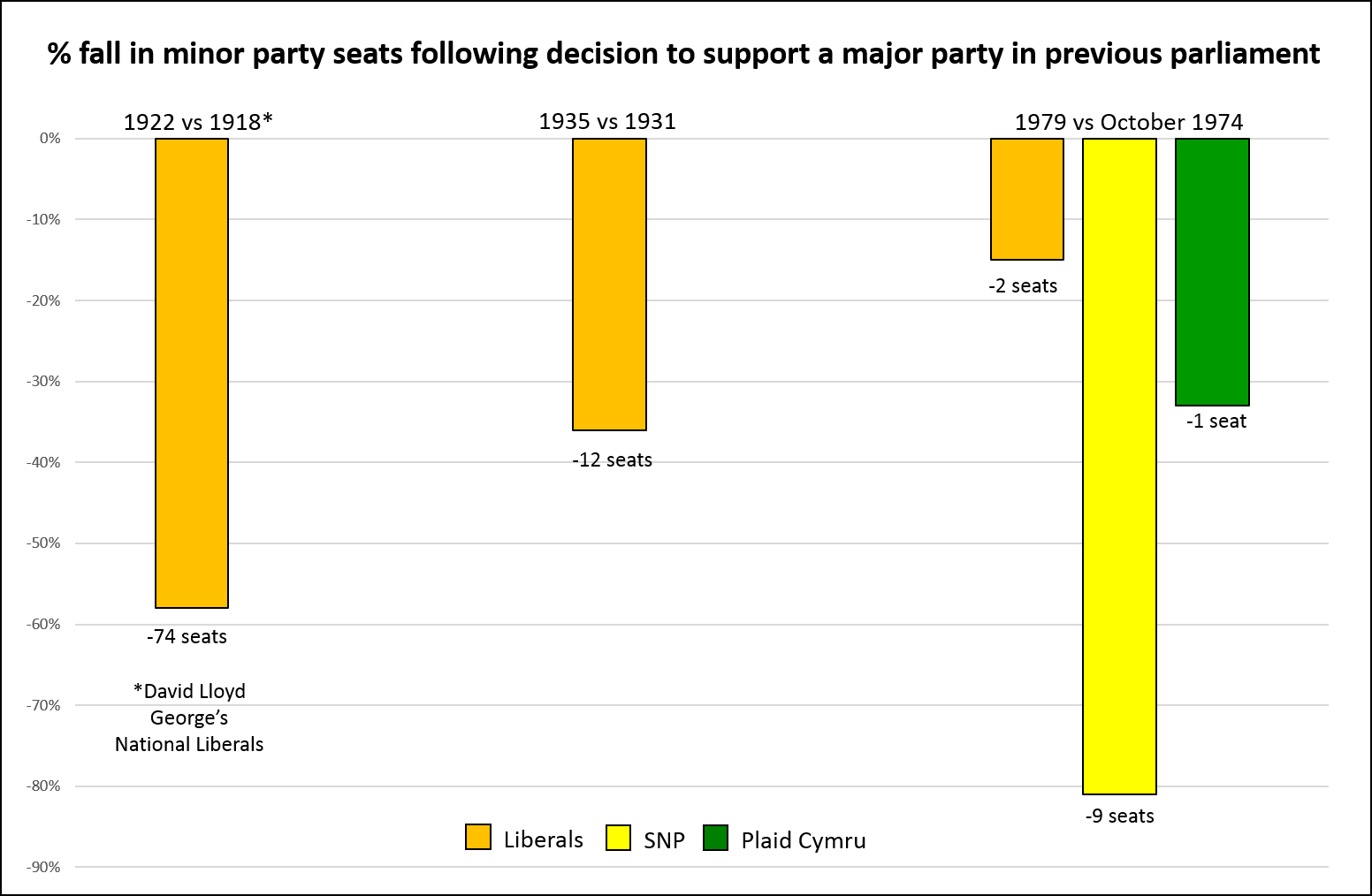
In peacetime, every time there has been a coalition, confidence and supply agreement or any type of deal for support in the last 100 years, it has been electoral poison for the minor party.

On three occasions there have been coalitions in the last century and one period of less formal support to sustain a government.

All involved the Liberals, with the SNP and Plaid Cymru also becoming mired in the mess of the 1970s Callaghan government.

The results speak for themselves.

Minor party fall

(more…)

Facebook Twitter Digg Delicious StumbleUpon

This curious Tory campaign is coming to us from another country

13/04/2015, 09:06:27 AM

by Jonathan Todd

Famously, the past is a foreign country: they do things differently there. In that country, they have naked women on Page 3 of The Sun. That publication peddles lies about football fans crushed on the terraces of Hillsborough. And claims to be able to determine the outcome of general elections.

That which largely went unquestioned in 1992 would not do so in 2015. The Sun has changed to survive in a changed country. In such a country, it may not necessarily follow that treatment for Ed Miliband akin to that which Neil Kinnock endured in 1992 will contribute to the same electoral outcome.

The fears about Kinnock that the Conservatives and their supporters in the media were then able to arouse chimed with underlying public perceptions. It may be that attacks like those of Michael Fallon on Miliband will again tap into deep seated fears about Labour.

Equally, reflecting on Miliband’s improving personal ratings, Damian Lyons Lowe, founder and chief executive of Survation, concluded, “people like the happy warrior”. If Fallon were mainlining fears in the same way that the Tories did during the 1992 campaign, we might expect Miliband’s ratings to be going in the other direction.

The Tory brand is also not as robust as it was in 1992. This weakness – the persistence of the “nasty party” perception – is one of the reasons that I have anticipated Labour victory this year. When brands have limited purchase, their capacity to impact how other brands are perceived is also undermined.

If you go round slinging dead cats on tables, people will think, “these are the kind of people who sling dead cats on tables”. Boris Johnson – whom David Aaronovitch recently described as being “like a man who breaks wind in a lift and everyone wonders what smells so good” – could sling a dozen dead cats on the table. And we’d all laugh. Then ask him to do it again.

(more…)

Facebook Twitter Digg Delicious StumbleUpon

Yes, the Tories were in the gutter yesterday. But that’s where elections are won

10/04/2015, 09:53:43 AM

by Atul Hatwal

It’s the hope that kills. That’s what large sections of the Labour party are about to find out. I certainly did in 1992. Now, as then, the Tories are accused of being in the gutter. Now, as then, several of the headline polls flatter.  And a few weeks from now, as then, Labour will be left to wonder how it all went wrong.

Yesterday, while Twitter was rapt with Ed Miliband’s rising ratings in Survation’s latest poll, a more apposite survey went without comment. The Sun’s YouGov poll, which asked who voters’ preferred as PM – Cameron or Miliband – found 40% opting for David Cameron and 24% for Ed Miliband.

Elections are a comparative choice. Only those questions which force voters to make a choice between the applicants for the job on offer, approximate the electoral decision-making process. Polls such as Survation’s, which ask questions on approval vs disapproval are better at capturing the public’s views of a leader’s performance relative to their past perceptions of that politician.

Some good days for a historically poorly rated leader could result in quite a bounce. Vice versa for a leader traditionally well regarded who stumbles.

This is what happened yesterday with Survation. On Tuesday, when the poll was conducted, Ed Miliband did well while David Cameron and the Tories looked awful defending non-doms.

But as James Kirkup astutely highlighted, while the public stand with Labour on the issue of non-doms, few votes will be switched. The perception of Labour as more committed to fairness is well established. As is the Tories’ penchant for backing the wealthy elite.

All of this has already been baked into voters’ perceptions. Which is why, when forced to choose between the two on preference for prime minister, those self-same voters, who will have seen an improved Ed Miliband over recent days, would still opt for David Cameron by double digits –  a majority that has remained stubbornly in place for years.

A few weeks from now, Thursday’s excitement will seem like yet another cruel false dawn. Rather than being viewed, in the words of an excitable Guardian splash as the “day the polls turned,” the focus will be on the Tories much derided mud-slinging strategy as a tactically telling intervention.

Michael Fallon and his Tory colleagues have been castigated for gutter politics with their emphasis on Ed Miliband’s conflict with his brother and patently ludicrous claims about Labour abandoning Trident. As news of the positive polls broke, the Labour Twittersphere was convinced that the Tory attacks were the last desperate act of a flailing campaign.

The Conservative’s onslaught was exactly the type of behaviour which alienates the public from politics. But parties, all parties, habitually engage in these types of attacks because they work.

The objectives of yesterday’s seemingly random act of political ABH were threefold.

(more…)

Facebook Twitter Digg Delicious StumbleUpon

Labour’s decision to abolish non-doms is tactically astute but strategically risky

08/04/2015, 05:54:55 PM

by Samuel Dale

There are 116,000 individuals resident in the UK but not domiciled here.

It means they pay no UK tax on their overseas income as their permanent home is judged to be in another country.

High profile non-doms include HSBC chief exec Stuart Gullliver, Tory peer Lord Ashcroft and Roman Abramovich.

Labour wants to restrict the maximum temporary resident status to two or three years. The only restriction today is to pay a £30,000 charge when a non-dom has been UK resident for seven years.

It’s good policy for three reasons.

Firstly, it is morally justified that everyone plays by the same tax rules.

Non-don rules are arcane, unfair and widely abused.

Business people support the change too to level the playing field – notably Dragon’s Den’s Duncan Bannatyne who signed a letter to the Telegraph last week but has switched his vote to Miliband after the move. That’s a big endorsement.

Secondly, it should raise some revenue although it is highly uncertain.

Some tax lawyers say up to £1bn, Labour says hundreds of millions and the IFS says it will raise more than zero.

And, incredibly, Labour will use the extra cash towards the deficit. Hallelujah! Even though it’s a tiny amount it is the first time in months a tax rise hasn’t been immediately spent elsewhere.

Thirdly, and in an election battle this is the most important, it’s politically astute.

I was convinced George Osborne would simply adopt the policy, claim it as his own and move on. The Crosbyite focus on the long-term economic plan has ruthlessly removed distractions.

Cameron pledged not to rise VAT last month while Osborne used the Budget to shoot every Labour fox out there from “1930s spending” to “falling debt”. Except non-doms.

(more…)

Facebook Twitter Digg Delicious StumbleUpon

Labour: on the verge of a historic victory, or partying like it’s 1992?

08/04/2015, 02:50:35 PM

by Rob Marchant

The short campaign has finally kicked off. Not that that usually makes much difference, and particularly not when we have all known the date of the election for the last four years. Perhaps fittingly, no party’s campaign has so far exactly knocked Britain off its feet.

In polling, Tories and Labour have been showing as neck and neck for some time, with each main party in turn delighted when a poll says it is a couple of points ahead. But within any measure of what statisticians call “standard error”, these polls tell us little.

In other words, any difference of this size – a few per cent – could just as easily be explained by the inaccuracy of polling as a predictor per se, as by a meaningful trend. In this strange, Alice-in-Wonderland world where the tossed coin seems to land on its side, we have to make our judgements using less obvious, but no less compelling, means.

Turn, for example, to that more traditional signal of electoral success, the bookies, and the story is a little different. It’s true that they are – by a rather small margin – predicting a Labour minority government as the most likely outcome from a number of difficult-to-predict outcomes, but now look at the party with most seats. It’s the Tories, odds on, by a mile. The next PM? Cameron, odds on, by a mile.

Now, on the back of the TV debates, Labour has had a welcome uptick in Miliband’s personal approval rating, it’s true. But this really needs to be seen in context: it is rather the difference between the cataclysmic (-46% a month ago) and the merely bad (-29%, against Cameron’s -2%).

And there has also been a positive story for Labour in the English marginals, according to Lord Ashcroft’s polling. But the story in Scotland is the opposite: even if it might not end up quite as badly as the Daily Mail might gleefully be predicting, it will certainly be bad.

(more…)

Facebook Twitter Digg Delicious StumbleUpon

We shouldn’t be surprised the Tories ‘phone a business friend’ but the timing shows they’re desperate

01/04/2015, 01:57:50 PM

There’s an air of inevitability about the publication of a letter from business leaders warning against a Labour government in today’s Daily Telegraph.

The Tories can always count on a swathe of blue chip executives to back their cause. (Presumably self-interest plays a part too, as the signatories are classic targets of Labour’s 50p top rate and the mansion tax).

There is is no argument that letters like this work. They are simple to put together, get broadcast follow-up and help frame the day’s coverage. They matter because the grand fromages of the business world represent an important barometer of credibility for any party.

Yet as a tactic, the business leader round-robin was more counter-intuitive – and seemed more effective – when Labour did it in previous elections.

And the timing of today’s letter feels like a reactive move by the Tories – as though party strategists had this pencilled-in for later in the campaign.

To have real purchase, publishing a list of business endorsers nearer to polling day would surely be more effective; showing momentum behind the Tory campaign and contrasting that with Labour’s failure to convince business about its fitness to govern.

Throwing it in during the first week feels like the waste of a valuable asset. Like when contestants on ‘Who Wants to be a Millionaire?’ phone a friend on one of the easy questions.

As ever in politics, when someone does something unexpected, it’s because they are rattled.

Could it be that Labour’s efforts this week to burnish their business credentials, contrasting the Tories’ pledge of an in/out referendum on the EU with Labour’s solid, if unfashionable, pro-European-ness, have spooked Tory high command?

After all, this is one of the few areas where the Tories “competence versus chaos” line reverses in Labour’s favour.

As David Cameron limbers up for the seven-way leaders’ debate, (after his uncertain performance against Paxman) he needs to project calm, statesmanlike competence. To show that he is a safe bet.

Does he need to wheel out his pin-striped pals this early in the campaign to get that message across?

Perhaps he does.

Facebook Twitter Digg Delicious StumbleUpon

David Cameron has made a massive mistake but Labour’s picked the wrong line of attack

24/03/2015, 08:50:59 AM

by Atul Hatwal

If the Conservatives win the next election, David Cameron has turned himself into a bystander in his next government.

By pre-announcing his resignation he’s dissolved his future authority with backbenchers, who will be more interested in winning the favour of the next leader, and shifted the media lens onto his potential successors. The question of when he will resign – because he surely won’t last a full term – will dog him each day and ultimately he will struggle for relevance. He’s condemned himself to a living political death.

In the wake of such an extraordinary unforced error, Labour’s chosen line of attack is that Cameron is taking the electorate for granted by assuming he will win the next election. It fits with Labour’s broader critique of him and in that sense is logical, but it’s also wrong.

Two of David Cameron’s greatest political assets are his double digit lead over Ed Miliband as the public’s preference for PM and the extent to which he personally outpolls his party.

David Cameron’s telegraphed resignation is the very antithesis of leadership; it’s the epitome of weakness and raises the likelihood that any one of a gaggle of unappealing Tories could be prime minister in the next Parliament. Suddenly, there might be some hope for Labour.

Instead of talking about arrogance, Labour should be recasting the leadership choice at this election as one between Ed Miliband and the dangerous unknown.

There are two aspects to this.

First, the message should be hammered home that David Cameron is about to quit on the British people in the next Parliament.

(more…)

Facebook Twitter Digg Delicious StumbleUpon