




Osborne’s made his move. Now it’s Labour’s turn

14/01/2014, 09:37:04 AM

by Jonathan Todd

We are a nation seeking to rebuild from the economic calamity of the past half decade. You might think this task merits a chancellor focused upon it. But George Osborne doesn’t look to Keynes, Friedman or other economists. He prefers his own ‘baseline theory’ of politics.

As we grasp for an economic rubber ring, we’re thrown the thin gruel of his politics. To the extent that his actions are informed by any economic strategy, it envisages a state so shrunken as to be beyond the ken of post 1945 Britain. Yet his political logic is robust enough that this troubling scenario may come to pass after May 2015.

Osborne’s theory is informed by an impeccable reading of recent general elections. It holds that oppositions never form governments unless they match the fiscal plan of incumbents. Governing parties hold the privilege of being able to set the fiscal baseline. Any departures from this baseline by oppositions will be subject to intense scrutiny. In 1992, this resulted in the Labour opposition seeming to threaten a ‘tax bombshell’, while in 2001 and 2005, it resulted in the Conservatives appearing a menace to public services.

Over the next 18 months or so, the TUC’s Duncan Weldon suspects, the implausibility of Osborne’s baseline will stretch this theory – perhaps to destruction. In this baseline, £25bn of additional spending cuts – much of them from the welfare budget – come after the next election. But, as Weldon notes, the necessity of running a surplus by 2018/19, which motivates these cuts, is not set in stone. It is a political choice. The UK will only come apart if Scotland votes for it, not if a surplus isn’t run by 2018/19.

In fact, there appears more likelihood of grim things happening if Osborne’s baseline is kept to than if it isn’t. It’s delivery – assuming no further tax rises, protection for pensioner benefits and continued ringfences for the NHS, schools and DfID – requires a much reduced role for government outside of ringfenced areas and/or further cuts for the disabled, children and the working poor.

This delivery isn’t impossible but it is likely to be brutal. Perhaps so much so as to effectively be impossible. The social strain and political pain might just be too much. Maybe Osborne knows this and has no genuine intention of seeing this through in the event of being in office after May 2015. But, in indicating that he will, he’s presented Labour with a set of unattractive options.

One such option is for Labour to accept Osborne’s baseline. In its toughest form, this would mean not only accepting £25bn of extra cuts but accepting that half of them will come from welfare payments to working age adults. This would put Labour in a position that Nick Clegg has already castigated as unfair.

It seems unlikely, therefore, that this will come to be Labour’s position. Instead, Labour might match the Liberal Democrat position: acceptance of the £25bn but rejection of the depth of cuts to working age welfare. This rejection, however, only deepens questions as to how the £25bn will be made up.

(more…)

Facebook Twitter Digg Delicious StumbleUpon

Simply locking up youth offenders doesn’t stop them re-offending. Providing the right support does.

13/01/2014, 04:11:33 PM

by Rob Flello

The majority of children in custody are themselves victims of abuse. The figures are staggering: 39% have been subject to a child protection plan, and experienced abuse of neglect; 76% have an absent father; 47% have run away or absconded; and 39% have been subject to a child protection place, and experienced abuse or neglect. Considering the struggle many of these children have experienced so early in their short lives, it’s surely not surprising that so many find themselves on a path of criminality and destruction.

The situation deteriorates further once children enter custody and vulnerable children too often leave the system far more damaged than when they entered.

The high levels of abuse children experience in custody indicate that there is a dire need to examine the institutional environment of the three secure estates where children are imprisoned. At present children are either imprisoned in under-18 Young Offender Institutions (YOIs), Secure Training Centres (SCTs), or Secure Children’s Homes (SCHs). Currently most children are imprisoned in YOIs. At the end of August 2013 there were 842 children held in YOIs, 270 in STCs, and 127 in SCHs.

YOIs and STCs have a poor record of delivering positive outcomes for children and have been described as adult prisons with children in them. But they are the cheapest option. YOIs and STCs have historically been the target of criticism from youth justice charities. Problems at YOIs and STcs have included suicides, bullying, and unsafe conditions for children. YOIs and STCs have the highest assault rates of any prisons in England and Wales.

The government recently launched a so-called radical plan to convert YOIs into Secure Training Colleges, where education would be put at the forefront of youth justice. The plan is far from radical. It is simply a rebranding exercise. It is an attempt to rebrand YOIs into educational institutions, which offer 30 hours of education every week, double the education time currently provided by YOIs. Other than increasing education time, there are no major differences between YOIs and Secure Training Colleges.

(more…)

Facebook Twitter Digg Delicious StumbleUpon

It’s not a new politics we need, it’s a new electorate

13/01/2014, 10:32:35 AM

by Kevin Meagher

I wrote a piece a while ago criticising the Welsh Assembly’s controversial proposal to introduce “presumed consent” for organ donations. In the comments section, without it seemed a hint of irony, someone wrote “Let’s start harvesting the organs of MPs”. It’s not clear whether they meant while they were still alive (I suspect they did) and probably with a rusty butter knife.

An all-too-familiar vignette from the dysfunctional frontline between the governed and the governing in our cynical, sour, clapped-out democracy? Alas so. It seems we’ve now moved beyond mere suspicion of our MPs. Frankly, we’ve moved beyond despair. We now want to cut them up for spare parts.

A recent ICM poll found 47 per cent of us are “angry” with politicians and a further 25 per cent of us are “bored” with them. A derisory two per cent are “inspired” by what’s on offer; hardly a blueprint for a system of popular legitimacy. The elastic has snapped and this sorry state of affairs – all cold-blooded contempt and disinterest – now seems to be permanent; the default setting of a mistrustful, disappointed public.

For optimists like Ed Miliband, the answer is to create “a new politics”. But what if we’ve got this totally wrong? What if we’re looking through the wrong end of the telescope? What if what’s needed is, in fact, a new electorate?

The one we’ve got isn’t fit for purpose any more. We’ve become a nation of the wilfully ignorant, not borne from a lack of opportunity, but from too much of it. We no longer read enough proper newspapers or watch or listen to enough news. Despite the infinite opportunities to do so, we simply don’t follow current affairs like previous generations did. Ignorance isn’t so much bliss, as standard.

That same ICM poll shows that 86 per cent of us recognise that politicians’ decisions are “fairly important” or “very important” to our lives, but we have simply lost interest in following how and why they are made. More precisely, we have abdicated our responsibility for knowing. We’ve opted out.

We don’t ‘do’ big ideas any more. We don’t understand what’s being done in our name or the alternatives on offer; and, it seems, we don’t really want to. And what we don’t understand we discount. We’re a people hiding our deficiencies as citizens behind our worship of sport and celebrity trivia. Most under 25s couldn’t tell George Osborne from Sharon Osbourne.

(more…)

Facebook Twitter Digg Delicious StumbleUpon

There is only one Thomas Hitzlsperger

11/01/2014, 01:43:16 PM

by Jonathan Todd

“Football,” according to The Times editorial on Friday, “is trapped in an intolerant culture that most other sports of the nation have passed by.” I’m sure the writer of this editorial drew upon close knowledge of many professional footballers in concluding “change has to come from the top”. If you ask footballers, though, they’d say that the most important change has to come from the sides; namely, the fans on the terraces.

What footballers “are all agreed on,” reports the Secret Footballer, probably Dave Kitson, “is that there is one very good reason that gay players would keep their sexual allegiance firmly in the locker: the fans.” This is hardly surprising if you think about it. “Would you come out and then travel round the country playing football in front of tens of thousands of people who hate you?”

It would take a super human courage to say, yes. In contrast, for a footballer to come out to the England captain, Steven Gerrard, wouldn’t seem such a big deal. Asked yesterday by Sky Sports how he’d handle this, Gerrard said he’d “certainly help to make his position a lot more comfortable … There certainly would be no problem in the dressing room. He’s a teammate and friend.”

It’s easy to dismiss this and insist that footballers must be more homophobic than others. But, I’d guess, broadly speaking, the people who work in football are no more open or closed minded than workers in most workplaces. Coming out to colleagues may be a challenge but I’m not convinced that if these colleagues are footballers that it would be any more of a challenge than if they were butchers, bakers or candlestick makers.

Yotam Ottolenghi, however, doesn’t travel the country baking in front of thousands of people who hate him. If he had to, no matter how tolerant his fellow chefs, perhaps he wouldn’t have publicly come out. As other worldly as this thought experiment is, it reinforces the Secret Footballer’s claim that the biggest barrier to gay players revealing themselves is the fans.

(more…)

Facebook Twitter Digg Delicious StumbleUpon

Three things we learnt about Ed Balls from his New Statesman interview that he probably didn’t intend

09/01/2014, 12:57:24 PM

by Atul Hatwal

Yesterday, George Eaton landed one of the most revealing interviews with a front rank Labour politician of the past few years.

The topline might have been about Ed Balls’ acceptance that he could work with Nick Clegg, but the broader content of the interview was actually far more interesting. Here are three things we now know about Ed Balls,

1. The relationship with Ed Miliband is as dysfunctional as suspected

One of the most revealing passages of the interview is when George asks whether Ed Miliband has guaranteed Balls will be shadow chancellor in 2015. The response is priceless,

“I’ve never had that conversation with him.”

Think about that for a moment. Despite the constant stream of articles discussing the potential for Ed Miliband to replace Ed Balls, and the endless tea room chatter in the Commons, neither man has felt able to address the elephant in the room in their discussions.

In any normal workplace, the union or staff representatives would demand some clarity if an employee’s position had been subject to so much public speculation.

But it’s not normal, it’s Westminster.

With an election rapidly approaching, Ed Balls would not be human if he did not wonder if he was still going to be in post over the coming months. As both Eds’ know from their time advising Gordon Brown in opposition, the effort involved for a shadow chancellor to prepare for an election, is enormous. It requires hard work, commitment and the full faith of the leader.

As a result of yesterday’s interview, we know that Ed Balls does not feel confident enough to ask for this backing and Ed Miliband is unwilling to give it voluntarily.

Labour’s shadow chancellor is essentially on a zero-hours contract.

2.       Ed Balls has shifted on spending cuts and is now a hawk

The Labour line has always been that the government’s approach to deficit reduction was beyond the pale. “Too far, too fast,” was the phrase in virtually every press release from 2010 through to 2012. For Ed Balls, even the spending reduction path set out before the last election by Alistair Darling was too aggressive. In 2010 he said,

“In government at the time in 2009 I always accepted collective responsibility, but at the time in 2009 I thought the pace of deficit reduction through spending cuts was not deliverable, I didn’t think it could have been done.”

But now, it’s all different.

(more…)

Facebook Twitter Digg Delicious StumbleUpon

Labour’s 2013 report card: relying on the kindness of strangers is not enough

08/01/2014, 07:00:18 AM

by Rob Marchant

Recently there seems to have been an odd acceptance by some right-wing commentators that Britain is to “sleepwalk to a Labour win”, as the Telegraph’s Matthew D’Ancona put it. It may be a genuine belief, rather than a way of giving Cameron a sly wake-up call. But if only that outcome were so sure from Labour’s current position.

On the contrary, when we look back on the third year of the Miliband project, we might struggle to see it as the success-filled year of the winning team.

For a start, any midterm year which an opposition ends with both a party and a leader less popular than at its start – as pollster Anthony Wells has observed – can hardly be declared an unqualified success.

This was a year in which a party going on to win a general election needed to be increasing its lead in both those categories, or at least holding them firm. If the near-halving of Labour’s poll lead had been down to some kind of surge for the Tories, it could have been acceptable. But the fact that both Labour and their leader are polling worse is discouraging news.

Pollster Deborah Mattinson’s noting that no party has ever gone on to win a majority from here is important, if not conclusive. And the answer is not, self-evidently, to simply lower our expectations and carry on as before, hoping to grasp at a deal with the Lib Dems, should such a thing one day be on the table.

When you are in a hole, stop digging, seems more appropriate. Or, put more simply, you do not tend to go down in the polls because the public thinks you are doing the right thing.

A second point would be the Syria vote: although Miliband managed to klutz it up fairly comprehensively, it is also fair to say that Cameron foolishly underestimated the lack of support in his own party. As a result, neither is cutting much of a figure of world statesman, as the bodies pile up in Syria at a higher rate than ever. “We stopped the rush to war” has a rather hollow ring to it, now it looks like the flimsiness of Western resolve means the murderer of thousands of children will stay in power after all.

(more…)

Facebook Twitter Digg Delicious StumbleUpon

It’s all about Obamacare in America

07/01/2014, 07:00:34 AM

by Jonathan Todd

Beyond being the first African-American president, an achievement, obviously, secured on day one, the Affordable Care Act (ACA) or Obamacare is Barack Obama’s best, perhaps only, hope for a positive, domestic legacy. Opposition to it binds Republicans. While it’s almost 4 years since Obama signed it into law and as a result, as of 1 January 2014, 6 million Americans are receiving insurance that they otherwise wouldn’t, it remains the dominant issue in US politics.

Obama has improved the economy, repealed “don’t ask, don’t tell” and exited the US from unpopular wars, while avoiding others and killing Osama Bin Laden. Largely creditable but not governing prose to match 2008’s poetry, which perhaps was pregnant with disappointment.

Equally, it shouldn’t seem too much to expect more concrete steps to eradicate the causes of the 2008/09 crash, a less dysfunctional DC, and a Middle East strategy that doesn’t cede so much to the regimes of Iran and Syria – especially when coinciding with an intended pivot to the Pacific that is not preventing China and Japan edging toward World War III.

This underwhelming record and the impending inevitability of lame-duck status makes ACA, the most significant US healthcare reform since the 1960s, vital to Obama’s submission to history’s judgment. The pendulum is swinging against his party, however.

In 2014, the Republicans are likely to hold the House and with victory in either North Carolina or Louisiana will probably take the Senate. There is a growing audience for what they have to say. It’s not clear, though, that they have much to say. Except how awful ACA is.

Re-election as governor in a traditionally Democratic state makes Chris Christie the Republican’s presidential frontrunner. To be this candidate, he’ll need to win the support of a party that brings together social conservatives and economic liberals, as well as Wall Street and rural America.

A positive platform to galvanise this eclectic bunch is a tough ask. ACA will loom large in its negative campaigning. That Republicans find it easier to agree on what they oppose, rather than what they support, means their legislative tactics will continue to raise the stakes on ACA.

(more…)

Facebook Twitter Digg Delicious StumbleUpon

The Milibelievers are destroying Labour’s chances for victory in 2015

06/01/2014, 10:47:37 AM

by Atul Hatwal

The polls are fine. Labour’s rating is holding firm in the high thirties, it will stay there because Lib Dem defectors will boost Labour’s core vote from 2010 and UKIP will squeeze the Tories’ vote.

This is the litany of the Milibelievers.  A group that is distinctly under-represented in the PLP but more vocal in the media community and believes Ed Miliband’s gameplan is working.

It was neatly summarised by George Eaton before Christmas and represents one the greatest threats to Labour success in 2015. Because unless Labour radically changes course and accepts the current gameplan is failing, defeat is increasingly likely.

There are two flaws to the Milibeliever prospectus.

First, Labour’s base is not the 29% achieved 2010.

Given how appalling Labour’s performance was in 2010, it’s tempting to believe that it represents rock bottom. 29% was derisory, but Labour can fall further. In polling for Uncut by YouGov in early September, just over 1 in 4 (26%) of Labour’s 2010 voters said they did not intend to vote for the party at the next election.

There may have been some minor movement in the attrition rate since Autumn, but given the broad similarity in the polls between then and now, it is unlikely to have changed significantly.

This means Labour’s current base is actually nearer 22% rather than 29% and unless something major changes, Labour will not even be the largest party, let alone a majority government, no matter how solid the block of Lib Dem defectors.

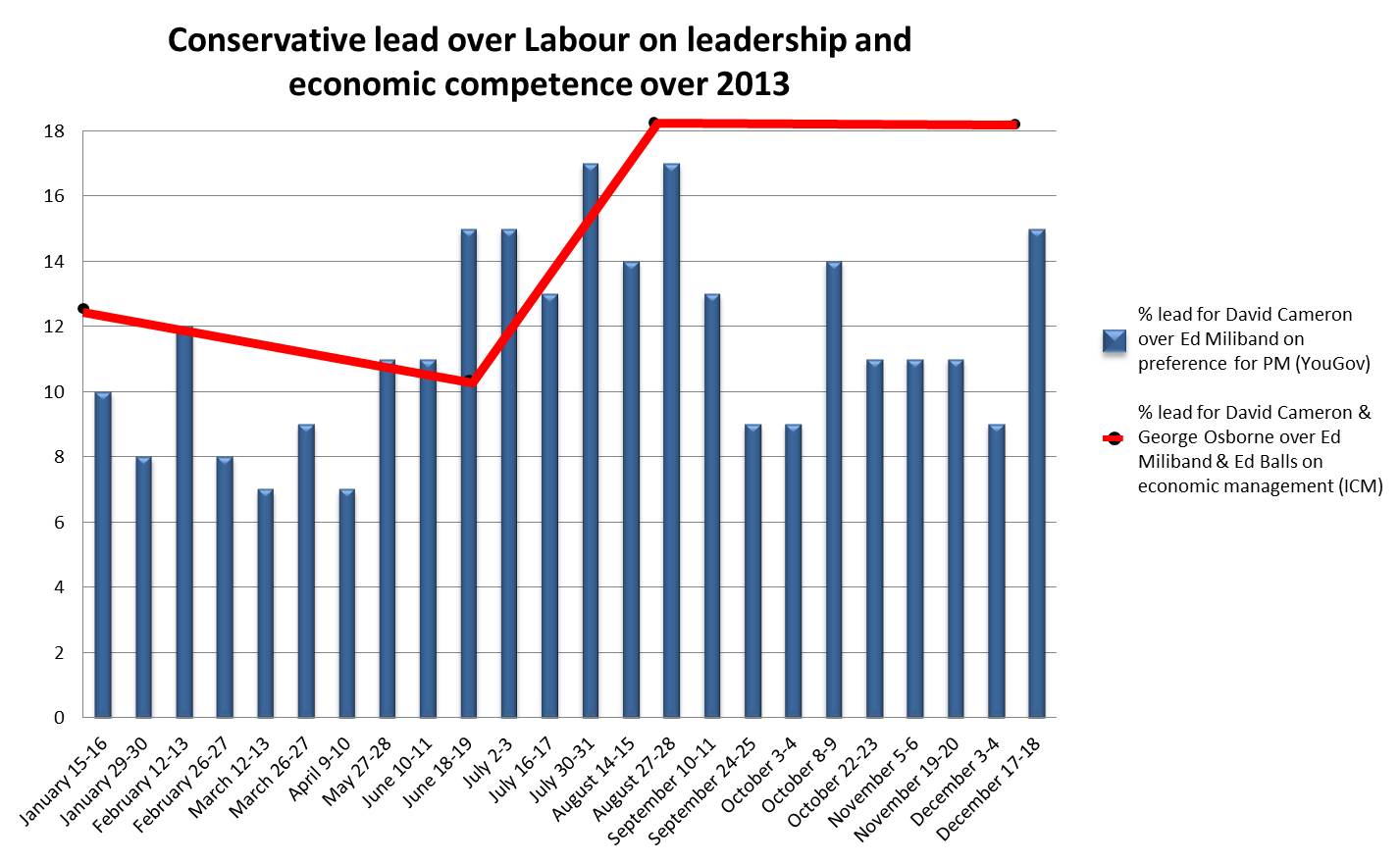
Second, Labour is losing the argument in terms of leadership and economic competence. This is the underlying reason why the party’s base vote has eroded since 2010, why it is overly optimistic to believe Labour can rely on legions of 2010 Lib Dem voters backing the party into the high thirties and why many UKIP converts are likely to lapse back into the Tory fold.

The chart below sets out the scale of Labour’s problem. No opposition has ever won while being behind on both leadership and the economy, and Labour now trails by double digits on both.

Con lead over Lab on PM and econ (more…)

Facebook Twitter Digg Delicious StumbleUpon

Ed Miliband’s simply trying to end “brutish jobs for British workers”

06/01/2014, 07:00:48 AM

by Kevin Meagher

Every mention of immigration is pored over for what the person raising it really means.

Ed Miliband’s piece in yesterday’s Independent on Sunday is pretty clear. A Labour government will close the loophole in the EU’s Agency Workers Directive that allows some companies to undercut British workers by employing agency staff on less favourable terms. This is particularly an issue in sectors like food production and hospitality which use a lot of foreign workers, resulting in 300,000 people being paid less than the minimum wage.

Miliband’s is firmly a critique of neo-liberalism, not immigration per se. His ire is reserved for the excessive effects of labour market deregulation on people in the foothills of the economy. He isn’t saying British jobs for British workers in a chauvinistic way, he’s saying that for too many it’s a case of “brutish jobs for British workers” as a race to the bottom in terms of pay and conditions for the least protected undermines everything Labour should stand for.

As he put it yesterday:

“What chance of rising living standards for all when unscrupulous firms can exploit workers from abroad to get around the minimum wage?

What chance of giving everyone a fair shot when recruitment agencies are allowed to recruit only from overseas, excluding locals from even hearing about jobs?

What chance of skills for the next generation when too many employers can just import them without having to train people here? Who would have predicted that just 14 years into the 21st century IT apprenticeships would be falling? Not because we don’t need IT skills but because they are too often just brought in from overseas.”

(more…)

Facebook Twitter Digg Delicious StumbleUpon

Rather than shedding tears for Mrs.Thatcher, Tory Ministers should apologise for their coalfields’ legacy

04/01/2014, 11:01:45 AM

by Michael Dugher

With the release of the cabinet papers on the 1984 miners’ strike, one of the more shameful chapters of our history has once again been exposed – and it’s time today’s Tory ministers apologised for the sins of their fathers.

Yesterday cabinet papers from 1984 revealed that Margaret Thatcher’s Conservative government did have a secret hit list of pits earmarked for closure.  Despite denials by the then government and by the National Coal Board, we now know that Tories planned to close 75 mines at the cost of some 65,000 jobs.

The papers also revealed that the previous Conservative government did seek to influence police tactics and put pressure on them to escalate the dispute.  Government ministers at the time pressured the Home Secretary, Leon Britton, to ensure chief constables adopt a “more vigorous interpretation of their duties”.

Shockingly, the cabinet papers also show that the Tories were willing to go as far as declaring a state of emergency and deploying the Army in order to gain victory over the striking miners and the unions – confirmation that it was a central tenet of government policy to regard tax-paying, law-abiding colliery workers, locked in struggle to defend their jobs and their way of life, as (to use that awful phrase of Margaret Thatcher’s) “the enemy within”.

Far from viewing people from these coalfield areas, such as in Barnsley where I represent, as ordinary, decent, hard-working people employed in a valuable and vital part of our economy, they presented the striking miners as dangerous ‘revolutionaries’ to be defeated. It is extraordinary to think that a British Prime Minister would seriously consider deployment of the British Armed Forces against ordinary British communities to further her domestic political ends, but this is the ugly truth of the Thatcher administration.

(more…)

Facebook Twitter Digg Delicious StumbleUpon