




Letter from Wales: Drakeford’s Etonian telescope

15/11/2013, 11:45:20 AM

by Julian Ruck

Mark Drakeford, Welsh health minister and professor of social policy no less (these days, just about everyone who has attended the Cardiff university Welsh madrassa is a professor of something or other), was spouting forth on the Sunday Politics show last Sunday – the Welsh version, which I assure readers is far more entertaining than Andrew Neil’s London spot.

Whilst ducking and diving in true Welsh government fashion, he seemed to be of the opinion that viewers were privileged to hear his pearls of medicinal wisdom and that indeed they were lucky to see him at all. He did have better things to do than accounting for himself you know. I mean, never mind the fact that the Welsh NHS is receiving less money than the English NHS due to Carwyn’s Bernie ap Madoff accountancy rules and farcical use of taxpayers’ money to generate no hope causes eg billions of European hard earned going AWOL, Carwyn’s Carriers at Cardiff airport, business ‘Techniums’ and bankrupt pubs (I’m not joking, see next column).

He began his justifications with a flogged out, tedious and somewhat pedestrian class war diatribe aimed at Cameron’s “telescopic Etonian” perceptions of right not being might – I wonder who wrote that for him? One cannot help but wonder here, what his views on Fettes College elitism and doctoral graduates of the University of Edinburgh are? Not quite the stuff of a Cardiff madrassa, are they? Maybe he had eaten too many laverbread splattered Welsh cakes for breakfast, who knows?

So, the point of all this?

The interview was a classic example of Carwyn’s government being camera shy and not taking kindly to public scrutiny. The soundings I hear from the Welsh media are all the same: Carwyn’s gegin cabinet (gegin, Welsh for kitchen) are always reluctant to show their faces and take a sound thrashing from their masters, indeed they won’t even advise the Assembly Communications Office of briefing times.

(more…)

Facebook Twitter Digg Delicious StumbleUpon

My generation isn’t apathetic. Telling us we are is an insult to democracy

15/11/2013, 10:09:01 AM

by Sam Fowles

We keep getting told that we’re not interested in “politics”, the reality is we’re just doing it better.

Apparently I don’t give a shit. Or at least my generation doesn’t. The story is we hate “politics”. Or, to use the most popular parlance, we’ve “lost faith” in it. We think “all politicians are the same” so we don’t vote.

Our elders are turning to UKIP in droves. Apparently because Nigel Farage will say things that ordinary politicians, hamstrung by their own bland, focus grouped platitudes, simply can’t.

Well yes, he does. It’s called extremism.

My generation’s collective decision to go home and watch The Inbetweeners again rather than vote for UKIP is possibly the strongest argument there is for putting us in charge of the country as soon as possible.

More importantly though, to say we don’t care about politics is just wrong. My generation may just be the most political in history. With Twitter, Facebook and blogs we’re analysing and commenting on the world around us on a far greater scale than our parents.

We have marched in our thousands against the war in Iraq, tuition fees and for fairer alternatives to the coalition’s economic masochism. Student activism and politics is a growing, not a declining phenomenon. No More Page 3, possibly the most important socio-political movement of the decade, is the brainchild of 20-somethings spread through social media and receiving it’s most decisive support through student unions.

Even outside those activities more overtly labelled “political”, my generation are churning out videos, songs, stories, plays, flashmobs and slutwalks which challenge every cultural dictum, from gender norms to post modernist theory.

So why does the prevailing opinion seem to be that we’re apathetic? Perhaps because people keep telling us we are. This is a story that’s being pedaled primarily by print media, TV and, somewhat paradoxically, politicians themselves.

Why do those most obviously involved in politics seem so desperate to convince us “millenials” that they’re irrelevant to us? That we are not interested in listening to them, debating their ideas or voting for them?

(more…)

Facebook Twitter Digg Delicious StumbleUpon

When Ed Miliband condemned Unite’s “machine politics” in Falkirk, did he forget his office had signed-off on their tactics?

13/11/2013, 07:14:31 PM

by Atul Hatwal

The Times today carried some revelatory new details on Falkirk (£). Strangely, they seemed to miss the real significance of what they’ve got (assuming the Ineos e-mails are as reported and what they say is true).

Their story focuses on a deal agreed between Iain McNicol, Labour’s general secretary, and Len McCluskey to ensure Unite members who were recruited into the party via the old “union join” scheme, where the union pays the first year of subs, were all moved onto direct debit so future payment could be assured.

The prospect of Labour’s general secretary cutting a deal with a union boss is hardly edifying but it’s not the big story. More interesting are the implications of an e-mail  from 21st January this year that is cited in the piece.

The mail is from Steve Hart, Unite’s political director at the time, to Karie Murphy, the Unite candidate and Tom Warnett, Unite’s political co-ordinator.  In it, Hart refers to delays by a sceptical Labour membership department, in processing the mass of new Unite recruits, stating,

“I was advised the week before Xmas that these had all been processed — advised by Jenny Smith [Ed Miliband’s union adviser at the time] and Scott Landon [Iain McNicol’s chief of staff] — but it is for the party to confirm authority, not us.”

Originally, the Sunday Times published the mail, but the names had been redacted. The inclusion of the names tells us that the leader’s office not only knew about Unite’s plans, they agreed them.

Dan Hodges picked up on the real importance of the revelations earlier today when he wrote,

“Back in July he [Ed Miliband] had said: ‘I am here to talk about a different politics, a politics that is open. Transparent. And trusted. Exactly the opposite of the politics we’ve recently seen in Falkirk. A politics that was closed. A politics of the machine. A politics that is rightly hated…’

But all the time his office had been supporting a deal with Len McCluskey to enable him to rig the selection.”

Think about it for a moment.

(more…)

Facebook Twitter Digg Delicious StumbleUpon

Labour history uncut: A party caught in two minds

12/11/2013, 11:53:24 PM

by Pete Goddard and Atul Hatwal

By late 1932 the recession had become a depression. Unemployment was stuck at 3 million and more austerity seemed the government’s only answer.

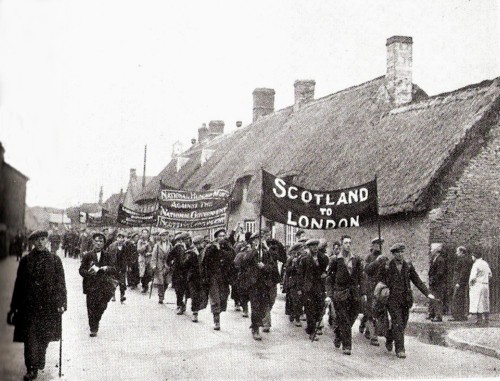
The communists responded through their National Unemployed Workers’ Movement (NUWM), which was like a union for the unemployed, with the slight drawback that when they went on strike, nobody could tell. The NUWM organised hunger marches to highlight the plight of the workless.

“Scotland to London, seriously? This is why we need a Scottish government.”

“Scotland to London, seriously? This is why we need a Scottish government.”

The government reacted by doing some organising of their own, arranging for 70,000 policemen to meet the hunger marchers and welcome them to London.

For its part, the Parliamentary Labour Party organised to stay in that evening with a cup of tea, peeking through the office curtains at the ensuing violence and hoping those nasty communists would just go away.

No such luck.

The deteriorating economic situation had helped membership of the Communist Party of Great Britain (CPGB) surge from 2,300 in 1930 to 9,000 by the end of 1932.

Meanwhile in Germany, the election in January 1933 of new chancellor with a hilarious Charlie Chaplin moustache and a less hilarious set of beliefs, led many on the left to seek common cause with the communists.

Moscow agreed, recognising an opportunity when they saw one.

(more…)

Facebook Twitter Digg Delicious StumbleUpon

Israel is like all nations and different from all nations

11/11/2013, 01:56:52 PM

by Jonathan Todd

1 December marks 40 years since the death of David Ben-Gurion, Israel’s George Washington. Yitzhak Rabin, its’ would-be Abraham Lincoln, was assassinated 18 years ago last Monday. Following the Six-Day War in 1967, during which Rabin was Chief of Staff to the Israeli Defence Force (IDF), Ben-Gurion, by then no longer prime minister, favoured returning all the captured territories apart from East Jerusalem, the Golan Heights and Mount Hebron as part of a peace agreement.

Peter Beinart last year published The Crisis of Zionism that calls for a revivified Zionism and recalls Ben-Gurion explaining: “Two basic aspirations underlie all our work in this country: to be like all nations, and to be different from all nations.”

Like all nations in providing a state for its people, a Jewish majority and homeland. Unlike all nations, as Beinart observes, in stressing: “Truly realizing the Zionist dream … required modelling various liberal or socialist principles for the world.” These principles led the Israeli constitution to commit to “complete equality of social and political rights to all its inhabitants irrespective of religion, race or sex”.

In contrast to Ben-Gurion’s vision, Israel is like and unlike all nations in ways that drive Beinart’s crisis. Like all nations in failing to fully make real these liberal/socialist principles. Unlike all nations in being the occupying force that Ben-Gurion cautioned against.

The Palestinian conflict is entangled with Egyptian instability, Syrian disintegration and Iranian nuclear capability. Iran desperately props up Assad in Syria, partly to maintain supplies to Hezbollah, which now directs 100,000 rockets toward Israel from the north. Iranian supplied weapons may again hit Israel from the south via Hamas in Gaza, if this Sunni body can be reconciled to Shia Iran after seeking an alliance with the Sunni Muslim Brotherhood in Egypt prior to them being swept from power.

(more…)

Facebook Twitter Digg Delicious StumbleUpon

Letter from Wales: In the spotlight: Keith Davies AM and Nia Griffith MP

08/11/2013, 10:27:23 AM

by Julian Ruck

Earlier this week I interviewed Labour AM,  Keith Davies and Labour MP, Nia Griffith.

Both interviews set out to explore firstly, the abysmal state of education in Wales and secondly, the political tensions that exist between Cardiff and London.

To begin, allow me to observe that Mr Davies was frank, open and obviously hasn’t forgotten that a sense of humour is an essential pre-requisite for any political ambition. His parliamentary counterpart however, was an accomplished pretender to the classic political art form of how not to answer a straight forward question. An ‘Off Message’ Bob Marhsall-Andrews, Ms Griffith was most definitely not. Ex-school mam and doyen of taxpayer funded haute cuisine, the lady was more a quintessential politician.

In relation to the parlous state of education in Wales, Mr Davies fully appreciated that a lot more needed to done in respect of science and engineering at Welsh schools, universities and colleges. He also readily agreed that inferior degrees were unacceptable if Wales is to compete in the modern world. When I quoted Matthew Taylor’s recent speech at the University of South Wales where he stated unequivocally that people in Wales should be ‘enraged’ at what was being done to Welsh schoolchildren, Mr Davies expressed at the very least some thoughtful understanding.

Ms Griffith on the other hand seemed to be in chronic state of Napoleonic denial, either this or she is an aficionado of Medieval trial by ordeal? It took a pair of dental pliers for her to concede and I quote, that “standards could be improved,” albeit that the evidence is clear and irrefutable: numeracy and literacy in Wales is on a par with Rumania and Bulgaria, that Welsh universities are accepting Law and Biology students who attain the minimum grade ‘E’ at two ‘A’ Levels and that spanking new Welsh education institutions are only allocating 12% of their budgets for engineering and science. As for the Welsh Baccalaureate and GCSE, apparently “plenty of consultation” makes them superior to the rest of the country and that was that. There was also a note of desperate satisfaction when she declared proudly that 40% of youngsters in the UK are now graduates “when in our day (she and I are the same age by the way) it was 2%”

(more…)

Facebook Twitter Digg Delicious StumbleUpon

Away from Plebgate, there’s another police conspiracy. But neither the Tories or the media want to talk about it

08/11/2013, 07:00:25 AM

by Sam Fowles

The Tories are only too willing to tolerate police corruption, so long as it’s people they don’t like who are the victims.

It’s almost Conan-Doyleesque. The blundering plods exposed by the quick wittedness of the (almost) aristocratic amateur. The emotional toll of the corrupt peelers’ betrayal, hitherto manfully concealed from the world, only revealed by the plaintive intervention of his loving daughter.

Except this isn’t a Sherlock Holmes story. This actually happened. Three police representatives have been exposed as liars after Andrew Mitchell revealed the recording he made of their meeting.

But the pious cries of corruption from Conservative MPs and their supporters in the media ring embarrassingly hollow when one considers their historic attitude to police malpractice.

The reality is that, when the victim is a rich, white, Conservative, police corruption represents a threat to our very democracy. If, however, the victim happens to be poor, black or a member of a group with which the right disagrees politically, then the thundering waves of outrage become rapidly tranquil.

They have, for example, remained positively glassy regarding the case of Mark Duggan, the man whom the police shot dead in 2011, sparking nationwide riots.

Let us, for a moment, consider the unfolding Duggan inquest.

The police, specifically three police officers involved, identified as W42, V53 and W70, claim that they followed Duggan from Tottenham to Leyton in unmarked cars and watched him pick up a package which, intelligence lead them to believe, was a firearm. They then followed him back to Tottenham until ordered to stop and detain him.

(more…)

Facebook Twitter Digg Delicious StumbleUpon

The real reason Labour is petrified of re-opening the Falkirk inquiry

05/11/2013, 02:16:13 PM

by Atul Hatwal

Tomorrow is prime ministers’ questions. At the despatch box, when David Cameron faces Ed Miliband, political reality will collide with the la-la land Labour is living in on Falkirk.

As in July, David Cameron will use the fiasco to hammer Ed Miliband.

Labour MPs are dreading it. The Tory backbench barrackers can barely wait. Journalists are gleefully expecting great copy.

Already today, George Osborne crow-barred Falkirk into Treasury questions, such is the Tories’ eagerness to use it as a means of attacking Labour.

Come what may, the post-PMQs story tomorrow won’t be about energy or the living wage, but Ed Miliband’s leadership and the power of Unite over the Labour party.

Over the past few days the shrieks of “nothing to see here” from Labour’s high command have become ever louder and more desperate. We are long past the stage where rationality seems to drive the party’s actions.

It is politically unsustainable for the party to continue insisting all is well when figures as senior as Alistair Darling are calling for the inquiry to be re-opened and news reports related to Labour are increasingly dominated by this one issue.

And on the evidence that has emerged from the cache of over 1000 Ineos mails that were passed to the Sunday Times, the party appears to be wilfully averting its gaze. Ed Miliband was wrong today when he said that no new information had come to light on Falkirk.

Quite apart from whether key witnesses have or have not withdrawn their original complaints, if the Sunday Times e-mails are true there are several other potential rule breaches now in the public domain that merit further examination by the party.

For example, the Sunday Times reports,

“Separately, an email from Karie Murphy, the hard-left candidate Unite was trying to parachute into Falkirk, reveals a secret system that gave Labour members colour-coded star ratings based on their perceived loyalty to Unite.

It gave red stars to those considered the union’s opponents, yellow stars to female members who might back it and double green stars to those the union had specifically ‘recruited for the selection’.”

If the last phrase, “recruited for the selection” is accurate, then it seems Labour party procedures have been broken. The party rule-book is quite clear that members cannot just be recruited for selections. In Appendix 2 NEC procedural guidelines on membership recruitment and retention, the rule-book states,

“The health and democracy of the party depends on the efforts and genuine participation of individuals who support the aims of the party, wish to join the party and get involved with our activities. The recruitment of large numbers of ‘paper members’, who have no wish to participate except at the behest of others in an attempt to manipulate party processes, undermines our internal democracy and is unacceptable to the party as a whole.”

If the party was serious about its own rules then this one potential breach alone would have been cause at least for some further investigation.

But clearly the party is not interested, regardless of the damage or the new evidence that has emerged.

The question is why? Why would the Labour leadership indulge in such an apparent act political of self-harm by pretending nothing has changed on Falkirk?

The answer is that there is a far greater fear of the consequences for Ed Miliband if the inquiry is re-opened and a civil war with Unite ensues.

Beyond the potential financial cost to the party of withheld union donations, the leader’s office is scared about what will happen at the special conference next year on Ed Miliband’s proposals to reform the union link.

(more…)

Facebook Twitter Digg Delicious StumbleUpon

Letter from Wales: Police commissioners to discuss “twitter beats” for cops to tackle trolls

04/11/2013, 07:00:32 AM

by Julian Ruck

If one was enjoying a pint in a pub or a casual stroll in a park and all of a sudden a motley bunch of cruel antagonists were to pounce with verbal abuse and barrages of weakling insult and threat, the police would jump pretty sharpish.

Not so it seems, at least where the much lowered tone and corruption of Berners-Lee intent is concerned. These pornographers of free speech can provoke suicides, breakdowns, destruction of reputations at will and all with a uniquely derisive impunity.

Democracy in action? It is time is it not, for a fresh look at these new 21st Century multi-headed monsters?

In recent times the media has been beside itself with the rampant pillaging of civilised behaviour by those who seek to make sexism, raw intimidation and vicious personal attack, veritable art forms.

All is not lost however. Readers will remember that only a few weeks ago I interviewed Dyfed Powys Police Crime Commissioner, Christopher Salmon. Following my interview, his office advise me that the Commissioner is going to discuss a new initiative with other PCC’s in an attempt to consider the potential for an online police presence tasked with patrolling internet trolling activity. Could these “twitter-beats” be the 21st century panda car equivalent of days gone by? One can only hope (or maybe not, to those of us who are old enough to remember them!), but it is at least a start.

(more…)

Facebook Twitter Digg Delicious StumbleUpon

Under Cameron, it’s easier to become a teacher than to get a job in a burger bar

01/11/2013, 02:01:32 PM

by Kevin Brennan

At the end of what has been a busy week for Labour’s shadow education team, today exam regulator Ofqual has announced its planned changes to GCSEs. It is welcome that Ofqual want to strengthen the rigour and integrity of qualifications – but it is odd that David Cameron is doing the exact opposite when it comes to teaching standards. David Cameron’s policy of allowing unqualified teachers in our schools is damaging education standards in our classrooms- as we have seen from the case of Michael Gove’s Al-Madinah free school in Derby.

Labour would bring an end to the watering down of standards and guarantee that all teachers in state funded schools would have to become qualified. That is what this week has been about.

On Wednesday afternoon, in a fashion of which we have unfortunately come to expect from them, the Liberal Democrats performed a remarkable feat of political contortion.

Nick Clegg had surprised his own schools minister by declaring “we should have qualified teachers in all our schools.”

It was a relief to hear Clegg agree with Labour policy on this issue. We have long warned of the dangers of the Government’s policy which allows unqualified teachers to teach in Free Schools and academies, and the inevitable watering down of teacher standards that it will lead to.

All this was a tad inconvenient for the Lib Dem schools minister, David Laws who just a few days earlier had passionately defended the policy of allowing unqualified teachers.

In an education select committee hearing last Wednesday, Laws was questioned about his party’s policy on this issue. Laws claimed that he supported a resolution at the Liberal Democrat conference which stated that “every child deserves to be taught by an excellent teacher and appropriately-qualified teacher, or a dedicated professional who is working towards such a qualification.” Then when closing up the debate that took place on Wednesday this week on the subject, he again indicated that he agreed with his party’s position.

It was a rapid volte face but surely welcome as it would mean that the House of Commons could pass a motion supporting having qualified teachers with Lib Dem support.

(more…)

Facebook Twitter Digg Delicious StumbleUpon