




New Falkirk twist: Now Labour refuse to commit to pass evidence of law-breaking to the police

04/07/2013, 07:00:33 AM

by Atul Hatwal

Another day, another Falkirk West farrago. Labour has now managed to tie itself in knots over what to do with evidence of illegal activities, uncovered as a result of the party’s inquiries.

The current position is that Labour will not commit to handing over any evidence of suspected law-breaking to the police or relevant authorities.

To recap, this sorry affair was kicked off when local Unite members complained to the party about being recruited into Labour without their knowledge.

In late May, the Sunday Herald carried details of one of the letters of complaint, originally sent in March, that ultimately triggered the NEC inquiry,

“Myself and two family members have been enrolled by Unite…I or my family did not fill in or sign any forms and wish to know what information the party holds about my family… I have concerns as to the way Unite in Falkirk are recruiting party members.”

On this basis, two laws appear to have been broken – the 1998 Data Protection Act and the 2006 Fraud Act.

Just over a month ago Uncut reported that angry members in Falkirk West were considering reporting Unite to the Information Commissioner because of a breach of their data protection rights.

Under the terms of the Act, each individual must have agreed before their personal details are passed to a different organisation.

At the point where Unite members’ personal details were registered with the Labour party, without their consent being first granted, the law will have been broken.

Then, yesterday Uncut reported on the likelihood of a breach of the Fraud Act. Whoever completed the bogus applications and validated them would have contravened section 2 of the Act under the terms of “false misrepresentation”

Submitting completed forms to the Labour party, without the new members’ consent, would have constituted false misrepresentation.

Two laws, two breaches. One to do with peoples’ rights over their personal information, the other with the act of someone deliberately falsifying membership forms.

(more…)

Facebook Twitter Digg Delicious StumbleUpon

New allegations of fraud and interference with party investigations emerge from Falkirk West

03/07/2013, 07:00:02 AM

by Atul Hatwal

For the past few days, the debacle in Falkirk West has been the main news story relating to the Labour party. The allegations of entryism by Unite are well known as is Labour’s response: to place the constituency in special measures and bar anyone who joined after 12th March 2012 from voting in the parliamentary selection.

But, new information has emerged that suggests the problems maybe even more serious. The latest allegations centre on a potential breach of the 2006 fraud act and a subsequent attempt to induce those who had complained , to change their testimony before the national party could investigate.

The Unite defence against claims of foul play in the constituency has been that the recruitment of union members, with their annual subscription paid by the union, is within party rules.

This is true, but only on the condition that the new members would actually be willing to pay the subscription themselves and want to join the Labour party to participate as individuals, not as part of a bloc interested only in manipulating selection processes.

In terms of payment of subscriptions, the rules are clear:

“It is an abuse of party rules for one individual or faction to ‘buy’ party membership for other individuals or groups of individuals who would otherwise be unwilling to pay their own subscriptions. “ Clause II Membership procedures, Chapter 2 Membership rules, Labour party rulebook 2013

As they are on the motivation of new recruits for joining the party,

“iii. The party is anxious to encourage the recruitment of new members and to ensure that new members are properly welcomed into the party and opportunities offered to enable their full participation in all aspects of party life.

iv. The party is, however, concerned that no individual or faction should recruit members improperly in order to seek to manipulate our democratic procedures.

v. The health and democracy of the party depends on the efforts and genuine participation of individuals who support the aims of the party, wish to join the party and get involved with our activities. The recruitment of large numbers of ‘paper members’, who have no wish to participate except at the behest of others in an attempt to manipulate party processes, undermines our internal democracy and is unacceptable to the party as a whole.” Sub-sections (iii)-(v), Section A, Appendix 2 NEC procedural guidelines on membership recruitment and retention, Labour party rulebook 2013

The party investigation into Falkirk West was prompted by complaints made by two families who mysteriously found that they had suddenly become Labour party members, despite never signing the forms to join the party.

They complained to the local party, to local councillors, and sources suggest, the police.

(more…)

Facebook Twitter Digg Delicious StumbleUpon

Ed’s right, small state socialism can still be radical – but Labour needs to govern better next time

02/07/2013, 07:00:11 AM

by Kevin Meagher

Whisper it, but governing is the boring part of politics. Ironic, really, given so many would-be ministers would scramble over broken glass on their hands and knees for the sniff of a chance of becoming a parliamentary under-secretary for paperclips and sustainable date-stamps.

It’s not that governing – sitting behind a desk and running things – is pointless or unrewarding; it’s just that it’s hard and time-consuming and politicians are easily distracted by the thrill of the chase. Tony Blair, of course, famously did sofas rather than desks. So Labour’s approach to government for 13 years was, crudely, to announce things then throw money at officials and assume change had been made. Job done.

This approach was tested to destruction. For public services to improve, more state spending was always needed. To make them improve a lot, spend a lot. As a result, ministers often overspent and over-legislated, but, paradoxically, under-governed too. Of course you have to put money into the Whitehall fruit machine to make the lights come on, but you still need to know which buttons to press. That’s what governing is all about.

When the buzz of the press launch has faded and the television cameras have gone away, all that is left is the spadework of navigating bills through parliament, rolling-out new programmes, retraining staff to implement the changes to policy (which invariably takes a fiendishly long time), listening to the gripes of one lobby group or another and sitting in meetings. Lots of meetings. All this slog takes time and commitment and, frankly, a few Labour ministers found themselves bewitched by the Age of Spin last time around and didn’t do the hard work that real change demands.

Take the police. Measurable crime halved under Labour (for a variety of reasons, not least the longest unbroken spell of economic growth in 200 years) but anti-social behaviour, the bureaucratic term for describing thoughtlessness and thugishness, flourished. Police numbers also swelled, while Parliament passed twenty odd pieces of criminal justice legislation.  Although the police had everything they could possibly need from Labour ministers, they still barely made a dent in tackling anti-social behaviour.

Not enough was demanded from them. In fact, unlike other public services, police performance targets were actually scrapped, apart for the single watery invocation to ‘raise public confidence’. Yet ministers didn’t ask why there had been a catastrophic loss of public trust in the first place. No chief constables were sacked for poor performance. The focus, especially after 9/11 was on security and no-one much bothered what the plod was doing – or not doing – on other fronts. It’s only now we get a sense of the rottenness at the heart of parts of our police force.

(more…)

Facebook Twitter Digg Delicious StumbleUpon

Labour history uncut: Labour wins the one to lose in 1929

28/06/2013, 06:40:53 PM

by Pete Goddard and Atul Hatwal

The first gusts of a returning wind seemed to be wafting into Ramsay Macdonald’s sails.

After the general strike in 1926 had shattered morale in the Labour movement, the Tories attempted to curtail union power with the 1927 Trade Union Disputes Act. That threat united activists and unions behind the party.

Once again, parliamentary action was the only game in town to stop the Tories.

As the 1927 conference approached, Macdonald wanted to wow the crowd with something big. A grand statement of Labour aims, perhaps. Or a medley of socialist showtunes.

Fortunately for everyone, he chose the former. Macdonald sat down with Labour’s Burt Bacarach, Arthur Henderson, and started scribbling. One montage sequence later, Labour’s new vision was complete.

They took the paper to the executive of the parliamentary Labour party for sign-off and some insincere praise before going to NEC and then conference. It was just a formality.

The PLP then, very formally, said “Ramsay, this is rubbish.” This was quite something coming from a body so pliable it would have declared Viva Forever ‘a tour de force’ had Macdonald produced it.

Hugh Dalton commented that it was “too long and very dully written,” before adding, “But it might sell if you chuck in a sparkly vampire.”

Meanwhile, the executive of the PLP passed a motion. It urged the NEC not to allow the document to be debated at conference because, being in Blackpool, the event was going to be quite boring enough already.

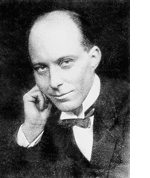
Hugh Dalton: in the opinion of the smartest man in the Labour party, he was the smartest man in the Labour party

Instead, Macdonald ended up part of an NEC sub-committee tasked with a rewrite.

(more…)

Facebook Twitter Digg Delicious StumbleUpon

Ken Loach is marvellous

28/06/2013, 01:32:08 PM

by Kevin Meagher

I’m always puzzled by the contrast between Ken Loach’s politics and his films. In person, Loach is a quiet and modest man with fairly run-of-the-mill and defiantly unreconstructed socialist views, having left the Labour party in the mid-1990s.

In contrast his films, although clearly polemical, are brilliantly nuanced. They take the broad theme of the value of collectivism but Loach’s amazing talent lies in small detail; nailing characters and situations with brilliant realism, simplicity and compassion.

His 2006 Palme D’or-winning film about the Irish War of Independence, The Wind that Shakes the Barley, is one of the finest parables about the clash between the politics of idealism and the politics of pragmatism that you will ever see.

Although his recent documentary, The Spirit of ’45, has been widely talked about before, it was two of his older films, shown this week as part of a Film Four series of Loach classics, that stand out for me.

The first, Riff Raff, was made in 1991 and sees Robert Carlyle’s jailbird, Stephen, an itinerant loner with a mysterious past, finding comradeship working on a London building site and love with a pub singer while squatting in a flat.

When Ricky Tomlinson’s character, Larry, a fellow labourer, complains to the management about the dangerous working conditions the men have to endure, he is sacked. Another man later falls to his death from the same scaffold Larry had been warning about. Given what we now know about the blacklisting of building workers in a notoriously un-unionised industry, the story is particularly poignant.

(more…)

Facebook Twitter Digg Delicious StumbleUpon

Letter from Wales: £400,000 for a man snoring in a telescope!

28/06/2013, 07:00:53 AM

by Julian Ruck

Skint UK? Ed Balls’ scrutinising of every pound? Don’t be daft this is the Arts Council of Wales!

And as if the £400,000 of tax-payers’ money for a Welsh contemporary artist to strut his stuff (no disrespect to said artist) at the Venice Biennale isn’t enough, it took the CEO of the Arts Council of Wales, one Nick Capaldi and six of his ACW cronies to tag along and hold his hand!

But what about the expenses the taxpayer has also forked up for? Following my FoI requests (12,13, 17th June 2013) it turns out we have paid  £260.00 per night for hotels and a damn your eyes to LateRooms.com and a brew of Tetley in a Venetian back alley.

Apart from Mr Capaldi’s £1,981.20 (for 4 nights), we have a real beauty: Professor Dai Smith, chair of the ACW not only claimed £1709.49 from the tax-payer for his three day Venetian jolly but his own book “Dream On” (you can say that again!) published last May, was also paid for by the tax-payer. Oh and he doesn’t like “nutters” like me scrutinising his artistic efforts either, I’m told.

Here are the expenses for the rest of ACW’s party-goers:-

David Alston (£1636.77 for his 4 nights) Arts Director ACW;  Louise Wright (£1569.85 for 4 nights) ACW Commissioner for the Biennale no less; Eluned Haf (£1638.51 for 4 nights) ACW Director of Wales Arts International; Sian James (£1,964.77 for 4 nights) ACW Press Officer and not forgetting Osi Rhys Osmond (£1687.16 for 4 nights), an Arts Council Member and Chair of Advisory Committee?

Now you may be thinking why all these people are needed for a quick few second turn on BBC Wales’ Today programme. Jobs for the boys time again perhaps? The usual old suspects again? You would also be forgiven for wondering why it needs 7 people to do the same thing and enjoy an expensive city break at tax-payers’ expense, while they are at it?

Classic devolved Welsh replication of jobs maybe?

CEO Nick Capaldi was quoted as saying about the Venetian visual art extravaganza, “It’s the Formula 1 of the visual arts world, in that a Formula 1 racing car has little in common with the family hatchback other than four wheels and a steering wheel”.

Excuse me? Sorry to disabuse you Nick, but right now many people in this country are struggling to keep a four-wheeled pram on the road and  you’re also dead right about the exhibition having little in common with the family hatchback man in the street – most of them are out there trying to hold on to a job.

(more…)

Facebook Twitter Digg Delicious StumbleUpon

The work programme: improving, but for who?

27/06/2013, 04:28:28 PM

by Bill Davies

The latest figures from the work programme show it is doing, on aggregate, better than it was. Now the programme has been running for 22 months, we are in a better position to consider whether it is achieving its main objective, to reduce unemployment and increase employment amongst all eligible claimant groups.

It is doing better than last time, particularly when you look at newer cohorts to the programme, but little better than the programme it replaced. At this stage of the flexible new deal, 13 week job outcomes as a percentage of eligible starts were 18%, and 26 week outcomes were 12%. The coalition’s work programme, introduced to dismantle the ‘fundamentally flawed’ Flexible New Deal, is at this stage achieving outcomes of 13%. Better than last time, but not brilliant. The statistical release of the department for work & pensions shows that 22 out of the 40 contracts have not met their targets for moving the largest group of job seekers allowance claimants (over 25 year olds) off benefits and into work. The target for this group was 27.5% of starters to move into work, but at this stage, the target has been narrowly missed, at 27.3%.

The most staggering figure is that employment & support allowance, the group for people moving from incapacity benefits gradually back into the labour market had a target of 16.5% of starts to job outcomes, but the actual outcome rate was 5.3%, only a third of the target.

Is the work programme assisting those regions that have the most difficult labour markets? On the basis of current performance, it is still largely reflecting them.

(more…)

Facebook Twitter Digg Delicious StumbleUpon

How Osborne is feathering his own nest

27/06/2013, 03:00:06 PM

by Dan McCurry

George Osborne is desperate to have some kind of legacy that he can tell his grandchildren about. Selling the state-owned banks would be that legacy. The only problem is that universal advice tells him that now is not the time.

Stephen Hester had earned great praise for his achievements as boss of RBS, with investors such as Fidelity’s £2.5billion fund manager Sanjeev Shah describing him as “doing a fantastic job.” But look at the reaction from the brokers since Hester announced his departure.

Investec Securities:

The manner of Mr Hester’s departure is deeply unsatisfactory. Since 2008, government inconsistency and mismanagement have hurt shareholder value and, as 81% shareholder, it reaps what it sows.

Espirito Santo:

Mr Hester’s departure was clearly against his wishes and it appears that Mr Osborne had different ideas as to how the bank should be run. The political wrangling has significantly impacted the franchise.

The Economist magazine:

[Osborne] shoved out RBS’s boss Stephen Hester, prompting a sharp fall in the bank’s shares. …It is politics not economics that underpins the government’s decision to privatise the banks.

The share price was 334p on 11th June and is now 275p (27/6/13) and continuing to fall against a rising market. That’s an 18% fall so far. Placed in context, that is roughly a £20 billion loss to the British taxpayer in the space of a couple of weeks. (see footnote)

(more…)

Facebook Twitter Digg Delicious StumbleUpon

Labour and Unite: a little time-bomb

26/06/2013, 04:51:18 PM

by Rob Marchant

This morning, Uncut reported developments in the Falkirk selection fiasco; Labour’s investigation confirmed that there was an attempt by Unite to recruit additional members in order to fix the selection. For a major union to intervene behind the scenes in the running of a selection may not be unheard of, but the careless and obvious entryist manner in which Labour implies it was carried out was, frankly, breath-taking.

Last weekend, further reports surfaced in the Times and the Mail on Sunday regarding the that Labour advisors Blue State Digital were arm-twisted by “a senior Labour figure” to lean on their employee to pull out and make way for a Unite-backed candidate, or risk losing their contract. Whoever the figure turns out to have been certainly has some very awkward questions to answer.

Essentially in denial over what happened, Unite’s woefully inadequate, “er, it was the Blairites wot did it” rebuttal brings to a head a power struggle which has been simmering ever since Miliband took the party’s reins.

But perhaps just as interesting was a less explosive, but not-entirely-unconnected event which happened last weekend, before all this became public.

The People’s Assembly, a new left project developing the anti-cuts argument to anti-austerity in general, had its debut in central London. Its only front-bench Labour attendance was from Diane Abbott, which gave a good indication of its political leanings.

The demo was largely peopled by the usual suspects from the hard left, who were also – as blogger Stephen Bush, in attendance, tweeted – not exactly representative of the ethnically and culturally diverse British electorate. At the moment the Assembly it is not even a party (although this did happen later with Respect).

As a rule, it is much better that such people develop their political ideas outside the Labour party than infiltrate it, and it seems safe to conclude that the Assembly is pretty much an irrelevance in terms of any direct effect on British politics. As, it seems, is the Left Unity project, triggered by filmmaker Ken Loach’s March call for a new left politics. They are the last in a long line of wildly over-optimistic attempts to realign the left.

What does all this mean for Labour? On the one hand, nothing. There is no “people’s army” about to storm the barricades and take Labour out at the next general election – at most there may be a new far-left grouping which might take some votes away in key marginals (and these would be more likely to take votes away from the now-declining Respect than Labour).

(more…)

Facebook Twitter Digg Delicious StumbleUpon

Unite found guilty of entryism in Falkirk West, but who within Labour was complicit?

26/06/2013, 07:00:04 AM

by Atul Hatwal

Yesterday evening, as politicians and the media prepared for today’s debate on the spending review, Labour’s press office found the ideal time to bury some bad news.

The result of the NEC inquiry into the Falkirk West parliamentary selection was finally announced.

The party has decided that the surge in Unite members joining the local party was sufficiently suspicious to warrant action.

Falkirk West CLP has been placed in “special measures” and members who joined the party after March 12th last year (the date Eric Joyce MP announced he would be stepping down) will now not be eligible to participate in the parliamentary candidate selection, which rules out the new Unite caucus.

Effectively, the party has found Unite guilty of entryism.

It’s a major decision to accuse Labour’s biggest donor of packing a constituency with ringers and trying to subvert a parliamentary selection, but one that was inescapable given the facts.

Uncut understands that in the last three months of 2012, the membership of Falkirk West CLP increased by over half – from 200 members, it grew by 130 to 330.

These weren’t members attracted by the magic of Arnie Graf’s community organising, or an inspirational Ed Miliband speech.

They were shipped in, en masse, by Unite.

In October last year, Labour party HQ started to receive packs of membership forms accompanied by a single cheque, cut by the union, to pay for all of the members’ annual subscriptions.

As the forms piled up at head office in Brewers Green in London, party officials started to get nervous.

Normally, membership applications are processed within days and contact is quickly made by the party with the new member.

Not so for Falkirk West.

(more…)

Facebook Twitter Digg Delicious StumbleUpon