




At last, some Labour pains

10/06/2013, 07:37:34 AM

by David Talbot

Labour might still easily lose, in 2015, an election it really ought to win. If that is indeed what happens, the reason, as so often with the Labour party, is that it will have operated in the world it so dearly wishes it to be, rather than the cold, rather more sobering, reality.

It will be because it didn’t understand what voters told it in 2010. It will be because unveiling daft posters, available, incidentally, at the not very One Nation price of £35, and talking of the “same old Tories”, lamenting their cuts and their rich friends, is far easier than undertaking a soul-searching examination of why the party was so comprehensively buried in 2010. It will be because it preferred to spend time in the seminar room, talking to nobody but itself, pontificating wildly on the politics of Neverland. This will be, as always, most soothing for the Labour movement. It will have its high-mindedness, and its piety, and it will lose.

The Labour party cannot win in this state of deluded comfort, revelling in the opportunities for moral indignation that austerity affords, whilst simultaneously saying nothing of note to the nation.

If there was a pain-free option, the Labour party would, of course, take it. In this make-believe world of Labour thinking, when, not if, Labour are elected in 2015 the party will have to impose no cuts, spending will be allowed to increase on nice things like the health service, and grateful voters will at last acknowledge they made a dreadful mistake in 2010 by voting for those ghastly Tories. This inability to face the truth is deeply worrying for those, which now include, seemingly, the Labour leadership, who believe the party has spent the past three years either saying the wrong thing or nothing at all.

On the great issues of the day too often there has come has come either silence from the Labour party or scorn from the labour movement. By wallowing in the trough of political invective, the Labour party doesn’t seem to have realised that it long ago lost the argument.

(more…)

Facebook Twitter Digg Delicious StumbleUpon

Letter from Wales: Let’s see if the Welsh gravy train survives a collision with Ed Balls’ fiscal reality

07/06/2013, 11:34:11 AM

by Julian Ruck

The other day Ed Balls said, “We need to look ruthlessly at how every pound is spent.”

He obviously has yet to travel on the Welsh express gravy train.

Devolution has allowed the ancient Labour enthusiasm for small-town political monopoly and personal fiefdom to run riot – for the impotence of democratic principle and challenge, look no further than Wales with its happy coteries, self-serving cabals and “all the usual suspects” political foxhole mentality.

Like the rest of the UK, there are three sectors in Wales. The public, the private sectors and  of course the third Sector which is not for profit and seeks to help citizens in varying and various ways eg health charities, CAB’s etc.

As alluded to in previous “Letters,” Wales is a tax-payer junky, it cannot and will not move away from the divine right of tax-payer subsidy in all things – as least Westminster subsidy that is.

Wales is small, many in Westminster may even think insignificant, its population not even  half of London’s. But should this smallness negate any scrutiny by its paymasters? Any accountability?

In Wales, criticism of the ruling party is viewed with suspicion and superior arrogance. The elite potentates of Old Labour carte blanche carry on with a 90 year mandate as if Blair never existed and the unions still rule the ghostly memories of coal and steel grandeur.

London must and always will, pay up.

Dissent is for the birds. Outspoken truth to be sneered at and discredited wherever possible. The Welsh will always vote old Labour.

So why don’t even a minority of the Welsh speak up? The answer is simple. All three sectors are in the tax-payer pocket, in some way or another. Even the private sector relies heavily on public subsidy, although it is debateable whether there is a Welsh private sector at all. To get on in Wales one has to be Old Labour, one has to toe an outdated and defunct Clause IV line and ignore what is going on in the rest of the world.

(more…)

Facebook Twitter Digg Delicious StumbleUpon

John Mills, tax and dishonesty

07/06/2013, 08:41:55 AM

by Dan McCurry

On the issue of taxation abuse, we need to move on from the oversimplified distinction between legal avoidance and illegal evasion.

At the moment some avoidance has shocked people, while other avoidance, such as my tax free savings, is not an abuse. In order to sort out the difference between good and bad avoidance, I suggest people concern themselves with whether the avoidance was dishonest or not.

In the case of George Osborne’s complaint about a Labour donation, we need to ask, was John Mills dishonest in his method of avoiding tax in this donation? If he was, then Labour is in trouble, if he wasn’t then we are not. Mr Mills chose not to sell the £1.5m of shares and give the cash to Labour, as that would have been taxed as a capital gain. By giving Labour the shares, then Labour will be taxed on the dividends, but only liable to the capital gains if they are sold.

I have some of my savings in an ISA as a tax efficient method of building a pension. I can invest £11,250 per year in my ISA and this will be exempt from taxation both on the dividends and on the capital gains. The same applies to a donation I might give to charity that can be given with “Gift Aid” so that the tax paid amount is passed on to the charity. Is that dishonest? No.

This is quite different from the case of Jimmy Carr who passed his money to an Isle of Man, company who then provided him with same amount back but called it a loan. A loan isn’t taxable, so he avoided tax. Now, any sensible person would describe that as completely dishonest, but because tax law is based on a set of rules, he wasn’t prosecuted.

Criminal law is a different set of law and can take precedence if policy makers wish it to. If the authorities wished to prosecute him for fraud, they could have done so, but if they had, then they would probably have to prosecute everyone else who has done similar, and that is a prospect that can be frightening to the people who run this country.

Fraud is when someone commits a dishonest act which makes a gain for himself, or a loss to another.

The other problem that exists with tax is that countries tend to have bilateral treaties with each other.

(more…)

Facebook Twitter Digg Delicious StumbleUpon

Labour history uncut: Everybody out!

05/06/2013, 06:00:12 PM

by Pete Goddard and Atul Hatwal

It’s somehow fitting that the fuse for the general strike was lit at the Daily Mail.

The government was still engaged in half-hearted negotiations with the unions when, on Sunday 2nd May 1926 the print compositors at the Mail refused to set an inflammatory editorial, entitled “For King and Country.” Although the companion piece, “Compositing print causes cancer” probably didn’t help either.

Seeing an opportunity to kick things off whilst still blaming the unions, the government summarily walked out of the talks muttering about threats to freedom of speech.

The unions thought, “Walk out will you? We’ll show you a thing or two about walking out.”

The next day letters went out to union members up and down the country and on Tuesday 4th May the whistle blew.

”Everybody out!”

The general strike had begun.

Around 1.5 million to 2 million workers took part in the strike. People downed tools all across the country.

Then, frequently, different people across the country picked those tools up again.

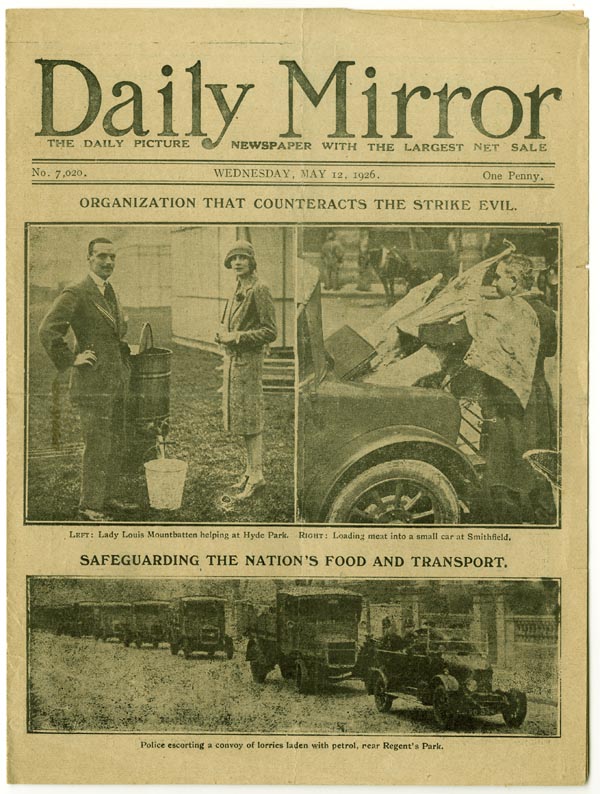
Approximately 300,000 volunteers had joined the overwhelmingly middle class and right-wing Organisation for Maintenance of Supplies. Their task was to help keep the country running during the period of the strike in a sort of extended “working class” themed fancy dress party.

The general strike’s PR team knew it had an uphill battle when even the Mirror started calling the strike "evil"

At the same time, with the print setters on strike, someone had to provide the British public with a replacement for their daily sports news, Sudoku and political misinformation. And who had enough spare time to moonlight over hot metal at a time of enormous national economic crisis? The chancellor of the exchequer, of course. Winston Churchill was put in charge of producing the government’s British Gazette.

(more…)

Facebook Twitter Digg Delicious StumbleUpon

Ed Miliband needs to tell us what he stands for

04/06/2013, 09:55:11 AM

by Dan McCurry

So YouGov tell us that Ed Miliband is regarded as “honest but untrustworthy”? What to make of it all? I’m sure his speech on Thursday will sort out all the confusion. What I think he need is to show us what he stands for.

There has been recent comment about whether Labour should reveal it’s policies, with Alan Johnson arguing that Miliband has already “shown too much leg”. Others, including myself, argue that a lack of openness creates a lack of trust. We’re both right and wrong. The confusion is in the distinction between policy, and aims/values.

The media always demand to know what the policies are, but the public want to know what the aims and values are. Policies are a list of promises while aims and values represent what we care about and what kind of a world we want to live in. It’s our aims and values to stick up for the small guy. It’s the aims and values of the Tories to stick up for big business and lobbyists.

Both parties try to present aims and values through slogans. The Tories say “We’re all in this together”, while Labour talk of “One Nation”. The Tory slogan is better because it’s about their intention to reduce the deficit. Ours was created as an attack on Tory hypocrisy, but has since been shown to mean little else.

It seems to me that Ed Miliband is forever working on the manifesto, instead of communicating what he stands for. Welfare is an obvious example. He chose to rise to the bait when Cameron challenged him on welfare, but then failed to put a lid on things when the “bedroom tax” got out of control.

(more…)

Facebook Twitter Digg Delicious StumbleUpon

Balls is no Churchill

03/06/2013, 05:40:13 PM

by Jonathan Todd

Politics, as Churchill said, is the ability to foretell what is going to happen tomorrow, next week, next month and next year. Much of the theatre of politics exists, however, in the unanticipated events to which Macmillan attributed the failure of political plans. While, to paraphrase Lennon, politics is what happens when you are making other plans, plans are politically necessary and should be attuned to the likely and inevitable.

Political tacticians specialise in events. Political strategists identify trends and plan accordingly. The character of politicians is revealed in their handling of events but they are exposed without convincing strategy. And the strategic context that was obvious from the outset of this parliament was the politics of the deficit.

We might have thought in May 2010 that the government’s economic strategy of tough deficit reduction would fail and the public would then turn to Labour. Perhaps we thought that this strategy would fail, causing the government to adopt the Plan B that Labour called for and the public to conclude that Labour was right all along.

Few seriously thought that things would work out precisely as George Osborne forecast in his hopelessly optimistic 2010 budget. The real debate was always about whether this failure in itself would be enough to return support to Labour.

Unsurprisingly, Osborne has not said: “Ed Balls was always right”. We don’t need the spending review to know, however, that the government is failing. But polling published by Labour List contains scant evidence that this failure builds support for Labour on the economy.

As Osborne scraps around to increase the capital budget and Vince Cable cobbles together the kind of active industrial strategy that he previously denounced, agreement with Balls is implicit in their actions. Government policy inches towards Plan B but recognition that this constitutes a Plan B is politically impossible.

(more…)

Facebook Twitter Digg Delicious StumbleUpon

3 years on: Five years’ hard Labour?

03/06/2013, 07:00:47 AM

It’s 3 years since Uncut started so, in a series of pieces we’ve been taking stock of what has changed for Labour since 2010. In the last of the pieces, Rob Marchant looks back at this parliament, and forward to 2015

Obviously, we’re only halfway through the parliament, but what would be a celebration of our third birthday without a look back at the immediate past and a little look to the future.

2010: the year of purgatory. Uncut is born out of the ashes of Labour’s electoral disaster in May. The country still in economic crisis. It takes six months, however, for the party to get itself together and organise a leadership election, in which David Miliband, the seeming heir apparent, is effectively defenestrated. Most of the year is wasted, politically.

2011: the year of innocence. There is the sad departure of Alan Johnson, but a fresh-faced Fotherington-Miliband has skipped into public view. Hullo clouds, hullo sky, says he. We are going to do a new kind of politics. There are good people and bad people, for example in business there are producers (good) and predators (bad). Eh? says the public, a bit confused, and rather more concerned about their jobs and mortgages. Much work to be done.

2012: the Tories’ annus horribilis. A disastrous budget, coalition scandals and the travails of the Murdoch press mark the year. Miliband plays a blinder on the conference speech and the party discovers One Nation Labour. There is hope.

2013: the year of drift. One Nation Labour stays a slogan. The Tories start to recover. Disappointing election results. Trouble with the unions looms. The party organisation, unreformed, falters over controversial candidate selections.

And some thoughts about a possible future:

(more…)

Facebook Twitter Digg Delicious StumbleUpon

Labour history uncut: Industrial war beckons, Labour looks at its shoes

02/06/2013, 04:24:37 PM

by Pete Goddard and Atul Hatwal

On 31st July 1925, the unions celebrated “Red Friday.” The threat of general strike over miners’ wages had forced prime minister Stanley Baldwin to concede a 9 month wage subsidy. A royal commission had also been sent off to peer down a few mines and figure out how to fix everything.

It looked like a victory for the unions, but everyone knew it wasn’t over yet. When the commission reported, battle was likely to be resumed unless the deadlock could be broken in the intervening nine months.

The best hope for peace lay with the miners’ leader, Herbert Smith.  He was a realist and a moderate union man.

Unfortunately, standing right next to him was almost the biggest threat to peace. The increasingly influential miners’ union secretary AJ Cook was, in the words of TUC general secretary Fred Bramley, “a raving, tearing Communist.”

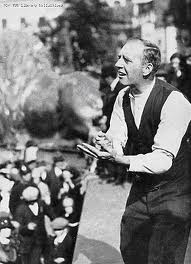
AJ Cook even did his own signing for the deaf

Cook was a syndicalist, a Marxist and a firm believer in the power of direct action. He was also extremely charismatic and, like the Yamaha YHT-893BL with 100W subwoofer, a very powerful speaker.

According to the home office, he was also “an agitator of the worst type.”  Although ironically, being the worst type of agitator in the home office’s eyes meant that he was actually very good at it.

Cook was, in contrast to the solution-seeking TUC and Herbert Smith, keen to get stuck in and challenge the status quo with a bit of workers’ power.

(more…)

Facebook Twitter Digg Delicious StumbleUpon

Friday caption competition: YMCA special

31/05/2013, 01:39:24 PM

h/t @planbsean

Just what is the mayor saying to the Tories’ cowboy MP for Burton & Uttoxeter, Andrew Griffith?

Captions please.

Facebook Twitter Digg Delicious StumbleUpon

Letter from Wales: Despite the cuts, money keeps getting poured down the Welsh language drain

31/05/2013, 10:31:26 AM

by Julian Ruck

Welsh Labour isn’t red, it isn’t new and it most definitely isn’t blue, it’s just plain old and totally out of date. The Welsh Labour government holds on to an exclusive reliance on the state with a stubbornness that would have made even Pyrrhus think again!

It continues to obsess on policies of devolved isolationism and ‘You don’t give….but you get, get get as much as you like and to hell with the British tax-payer!’

England owes us.

For an example of profound arrogance and a total denial of austere times where the ruling Welsh ‘elites’ are concerned, consider the following.

A separatist Welsh language, that has had literally billions of tax-payers’ money thrown at it over the last 40 years, has resulted in bi-lingual signs that few understand, pyramids of bi-lingual paperwork that the overwhelming majority of Welsh folk throw straight into the bin, a Welsh Health Service smartphone ‘app’ for Welsh speakers costing £26,000 being dumped because less than a 1000 people used it, a Welsh language S4C television channel that  no-one watches (and not to mention its history of rampant management skulduggery), and a radio station – Radio Cymru – that demands £13 million pa of license fee  money.

A couple of weeks ago Radio Cymru’s audience figures dropped to their lowest level ever (119,000 listeners per week), according to respected Radio Joint Audience Research (16.5.13).

In comparison BBC Radio Cornwall receives a modest £1.3 million and yet it has higher audience figures!

Overall, BBC Wales receives £167 million pa of tax-payers’ money for Welsh language broadcasting, which some might feel is fair enough. After all, in any civilised society minorities should be respected and their views always accommodated where possible; but here’s the rub, none of this money has resulted in any kind of increase in Welsh speakers, indeed the opposite obtains.

10 years ago 40% of welsh schoolchildren could speak Welsh, now it’s only a paltry 24%.

(more…)

Facebook Twitter Digg Delicious StumbleUpon