




The Lib Dems and their dissociative disorder

26/03/2012, 07:30:10 AM

by Kevin Meagher

Making a diagnosis for multiple personality disorder (MPD) requires the presence of two or more distinct identities which recurrently take control of a person’s behaviour.

Two competing, contradictory personalities vying for supremacy? Now I am no psychiatrist, but if organisations could develop the condition, then the Liberal Democrats are surely a classic case?

Take Simon Hughes. He is the personality who dominates the airwaves when the Lib Dems have done something bad. Every time they sell their soul to the Conservatives up pops Simon, combining earnestness and convoluted circumlocutions to explain away why they have not done what the dogs in the street can see they have done.

He is like a bank robber pleading in mitigation that the gang were only interested in notes and at least had the decency to leave the loose change alone. They may have waved the sawn-off shotgun in the bank teller’s face, but they didn’t actually pull the trigger. He is a splitter of hairs so fine that it would require the Hubble telescope to be trained on his logic in order to make out the nuances.

He was out there on Wednesday and Thursday, distancing himself from the decision to scrap the 50p top tax rate – the signature proposal in the budget – and one to which the entire cabinet is actively signed-up. “The chancellor took a view that he wanted to do things that mattered a lot to Conservatives” the deputy leader of the Lib Dems told Radio Five Live. “What mattered to us [the Lib Dems] was not that at all.”

(more…)

Facebook Twitter Digg Delicious StumbleUpon

Whips Notebook: Postcard from Bradford West

23/03/2012, 03:15:10 PM

by Jon Ashworth

I love by elections and always have done so since I first campaigned as a scruffy teenager with a hair-do like Noel Gallagher in Littleborough and Saddleworth.

Those were heady summer days indeed as us young insurgents fought like tigers for every Labour vote. The drill was soon to become familiar in by election after by election. We slept on floors at night and knocked on doors all day. A merry band of brothers and sisters from which enduring friendships formed and last to this day – Tom Watson, Michael Dugher, Gloria De Piero to name just a few of the future stars I would first meet on the by election campaign trail in towns like Littleborough.

Sadly in Littleborough and Saddleworth it wasn’t enough with the Lib Dems managing to just nick it. But the Tories were obliterated and we knew that our unsuccessful candidate Phil Woolas would easily take the redrawn seat whenever the general election came. 15 years later I would be trudging through many of the same streets in thick snow to help Debbie Abrahams secure victory in the successor Oldham East and Saddleworth seat.

Not downhearted with defeat, in fact the very opposite, we moved on to Wirral South. A ‘safe’ Tory seat that easily tumbled to us with local businessman Ben Chapman, whose election posters proudly boasted “Ben Chapman means business”, becoming Wirral South’s first Labour MP. Ben retired at the 2010 election but Wirral South is still held by us today by the ever impressive Alison McGovern.

Looking back it feels like all I did was work on by elections in those early years of the Labour government.

(more…)

Facebook Twitter Digg Delicious StumbleUpon

Ken Livingstone’s crumbling Labour flank

23/03/2012, 08:52:50 AM

by Atul Hatwal

Earlier this week YouGov released their latest London mayoral poll. While Boris Johnson’s 49%-41% lead on first preferences was widely reported, some of the most striking results were lost in the news vortex of the budget.

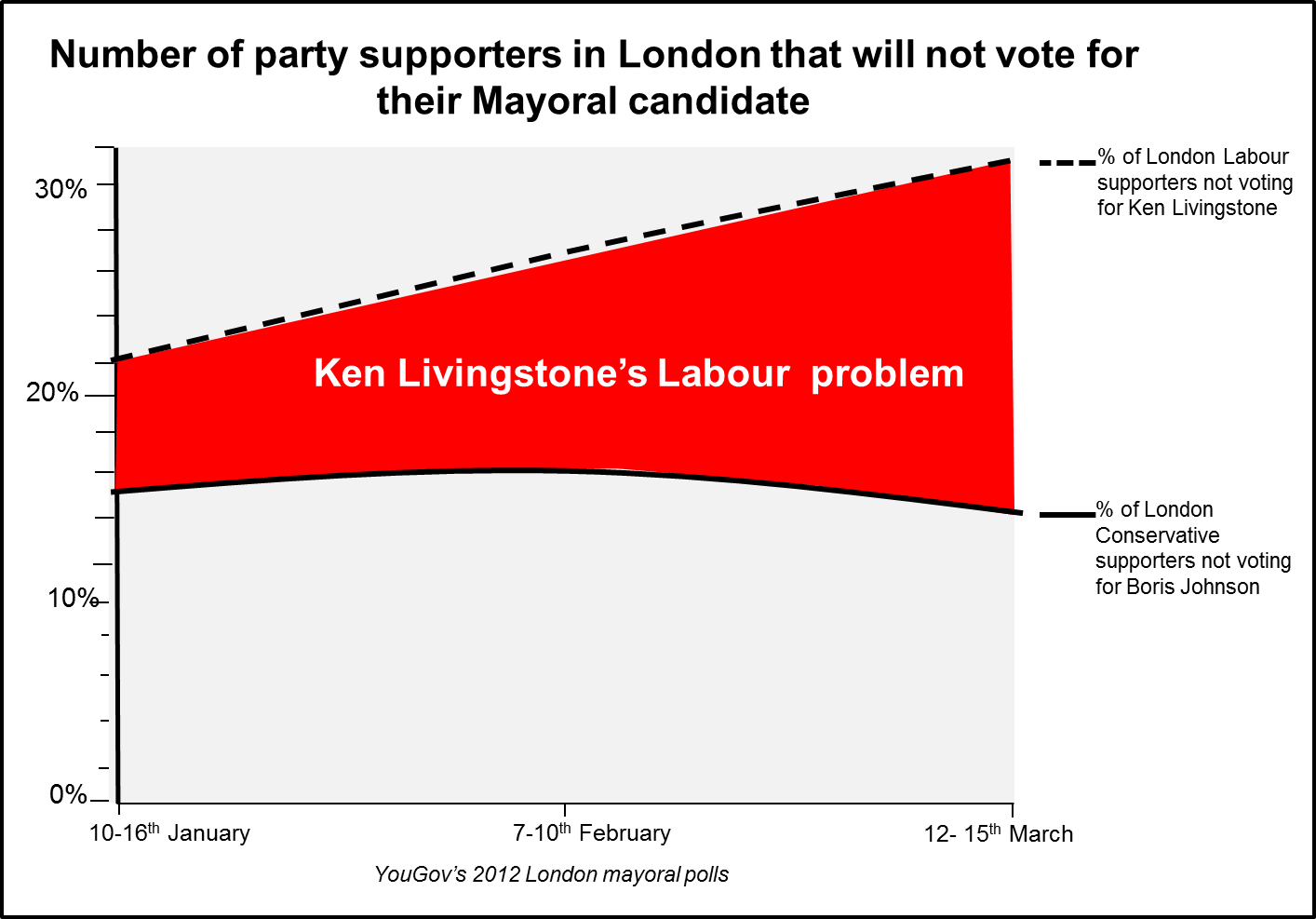
Chief among these is the scale of Ken Livingstone’s problem with Labour supporters: 31% say they will not vote for him in the mayoral election.

Just weeks before the election, almost 1 in 3 Labour supporters are refusing to back the party’s candidate for mayor.

In comparison, Boris Johnson’s core support is firmer. 86% of Conservative backers say they will vote for him with 14% either supporting other candidates or undecided.

The impact of this differential in party supporters’ commitment to their candidate is critical for the mayoral race: it translates into an 8% boost in Boris Johnson’s overall total.

And 8% is, coincidentally, the size of Johnson’s latest lead over Livingstone.

The bad news for Labour is that this problem has been building all year. The graph below shows how Ken Livingstone has progressively bled support from Labour backers while Johnson has consolidated his vote amongst Conservatives.

(more…)

Facebook Twitter Digg Delicious StumbleUpon

Sunday Review on Thursday: Progress Political Weekend 2012

22/03/2012, 01:22:41 PM

by Jonathan Todd

Peter Mandelson was there but, pace Michael Meacher, the Progress Political Weekend 2012 was not a meeting of the Bilderberg group. For one thing, I imagine, the Bilderberg Group comes to conclusions.

This was not the only difference. There was no secret agenda. It was advertised online. This was less an elite stitch-up and more the imbibing, both of learning and alcohol, by bright young things.

The discussion was perceptive, but the themes covered were not unexpected: fiscal credibility, public service reform, southern discomfort. So much was everyone on pretty much the same page that Douglas Alexander arrived, having followed earlier proceedings on twitter, worried that Liam Byrne had already delivered his speech.

I’m not sure what Meacher would expect but I got what I anticipated, which was some education (Phil Collins’ session on speech writing was particularly illuminating) and some reflection on the hard questions that face Labour.

But I’m not sure how far we got with answers.

At the same conference a year ago Douglas Alexander and Jim Murphy in separate sessions said that Labour needs “a draw on the deficit, a win on growth”. How is that working out?

This year Patrick Diamond warned against Labour being hawkish in principle and dovish in practice on the deficit. Talking tough on the deficit but not providing support for cuts to match this tough talk.

But Meacher can be assured that no plans were hatched to carve up the state in the country house, now owned by the NUT, just a taxi ride away from the grocers in which Margaret Thatcher grew up.

Not one suggestion for a cut was proffered, as far as I recall, though, sadly, I needed to be in London on Sunday, so missed the second day of the conference and perhaps some proposals for cuts.

(more…)

Facebook Twitter Digg Delicious StumbleUpon

The real impact of the budget on the public

22/03/2012, 07:00:14 AM

by Peter Watt

The thing about big political events is that they generally aren’t big events in the same way that, say big sporting events or a royal wedding are.  The latter are things that most people are aware of and that get people talking.  Big political events generally do neither.  But they certainly feel like really big events if you are a political junkie or you are working inside the political world.

I can remember when Labour Party HQ used to buy all of the staff ice-creams on budget day; it was a bit of a tradition.  In the weeks building up to the day itself there would be mounting excitement.  Briefings were prepared and printers were primed to start printing materials within minutes of the end of the budget so that local campaigners were ready for their weekends work. Because the point was that budgets were big, game-changing, or game re-enforcing events.

Except looking back, they generally weren’t, and very little actually changed.  The polls might blip but they soon blipped back to where they were before.

And I was reminded of this yesterday; because I, along with every other political obsessive, had enjoyed this last week.  The NHS Bill skirmishes and the budget briefing.  Both had left us all with plenty to read, discuss and tweet about.

(more…)

Facebook Twitter Digg Delicious StumbleUpon

Budget preview: The polling that explains why George Osborne is cutting the 50p rate of tax

21/03/2012, 08:10:41 AM

by Atul Hatwal

When George Osborne steps up to the despatch box later he will publicly launch his campaign to be leader of the Conservative party.

David Cameron can breathe easy though. It will not be a throwback to the TB-GBs. Osborne’s real target will likely be shuffling about his city hall office, watching the TV coverage, thinking that he could do it all so much better.

Until now, Boris Johnson has been the darling of the Tory faithful. He shone at last year’s party conference, has repeatedly tweaked the prime minister’s nose on issues like cuts to policing and has been the king over the water to true blue believers who see too much yellow in the government.

In contrast, his rival to succeed David Cameron, has been conducting his campaign in stealth mode. But away from the bright lights of media scrutiny, in the corridors of Westminster, George Osborne has been very active.

If any evidence were needed, just speak to any first term Tory MP: Osborne has been almost indecent in courting the new intake into the parliamentary party.

The chancellor has deployed the full range blandishments: from hand written notes in the pigeon hole to invitations to select dinners, each and every member of the class of 2010 has had unbelievable amounts of personal attention lavished on them.

Team Osborne is confident that two years into government, they have the parliamentary vote locked up. For all of Boris’s grandstanding and media profile, few in the parliamentary party view him as a serious alternative to either David Cameron or George Osborne.

Recently, at a private dinner, one member of the 2010-ers went so far as to suggest that Osborne might even defeat Cameron in a vote amongst his contemporaries.

But that still leaves the blue rinse legions swooning for their blonde mop-topped heir apparent.

(more…)

Facebook Twitter Digg Delicious StumbleUpon

Budget preview: abolishing national public sector pay rates is right

20/03/2012, 12:00:32 PM

by Rob Marchant

As part of the Budget run-up, on Friday Britain’s labour movement was convulsed at the thought of the latest Osborne proposal: that national public sector pay rates might be scrapped.

But, before we join the voices of the major trade unions and the TUC who are, understandably, trying to look out for their own interest group, as a party whose interests are not always identical to those of our union colleagues, it might behove us to take a few minutes to take a step back.

Now, while no-one would suggest we should be adopting the Tory Budget wholesale, smart opposition is about determining which bits to oppose. A regional bargaining system would likely increase some pay-rates, as well as decreasing (or failing to increase) others.

And it is surely difficult to argue that the current, entirely inflexible system of fixed national pay rates, which was put in place decades ago in a corporatist state era, is fit for purpose.

First, as the Treasury points out, there are absurd variations depending on where you live. In some places pay rates can be artificially up to 18% higher than their private sector equivalents. And furthermore, applying the only current regional exception to the national system, the addition of London weighting, the system even then visibly fails to attract, for example, enough teachers to schools in inner London because many cannot afford to live there. So some people are still not paid enough. Result: poor levels of public service.
(more…)

Facebook Twitter Digg Delicious StumbleUpon

Budget preview: Osborne plays politics with Britain’s economy

20/03/2012, 07:00:25 AM

by Jonathan Todd

Literally no one alive today has experienced a period as economically bleak as we face today.

There could be hope. The chancellor retains a capacity to improve our situation through bold policy and a display of leadership. Instead we can expect a Budget of ruses, a rearranging of the pieces on the political chessboard with little or no thought for the wider reality in which the rest of us reside.

Osborne’s capacity to frame political debate should not be underestimated. He has the bully pulpit of office, a sympathetic media, and the public have bought into his central narrative: there is no alternative to his tough deficit-reduction medicine and anyone who suggests otherwise, particularly on behalf of Labour, who he paints as wholly culpable for our economic predicament, represents an unaffordable risk.

It is a powerful argument, a train rumbling down the track straight for Labour, threatening to smash us into another parliament in opposition. Some think the train will change direction, almost irrespective of what Labour does. They hope and believe that exasperation with Osborne will build such that his prescription is rejected.

Some contend that the train is immutable and that Labour had better adjust – deficit reduction will remain the key issue and Labour must do more to demonstrate how we would deliver this.

(more…)

Facebook Twitter Digg Delicious StumbleUpon

Love thy Tory

19/03/2012, 07:00:01 AM

by Peter Goddard

Because I enjoy becoming maddeningly frustrated with other people’s stupidity I am a keen reader of the Guardian’s Comment Is Free (CiF) section.

On CiF over the last couple of years it appears that reasoned debate has become increasingly neglected in favour of vituperative attacks by all sides on all the others.

A five minute survey reveals “filthy free market scum” (Tories), “the scum of the Earth” (Labour) and “lickspittles” (Liberal Democrats).

And as the budget draws nearer, the temperature keeps rising.

All good fun, no doubt, but is it helpful?

From the perspective of what passes for everyday politics – I’m thinking prime minister’s questions, media interviews and press releases – the answer is “yes” (although perhaps without being quite so rude). This is because these events are not dialogues but showcases.

Ed Miliband will not rise to give the opposition response to the Budget on Wednesday hoping that maybe this time, this time he will finally succeed in changing Cameron and Osborne’s minds.

(more…)

Facebook Twitter Digg Delicious StumbleUpon

Budget preview: an opportunity to change the nature of Labour’s political attack?

18/03/2012, 08:00:52 AM

by Anthony Painter

If the leaks turn out to be true, we are facing one the most radical Budgets in living memory. The abolition or reduction of the 50p rate, regionalisation of public sector pay, increasing the personal allowance, and the introduction of “tycoon tax” (ie: minimum tax rate for all) is a major package of reform. As soon as George Osborne stands up, the framing battle will commence. What should Labour’s line be?

I’ll put my personal allowance tax saving on the fact that the line will be “fairness”. Ed Miliband and Ed Balls will focus on the abolition or reduction of the 50p tax rate. They will say this proves we are not all in it together; one rule for the rich and one rule for the rest of us. They will follow with a flurry of numbers about how the average family has been hit by the Tory-led government’s tax and spending changes since 2010. Labour would tax banks, protect tax credits and reduce VAT. The Tories favour the rich over the rest.

When George Osborne announced the VAT increase, the reaction was pretty much the same. The party HQ printing presses went into overdrive even while the leadership election was on and off Labour went. People didn’t want VAT to increase and they don’t want the 50p tax rate abolished. So it’s a no-brainer, right?

The problem is that it didn’t work.

Labour cries “unfair” at every possible opportunity. People know that Labour thinks everything the government has done is “unfair”. A good portion of the population think it is unfair too. One problem is that they take “fairness” to mean a slightly different thing to Labour. They take it mean reciprocal fairness: you should receive in accordance with your contribution. Labour means distributional fairness: the poorer you are, the more you should get. That is why Labour’s cris de coeur about fairness slightly miss the mark.

There is another approach: attack the government’s fiscal and economic decisions. The package of measures which is rumoured undermines fiscal consolidation and economic growth.

(more…)

Facebook Twitter Digg Delicious StumbleUpon