


How Boris calling Ken a “f***ing liar” will play out

03/04/2012, 04:56:10 PM

by Atul Hatwal

Politics is an uptight profession. Displays of genuine emotion by our leaders chills the blood of advisers and apparatchiks. Control is lost, the roulette wheel is spinning and anything can happen next.

Even if there isn’t a total meltdown, loss of composure alone is a sign of political weakness and opens up a line of attack on temperament and suitability for office.

Reports of this morning’s nose-to-nose confrontation between Ken Livingstone and Boris Johnson will have initially sent the Tories into a tailspin. Labour tweeters duly piled on  immediately following the exchange to push the line that Livingstone had touched a raw nerve in Johnson, who was seriously rattled.

But emotion isn’t always bad. Sometimes, when a politician shows genuine feeling, it reflects authenticity rather than weakness.

Think Hilary Clinton’s teary performance at the diner in New Hampshire in the 2008 race for the Democratic nomination . The immediate assumption in the press pack following her appearance was that she had cracked under the pressure. She was weak.

The voters disagreed. For the electorate, she had just become human and following her victory in New Hampshire the race was prolonged for months.

Or John Prescott in the 2001 general election campaign. When that mulleted moron threw an egg at him, Prescott’s reaction was natural and understandable, he punched him.

I can clearly remember the unbridled panic that gripped the Labour side in the minutes and hours after the punch, as well as the glee among Tory campaigners at this turn of events. At bare minimum, the Tories felt this demonstrated JP’s unsuitability for office.

Wrong again. For the voters, John Prescott was behaving like a normal person – the type that polls constantly say people want to see more of in politics.

As with Prescott, the key to the denouement for this morning’s fracas will be the substance – was  Boris Johnson in the right?

(more…)

Facebook Twitter Digg Delicious StumbleUpon

Stop taking liberties

03/04/2012, 07:00:31 AM

by Kevin Meagher

Last week we learned that the government, in its benign munificence, wants to have access to all our emails “on demand”. We are, it seems, all now assumed to be terrorists or master criminals until proven innocent. Our calls, texts, internet searches and other electronic messages will be fair game for the prying eyes of our securocrats.

A one-off sortie across the demarcation that separates personal liberty from an ever-encroaching state? Were that it were so. The past week has been an utterly dreadful one for Lady Liberty.

Take into consideration, if you will, the case of 21 year-old Liam Stacey. He was jailed for 56 days last week for posting racially offensive comments on Twitter following the collapse of Bolton Wanderers player Fabrice Muamba. No need to recite his vile ramblings, but let’s say he stood out from the crowd in not wishing the footballer a swift recovery.

Sentencing him at Swansea Magistrates’ Court, District Judge John Charles told Stacey: “In my view, there is no alternative to an immediate prison sentence.” Wow, really? No other means of punishing this stupid, half-pissed student for tweeting his brainless racist tirade without locking him up and ruining his life?

His university was no less draconian. He faces being booted off his course, despite being in the third year of a biology degree, at the whim of some po-faced university commissar. Will his own parents be obliged to disown him next?

When we hurtle past “reaction” and crash headlong into “over-reaction”, nothing should come as a surprise. Like any other sentient human being, I abhor racism and as a Wanderers fan was doubly aggrieved at what Stacey posted. But when did boorishness come with an automatic jail sentence?

(more…)

Facebook Twitter Digg Delicious StumbleUpon

Back in the real world, it’s still the budget, stupid

02/04/2012, 03:17:59 PM

by Ian Lucas

As the dust settles on a tumultuous couple of weeks it is becoming clear that outside the Westminster bubble, only one event has truly cut through to the general public: the budget.

With the cut in the 50p rate of tax and the imposition of the “granny tax”, this was truly a Budget for “the premier league” – those top rate taxpayers who had the ear of the prime minister and have benefited directly as a consequence of George Osborne’s announcements.

What is clear is that securing economic growth and new jobs  was not a key topic of conversation at the Downing Street dinners. Before the Budget, and after it, the failure of this Government is its failure to build growth.

A cut to capital projects has taken away key Government support for private sector job creation. Whole industrial sectors – such as construction – are suffering as a result, and both large-scale firms and their smaller subcontractors are holding back.

The uncertainty in the jobs market is reducing employee confidence. People are postponing major spending decisions. If you are worrying about your job, you won’t move house. Income for the local economy, agents’ fees, finance to builders is held back.

Worries about jobs are hold back spending; yet the Government has increased taxes on consumers. Every penny more on VAT for central Government is a penny less for local business.

It is necessary to reduce the deficit. But the most damning statistic for the Government is that it is borrowing £147 billion more than predicted – because the economy is not growing and more people are out of work.

(more…)

Facebook Twitter Digg Delicious StumbleUpon

Revealed: Secret ministerial transport memo

01/04/2012, 08:00:53 AM

by Kevin Meagher

Labour Uncut can reveal the existence of a secret government contingency plan to transport ministers to meetings around Whitehall in the event of a fuel shortage.

Ministerial cars will be mothballed for the duration of any fuel strike in order to show “we’re all in this together”. Instead ministers who need them will shuttle between appointments across Whitehall by… sedan chair.

The novel idea, brainchild of Chancellor George Osborne, will see unemployed young people specially trained to carry ministers around. The ability to carry a sedan chair may also be used as a means of qualifying for DLA in a tightened ‘fitness to work’ test.

According to a leaked memo entitled: ‘Contingency Ministerial Transportation: Safari Old Ploy’, Ministers will be carried around as if they were on safari. “It is important” the memo says “that we do not give rise to the impression that ministers are behaving like Roman emperors.”

The original plan was for rickshaws, but Osborne vetoed this move, claiming they would need a road fund license. Also, it is believed the Chancellor in fact has his own sedan chair, which he is eager to use in public.

(more…)

Facebook Twitter Digg Delicious StumbleUpon

Is this the beginning of the end for Ed Miliband?

30/03/2012, 07:55:37 AM

by Atul Hatwal

This morning it’s a cold new world. But as the shock passes and the harsh reality of George Galloway’s crushing victory begins to sink in, the questions will become louder and more insistent. Two in particular will dominate: How could this happen? And what does it mean for the leader?

The party briefers will try to box this result as a freak. They will cite the combined effect of the swing from Labour towards Respect among the British Pakistani community and the collapse in Tory vote as a localised one-off.

They will be wrong.

The vote demonstrates two critical points: first, hell will freeze over before large numbers of Tories switch to Labour. After the week the Tories have had, it’s not surprising their vote was down. But Labour picked up no Conservative switchers and remains toxic to swing voters.

The reality is, for too many people, Labour under Ed Miliband is not a viable alternative. The polls on leadership and economic competence have been unrelenting since he became leader.

Earlier this month the Guardian’s ICM poll placed David Cameron and George Osborne 17% ahead of Ed Miliband and Ed Balls on managing the economy 42% to 25%.  Meanwhile YouGov’s latest March figures on peoples’ preference to be prime minister had David Cameron 20% ahead of Ed Miliband 38% to 18% – that’s double the lead he held at the same point last year.

Second, the British Pakistani community has sent a clear signal to a party that has long taken their vote for granted: no more. Labour has spent two years since the general election agonising about Mrs.Duffy, Englishness and what are euphemistically called “white working class issues”. Well, congratulations, this is the result.

Simply cranking the handle on decaying community political machines and expecting the sheep to file through the pen will not work forever. When George Galloway condemned Labour’s use of “biraderi” or clan-based politics last night, he was right.

At some point Labour as a party will have to engage with its former ethnic minority supporters rather than just assume they will be there, regardless of whatever the party does.

But in one sense, there really is no excuse for such total and utter shock. This isn’t the first time that a feeling has taken hold in a formerly Labour supporting electorate that the party is no longer upto  leading or even interested in the local community.

What just happened in Bradford now happens in Scotland as a matter of course.  For Alex Salmond read George Galloway and the pattern begins to look a little more familiar.

(more…)

Facebook Twitter Digg Delicious StumbleUpon

The Youth Contract must be the beginning not the end

28/03/2012, 12:30:17 PM

by Richard Darlington

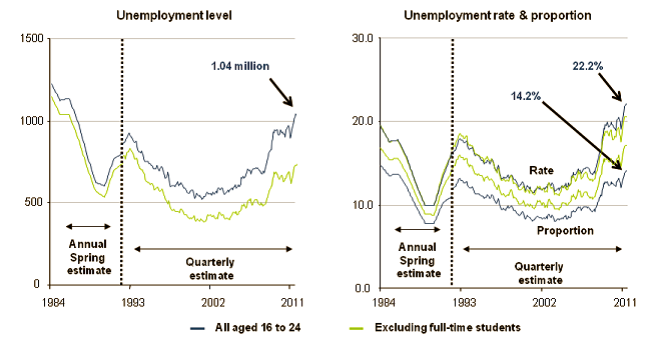
Any day now, the Government will formally launch the new Youth Contact and from April, 160,000 job subsidies and an extra 20,000 apprenticeships will begin to come on stream to help young people who have been out of work for more than a year. The new scheme cannot come soon enough and it will fill the policy vacuum left by the abolition of the Future Jobs Fund, more than a year ago.

Since that decision was taken, youth unemployment has risen to the highest since records began in 1986/7.

Last month, the latest stats show that more than a million (1,042,000) young people (aged 16-24) are now unemployed, the second highest since comparable records began in 1992, and a rise of 67,600 in the last year.

Most worrying of all, there are now more than a quarter of a million 253,000 young people (aged 16-24) who have been unemployed for more than a year. There has been an increase of 24,900 over the last year in this group, that would have been helped had the Future Jobs Fund not been abolished.

But it is not just work, but training, where too many young people are losing out in record numbers. There are now a total of 958,000 young people (aged 16-24) who are NEET (not in education, employment or training), up 19,000 over the last year and a record high of 15.9 per cent for a fourth quarter.

(more…)

Facebook Twitter Digg Delicious StumbleUpon

Time for Ed and Cam to grow up on funding

28/03/2012, 07:00:23 AM

by Peter Watt

The cringe inducing video of Peter Cruddas promising supper with Sam and David with comic buffoonery was still leading the news.  The nod and a wink about the promise of policy input into (something called) the number ten policy committee of course took this to another level.  At a stroke it went from being just another “cash for access story” to “cash for policy” – the real daddy of political sleaze.  Having said that, I was actually still quite optimistic on Sunday, maybe this time there would be a political deal; maybe this time our politicians will sort it out; maybe this time there would be legislation fundamentally reforming the funding of political parties?

But by Monday evening the optimism was dashed.  Once again the ugly head of tribal politics intervened.  Ed Miliband and Francis Maude stood at the respective dispatch boxes and shouted at each other.  It was horrifically depressing.  Neither of them in my view did politics any favours, despite the supportive bellowing from their respective benches behind them.  The public, to the extent that they were watching, must have thought, “WTF was that” because it certainly wasn’t edifying.

None of the parties has much to boast about here.  Each has their list of scandals involving party and MP finances.  It is all too easy to get dragged in, as I very well know. Some scandals involve people trying to personally gain while some involve mistakes, or are the result of playing within the rules but not within the spirit of them.  All though, involve a further nail in the coffin of the reputation of politics, as a sceptical public do not draw any distinction as to the motives.  I know that I certainly regret my part in the succession of stories that have damaged politics.

Now if someone decides to feather their own nest and act corruptly there is probably not much that we can do about it, but there is something that we can do to reduce the risk of other funding scandals.  Because the harsh truth is that the current system encourages the parties to push at the boundaries of the legislation passed ostensibly to clean up politics.  Just as people perfectly reasonably employ accountants to help them avoid tax, so political parties employ people to maximise the income that they can receive.  After all, why should they turn a gift horse away?  So loop holes are found and exploited.  Legal?  Yes.  Acceptable?  Certainly not to the public.

(more…)

Facebook Twitter Digg Delicious StumbleUpon

The false debate over the public funding of politics

27/03/2012, 09:00:15 AM

by Atul Hatwal

Here’s a question: who is Labour’s biggest donor under Ed Miliband?

Is it Unite? Unison? Maybe the GMB?

Answer: none of the above.

An Uncut analysis of donations to the Labour party since Ed Miliband became leader reveals that the biggest single donor is the House of Commons, giving £9.6m. This so called “short money” is a stipend paid to the opposition to balance the advantage a government gains from the enormous resources of the civil service.

Roll in the funding the opposition receives from the House of Lords, the Scottish Parliament and grants from the Electoral Commission for policy development and Labour has banked almost £11.3m from public funding sources since October 2010. That’s more than the combined donations to the central party (as opposed to individual constituency parties) from the all of the unions.

This isn’t a recent a development either. A decade ago, when the Tories were at their nadir, what was their biggest source of funding? Was it Lord Ashcroft? Or a.n.other city gent, eager to run down his bank balance?

Of course not. In 2002 the total donations from individuals to the Tories came to £2.3m. In comparison the amount the Tories drew from public funds was nearly double at £4m.

These figures expose one of the myths in the political debate on funding – that the public will not accept state funding of politics.

Newsflash: they already have.

(more…)

Facebook Twitter Digg Delicious StumbleUpon

Where have the working class MPs gone?

26/03/2012, 02:26:11 PM

by Hazel Blears

The 2010 General Election was notable for ending – at least temporarily – the era of one-party dominant governments in the UK, and ushering in a coalition. Less notable, but much more worrying, was the continued demise of that all too rare representative: the working class MP.

In 1983, a staggering 51% of MPs had been educated at private school. This began to gradually fall, dropping to a low of 30% in 1997. However since then the figure has begun to rise again, and the 2010 election saw constituencies return an intake of MPs of which 35% have been privately educated. By comparison, only 7% of the school age population are in private schools; politicians are drawn from a narrow social class.

Of the 2010 intake 91% of MPs have attended university. So cliquey is politics that just under 30% of our MPs come from two universities, Oxford and Cambridge. Just 13 schools produce a tenth of MPs. Politics is clearly becoming a graduate profession.

Whilst some MPs from working class backgrounds have made it to the top of politics – the likes of Alan Johnson and David Davis – the reality is that the social composition of our representatives is not representative of our country.

Good governance requires a range of views for effective policy making. If politicians are approaching issues from the same point of view and life experiences, they are likely to create group-think, and their narrow social experiences will be reflected in policy making. A case in point – would the current cabinet have been so quick to withdraw tax credits for working families if any of them had ever had to rely on them? Even the Labour party – the most diverse of all three main political parties – is hardly in a position to lecture about diversity.

(more…)

Facebook Twitter Digg Delicious StumbleUpon

The Kelly proposals: eminently sensible and workable

26/03/2012, 02:08:13 PM

This post by Peter Watt was originally published on 24th November 2011. David Cameron could have done with reading it back then, might have saved himself a spot of bother. But at Uncut we believe in giving people second chances, so here it is again.

The reaction to the report “political party funding – ending the big donor culture“, by the committee on standards in public life, chaired by Sir Christopher Kelly, has been depressing if not surprising.

I feel strongly about this issue. I was caught up in “cash for honours”. I had to instigate swingeing budget cuts and redundancies to avoid bankruptcy at the Labour party. I was part of Labour’s negotiating team in the failed Haydn Philips inter-party talks on party funding in 2006 and I was embroiled in a pretty major funding scandal that lead to my resignation as general secretary and another police investigation. I also gave evidence to the Kelly enquiry.

So let’s start with some cold hard facts.

  1. Politics is expensive. Staff that run campaigns, develop policy and arrange conferences, plan strategy, engage the public and design materials, websites and videos cost money. And there’s everything a reasonable sized organisations needs:  advertising, membership systems, property, cars, travel, hotels, publications, professional services like accountants and lawyers, furniture, computers, software licenses, insurance and stationery. This does not come cheap and it all needs to be paid for.
  2. Politicians are generally shallow and fear failure. This means that they don’t care all that much about where the money comes from to pay for those things that they think that they need to maximise their chances of winning. They will dress it up as wanting to win to do good things, and there is obviously some truth in that. But fundamentally they want the glory; and they need funds to achieve it.
  3. Politicians do not get involved in fundraising. They, rightly, fear being tainted by the “dirty” business of fundraising. So while they demand that the funds are there when they need them, they generally don’t lift a finger to raise it unless absolutely forced. The result is that those charged with raising funds are put under enormous pressure and are given very little support to raise the necessary cash.
    (more…)
Facebook Twitter Digg Delicious StumbleUpon