Ed’s funding proposals: Nearly but not quite

16/04/2012, 07:00:55 AM

by Peter Watt

Yesterday morning Ed Miliband used his slot on the Andrew Marr show to outline some eye-catching new proposals on funding political parties.  It sounded good and it almost was, but it could end up being a disaster.

First let’s expose some myths.

The Labour party does not receive the majority of its income from the trade unions.  In an average, non-general election year, income comes roughly from the following sources:

  • £8  million in affiliation fees from trade unions;
  • £7 million from the tax payer in Short money and so on;
  • £5 million from individual membership subscriptions.

This gives a “definite” income of about £20 million per year.  In addition the Labour party gets:

  • £2 – 5 million in donations from individuals, companies and trade unions; and
  • £5 million from other things like commercial income, legacies and dinners.

This gives a potential income of £27 – £30 million per year.  Clearly in the run up to an election you would expect an increase in donations.  So Ed’s cap of £5000 per year will hurt. Under his proposal this will impact between £2 and £5 million per year and more in the year before an election.

(more…)

Facebook Twitter Digg Delicious StumbleUpon

The Sunday review: “The Righteous Mind” by Jonathan Haidt

15/04/2012, 08:00:19 AM

by Anthony Painter

The other day a bus passed by me adorned with an ad from the campaign group, Stonewall. On a bold red background, white writing declared: “Some people are gay. Get over it.” The “get over it” was in black lettering. I thought “uh-oh, that’s dumb”.

To understand why I thought that, you need to read The Righteous Mind by Jonathan Haidt.

For many years, Haidt has deployed the tools and insights of psychology, sociology, anthropology, philosophy and economic theory to understand the nature of human morality. He essentially breaks our moral instincts down into categories: harm; fairness (which is actually about reciprocity); respect for authority; commitment to an in-group; sanctity and purity which is associated with religious and tribal ceremony; and, for this book, he has added a sixth – liberty/oppression.

Those who believe in equality for homosexuals are generally motivated by reducing harm and liberty from oppression. Cards on the table – I happen to be one of the people with this instinctive moral sense. I am closer to a left-wing (liberal in Haidt’s terms) than a conservative morality. The problem is that there are different moral senses too. Those who are adamantly against homosexuality – a minority in recent years in our society – may feel that they threaten their group which may be a church, for example, or there is something impure about homosexuality. They may also feel that legal changes to advance equality oppress their liberty to reject homosexuality.

And this is why I felt discomfort at the “get over it” message. Presumably, the objective of a campaign is to persuade. This slogan almost seemed designed to mock, belittle and entrench positions against it. It seemed likely that there would be a reaction.

On Thursday, the reaction came. A group promoting “gay cure” therapies bought ad space and mimicking the original ad, deployed the slogan: “Not gay! Ex-gay, post-gay and proud. Get over it!” The entire notion of “gay cure” is harmful and oppressive.

(more…)

Facebook Twitter Digg Delicious StumbleUpon

Livingstone’s scripted tears

13/04/2012, 08:00:54 AM

by Atul Hatwal

16/04/12 10.30 Update: Fair’s fair: it looks like the party press officer who told the Guardian that the PEB used actors, was wrong. We know that some weren’t and the Guardian piece was at least partially incorrect.

So the record needs to be set straight for this article. It looks likely that the people featured in the PEB weren’t professional actors, they were supporters. It is certainly the case that no-one has contradicted the Livingstone team’s contention that they were supporters.

But whether these were actors or carefully selected supporters, the central point of the piece remains the same: to cry in response to a video montage of your own supporters, reading your script , about how much they want you to be mayor, that you have already seen, is more Pyongyang than London.

13/04/12 10:51 Update: Well, there’s been quite the flap following this piece. The Livingstone campaign are resolutely denying that any of the people in the PEB are actors. This is the relevant section from the Guardian on which the article is based:

On Wednesday Ken Livingstone revealed his emotional side, sniffling at a launch of his new party political broadcast. “The people you saw on the screen represent hundreds of thousands of Londoners who desperately want a mayor who is going to make their life easier in this city,” Ken said, as Ed Miliband patted him on the back. For sure, the broadcast is slicker than anything his team has previously produced; it features a boxer, a groundsman, one posh woman and an extremely cute baby. But who exactly are they? The Labour party confessed yesterday that the Londoners are all actors – but actors who support Ken. Of the crying, it said: “It was very genuine. It really was.”

Clearly there has been some form of breakdown in communication between the Livingstone campaign and the Labour party press office. The issue at the heart of this article is authenticity. The key question is: were  the people in the PEB were scripted?

If their words were drafted by the campaign team then it is disingenuous to claim these are the authentic responses of ordinary Londoners that prompted a heartfelt reaction from Livingstone. If their words were their own, then patently that is more powerful.

At the moment it looks like team Ken are saying that people were scripted. We will update as we receive more information.

***

Another week, another new depth plumbed in the mayoral campaign.

In yesterday’s Guardian diary, there was a little snippet about Labour’s latest party election broadcast (PEB).

For those who haven’t seen it, the PEB is very effective. Engaging and well-paced, above all it shows rather than tells. It features Londoners speaking about their issues, directly into camera, edited tightly together. The climax at the end where they each ask Ken to win for them carries some real emotional weight.

I’m no fan of Labour’s candidate but even I was impressed.

Until, that is, I read the Guardian diary. This told me that the plaintive and persuasive Londoners were in fact all actors. Not a boxer, a mother, a groundsman or a businessman. Just actors, hired to do a job.  “Labour supporting actors” is how the party press office described them, as if this somehow helped.

This mini-revelation robs the PEB of its authenticity. It remains a very good piece of political communication, but watching the broadcast again, knowing that these folk were shipped in from London’s version of central casting, drains the emotion out of the piece.

Oh well. “Disappointing” was my take. And then I thought, “hang on.”

Most people will have seen this photo of Ken Livingstone, overcome by emotion, crying at the screening of his election broadcast.
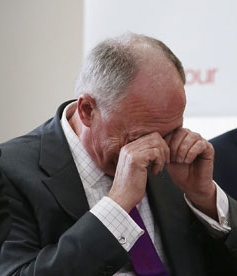
At the time the explanation given to reporters was that Ken was moved by the genuine words of Londoners and the responsibility he felt to win the election for them.

Stirring stuff. Shame it was rubbish.

The actual situation in the room was this: Livingstone was crying after watching a series of actors that had been carefully selected by his team, read out lines that his writers had penned, in a style directed by his staff. He knew that these were not typical Londoners. He knew that this was his script.

But still the tears flowed.

(more…)
Facebook Twitter Digg Delicious StumbleUpon

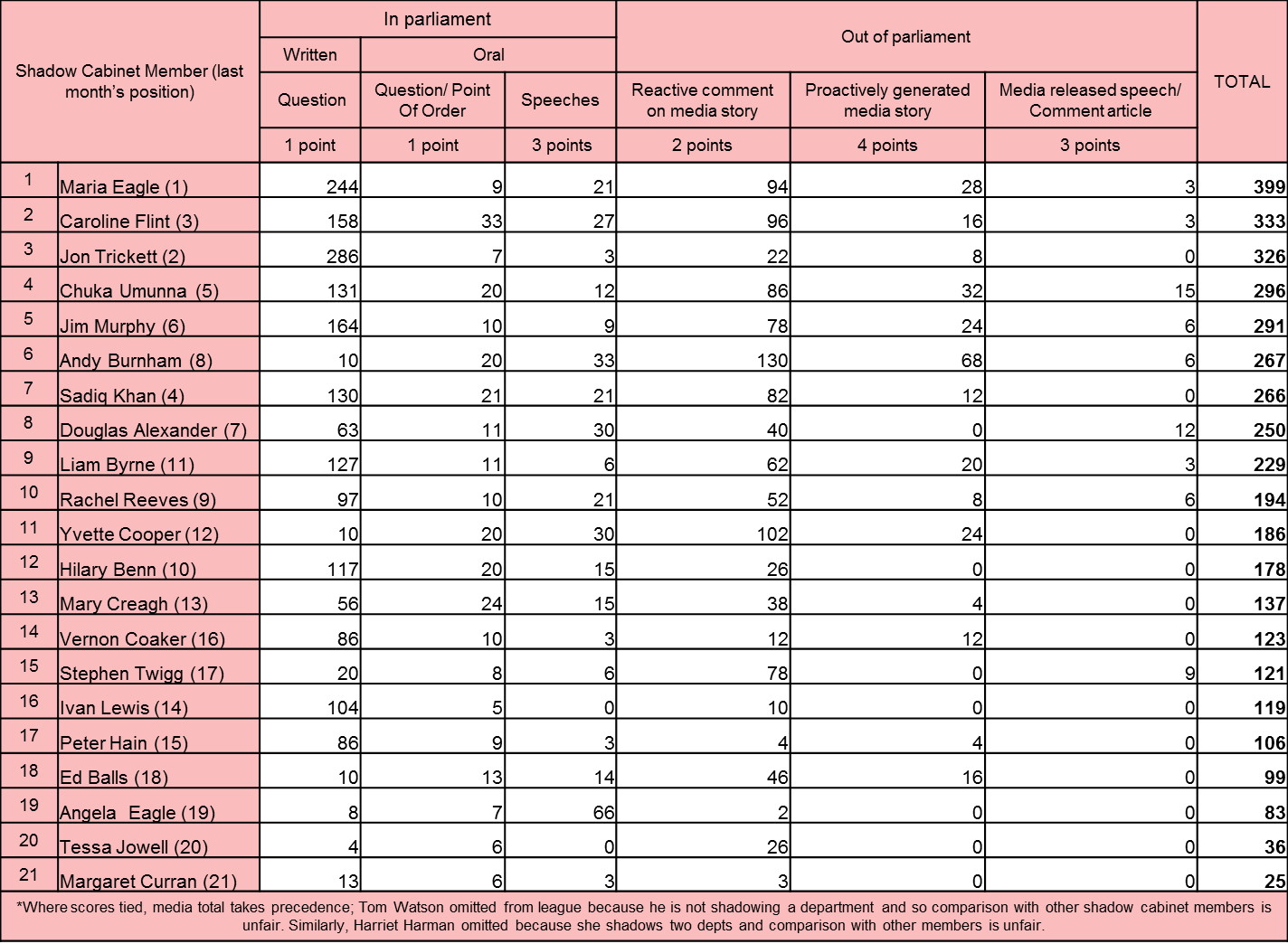
The April shadow cabinet league

12/04/2012, 08:30:36 AM

by Atul Hatwal

It’s become a tedious holiday tradition: MPs tweeting about their various constituency appointments and local campaign meetings, furiously reassuring voters and party members that they are busy at work, despite the long parliamentary recess.

The world really doesn’t need another tweet telling us yet again about a “good reaction on the #Labour doorstep” and for Labour’s shadow cabinet, many (though not all) should just take their break with good grace – they have earned it.

The first three months of this year have seen an unprecedented work rate: over 400 press releases, nearly 1000 written questions and almost 50 speeches from the despatch box.

Compared to last year, at this stage in the parliament, the shadow cabinet’s total score indicates a 54% hike in effort. In every category, the shadow cabinet has done more and worked harder.

While doubts will persist on the effectiveness of the party’s overall strategy, and Bradford West might be a prologue to greater disappointments in the May elections, it is hard to criticise the work ethic of many at Labour’s top table.

Since the last league in early February there has been a minor shuffling of the pack with three shadow cabinet members posting notable performances: Caroline Flint, Chuka Umunna and Andy Burnham.

(more…)

Facebook Twitter Digg Delicious StumbleUpon

Time to put away the needle and thread and stop stitching up selections

11/04/2012, 08:30:59 AM

by Peter Watt

If I was sat in Labour party HQ in Victoria Street right now, staring down the barrel of further financial strife, then I would be tempted to do everything I could to minimise unnecessary expenditure.  And I would be right to do so.  If the reports are true that the party overspent last year by £1.7 million then it is quite a big gun after all!

But if it really is financial strife that has apparently lead to a proposal to ban sitting MPs from standing for election to directly elected mayors or police and crime commissioners later this year, then that is a terrible error.

It is however an error that merely highlights a serious malaise at the heart of our politics, and to be fair, the politics of all of the major parties.

On the face of it, the argument for the decision to ban ambitious MP’s from standing is persuasive.  Each by-election will cost £70 – £100,000 or so.  We might lose to another (popular) candidate.  Why take the risk?

But these reasons are all predicated on an out-of-date thought process.

The assumption is that the only way to win is for the party to impose the “right” candidate. That the campaign must be run using the central party machine which imposes the will of the “experts” on the locals.  And finally that the campaign must then spend on staff, hotels, travel, campaign HQ and lots of flash literature.  All spending money that the party doesn’t actually have.

To be fair, for many years this model served the party pretty well.  As I know well because I have worked on, planned, set budgets for and managed selections (read into that what you will) for more by-elections than I care to remember.  But it is a model that is simply no longer fit for purpose.

(more…)

Facebook Twitter Digg Delicious StumbleUpon

Why nobody “likes” Ed Miliband

10/04/2012, 07:00:49 AM

by Peter Goddard

Who likes Ed Miliband? Not the world of Facebook apparently. A quick look at each of the party leaders’ Facebook pages shows David Cameron out in front with 160,514 “likes”, Nick Clegg on 85,488 and Ed Miliband on 13,942.

It seems that Ed is trailing when it comes to the personal touch. Not that any of them are doing stratospherically well in comparison to some of Facebook’s most loved; for example Barack Obama clocks in with just under 26 million “likes” while Rhianna has a little over 54 million admirers.

OK, it’s hardly surprising that none of the leaders can touch the popularity of a US President or a foxy pop sensation, and posting exclusive pics of Ed Miliband in a boob tube probably isn’t the way forward, but these numbers do provide some idea of the potential benefits and audience available from a canny use of social media.

A quick visit to the Labour website indicates the party has some awareness of this. The site is well laid out and clean. It has a clear set of calls to action – it offers you options of joining, volunteering and donating most obviously.

Below this, it provides a neat set of active opportunities for the visitor including “protect pensioners” and “defend working families”.

It’s clear that some learnings from the social media side of things have been applied, demonstrated by the live feed of “recent actions” which shows us what other people are supporting and campaigning for.

The only problem is, Labour.org.uk is not a diverse social media site, it is a special interest site. Whilst they are useful, these functions are primarily preaching to the converted.

(more…)

Facebook Twitter Digg Delicious StumbleUpon

Livingstone NIC-ed on tax avoidance

06/04/2012, 08:04:03 AM

by Atul Hatwal

The hand to hand combat of a mayoral campaign is hardly the ideal environment for sober reflection, but for the Labour party, it’s time to have a long hard think.

After yesterday’s partial release of the mayoral contenders’ tax and earnings details, there is now a threat that Ken Livingstone will not just lose the London election, but will seriously damage the national party in the process.

The full nature of this danger is not quite apparent yet. The media focus over the last 24hours has been on examining the total tax paid by each of the candidates, looking at who paid the most. This is understandable but misses the point.

The issue is not about the absolute amounts handed over to HMRC, but whether these figures demonstrate that the candidates have, or have not, lived up to their rhetoric.

It’s about trust, not finance and for one of Labour’s most high profile figures, who has volubly railed against tax avoidance, the figures are damning.

In 2010/11, setting aside pension contributions, Ken Livingstone received 92% of his income – £63,333 – through dividends and just 8% or £5,700 through a normal salary where tax was deducted on a pay as you earn (PAYE) basis.

This approach is a standard and perfectly legal way of drawing down money from a company and is used by hundreds of thousands of people for one simple reason: it avoids national insurance contributions (NICs).

Dividends are not liable for NICs, so being paid principally through dividends reduces or completely removes NICs payments.

In 2010/11 the threshold to start paying NICs was £5,720 per year and as if by magic, Ken Livingstone’s PAYE income for the year was £20 below the level where any NICs would have to be paid.

Fancy that.

The only reason £5,700 was paid as PAYE income at all is that that there needs to be a  level of PAYE earnings each year above a minimum threshold (£5,044 in 2010/11) to  build eligibility for certain benefits. For example, the state pension, for which Ken Livingstone qualified, during 2010/11.

Again, to be clear, this is not tax evasion, and it’s certainly not illegal, but avoiding NICs is tax avoidance for most voters.

(more…)

Facebook Twitter Digg Delicious StumbleUpon

London deserves a better mayoral campaign

05/04/2012, 07:55:31 AM

by Peter Watt

Does anyone outside the heady world of politics actually care about the London mayoral election?

Setting aside the train wreck of last night’s debate on Newsnight, the mayoralty is one of the highest profile positions in British politics and carries the biggest personal mandate for any politician in Europe, bar the French presidency. It should matter.

The reason I ask is that my 18 year old daughter (18 last week) received her poll card recently.  I overheard her chatting to a friend about the fact that she could now vote which she was pleased about.  But then she said that she wasn’t actually sure if she should bother voting at all.  So I decided that I would tackle this appalling apathy head on and explain the importance of voting and the particular merits of voting in the London mayoral election.

But I decided, I had better marshal my thoughts first – you know what tricky buggers teenagers can be if you’re not prepared.  Anyway, I worked up what I hoped would be a concise set of arguments that set out the importance of democracy and of voting.  People have died for the right to vote; having your say; preserving freedoms and so on.  It wasn’t exactly Mandelaesque but it wasn’t bad.   But then I began thinking about the reasons to specifically vote in the London mayoral election and I struggled.

This has to be one of the least inspiring election campaigns that I have ever witnessed.  It seems to boil down to: vote for Ken because he isn’t Boris or vote for Boris because he isn’t Ken.  Unless you want to vote for some bloke called Brian whose most endearing feature seems to be that he isn’t called Boris or Ken.  I mean beyond that, what else is there?

According to Ken’s website, he is going to give all Londoners a “Fare Deal” by cutting transport costs.  Well that’s good.  But is that it?  According to Boris’s website the main reason to vote for him is to re-elect him.  Not even a fare cut from Boris then.  But to be fair, if the opportunity to re-elect Boris is not enough to excite you then if you click through to the main site then you learn that by voting for Boris you can cut waste, create an Olympic legacy and…to be honest I got bored.  It’s not really the stuff of political legend is it?

(more…)

Facebook Twitter Digg Delicious StumbleUpon

Two years, two David Camerons

04/04/2012, 03:22:51 PM

by David Talbot

Another day, another big society re-launch. The surest sign that this government is in trouble is when they wheel out the big society for another spin round the news cycle.

It was all so different just three weeks ago. Then, a confident Cameron stood next to President Obama in the rose garden at the White House. Under the Washington sun the two leaders peppered each other with lavish praise. It harked back to the mood and setting of where this government began.

Almost two years before, Cameron strode out with the Liberal Democrat leader Nick Clegg, basking in the warmth of the Downing Street rose garden. The easy rapport between the two men was as self-evident as it was the government’ initial strength.

Though their first press conference has long-since passed into Westminster legend, the political significance is not to be underestimated; Cameron had risked his career – Clegg his party.

The 12th of May will see that modest milestone pass, two years to the day that Clegg and Cameron announced the creation of Britain’s first peacetime coalition since the 1930s. Cameron, against a visibly decaying Labour party, had failed to deliver an outright Conservative majority. At his weakest he had made a “big, open and comprehensive offer” to secure a parliamentary majority, and his position as Conservative leader.

He produced a masterful political coup, not so much a coalition as a political chokehold on the Liberal Democrats. He needed them badly, but never showed it. Without them he might have stumbled on for a few months, and then risked the uncertainty of another election.

Those few days must seem like a life time ago given the past two weeks. The Budget, the funding scandal and the manufactured fuel crisis have risked destroying years of work under project Cameron.

(more…)

Facebook Twitter Digg Delicious StumbleUpon

The return of the far-left: a turning point for Labour

04/04/2012, 07:40:18 AM

by Rob Marchant

Politics has its own rhythm. It is governed partly by obvious dates, like general elections, but partly by longer-term movements in the tectonic plates. It is easy to overestimate by-elections – the media almost invariably do – but I suspect that Bradford West might just be one of the few that historians remember.

Until Thursday, it was all going so well: but only because the Tory-led government had been in disarray all week, not because of anything that Labour had done. The fact that Labour could lose an entirely safe seat to George Galloway, who won an extraordinary 56% of the vote, means that Labour will want to, at the very least, review its approach.

Aside from the unpleasant re-emergence of sectarian politics, there are two obvious stories: one is Labour’s collapse, for which we might come up with a lot of distinct reasons and which is already being dissected at length.

But while we might debate those reasons, the impact of Labour’s collapse is clear. Above all, the impact on its political credibility.

Oppositions usually win by-elections: a result which hands such a high proportion to a newcomer does not generally happen to oppositions where everything is in order. Rather to parties where the wheels are starting to fall off, as Roy Jenkins showed when he won 42% of the vote in Warrington in 1981. Someone now really needs to explain, convincingly, why this case is different.

The other major story, as Dan Hodges rightly identifies , is the resurgence of the far left as a political force. This matters to Labour in a way it does not to the Tories or Lib Dems. And many commentators are in shock about this second story. Indeed, until Thursday, many found it laughable the idea that the pro-Islamist, anti-American far left was on its way back into respectable politics.

They’re not laughing now.

So let’s look a little closer: why would this comeback happen now and not, say, in the late 1990s or early 2000s? Three reasons spring to mind.

(more…)

Facebook Twitter Digg Delicious StumbleUpon